Contract security work in the UK: Roles, pay and career paths

Contract security work is far more common in the UK than most people assume. Whilst permanent roles dominate the public image of the industry, a significant share of security professionals work on fixed-term, project-based, or outsourced engagements at any given time. The manned guarding market shows that contract security is a major, flexible employment path running alongside permanent work. Whether you are new to the industry or an experienced officer weighing your options, this guide covers everything you need to know: how contract work is structured, what the daily reality looks like, how pay compares, what compliance you need, and how to build a career from it.
Table of Contents
- What contract security work really means
- How contract security operates: Processes and daily reality
- Pros and cons: Contract vs permanent security roles
- Compliance and qualification essentials for contract work
- Practical scenarios and career pathways in contract security
- Find your next contract security role with The Security Jobs Board
- Frequently asked questions
Key Takeaways
| Point | Details |
|---|---|
| Flexible career route | Contract security offers flexibility, varied experience, and higher pay potential versus permanent work. |
| Compliance is critical | A valid SIA licence and understanding your employment status are essentials for contract professionals. |
| Plan for stability | Consider both pay rates and job security when choosing between contract and permanent roles. |
| Diverse progression options | Contract work can boost your CV and open paths to supervisory or permanent positions. |
What contract security work really means
Contract security work is not simply a temporary job. In the UK, contract work refers to temporary, project-based, or outsourced roles that are distinct from permanent employment. You might be engaged directly by a security firm, placed through a staffing agency, or operate as a self-employed subcontractor supplying your services to multiple clients.
The types of contract engagement vary considerably. Manned guarding roles are the most common, covering everything from retail sites and corporate offices to industrial estates. Static guarding duties involve protecting a fixed location, whilst mobile patrol and event security contracts tend to be shorter and more variable in schedule.
Understanding the difference between contract and permanent roles matters before you commit to either path. Here is a quick comparison:
| Feature | Contract role | Permanent role |
|---|---|---|
| Employment term | Fixed-term or ongoing via agency | Open-ended |
| Pay structure | Hourly or day rate | Monthly salary |
| Benefits | Rarely included | Usually included |
| Flexibility | High | Lower |
| Job security | Variable | More stable |
| Route of engagement | Agency, firm, or self-employed | Direct employer |
The key factors that distinguish contract vs permanent roles come down to employment terms, how you are managed, and what protections you have. Contract officers often move between sites and clients, which builds breadth of experience quickly. Here are the most common contract engagement types you will encounter:
- Agency placements: You are employed by the agency and placed with client firms.
- Direct fixed-term contracts: A security firm hires you for a specific project or period.
- Self-employed subcontracting: You operate independently and invoice clients directly.
- Temp-to-perm arrangements: A contract role that transitions into a permanent position.
- Event security contracts: Short-term engagements tied to specific events or venues.
How contract security operates: Processes and daily reality
Behind every contract security officer on a site, there is a structured commercial arrangement driving the operation. Security firms win client contracts, and firms handle recruitment, training, payroll and SLAs on terms typically spanning 12 to 36 months. The firm is responsible for ensuring officers are licensed, trained, and deployed in line with the agreed service level agreement (SLA), which sets out response times, reporting standards, and key performance indicators (KPIs).
For you as an officer, the daily reality depends on the type of contract. Static site work follows predictable shift patterns, often 12-hour days or nights. Mobile patrol work is more dynamic, covering multiple locations per shift. The hiring process for security firms typically involves vetting, SIA licence checks, and a site-specific induction before you start.
Here is how a typical contract security engagement unfolds from start to finish:
- Contract award: A security firm wins a client contract after a competitive tender process.
- Recruitment: Officers are recruited or redeployed to meet the contract’s staffing requirements.
- Vetting and induction: Background checks, SIA licence verification, and site-specific training are completed.
- Deployment: Officers begin shifts according to the agreed rota and site instructions.
- Performance monitoring: KPIs, incident reports, and patrol logs are reviewed against the SLA.
- Contract review or renewal: At the end of the term, the client decides to renew, retender, or end the contract.
If you work as a self-employed contractor, the process differs. You are responsible for your own tax returns, public liability insurance, and ensuring your SIA licence remains valid. The legal contract requirements for self-employed security professionals include written agreements covering scope of work, payment terms, and liability. Mobile patrol security roles in particular often suit self-employed officers who prefer varied work across multiple client sites.

Charge-out rates, which are the hourly fees a firm bills to the client, are always higher than what the officer receives. Understanding this margin helps you negotiate better when moving between firms or going self-employed.
Pros and cons: Contract vs permanent security roles
Contract security is praised for flexibility but criticised for high turnover, whilst permanent roles offer stability that contract work rarely matches. Neither path is universally better. The right choice depends on your career stage, financial situation, and personal priorities.
Here is a side-by-side look at how the two compare across the factors that matter most:
| Factor | Contract | Permanent |
|---|---|---|
| Hourly pay | Often higher | Usually lower |
| Job security | Variable, gaps possible | Stable |
| Holiday pay | May not be included | Included |
| Pension contributions | Rarely provided | Usually provided |
| Flexibility | High, choose your shifts | Lower, set rota |
| Career progression | Broad experience, faster | Structured, slower |
| Admin burden | High if self-employed | Minimal |
The pros and cons of each path are real and worth taking seriously. Contract work suits officers who value autonomy, want to build diverse experience quickly, or are between permanent roles. Permanent work suits those who prioritise financial predictability and employer-provided benefits.
“The best contract officers treat every engagement as a professional showcase. Your reputation travels faster than your CV in this industry.”
Pro Tip: If you are considering contract work for the first time, start through an agency rather than going fully self-employed. Agencies handle payroll, tax, and placement, which reduces your admin burden whilst you learn how contract engagements work.
One area often overlooked is your rights under security employment law. Even on a contract basis, you retain certain statutory rights including the national minimum wage, rest breaks, and protection against unlawful deduction from wages. Knowing these protections stops you from accepting arrangements that undercut your legal entitlements.
Compliance and qualification essentials for contract work
You cannot legally work in contract security in the UK without a valid SIA licence. The Security Industry Authority (SIA) is the regulatory body that oversees licensing for all front-line security roles. All roles require an SIA licence with a three-year validity and a fee of approximately £184. The licence type you need depends on your role: Door Supervisor, Security Guard, CCTV Operator, and others each require a specific licence.
If you are new to the industry, the process of getting your SIA licence involves completing an approved training course, passing the relevant assessments, and submitting your application to the SIA. The SIA badge explained in detail covers what each licence type covers and how to display it correctly on duty. You must also keep track of your SIA licence renewal date, as working with an expired licence is a criminal offence.
Beyond licensing, here is a checklist of credentials and compliance requirements for contract security work:
- Valid SIA licence for your specific role type
- BS 7858 vetting clearance (screening standard required by most firms and clients)
- First aid certificate (strongly recommended, required by some contracts)
- Public liability insurance (essential if self-employed)
- Up-to-date training records covering conflict management and emergency procedures
- Right to work documentation verified and on file
- Tax registration with HMRC if operating as self-employed
Working with ACS-accredited firms adds another layer of credibility. The Approved Contractor Scheme (ACS) is a voluntary quality standard that signals a firm meets SIA benchmarks for training, management, and compliance. Clients increasingly specify ACS status in their tenders, so working for an accredited firm improves your access to better contracts. The SIA official requirements outline what both firms and individuals must meet to remain compliant.
Technology is also changing compliance expectations. GPS tracking, digital patrol logging apps, and real-time accountability platforms are now standard on many contracts. Familiarising yourself with these tools, as part of your security training checklist, makes you a more attractive candidate to firms running tech-enabled operations.
Pro Tip: Set a calendar reminder six months before your SIA licence expiry date. The renewal process takes time, and working with an expired licence, even accidentally, carries serious legal consequences.
Practical scenarios and career pathways in contract security
Contract work builds diverse experience that helps officers transition into permanent or supervisory roles, and self-employment suits those with significant experience who want greater autonomy. The career ladder in contract security is not always obvious, but it is very real.
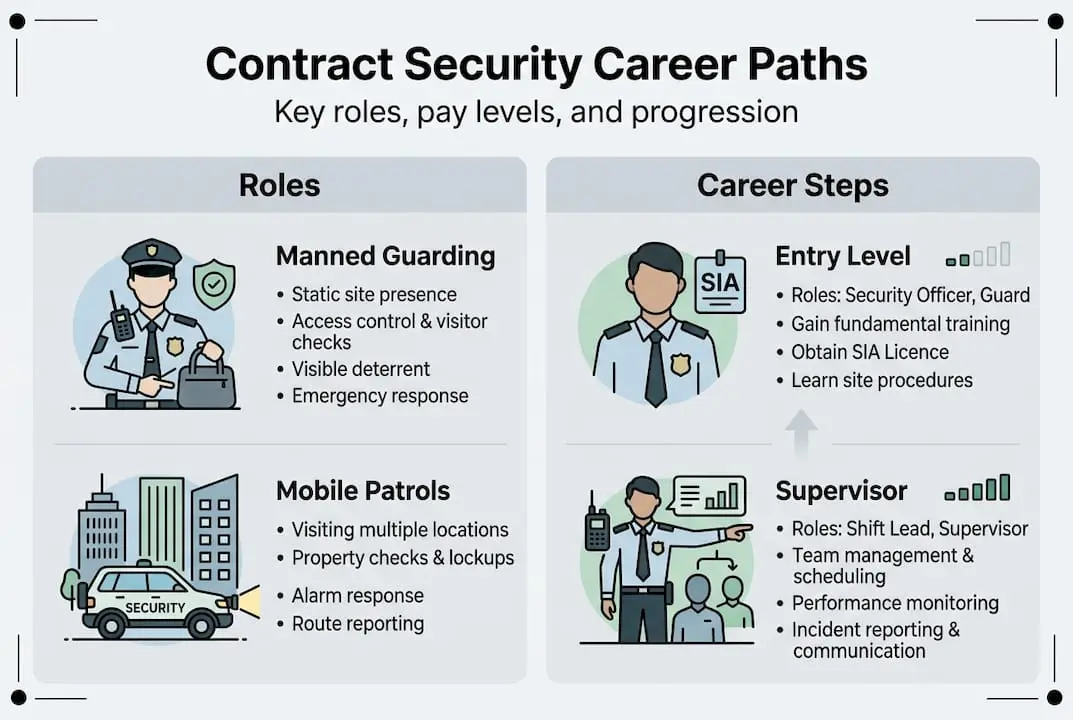
Here is how a typical career progression might look for a contract security officer:
- Entry-level site officer: Working fixed-site contracts through an agency, building your licence portfolio and site experience.
- Relief officer: Covering multiple sites across a firm’s contract portfolio, developing adaptability and client-facing skills.
- Senior officer or team leader: Taking responsibility for a small team on a high-value contract, often with supervisory duties.
- Contract supervisor or client liaison: Managing the day-to-day delivery of a contract, acting as the point of contact between the firm and the client.
- Operations manager or account manager: Overseeing multiple contracts, handling staffing, compliance, and client relationships at a strategic level.
The variety of security patrol duties across different contract sites accelerates this progression. Officers who have worked retail, corporate, construction, and event security develop a breadth of situational awareness that permanent site officers rarely acquire at the same pace.
Self-employment is a realistic option for experienced officers, but it comes with contractual risks that you must manage carefully. Late payment, scope creep, and unwritten agreements are the most common pitfalls. Always use a written contract, specify payment terms clearly, and ensure your insurance covers the specific activities in each engagement.
Here are the practical scenarios where contract security work genuinely shines:
- High-security escort assignments requiring specialist skills and short-notice availability
- Construction site security on projects with defined start and end dates
- Retail loss prevention during peak trading periods such as Christmas or major sales events
- Temp-to-perm placements where a client tests an officer before offering a permanent role
- Event security at concerts, sporting events, and corporate functions
The contacts you build across different clients and sites are often as valuable as the experience itself. Many permanent roles are filled through referrals from contract engagements, making your professional reputation a genuine career asset.
Find your next contract security role with The Security Jobs Board
If you are ready to explore contract security opportunities, having the right platform behind you makes a real difference. The Security Jobs Board is a specialist UK job board built specifically for security professionals, with listings across manned guarding, mobile patrol, event security, and more.

You can create a free candidate profile, upload your CV, and set up job alerts so the right contract roles come to you. Every listing on the platform is security-specific, which means you are not competing against unrelated candidates or wading through irrelevant results. The platform is affiliated with the BSIA, adding a layer of trust and credibility that matters when you are vetting employers. Whether you are looking for your first contract role or your next step up the career ladder, browse current security vacancies and take the next step today.
Frequently asked questions
Do I need an SIA licence for all contract security roles?
Yes, nearly all contract security jobs in the UK require a valid SIA licence, as all security roles are regulated by the Security Industry Authority. Working without one is a criminal offence.
Is contract security work better paid than permanent roles?
Hourly rates for contract security are often higher than permanent salaries, but contract roles rarely include benefits such as pension contributions, paid holiday, or sick pay.
How do I find legitimate contract security jobs?
Apply through ACS-accredited firms or specialist job boards, and always verify that the employer meets ACS accreditation and compliance standards before accepting a contract.
Can contract work lead to a permanent position?
Yes, contract work builds experience that frequently helps officers move into permanent or supervisory roles, particularly through temp-to-perm arrangements with client firms.


