Planning your security engineer career path in the UK 2026

Many aspiring security professionals underestimate the depth and complexity of building a sustainable career as a security engineer in the UK. The path isn’t linear, and misconceptions about required qualifications, salary expectations, and progression routes often leave talented individuals uncertain about their next steps. This guide cuts through the confusion by providing a comprehensive roadmap for security engineers at every stage. You’ll discover the essential skills needed for advancement, explore diverse specialisation options, and gain insight into current market trends and salary benchmarks for 2026. Whether you’re just starting out or looking to accelerate your progression, this article equips you with practical strategies to navigate your career journey effectively.
Table of Contents
- Understanding The Security Engineer Career Path In The UK
- Key Skills And Qualifications For Career Advancement
- Career Advancement Routes And Specialisations For Security Engineers
- Current Job Market Trends And Salary Expectations In 2026
- Advance Your Security Engineer Career With Tailored UK Job Resources
- Frequently Asked Questions
Key takeaways
| Point | Details |
|---|---|
| Career stages | Security engineer roles progress from junior analyst positions through mid-level specialists to senior strategic leadership. |
| Essential skills | Technical expertise in network security and encryption must be balanced with strong communication and analytical abilities. |
| Market demand | Digital transformation and cyber threats drive steady demand with competitive salaries across UK regions in 2026. |
| Specialisation paths | Engineers can advance through technical specialist routes, managerial tracks, or consultancy roles depending on career goals. |
| Salary expectations | Entry-level positions start around £30,000, whilst senior engineers command over £70,000 based on expertise and location. |
Understanding the security engineer career path in the UK
A security engineer designs, implements, and maintains systems that protect organisations from cyber threats and physical security breaches. This role spans diverse sectors including transportation, logistics, financial services, and critical infrastructure across the UK. The responsibilities vary significantly depending on the industry context, but all security engineers share a common goal: safeguarding assets, data, and people through proactive security measures.
Entry-level positions typically include junior security engineer or security analyst roles. These foundational positions focus on monitoring systems, conducting vulnerability assessments, and supporting senior team members in implementing security protocols. You’ll spend considerable time learning organisational systems, understanding threat landscapes, and developing practical skills through hands-on experience. Most junior engineers work under close supervision whilst building the technical competence needed for independent work.
Mid-level security engineers develop specialised expertise in areas such as penetration testing, systems hardening, or incident response. At this stage, you’ll take ownership of specific security domains, lead smaller projects, and mentor junior colleagues. The transition from junior to mid-level typically occurs after two to four years of focused experience and relevant certifications. Your responsibilities expand to include security architecture decisions, risk assessments, and cross-functional collaboration with IT and business teams.
Senior security engineers and managers assume strategic responsibilities that shape organisational security posture. These roles involve developing comprehensive security strategies, managing teams, liaising with executive leadership, and ensuring compliance with industry regulations. Senior positions require both deep technical knowledge and strong business acumen. You’ll influence budget decisions, technology investments, and long-term security roadmaps whilst maintaining awareness of emerging threats and evolving best practices.
Pro Tip: Building relationships with experienced professionals early in your career opens doors to mentorship opportunities and insider knowledge about progression routes that aren’t always advertised publicly.
The UK security engineering landscape offers numerous pathways depending on your interests and strengths:
- Technical specialist roles focusing on cutting-edge technologies and advanced threat detection
- Management positions overseeing security operations and team development
- Consultancy work providing expert guidance to multiple organisations
- Research and development roles advancing security methodologies and tools
Key skills and qualifications for career advancement
Technical proficiency forms the foundation of any successful security engineering career. You need strong knowledge of network security protocols, encryption methods, firewall configuration, and vulnerability assessment tools. Understanding operating systems at a deep level, particularly Linux and Windows environments, enables you to identify weaknesses and implement robust defences. Familiarity with programming languages such as Python, Java, or C++ allows you to automate security tasks, analyse malware, and develop custom security solutions.
Soft skills distinguish exceptional security engineers from merely competent ones. Communication abilities enable you to explain complex technical concepts to non-technical stakeholders, write clear documentation, and collaborate effectively across departments. Analytical thinking helps you assess risks systematically, prioritise threats based on potential impact, and develop strategic responses. Teamwork skills prove essential as security engineering rarely occurs in isolation. You’ll coordinate with developers, system administrators, compliance officers, and business leaders to implement comprehensive security measures.
Relevant qualifications significantly accelerate career progression and demonstrate commitment to professional development. The Certified Information Systems Security Professional (CISSP) credential validates broad security knowledge and is highly valued for mid to senior-level positions. The Certified Information Security Manager (CISM) focuses on governance and risk management, making it ideal for those pursuing management tracks. CompTIA Security+ provides an excellent entry point for junior engineers, covering fundamental concepts and practical skills that employers actively seek.
Continuous learning separates stagnant careers from thriving ones in this rapidly evolving field. Cyber threats change constantly, new technologies emerge regularly, and regulatory requirements evolve. Attending workshops, completing online courses, and pursuing advanced certifications keeps your skills current and marketable. Many UK organisations support professional development through training budgets and study leave. Taking advantage of these opportunities demonstrates initiative whilst building capabilities that benefit both you and your employer.
Pro Tip: Align your certification choices with specific career goals and current market demand rather than collecting credentials randomly, ensuring each qualification delivers tangible career benefits.
The training and courses you pursue should reflect both your interests and market needs:
- Industry-recognised certifications that validate expertise and open doors
- Hands-on technical training in emerging security technologies
- Leadership and management courses for those pursuing supervisory roles
- Specialised programmes in areas like cloud security or ethical hacking
Understanding the qualities employers seek helps you focus development efforts on high-impact areas that directly influence hiring decisions and promotion opportunities.
Career advancement routes and specialisations for security engineers
The technical specialist path offers deep expertise in focused security domains. Ethical hackers and penetration testers simulate attacks to identify vulnerabilities before malicious actors exploit them. Intrusion detection specialists develop and maintain systems that recognise unauthorised access attempts in real time. Security architects design comprehensive security frameworks that protect entire organisational infrastructures. This route suits individuals who thrive on technical challenges, enjoy continuous learning about emerging threats, and prefer hands-on problem-solving over administrative duties.
Managerial progression involves transitioning from individual contributor to team leadership and strategic oversight. Security team leads coordinate daily operations, assign tasks, and ensure projects meet deadlines whilst maintaining quality standards. Security managers oversee multiple teams, allocate resources, and align security initiatives with business objectives. Chief Information Security Officers (CISOs) sit at the executive level, shaping organisational strategy and representing security interests to boards and stakeholders. This path requires developing people management skills, business acumen, and the ability to communicate security value in financial terms.

Consultancy and advisory roles provide variety and exposure to diverse security challenges across multiple clients. Security consultants assess organisational vulnerabilities, recommend improvements, and guide implementation of security programmes. This work demands excellent communication skills, adaptability to different organisational cultures, and the ability to quickly understand complex business contexts. Consultants often command premium rates and enjoy flexibility, but the role requires managing client expectations and delivering results under tight timelines.
Emerging fields present exciting opportunities for forward-thinking security engineers. Cloud security specialists protect data and applications in AWS, Azure, and Google Cloud environments as organisations migrate infrastructure. Internet of Things (IoT) security experts address unique challenges posed by connected devices in smart buildings, industrial systems, and consumer products. AI-based threat detection specialists leverage machine learning to identify patterns and anomalies that traditional methods miss. These specialisations position you at the forefront of security innovation.
| Career path | Focus area | Typical responsibilities | Salary range (2026) |
|---|---|---|---|
| Technical specialist | Deep technical expertise | Penetration testing, threat analysis, security tool development | £40,000-£75,000 |
| Security manager | Team leadership and operations | Resource allocation, project oversight, policy development | £50,000-£85,000 |
| CISO | Strategic executive leadership | Board liaison, budget management, organisational security strategy | £80,000-£150,000+ |
| Security consultant | Client advisory services | Assessments, recommendations, implementation guidance | £45,000-£90,000 |
Choosing and progressing in a specialisation requires deliberate planning:
- Assess your natural strengths and genuine interests rather than chasing trends or salaries alone.
- Research market demand for different specialisations in your target region and industry.
- Gain foundational experience across multiple security domains before committing to a narrow focus.
- Pursue relevant certifications and training that validate your chosen specialisation.
- Build a portfolio of projects and achievements that demonstrate expertise to potential employers.
- Network with professionals already working in your target specialisation to gain insights and opportunities.
- Regularly reassess your path as technologies evolve and new specialisations emerge.
Exploring different security roles helps you understand the full spectrum of opportunities available and make informed decisions about your career direction. The career advice resources available provide additional guidance for navigating these choices effectively.
Current job market trends and salary expectations in 2026
Digital transformation initiatives across UK industries drive sustained demand for security engineers in 2026. Organisations recognise that cyber threats pose existential risks, not merely IT problems. This awareness translates into increased security budgets, expanded teams, and competitive compensation packages designed to attract and retain talent. The shift towards remote and hybrid work models creates additional security challenges, further amplifying demand for professionals who can protect distributed workforces and cloud-based systems.
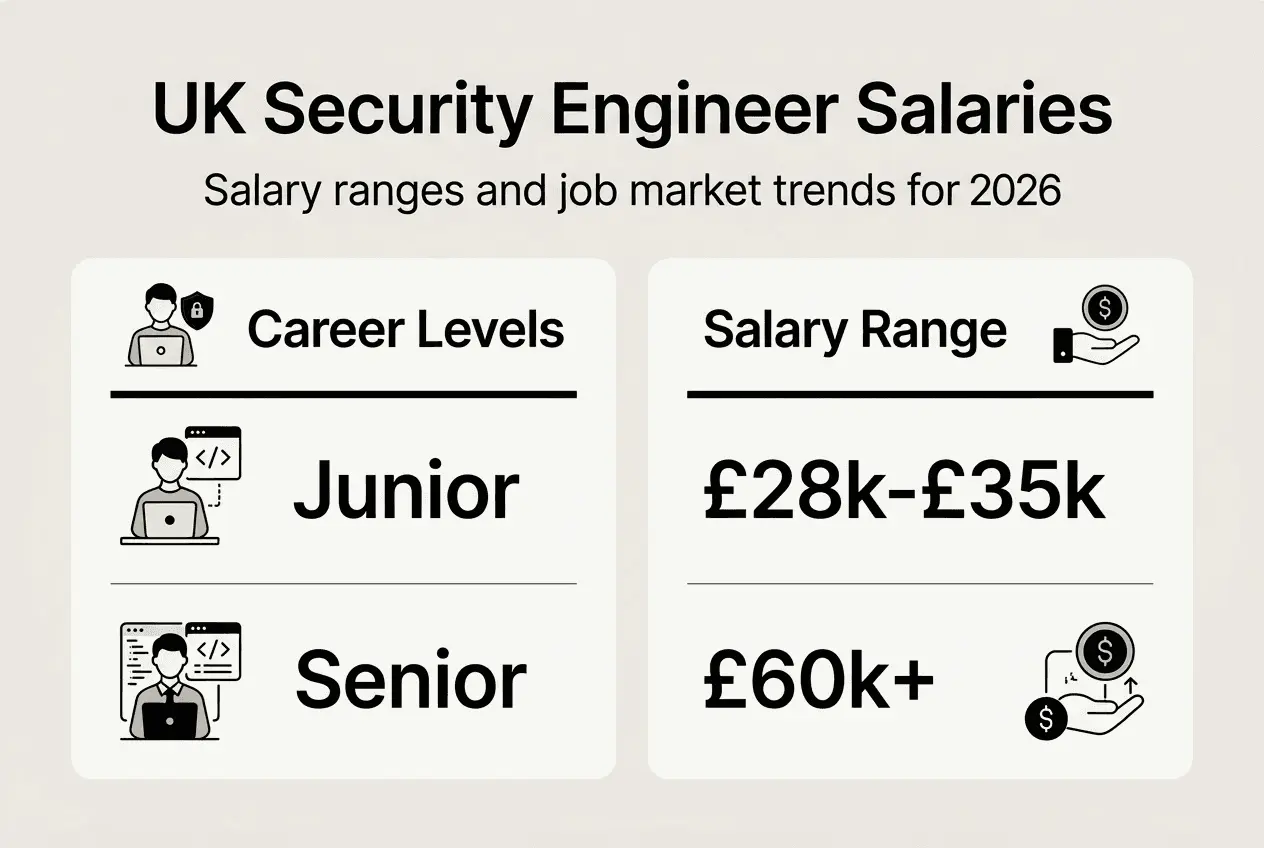
Salary ranges reflect experience levels, specialisations, and geographic locations. Junior security engineers typically earn between £28,000 and £35,000 as they build foundational skills and gain practical experience. Mid-level professionals with three to seven years of experience and relevant certifications command £45,000 to £60,000, depending on specialisation and industry. Senior security engineers and managers earn £65,000 to £90,000, whilst CISOs and highly specialised consultants exceed £100,000 in many organisations. These salary benchmarks provide realistic expectations for career planning.
Regional variations significantly impact compensation packages. London and the South East offer the highest salaries, often 15 to 25 percent above national averages, reflecting higher living costs and concentrated demand from financial services and technology firms. Manchester, Birmingham, and Edinburgh present strong opportunities with competitive salaries and lower living expenses. Scotland, Wales, and Northern Ireland offer growing security sectors with salaries slightly below English averages but attractive quality of life benefits. Remote positions increasingly blur geographic boundaries, allowing professionals to access London salaries whilst living in lower-cost regions.
Maximising salary offers requires strategic preparation and negotiation skills. Research typical compensation for your experience level and specialisation before interviews. Highlight certifications, successful projects, and quantifiable achievements that demonstrate value. Consider the complete package including bonuses, pension contributions, training budgets, and flexible working arrangements rather than focusing solely on base salary. Be prepared to articulate your worth confidently whilst remaining realistic about market rates. Following a structured job search checklist ensures you present yourself effectively to potential employers.
| Experience level | London salary range | Regional salary range | Key factors |
|---|---|---|---|
| Junior (0-2 years) | £32,000-£40,000 | £28,000-£35,000 | Certifications, degree quality, internship experience |
| Mid-level (3-7 years) | £50,000-£65,000 | £45,000-£55,000 | Specialisation, certifications, project leadership |
| Senior (8+ years) | £70,000-£95,000 | £60,000-£80,000 | Management experience, strategic impact, industry reputation |
| Executive (CISO) | £100,000-£180,000 | £85,000-£140,000 | Business acumen, board experience, organisational size |
Key job market trends shaping security engineering careers in 2026:
- Growing emphasis on cloud security expertise as infrastructure migration accelerates
- Increased demand for professionals who understand both security and compliance requirements
- Rising importance of soft skills and business communication for career advancement
- Expansion of remote and hybrid positions offering geographic flexibility
- Greater focus on diversity and inclusion in security team composition
- Integration of AI and machine learning into security tools and processes
Advance your security engineer career with tailored UK job resources
Navigating your security engineering career becomes significantly easier with dedicated resources designed specifically for UK professionals. The Security Jobs Board connects ambitious security engineers with employers across England, Scotland, Wales, and Northern Ireland, including specialised opportunities in Northern Ireland that match your skills and aspirations. Whether you’re seeking your first junior role or pursuing senior leadership positions, targeted job listings save time and connect you with relevant opportunities.

Expert career advice tailored for security professionals helps you make informed decisions at every career stage. From crafting compelling CVs to preparing for technical interviews, these resources address the unique challenges security engineers face. Regular updates ensure guidance reflects current market conditions and employer expectations in 2026.
Pro Tip: Regularly updating your profile with new certifications, projects, and skills ensures recruiters find you when relevant opportunities arise, often before positions are publicly advertised.
The Security Jobs Board platform streamlines your job search with user-friendly tools, personalised alerts, and direct communication with hiring managers. Take control of your career progression by leveraging resources specifically designed to support security professionals across the UK.
Frequently asked questions
What qualifications do I need to start as a security engineer?
Entry-level security engineer positions typically require a degree in computer science, cybersecurity, information technology, or a related field. Certifications such as CompTIA Security+ demonstrate foundational knowledge and significantly strengthen applications. Practical experience through internships, personal projects, or relevant IT roles also proves valuable to employers. Strong analytical skills, attention to detail, and genuine interest in security complement formal qualifications. Many successful security engineers begin in adjacent IT roles before transitioning into dedicated security positions. Exploring essential skills helps you understand what employers prioritise beyond formal credentials.
How can I specialise within security engineering?
Specialisation options include penetration testing, cloud security, incident response, security architecture, compliance and governance, and emerging areas like IoT security. Choosing a path depends on your interests, natural strengths, and market demand in your target industry or region. Start by gaining broad experience across multiple security domains, then focus on areas that genuinely engage you. Pursue relevant certifications, build a portfolio of specialised projects, and network with professionals already working in your chosen field. Understanding different security roles provides clarity on available specialisations and their requirements.
What is the typical salary range for security engineers in the UK?
Entry-level security engineers earn approximately £28,000 to £35,000 depending on location and employer. Mid-level professionals with proven experience command £45,000 to £60,000, reflecting specialised skills and increased responsibilities. Senior security engineers and managers earn £65,000 to £90,000, whilst executive positions like CISO exceed £100,000 in many organisations. Location significantly impacts compensation, with London offering premiums of 15 to 25 percent above regional averages. Specialisation, certifications, and industry sector also influence salary expectations considerably.
How long does it take to progress from junior to senior security engineer?
Progression from junior to senior level typically takes seven to ten years, though individual timelines vary significantly based on effort, opportunities, and organisational context. Advancing to mid-level positions usually requires three to five years of focused experience and relevant certifications. Reaching senior roles demands additional years developing strategic thinking, leadership capabilities, and deep technical or business expertise. Accelerating progression requires proactive skill development, seeking challenging projects, building professional networks, and demonstrating consistent value to employers. Some engineers reach senior positions faster through exceptional performance, whilst others take longer depending on available opportunities and personal circumstances.
What emerging technologies should security engineers focus on in 2026?
Cloud security remains paramount as organisations continue migrating infrastructure to AWS, Azure, and Google Cloud platforms. Artificial intelligence and machine learning applications in threat detection and response represent growing specialisations with strong demand. Internet of Things security addresses vulnerabilities in connected devices across industrial, commercial, and consumer contexts. Zero-trust architecture principles reshape how organisations approach network security and access control. Quantum computing poses future cryptographic challenges that forward-thinking engineers are already exploring. Blockchain security applications extend beyond cryptocurrency into supply chain and identity management. Focusing on technologies aligned with your interests and market demand positions you for long-term career success.
Recommended
- How to attract top security talent in the UK in 2026|SJB
- Optimising Security Job Searches for Fast UK Career Moves
- 7 Essential Security Job Hunting Tips for 2025 UK Seekers
- 7 Key Security Job Trends in the UK for 2025 Explained
- Bästa säkerhetsutbildningar för verksamheter – Jämförelse 2025 - DISTANSUTBILDNING


