Licence Renewal – Why It Matters for UK Security Work

Missing your Security Industry Authority licence renewal means an immediate halt to your legal employment as a Security Guard, Door Supervisor, or CCTV Operator in the United Kingdom. Renewal does not happen automatically and there is no grace period, so acting early is vital for uninterrupted work. This guide cuts through licence-specific renewal requirements, refresher training, and step-by-step instructions, helping you navigate compliance, avoid costly mistakes, and carry your security career forward without disruption.
Table of Contents
- What Is Licence Renewal in UK Security
- Types of SIA Licences and Renewal Differences
- How the Renewal Process Works Step-by-Step
- Refresher Training and 2026 Requirements
- Risks, Costs and Compliance Obligations
Key Takeaways
| Point | Details |
|---|---|
| Mandatory Renewal Process | Security professionals must actively renew their SIA licence before it expires to remain legally employed in their roles. |
| Renewal Timing | Begin the renewal process up to four months before expiry to avoid employment gaps and ensure all requirements are met on time. |
| Training Requirements | Different licence types have varying training needs; ensure all necessary refresher training and certifications are completed prior to submission. |
| Compliance is Critical | Missing any renewal requirements can result in application rejection, leading to severe employment and financial repercussions. |
What Is Licence Renewal in UK Security
Licence renewal is the mandatory process where security professionals must reapply to the Security Industry Authority (SIA) to continue working legally in their licensed security role. Your current licence does not automatically renew, which means you must actively submit a new application before your existing licence expires.
Without valid renewal, you cannot legally work in your security position. This applies whether you’re a door supervisor, security guard, CCTV operator, or any other licensed security operative.
Why Renewal Matters
Renewal ensures you still meet SIA licensing requirements. The process verifies:
- You have no relevant criminal convictions
- You comply with updated SIA professional standards
- Your training and qualifications remain current
- You continue to meet fitness-to-practise criteria
The SIA uses renewal as a checkpoint to maintain professional standards across the entire UK security industry. This protects both workers and the public.
Renewal must happen before your licence expires—there is no grace period once your licence lapses. Working without a valid licence carries serious legal consequences.
When and How Renewal Works
You can start your renewal application up to four months before your licence expires. Many professionals benefit from early renewal, which allows you to continue your current licence term without losing any working time.
The renewal process typically involves:
- Check your licence expiry date on your SIA documentation
- Complete any mandatory refresher training required for your security licence type
- Submit your renewal application to the SIA
- Pay the relevant renewal fee
- Await SIA processing and approval
Understanding how to get your SIA licence provides detailed guidance on the application requirements and standards you’ll encounter during renewal.
The exact timeline and requirements depend on your specific security role. Different licence types—door supervision, security guarding, CCTV operation, cash and valuables in transit, or close protection—may have slightly different renewal procedures.
The Renewal Timeline
Starting your renewal early gives you buffer time if additional documentation is needed. Checking your licence expiry date is your first step in the process.
If you wait until the last moment and your application faces delays, you risk working without valid licensing. This creates employment and legal problems for both you and your employer.
Pro tip: Set a calendar reminder four months before your licence expiry to begin the renewal process immediately—this gives you adequate time to gather documents, complete training, and submit without rushing.
Types of SIA Licences and Renewal Differences
The Security Industry Authority issues several distinct licence types, each with its own renewal requirements and timelines. Understanding which licence category applies to your role is crucial for planning your renewal properly.
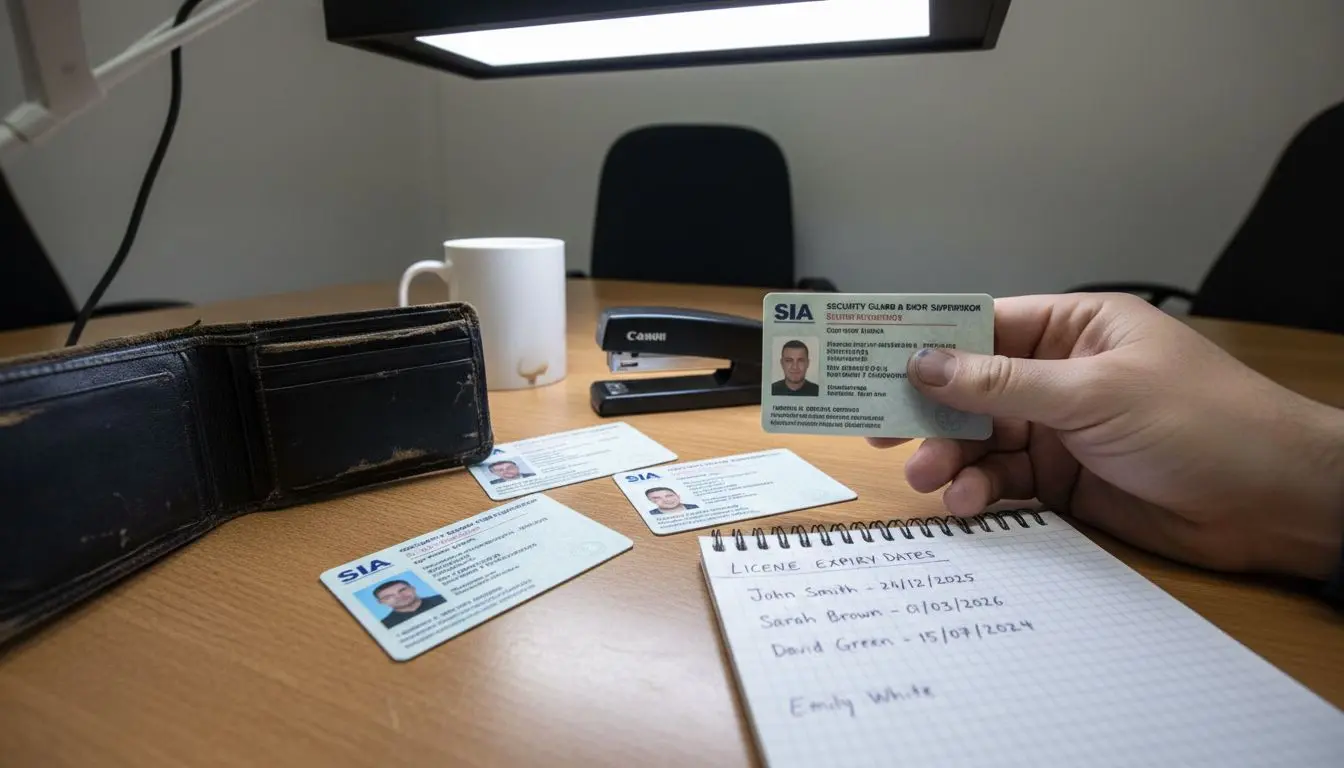
The main SIA licence types include Door Supervisor, Security Guard, CCTV Operator, Close Protection, Key Holding, and Cash and Valuables in Transit. Each serves a different security function and carries different responsibilities.
Renewal Requirements by Licence Type
Renewal processes are not one-size-fits-all. Your specific licence type determines what you need to complete before renewal.
Door Supervisor and Security Guard licences require the most comprehensive renewal preparation:
- Mandatory refresher training completion
- Valid First Aid certificate (must be current)
- Updated compliance verification with SIA standards
- Confirmation of no relevant criminal convictions
CCTV Operator licences have fewer training requirements. CCTV renewal typically does not require refresher training, though you must still verify your fitness to hold the licence.
Here’s a quick overview of SIA licence renewal requirements by role:
| Licence Type | Training Needs | First Aid Certificate Needed | Typical Renewal Cost |
|---|---|---|---|
| Door Supervisor | Mandatory refresher and updates | Yes, must be valid | £184 + training fees |
| Security Guard | Mandatory refresher and updates | Yes, must be valid | £184 + training fees |
| CCTV Operator | Minimal or none | Not required | £184 |
| Close Protection | Role-specific training | Depends on employer | £184 + possible costs |
| Key Holding | Minimal | Not required | £184 |
| Cash in Transit | Role-specific updates | Depends on employer | £184 + possible costs |
The training and certification demands vary significantly across licence types. Door Supervisors face stricter renewal conditions than CCTV Operators because of the direct public interaction and safety responsibilities involved.
Costs and Financial Planning
Renewal fees remain consistent across most licence types at £184. However, total renewal costs depend on additional requirements specific to your role.
If you hold multiple licences across different sectors, you may qualify for discounts on your renewal applications. This applies when renewing several licence types simultaneously.
Factors affecting your total renewal cost:
- Base renewal fee (typically £184 per licence)
- Refresher training course costs (varies by provider and licence type)
- First Aid certification renewal (if required for your licence)
- Any specialist training updates for your specific security role
Planning Your Renewal Timeline
Different licence types may need different preparation periods. Door Supervisors and Security Guards should budget additional time for First Aid certification if theirs is expiring soon.
Start your renewal process four months before expiry. This gives you adequate time to complete any mandatory training without pressure.
If you hold multiple licences with different expiry dates, track each one separately. Missing renewal on any single licence means you cannot legally work in that particular security role.
Pro tip: Create a spreadsheet listing each licence type you hold, its expiry date, and specific training requirements—this prevents missing renewal deadlines and helps you budget for costs across multiple licences.
How the Renewal Process Works Step-by-Step
Renewal follows a structured process that takes several weeks from start to finish. Understanding each step helps you prepare properly and avoid delays that could interrupt your work.
The process begins with verification and ends with your new licence card arriving by post. Timing matters—apply too late and you risk working without valid licensing.
Step 1: Verify Your Expiry Date and Requirements
Your first action is checking when your licence expires and what you must complete before renewal.
Locate your current SIA licence card. It displays your expiry date clearly. You can begin the renewal process up to four months before this date.
Identify your specific renewal requirements:
- Check if you need refresher training for your licence type
- Confirm whether First Aid certification renewal is mandatory
- Note any other role-specific training requirements
- Gather the documents you’ll need during application
Step 2: Complete Required Training and Certifications
If your licence type requires refresher training, complete it before applying for renewal. This applies particularly to Door Supervisors and Security Guards.
Book your training courses with approved providers. Allow sufficient time—courses typically take one to two days. Your First Aid certificate must remain valid throughout the process.
Step 3: Access Your SIA Online Account
Log into your official SIA online account using your existing credentials. This is where you’ll submit your renewal application.
Select the renewal option from your account dashboard. The system will prompt you through the renewal application form. Update any personal information that has changed since your last application.
Step 4: Upload Documents and Complete Your Application
Upload required documents including your ID and training certificates through your account. The system specifies which documents it needs.
Complete all application fields accurately. Double-check your information before proceeding. Errors can delay processing significantly.
Early renewal prevents work interruption. Applying four months before expiry ensures your new licence arrives before your current one expires, eliminating any gap in legal working status.
Step 5: Pay and Submit
Pay the renewal fee of £184 online. The system accepts standard payment methods. Once payment is processed, your application officially submits.
You’ll receive a confirmation email. Save this for your records.
Step 6: Wait for Processing and Background Checks
The SIA processes your application and conducts background verification. This typically takes two to three weeks, though it can occasionally take longer.
You cannot work without a valid licence during processing. This is why early renewal matters—your old licence remains valid until the new one arrives.
Step 7: Receive Your New Licence Card
Once approved, your new licence card posts to your registered address within two to three weeks of approval. Your new licence term begins immediately upon receipt.
Pro tip: Submit your renewal application exactly four months before expiry to create maximum buffer time. This guarantees your new card arrives well before your current licence expires, preventing any work gaps or legal issues.
Refresher Training and 2026 Requirements
The SIA has strengthened its training requirements for 2026. These updates ensure security professionals remain competent and current with evolving industry standards and threats.
If you’re renewing your licence in 2026 or beyond, you need to understand what training is now mandatory for your specific role. Missing these requirements will prevent your renewal from being approved.
Who Must Complete Refresher Training
Door Supervisors and Security Guards face the most comprehensive training updates. These roles directly interact with the public and require the highest safety standards.
Other licensed security roles may have specific requirements depending on their function. CCTV Operators generally have fewer mandatory training obligations, though this can vary.
Check your licence type carefully. Even if you’ve renewed previously without extensive training, 2026 requirements are different.
What 2026 Refresher Training Covers
Refresher training now includes updated physical intervention techniques and terrorism threat awareness modules. These topics reflect current security challenges and best practices.
The training covers:
- Physical intervention and control techniques (updated methods)
- Terrorism awareness and threat recognition
- Updated security procedures and protocols
- Conflict de-escalation strategies
- Emergency response procedures
- Professional conduct standards
These modules ensure you’re prepared for real-world scenarios you might encounter at work.
First Aid Certification Requirements
Emergency First Aid at Work (EFAW) certification is now mandatory for Door Supervisors and Security Guards renewing in 2026. Your certificate must be valid at the time of renewal.
If your First Aid certificate is expiring, renew it well before your licence renewal deadline. Do not wait until the last moment.
Failure to complete refresher training or maintain valid First Aid certification will result in licence renewal rejection. There are no exceptions or grace periods for 2026 requirements.
Planning Your 2026 Renewal Training
Booking training courses early prevents last-minute pressure. Refresher training courses typically take one to two days to complete.
Approved training providers offer courses throughout the year. Search for providers in your area and book several months before your renewal deadline.
Cost considerations:
- Refresher training: £100–£200 (varies by provider)
- First Aid certification: £80–£150
- Total training investment: £180–£350
This is separate from your £184 licence renewal fee.
Timeline for 2026 Preparation
If your licence expires in 2026, start planning now. Complete your training at least one month before applying for renewal.
This timeline prevents delays and gives you buffer time if your provider has booking delays.
Pro tip: Book your refresher training and First Aid courses three months before your licence expiry, then schedule your renewal application immediately after completing training—this guarantees you meet all 2026 requirements without rush.
Risks, Costs and Compliance Obligations
Skipping licence renewal or missing compliance deadlines creates serious consequences for your career and finances. The stakes are genuinely high—this isn’t an administrative box to tick casually.
Understanding the real costs and risks helps you prioritise renewal and protect your security career.
The Cost of Renewal
Licence renewal costs £184 for a three-year licence period. This is the same price as applying for a new licence initially.
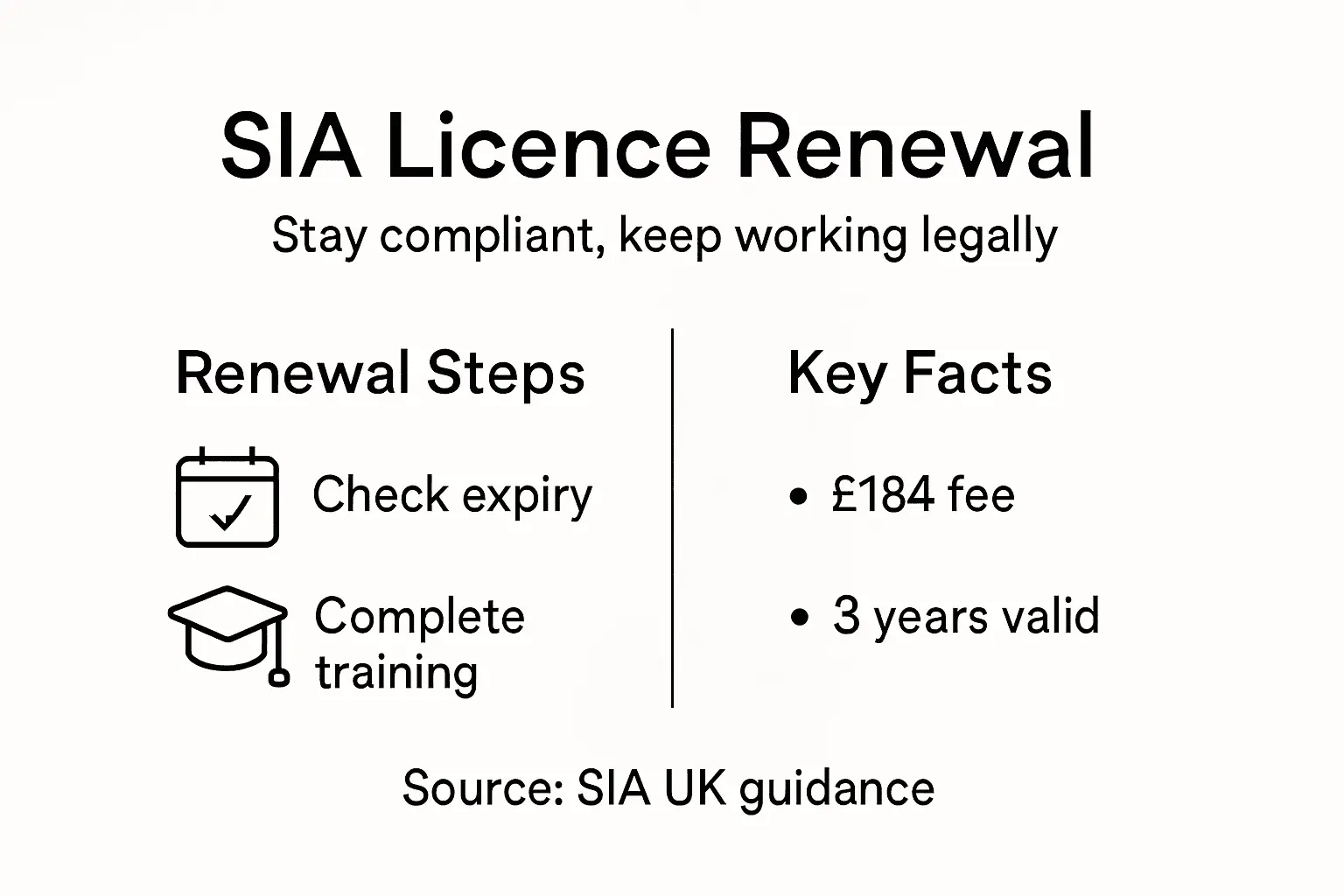
If you hold multiple licences across different security sectors, you qualify for a 50% discount on additional licences. This significantly reduces your total renewal investment if you’re licensed for multiple roles.
Calculating your total renewal cost:
- First licence: £184
- Second licence: £92 (50% discount)
- Third licence: £92 (50% discount)
- Training and First Aid costs: £180–£350 (separate)
Plan your budget accordingly. Combine renewal costs with mandatory training expenses when calculating your annual professional development investment.
Risks of Missing Your Renewal Deadline
Let your licence lapse and you cannot legally work in any security role. No exceptions exist—your employer cannot legally employ you without a valid licence.
Failing to renew on time can result in suspension or termination of employment, loss of income, and potential legal penalties. You lose both your job and your ability to earn immediately.
The consequences extend beyond immediate job loss:
- Loss of income whilst renewing
- Damage to professional reputation
- Difficulty securing future employment
- Potential disciplinary records with your employer
- Gap in your security industry experience
Compliance Obligations You Must Meet
Renewal requires more than paying a fee. You must meet strict compliance standards or your application will be rejected.
Compliance requirements include:
- Maintaining a clean criminal record (no relevant convictions)
- Completing all mandatory refresher training
- Holding valid First Aid certification (if required for your role)
- Providing accurate and honest documentation
- Meeting health and fitness standards
- Confirming you remain fit to hold a security licence
Non-compliance with even one requirement delays approval and creates gaps in your ability to work. A single missing document or expired certificate can halt your entire renewal application.
Employer Responsibilities and Liabilities
Your employer shares responsibility for ensuring you maintain valid licensing. They cannot legally employ you without a valid licence.
Employers face potential penalties for employing unlicenced security staff. This makes them sensitive to renewal timelines—they may terminate employment if you miss deadlines.
Communicate renewal progress to your employer. Let them know when your training is scheduled and when you’ve submitted your application.
Planning to Avoid These Risks
Preventing these consequences is straightforward—renew on time. Start your process four months before expiry and follow each step methodically.
Create a renewal calendar with key dates:
Below is a concise timeline for efficient SIA licence renewal preparation:
| Timeline Stage | Recommended Action | Purpose |
|---|---|---|
| 4 months before expiry | Check requirements, start planning | Avoid last-minute issues and delays |
| 3 months before expiry | Book all required training | Guarantee course availability |
| 1 month before expiry | Complete training, gather documents | Ensure all certifications remain current |
| After training completed | Submit renewal application online | Start SIA processing with all evidence ready |
| 2 weeks before expiry | Follow up on application progress | Confirm approval, prevent work gap |
- Four months before expiry: Begin planning and research providers
- Three months before expiry: Book training courses
- One month before expiry: Complete all training
- Submit application immediately after training completion
- Two weeks before expiry: Confirm processing status
Pro tip: Set automatic calendar reminders at the four-month mark and again at two months before expiry—these check-ins prevent you forgetting and protect your income and career continuity.
Stay Ahead in UK Security With Timely Licence Renewal and Career Opportunities
Renewing your Security Industry Authority licence is essential to maintain your legal right to work and protect your career from costly interruptions. This process demands careful planning, compliance with updated training, and meeting strict standards. Without a valid licence, your employment options narrow dramatically and the risk to your livelihood intensifies. If you are navigating the complexities of licence renewal, including refresher training for roles like Door Supervisor or Security Guard, it is crucial to align your professional development with fresh job opportunities.

Secure your future by exploring fresh roles tailored for licensed security professionals at Security Jobs Board. Our platform connects you directly with UK security employers who value up-to-date compliance and qualifications. Use our user-friendly tools to upload your CV, set job alerts, and apply quickly to vacancies relevant to your renewed status. Remember that timely renewal is not just a legal requirement but a strategic step to access better career prospects. Begin your journey now with insights on how to get your SIA licence and keep your security career on track without disruption.
Don’t let expiry dates or compliance challenges stall your work life. Act early, meet your renewal obligations confidently, and find your next security role swiftly by starting at Security Jobs Board.
Frequently Asked Questions
What is the process for renewing my SIA licence?
Renewing your SIA licence involves several steps: check your licence expiry date, complete any required refresher training, submit your renewal application online, pay the renewal fee, and await processing and approval from the SIA.
How early can I start my SIA licence renewal application?
You can begin your renewal application up to four months before your current licence expires. Early renewal helps ensure there are no gaps in your legal ability to work.
What are the consequences of not renewing my SIA licence on time?
If you fail to renew your SIA licence before it expires, you cannot legally work in your security role. This can lead to job loss, income stoppage, and potential legal penalties for both you and your employer.
What are the specific training requirements for licence renewal in different security roles?
Renewal requirements vary by licence type. For example, Door Supervisors and Security Guards need mandatory refresher training and a valid First Aid certificate, while CCTV Operators may have minimal training requirements. Always check your specific licence category for detailed obligations.
Recommended
- Why CPD Is Important for Security Careers | Security Jobs Board
- What Is SIA Badge? Key To UK Security Careers | Security Jobs Board
- Why Choose Security Jobs: Complete Guide UK | Brainiac Media
- Security Screening: Crucial Checks for UK Security Roles|BM
- Why Hire Licensed Waterproofing Contractors Locally
- Accident at Work – Impact on UK Workers’ Rights


