Step by Step Hiring Process for Security Firms UK

Finding and securing skilled professionals is an ongoing challenge for British security firms competing for top talent. Precise definition of job requirements and candidate profiles is the foundation for attracting applicants with the right expertise. By focusing on clear and detailed role specifications, you set the stage for a recruitment process that enhances team effectiveness and compliance with UK employment standards. This approach helps ensure you consistently identify and hire high-calibre security practitioners for your organisation.
Table of Contents
- Step 1: Define Job Requirements And Candidate Profile
- Step 2: Create And Publish Effective Job Listings
- Step 3: Screen Applications And Shortlist Candidates
- Step 4: Conduct Interviews And Assess Suitability
- Step 5: Verify Credentials And Make Final Selection
Quick Summary
| Main Insight | Detailed Explanation |
|---|---|
| 1. Clearly Define Job Requirements | Establish precise responsibilities and qualifications to attract the right candidates in security roles. |
| 2. Craft Engaging Job Listings | Write clear, informative listings that highlight the role and your organisation’s culture to appeal to talent. |
| 3. Implement Rigorous Application Screening | Use a structured evaluation approach to identify the most qualified candidates fairly and objectively. |
| 4. Conduct Structured Interviews | Prepare standardised questions and assessments to ensure consistency and thoroughly evaluate candidates’ fit. |
| 5. Verify Credentials Diligently | Perform comprehensive checks on candidates to confirm their qualifications and ensure compliance with regulations. |
Step 1: Define job requirements and candidate profile
Defining clear job requirements and candidate profiles is crucial for successful security recruitment in the UK. This step helps you attract qualified candidates who possess the right skills and experience for your organisation.
When crafting a comprehensive job profile, you need to outline specific responsibilities and qualifications. Candidate profiling in security recruitment requires careful consideration of multiple factors. Start by detailing the core responsibilities, which typically include:
- Monitoring security systems
- Analysing security alarms
- Conducting risk assessments
- Planning disaster recovery strategies
- Implementing cybersecurity protocols
The job description should clearly articulate the necessary technical and soft skills. For a security professional, this might encompass:
- Technical competencies
- Communication abilities
- Problem-solving skills
- Analytical thinking
- Adaptability to changing security landscapes
A precise candidate profile attracts high-calibre professionals who align with your organisation’s security objectives.
Ensure your job requirements comply with UK employment regulations, avoiding discriminatory language or unnecessary restrictions. The goal is to create a clear, comprehensive profile that attracts top security talent.

Top tip: Consult with current security team members to refine job requirements and ensure they reflect real-world operational needs.
Step 2: Create and publish effective job listings
Creating compelling job listings is a critical step in attracting top security talent across the UK. Your job advertisement serves as the first point of contact with potential candidates, so it needs to be clear, informative, and engaging.
When crafting your job listing, focus on providing precise details that will appeal to qualified security professionals. Effective job vacancy information should include comprehensive yet concise details about the role. Key elements to incorporate are:
- Accurate and specific job title
- Detailed role responsibilities
- Required technical and soft skills
- Salary range and benefits
- Work location and employment type
- Specific application instructions
Structure your job listing to highlight the unique aspects of your organisation and the specific security role. Consider including:
- Company overview and culture
- Specific technical requirements
- Progression opportunities
- Training and development potential
- Competitive compensation details
A well-crafted job listing acts as a powerful recruitment tool that attracts high-calibre security professionals.
Ensure your job posting is free from jargon and uses clear, professional language that speaks directly to experienced security practitioners. Utilise multiple channels such as specialised job boards, company websites, and professional networking platforms to maximise your reach.
Professional tip: Review and refine your job listing draft with current team members to ensure it accurately reflects the role and organisational culture.
Step 3: Screen applications and shortlist candidates
Screening applications and creating a shortlist is a critical stage in identifying the most suitable security professionals for your organisation. This process requires careful, systematic evaluation to ensure you select the most qualified candidates.
Systematic candidate assessment involves a structured approach to reviewing applications against your predefined job criteria. Develop a robust screening process that includes:
- Checking minimum qualification requirements
- Assessing relevant security experience
- Evaluating technical and soft skills
- Matching candidates against essential job criteria
- Identifying potential red flags in applications
- Verifying professional credentials
Implement an objective scoring system to rank candidates fairly. Consider creating a standardised evaluation matrix with weighted criteria:
- Essential qualifications (highest weight)
- Relevant work experience
- Technical competencies
- Security certifications
- Soft skills and cultural fit
A rigorous and transparent screening process helps identify top-tier security talent while maintaining fairness and objectivity.
Ensure multiple panel members review applications independently to reduce individual bias. Document your assessment rationale to maintain transparency and support potential future reviews of the recruitment process.
Professional tip: Create a consistent scoring template that allows objective comparison between candidates, minimising subjective decision-making.
Step 4: Conduct interviews and assess suitability
Interviewing candidates for security roles requires a structured and comprehensive approach to identify the most suitable professionals for your organisation. This critical stage determines whether a candidate has the right skills, experience, and cultural fit for your team.
Structured interview techniques are essential for making informed hiring decisions. Develop a robust interview strategy that includes:
- Preparing consistent, non-discriminatory interview questions
- Conducting interviews with multiple panel members
- Assessing technical and soft skills thoroughly
- Evaluating candidate motivation and cultural alignment
- Making reasonable adjustments for candidates with disabilities
- Ensuring fair and objective assessment
Design your interview process to comprehensively evaluate candidates across multiple dimensions:
- Technical knowledge and security expertise
- Problem-solving and analytical capabilities
- Communication and interpersonal skills
- Adaptability and resilience
- Alignment with organisational values
A well-designed interview process reveals a candidate’s true potential beyond their written application.
Documentation is crucial. Take detailed notes during interviews and use a standardised scoring system to maintain objectivity. After interviews, provide clear communication about the next steps and be prepared to offer constructive feedback if requested.
Professional tip: Develop a consistent interview scorecard that allows objective comparison across candidates, minimising individual bias in the selection process.
Step 5: Verify credentials and make final selection
The final stage of recruitment demands meticulous verification of candidate credentials to ensure the highest standards of security and compliance. This critical step protects your organisation from potential risks and confirms the suitability of your chosen candidate.
Security credential verification involves comprehensive checks to validate a candidate’s professional background and legal eligibility. Your verification process should encompass:
- Checking Security Industry Authority (SIA) licensing status
- Confirming professional qualifications
- Conducting thorough background checks
- Verifying employment history
- Validating security clearance levels
- Reviewing professional references
The final selection process requires careful consideration of multiple factors:
- Comprehensive credential verification
- Interview performance assessment
- Technical competency alignment
- Cultural fit evaluation
- Long-term potential within the organisation
A rigorous verification process is the final safeguard in selecting top-tier security professionals.
Document all verification findings systematically and maintain confidential records. Ensure your selection process complies with data protection regulations and provides transparent communication to candidates about their application status.
The table below outlines the impact of each recruitment step on business outcomes:
| Stage | Business Impact | Long-term Benefit |
|---|---|---|
| Role Definition | Ensures role clarity and legal compliance | Attracts best-fit candidates |
| Listing Publication | Improves vacancy visibility and applications | Builds employer reputation |
| Candidate Screening | Filters top-quality security professionals | Reduces staff turnover risk |
| Interview Assessment | Gauges skills and organisational alignment | Enhances team effectiveness |
| Credential Verification | Upholds regulatory and security standards | Mitigates hiring compliance risk |
Here is a summary comparing key elements of effective security recruitment steps:
| Recruitment Step | Main Focus | Typical Methods | Potential Pitfalls |
|---|---|---|---|
| Job Definition | Clarify role and candidate profile | Team consultation, role analysis | Vague requirements, bias |
| Job Listing | Attract qualified candidates | Clear ads, multi-channel posting | Unclear ads, jargon |
| Application Screening | Select most suitable applicants | Scoring matrices, multi-panel review | Subjective assessment, bias |
| Interview Process | Assess suitability and fit | Standardised questions, scorecards | Inconsistency, lack of notes |
| Credential Verification | Confirm qualifications and compliance | Background/authentication checks | Incomplete checks, errors |
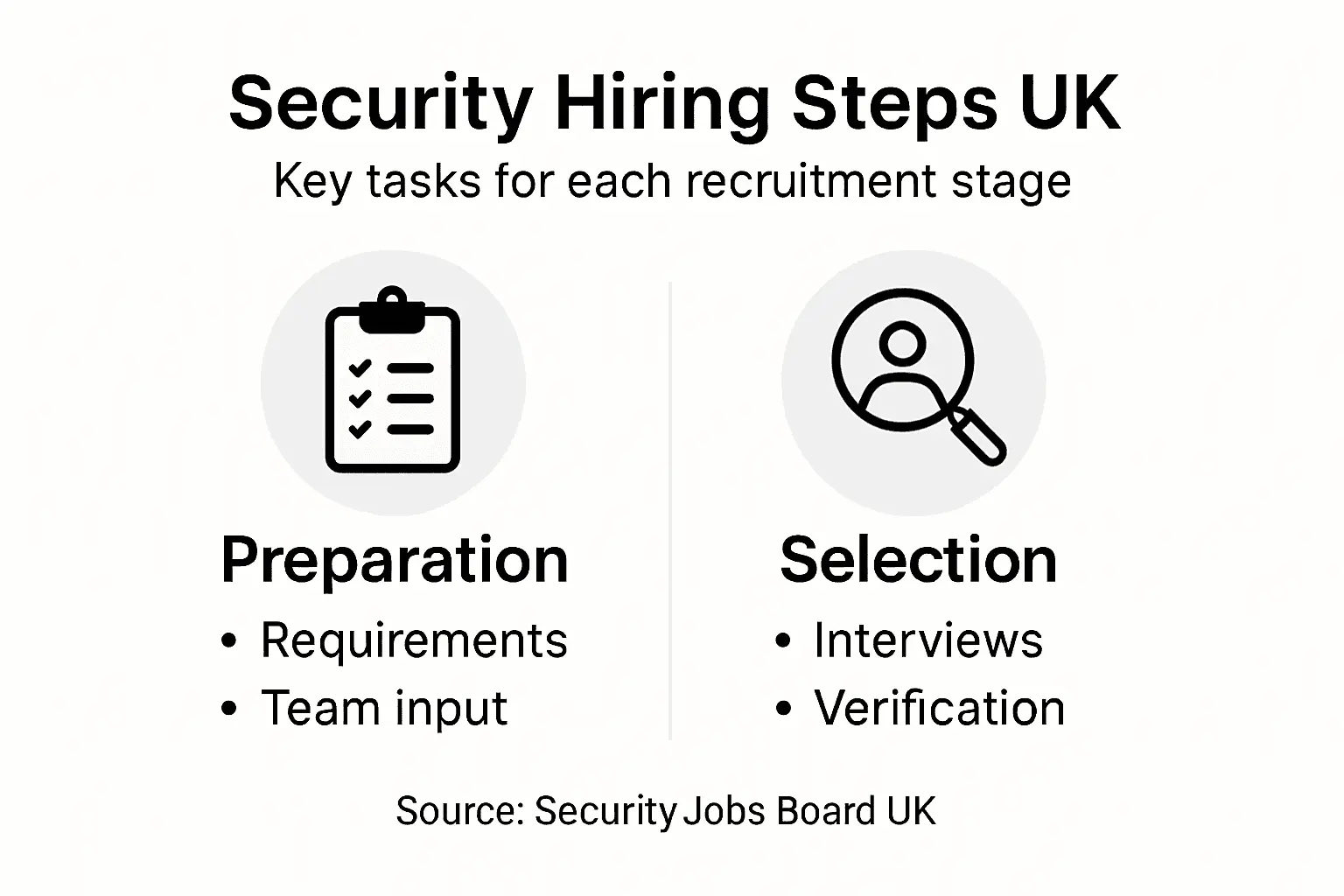
Professional tip: Create a standardised verification checklist to ensure consistent and thorough assessment of candidate credentials across all recruitment stages.
Streamline Your Security Recruitment with Expert Support
Navigating the detailed hiring process outlined in “Step by Step Hiring Process for Security Firms UK” can be challenging. From defining precise job requirements and candidate profiles to verifying credentials thoroughly every step demands attention to fairness and compliance. If recruiting top-tier security professionals feels overwhelming and time-consuming, you are not alone. The need to attract the best candidates while ensuring a transparent and GDPR-compliant process creates pressure for security firms aiming to build reliable teams.
The Security Jobs Board offers a tailored solution to meet these exact challenges. Our platform connects you directly with qualified security candidates across the UK through an easy-to-use interface. Post your well-crafted job listings based on your detailed role definitions and quickly access a screened pool of professionals ready to meet your organisation’s needs. Benefit from features like CV database browsing and fast communication channels that reduce recruitment bottlenecks. By leveraging our industry-focused job board you can simplify candidate screening, accelerate interviews, and confirm credentials efficiently — all while maintaining regulatory standards.
Ready to take the next step in your hiring journey with a trusted partner aligned to your sector’s needs? Visit Security Jobs Board today and explore how our services empower your recruitment process. Learn more about crafting job listings, screening applicants, and managing interviews effectively at our platform. Elevate your recruitment strategy now for better hires and stronger security teams.
Frequently Asked Questions
How can I define clear job requirements for hiring security professionals?
Defining clear job requirements involves outlining specific responsibilities and necessary qualifications for the role. Start by detailing core tasks such as monitoring security systems and conducting risk assessments to attract suitable candidates.
What details should I include in job listings for security roles?
Include accurate job titles, detailed responsibilities, required skills, salary ranges, and specific application instructions in your listings. This information helps attract qualified professionals and sets clear expectations for the role.
What is the best method for screening applications for security positions?
Implement a systematic approach by checking minimum qualifications, relevant experience, and assessing technical and soft skills. Use an objective scoring system to rank candidates against predefined criteria, which reduces bias in the selection process.
How should I conduct interviews to assess candidates for security roles?
Use consistent, non-discriminatory questions and involve multiple panel members to thoroughly evaluate candidates. Focus on candidates’ technical knowledge, problem-solving abilities, and cultural fit to determine their suitability for your organisation.
What steps are involved in verifying a candidate’s credentials for security hiring?
Verify candidates’ credentials by checking their licensing status, professional qualifications, and conducting thorough background checks. This process is essential to ensuring the security and compliance standards of your organisation are upheld.
How can I improve my hiring process for security firms?
Evaluate each stage of your hiring process to identify areas for improvement, such as refining job descriptions and enhancing interview techniques. Aim to document all findings and feedback to streamline your recruitment process and reduce time-to-hire.


