
TL;DR:
- The SIA is the UK regulatory body ensuring private security professionals are trained, licensed, and compliant.
- Working without an SIA license is illegal and can lead to prosecution, fines, or imprisonment.
- The Approved Contractor Scheme is voluntary but signals high standards for security companies aiming for public trust.
Most people assume working in private security is straightforward. You get a job, you show up, you do the work. What few realise is that a complex regulatory framework sits behind every shift, every badge, and every contract. The Security Industry Authority (SIA) governs who can legally work in UK private security, and misunderstanding its role can cost you your career or your business. Whether you are a jobseeker pursuing your first licence or a manager trying to keep your firm compliant, this guide cuts through the confusion and gives you a clear picture of what the SIA actually does and why it matters.
Table of Contents
- What is the Security Industry Authority?
- Compulsory licensing: Roles, rules and processes
- Enforcement, compliance and penalties
- Approved Contractor Scheme: Voluntary quality for businesses
- Why SIA compliance is about more than ticking boxes
- Connect with top UK security jobs and resources
- Frequently asked questions
Key Takeaways
| Point | Details |
|---|---|
| Core regulator | The Security Industry Authority oversees all compulsory licensing and standards in UK private security. |
| Strict licensing rules | Most frontline security roles need an SIA licence, including background and identity checks. |
| Robust enforcement | SIA spot checks and penalties keep compliance rates high and weed out unlicensed operators. |
| ACS is voluntary | The SIA’s Approved Contractor Scheme offers a recognised quality benchmark for security businesses but is not mandatory. |
| Staying informed matters | Understanding SIA rules is crucial for career advancement and avoiding costly mistakes in the UK security industry. |
What is the Security Industry Authority?
The SIA is an executive non-departmental public body, sponsored by the Home Office. It was created to bring order to a sector that, before 2001, had very few formal controls. Established under the Private Security Industry Act 2001, the SIA is the statutory regulator of the UK’s private security industry, with a core mission to protect the public and raise professional standards across the board.
It is worth clearing up two common myths straight away. The SIA is not a trade union. It does not negotiate pay or represent workers. It is also not an employer. You cannot apply to the SIA for a security job. Its role is purely regulatory, setting and enforcing the rules that everyone in the sector must follow.
The SIA regulates a wide range of activities and individuals, including:
- Door supervisors working at licensed premises
- Security guards on commercial or residential sites
- CCTV operators in public spaces
- Close protection officers
- Cash and valuables in transit operatives
- Key holders and vehicle immobilisers
Understanding the SIA badge in UK security is essential because carrying the wrong badge, or no badge at all, is a criminal offence. The SIA badge is not just a piece of plastic. It is proof that you have met the required standards of training, identity verification, and criminal record checks.
“The SIA exists to ensure that those working in the private security industry are fit and proper persons, properly trained, and operating within the law.” This principle underpins every decision the authority makes, from licence approvals to enforcement actions.
For official SIA information, including current fees and application guidance, the GOV.UK page is always your most reliable starting point.
Compulsory licensing: Roles, rules and processes
The SIA’s primary functions include compulsory licensing of individuals in licensable activities such as door supervisors, security guards, CCTV operators, and close protection officers, alongside criminal record and identity checks and the setting of training standards. If your role falls into one of these categories, working without a valid licence is illegal.
The eligibility criteria for an SIA licence are clear but non-negotiable. You must:
- Be 18 years of age or older
- Have the right to work in the UK
- Pass an identity check
- Pass a criminal record check (both UK and overseas where applicable)
- Hold a recognised first aid qualification
- Complete the relevant sector-specific training qualification
The SIA licence process involves submitting your application online, paying the current fee, and waiting for the SIA to verify your documents and checks. Licences are valid for three years, after which renewal is required. Missing your renewal window means you cannot legally work, so licence renewal importance should never be underestimated.

There is an important distinction between frontline and non-frontline licences. Frontline licences cover roles where you are physically present and actively providing security. Non-frontline licences, sometimes called manager or supervisor licences, cover those overseeing frontline staff without directly carrying out licensable activities themselves.
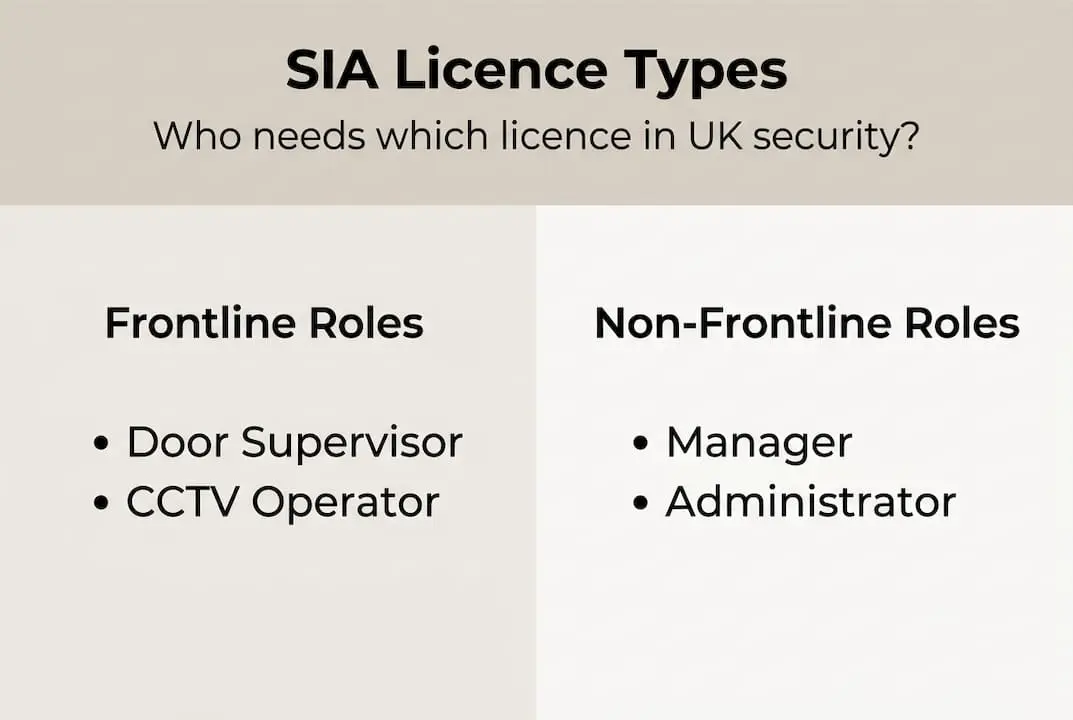
| Licence type | Example roles | Frontline? |
|---|---|---|
| Door supervisor | Nightclub security, event staff | Yes |
| Security guard | Retail, corporate, industrial sites | Yes |
| CCTV operator | Public space surveillance | Yes |
| Close protection | Bodyguarding, executive protection | Yes |
| Non-frontline | Security managers, supervisors | No |
Dog handler licensing adds another layer of nuance. If a dog handler is also performing a licensable activity such as guarding, they need the relevant licence for that activity. The dog handling itself is not separately licensed, but the guarding function is.
The training requirements for SIA licensing vary by role and are set by Ofqual-regulated awarding bodies. Similarly, the background checks for security roles go beyond a basic DBS check and can include overseas criminal records where you have lived abroad.
Pro Tip: Start your training well before your current job ends. SIA applications can take several weeks to process, and working without a valid licence during that gap is still an offence.
Enforcement, compliance and penalties
Knowing the rules is one thing. Understanding how they are enforced is quite another. The SIA does not simply issue licences and walk away. It actively monitors the industry through a combination of intelligence-led operations and physical spot checks at venues, sites, and events across the UK.
The results speak for themselves. Compliance rates typically reach 98% across the industry, which reflects both the effectiveness of the licensing regime and the professionalism of most workers. However, that remaining 2% still represents thousands of potential breaches in a sector with around 451,000 active licence holders in 2024.
When the SIA finds non-compliance, the consequences are serious:
- Licence suspension or revocation for individuals
- Criminal prosecution for working without a licence
- Fines for both individuals and employers
- Withdrawal of Approved Contractor Scheme (ACS) status for businesses
- Public naming of offenders in enforcement notices
| Enforcement action | Who it affects | Typical outcome |
|---|---|---|
| Spot check failure | Individual operative | Immediate removal from site |
| Working unlicensed | Individual | Prosecution, fine or imprisonment |
| Employing unlicensed staff | Employer | Prosecution, ACS withdrawal |
| Repeated breaches | Business | Loss of contracts, reputational damage |
The SIA has been revoking and suspending licences since 2004, and its enforcement activity has grown more sophisticated over time. Intelligence from police, local authorities, and industry partners feeds into targeted operations rather than random checks alone.
For businesses, a compliance guide for security firms is an invaluable reference. Understanding the legal landscape around static guarding legal aspects and keeping up with your security training checklist are both practical ways to stay on the right side of enforcement.
Pro Tip: Keep digital copies of all your licence documents, training certificates, and renewal reminders in one place. If an SIA officer asks for proof on site, you need to produce it quickly.
Approved Contractor Scheme: Voluntary quality for businesses
While individual licensing is compulsory, businesses face a different set of choices. The SIA manages the voluntary Approved Contractor Scheme (ACS), and in 2023 to 2024 alone, 106 new applications were received, with 33 approved, alongside withdrawals and sanctions for those who breached standards.
The ACS is open to any business that provides licensable security services. To achieve accreditation, a company must demonstrate that it meets a set of quality standards covering areas such as:
- Management and leadership practices
- Staff recruitment and vetting procedures
- Training and development programmes
- Health and safety policies
- Customer service standards
Accreditation is assessed through an independent inspection process. Companies that pass can display the ACS approved contractor logo, which signals to clients that they operate above the legal minimum.
| Feature | Compulsory licensing | ACS accreditation |
|---|---|---|
| Who it applies to | Individuals | Businesses |
| Is it mandatory? | Yes | No |
| Assessed by | SIA | Approved inspectorate |
| Benefit | Legal right to work | Competitive advantage |
For clients procuring security services, ACS status is a useful shorthand for quality. Many public sector contracts and large private clients now specify ACS membership as a minimum requirement, even though the law does not demand it. This makes contractor compliance in security a commercially smart move as well as an ethical one.
The debate around whether business licensing should become mandatory has not gone away. The Manchester Arena Inquiry highlighted gaps in how security companies are regulated at a corporate level, and the sector is watching closely for any legislative changes that may follow.
“Voluntary schemes can only go so far. The question the industry must face is whether self-selection is enough when public safety is at stake.” This tension between voluntary and compulsory standards will define the regulatory conversation in 2026 and beyond.
For the SIA’s official record on ACS statistics and outcomes, the published data gives a transparent view of how the scheme is performing year on year.
Why SIA compliance is about more than ticking boxes
Here is an uncomfortable truth that many in the industry quietly acknowledge but rarely say out loud: a significant number of security professionals treat their SIA licence as a box to tick rather than a standard to uphold. They get the badge, they renew it on time, and they consider the job done. That mindset is understandable, but it misses the bigger picture entirely.
The SIA exists because private security operatives hold real power over members of the public. A door supervisor can refuse entry, detain someone, or use physical force within the law. A CCTV operator can influence how footage is used in legal proceedings. These are not trivial responsibilities. The regulatory framework around them is not bureaucratic excess. It is public safety architecture.
What we see at The Security Jobs Board is that the professionals who genuinely understand the spirit of SIA regulation, not just the letter, are the ones who build lasting careers. They are the ones employers trust with sensitive contracts. They are the ones who move into management and training roles. Compliance, done properly, is a career asset.
The regulatory environment is also tightening. With ongoing reviews following major public safety incidents and increasing scrutiny of how security businesses operate at a corporate level, 2026 is a year to pay close attention. Jobseekers who understand what the SIA is actually trying to achieve will be better placed to adapt as those changes arrive.
Connect with top UK security jobs and resources
Understanding the SIA is the foundation. Building a career on that foundation is the next step.

At The Security Jobs Board, we connect SIA-licensed professionals with employers who value compliance and quality. Whether you are searching for security jobs in Northern Ireland or exploring UK security careers across every region and specialism, our platform is built specifically for this industry. You can create a free profile, upload your CV, and set job alerts so the right roles come to you. Every listing on our board is security-specific, meaning you are never wading through irrelevant results. Take the next step in your security career today.
Frequently asked questions
What does the Security Industry Authority (SIA) do?
The SIA licenses individuals and sets training standards for UK private security, enforcing compliance to protect the public. It is the statutory regulator established under the Private Security Industry Act 2001.
Who needs an SIA licence to work in security?
Frontline roles including security guards, door supervisors, CCTV operators, and close protection officers all require a valid SIA licence. Working in these roles without one is a criminal offence under UK law.
What happens if you work without an SIA licence?
Working without a required licence can lead to prosecution, fines, or imprisonment, and employers who knowingly use unlicensed staff face serious penalties including prosecution and loss of ACS status.
Is SIA accreditation mandatory for security companies?
No, the Approved Contractor Scheme is voluntary for businesses, though many clients and public sector contracts treat it as a de facto requirement when selecting security providers.
How many SIA licence holders are there in the UK?
There are around 451,000 active licence holders in the UK as of 2024, reflecting the scale and importance of the private security sector to public life.


