Contractor Compliance – Ensuring Safety and Legal Integrity

Staying compliant as a security compliance officer involves more than just ticking a box when engaging contractors in the United Kingdom. The challenge grows as each project demands that every contractor possesses the right skills, documented training, and proven competence from day one. With regulations like the Construction (Design and Management) Regulations 2015 shaping expectations, understanding contractor compliance ensures safe operations and helps you build a workforce that consistently meets both legal and safety standards across the organisation.
Table of Contents
- Defining Contractor Compliance In The UK
- Types Of Contractors And Compliance Differences
- Key Legal Standards And Regulatory Frameworks
- Essential Employer Responsibilities And Duties
- Risks Of Non-Compliance And Common Pitfalls
Key Takeaways
| Point | Details |
|---|---|
| Importance of Contractor Compliance | Ensuring contractors meet regulatory requirements is vital for workplace safety and operational integrity. |
| Diverse Contractor Types | Different contractor categories possess unique compliance obligations, necessitating tailored management strategies. |
| Legal Accountability | Organisations must conduct thorough background checks and ongoing performance monitoring to maintain compliance. |
| Risks of Non-Compliance | Non-compliance can lead to severe financial, legal, and reputational repercussions for organisations. |
Defining Contractor Compliance in the UK
Contractor compliance in the United Kingdom represents a comprehensive framework of legal, safety, and operational standards that businesses must meet when engaging external workforce professionals. At its core, contractor compliance involves ensuring that external workers meet specific regulatory requirements, possess necessary qualifications, and operate within defined legal boundaries.
The United Kingdom has established robust mechanisms to regulate contractor engagement, particularly within high-risk sectors like construction and security. Construction (Design and Management) Regulations 2015 provide a critical blueprint for how contractors must approach workplace safety and professional competence. These regulations mandate that contractors demonstrate:
- Appropriate skills and knowledge for assigned tasks
- Comprehensive risk management capabilities
- Proper training and certification documentation
- Ability to plan and supervise work effectively
- Understanding of health and safety protocols
Moreover, contractor compliance extends beyond mere documentation. It represents a proactive approach to managing external workforce risks, ensuring that organisations protect themselves, their employees, and the broader public from potential workplace hazards. Building regulations and safety standards require contractors to collaborate closely with clients and designers, maintaining transparent communication and demonstrating technical competence.
Legal accountability remains a cornerstone of contractor compliance in the UK. Organisations must verify contractor credentials, assess their capabilities, and establish clear contractual expectations that align with national regulatory frameworks. This involves comprehensive background checks, skill assessments, and ongoing performance monitoring.
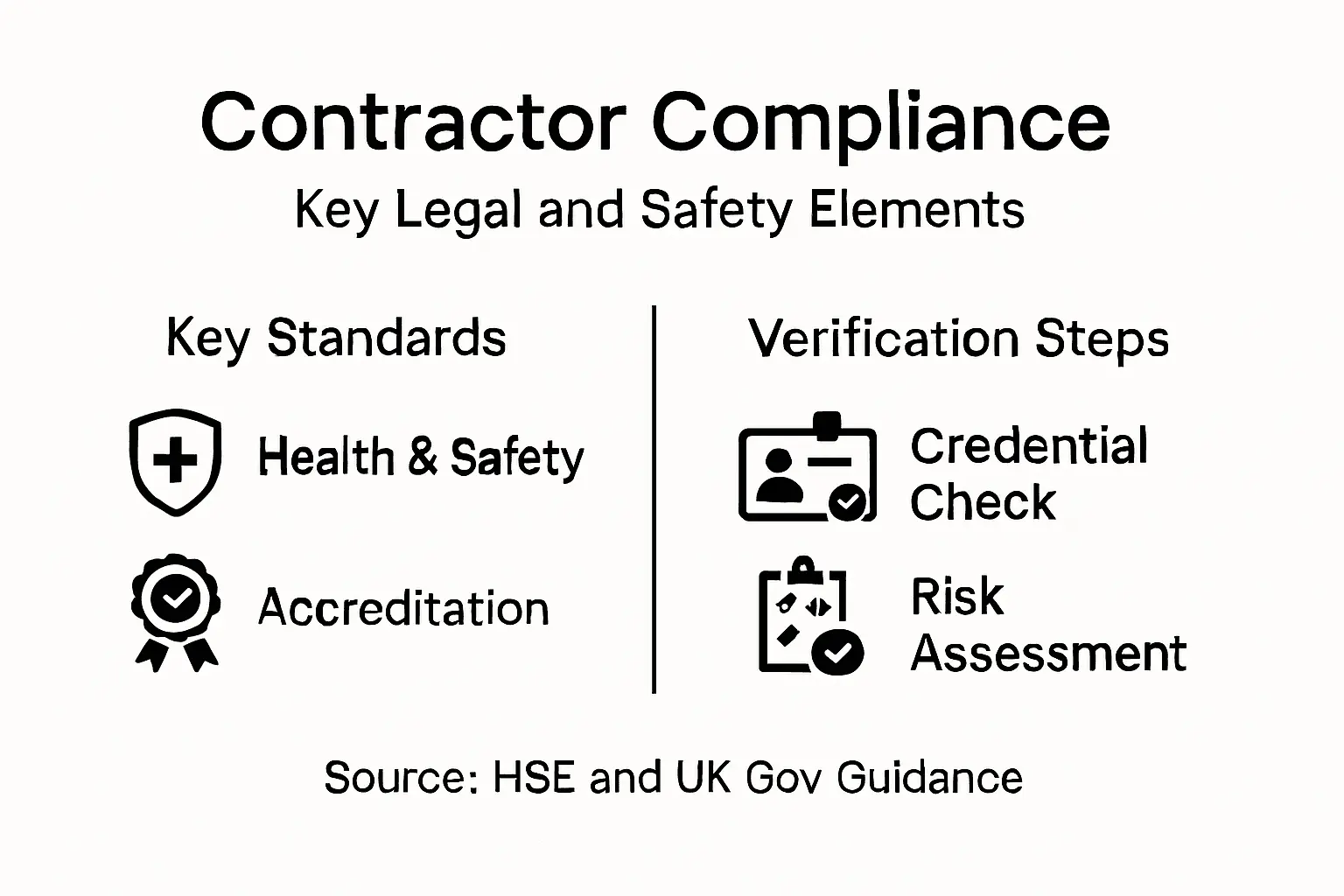
Pro tip: Always maintain a robust contractor management system that includes regular skills audits, safety training verifications, and periodic competence reassessments to ensure continuous compliance and risk mitigation.
Types of Contractors and Compliance Differences
Contractor categories in the United Kingdom are diverse, with each type bearing unique compliance responsibilities and legal obligations. Understanding these distinctions is crucial for organisations seeking to manage external workforce risks effectively and maintain regulatory alignment.
Construction industry contractors can be broadly categorised into several key types, each with specific compliance requirements:
- Principal Contractors: Responsible for coordinating entire construction phases
- Sub-contractors: Perform specialised tasks under primary contractor supervision
- Self-employed Contractors: Independent professionals with direct contractual responsibilities
- Temporary Workers: Engaged for specific project durations with limited ongoing obligations
- Specialist Trade Contractors: Focused on specific technical or professional domains
Each contractor type must demonstrate competence through different compliance mechanisms. Government building regulations mandate that principal contractors have more extensive coordination duties, including ensuring overall project safety, managing multi-contractor interactions, and maintaining comprehensive documentation.
Here is a summary of primary contractor types and their distinct compliance focuses in the UK:
| Contractor Type | Main Compliance Focus | Typical Complexity |
|---|---|---|
| Principal Contractor | Project safety coordination | High |
| Sub-contractor | Domain-specific risk control | Moderate |
| Self-employed Contractor | Personal competence evidence | Variable |
| Temporary Worker | Short-term safety validation | Low |
| Specialist Trade Contractor | Technical expertise assurance | Moderate |
Risk management varies significantly across contractor types. Principal contractors must develop holistic safety strategies, while individual trade contractors focus on domain-specific risk mitigation within their specific work scope. This nuanced approach ensures that each professional contributes to overall project safety while meeting their specific regulatory obligations.
Contractor compliance is not a one-size-fits-all approach, but a dynamic process tailored to each professional’s specific role and project context.
Moreover, compliance requirements differ based on project complexity, sector-specific regulations, and the potential hazards associated with specific work environments. Construction, security, and technical sectors each impose unique compliance frameworks that demand specialised knowledge and proactive risk management.
Pro tip: Create a tailored compliance matrix that maps specific regulatory requirements to each contractor type, enabling more precise risk assessment and management strategies.
Key Legal Standards and Regulatory Frameworks
The United Kingdom’s contractor compliance landscape is underpinned by a comprehensive network of legal standards and regulatory frameworks designed to ensure workplace safety, professional competence, and organisational accountability. These frameworks establish critical guidelines that govern how contractors operate across various industrial sectors.
Construction (Design and Management) Regulations 2015 represent a cornerstone of contractor compliance, providing a robust legal foundation for managing health and safety risks. Key legislative instruments include:
- Health and Safety at Work etc. Act 1974: Fundamental legislation establishing core safety responsibilities
- Construction (Design and Management) Regulations 2015: Specific framework for construction sector safety
- Building Safety Act 2022: Enhanced safety standards for high-risk building projects
- Management of Health and Safety at Work Regulations 1999: Detailed risk management requirements
- Working Time Regulations 1998: Governing working hours and employee protections
These regulations collectively establish a multilayered approach to contractor compliance, emphasising proactive risk management and clear organisational responsibilities. Contractor legal obligations extend beyond mere procedural adherence, demanding comprehensive competence assessments and ongoing performance monitoring.

This table compares the impact of key UK regulations on contractor compliance:
| Regulation | Main Focus | Compliance Impact |
|---|---|---|
| Health and Safety at Work etc. Act 1974 | Overall workplace safety | Sets baseline legal obligations |
| CDM Regulations 2015 | Construction risk control | Mandates project-level oversight |
| Building Safety Act 2022 | High-risk building safety | Introduces stricter competency |
| Management of H&S at Work Regulations | Risk management process | Requires systematic assessments |
| Working Time Regulations 1998 | Working hours protections | Ensures welfare and rest breaks |
Legal compliance is not a static checkbox, but a dynamic process of continuous improvement and risk mitigation.
Regulatory complexity varies across different industrial sectors, with construction and high-risk environments demanding more stringent oversight. The Building Safety Act 2022, for instance, introduced more rigorous competency requirements, particularly for projects involving complex or potentially hazardous construction work.
Pro tip: Develop a comprehensive compliance tracking system that maps specific legal requirements to each contractor type, enabling real-time monitoring and proactive risk management.
Essential Employer Responsibilities and Duties
Employers play a pivotal role in maintaining contractor compliance, serving as the critical linchpin between regulatory requirements and operational safety. Their responsibilities extend far beyond simple contractual arrangements, encompassing comprehensive risk management, continuous monitoring, and proactive safety interventions.
Employer health and safety duties involve a multifaceted approach to contractor management, including:
- Competence Verification: Rigorously assessing contractors’ skills and qualifications
- Training Provision: Ensuring contractors receive appropriate safety and role-specific training
- Risk Assessment: Conducting comprehensive workplace hazard evaluations
- Continuous Monitoring: Implementing ongoing performance and safety checks
- Documentation Management: Maintaining detailed records of contractor credentials and activities
Legal frameworks mandate that employers exercise due diligence in contractor selection and management. Contractor compliance strategies require systematic approaches to prequalification, supervision, and performance evaluation.
Effective contractor management is not about creating barriers, but about establishing collaborative safety ecosystems.
The complexity of employer responsibilities varies across different industrial sectors, with high-risk environments like construction and security demanding more rigorous oversight. Employers must develop robust systems that enable real-time tracking of contractor competencies, safety performance, and regulatory adherence.
Pro tip: Implement a digital contractor management platform that centralises credential verification, tracks training certifications, and provides automated compliance alerts.
Risks of Non-Compliance and Common Pitfalls
Contractor non-compliance represents a complex and potentially catastrophic risk landscape for organisations across the United Kingdom, with consequences that extend far beyond immediate financial penalties. Understanding these risks is crucial for proactively managing external workforce engagements and maintaining organisational integrity.
Construction compliance failures can result in devastating operational consequences, including:
- Financial Penalties: Substantial fines and legal sanctions
- Reputational Damage: Significant erosion of organisational credibility
- Project Disruptions: Unexpected delays and potential contract terminations
- Legal Liability: Potential criminal and civil legal proceedings
- Safety Compromises: Increased workplace accident risks
Common pitfalls that organisations frequently encounter include systematic compliance failures such as:
- Inadequate contractor skill verification processes
- Insufficient ongoing performance monitoring
- Poor documentation and record-keeping practices
- Limited health and safety training provisions
- Weak risk assessment methodologies
Non-compliance is not merely a regulatory issue, but a fundamental risk management challenge that demands strategic attention and proactive intervention.
Regulatory complexity means that different industrial sectors face unique compliance challenges. High-risk environments like construction and security require particularly stringent oversight, with potential consequences ranging from immediate project shutdowns to long-term operational restrictions.
Pro tip: Develop a comprehensive compliance checklist that includes automated alerts for credential expirations, mandatory training updates, and periodic competency reassessments.
Secure Contractor Compliance with Trusted Security Professionals
The challenge of maintaining contractor compliance while ensuring safety and legal integrity in the security sector requires access to competent and reliable contractors. The complexities surrounding risk management, verification of credentials, and ongoing compliance monitoring demand a proactive recruitment strategy. By sourcing skilled security professionals who meet strict regulatory standards, organisations can reduce risks and safeguard their operations effectively.

Take control of your compliance management today by connecting with verified security experts on the Security Jobs Board. Our platform is dedicated to matching employers with professionals who understand the importance of rigorous health and safety standards outlined in UK legislation. Find the right candidates swiftly, verify credentials with confidence, and ensure your workforce aligns with key contractor compliance requirements. Visit Security Jobs Board now to streamline your recruitment and reinforce your organisation’s safety commitments.
Frequently Asked Questions
What is contractor compliance?
Contractor compliance refers to a framework of legal, safety, and operational standards that businesses must adhere to when engaging external workforce professionals, ensuring they meet specific regulatory requirements and possess necessary qualifications.
Why is contractor compliance important for businesses?
Contractor compliance is crucial as it helps organisations manage risks associated with external workers, ensuring workplace safety, legal accountability, and protection from potential liabilities and penalties related to non-compliance.
What are the key legal standards governing contractor compliance?
Key legal standards include the Health and Safety at Work etc. Act 1974, Construction (Design and Management) Regulations 2015, Building Safety Act 2022, and Management of Health and Safety at Work Regulations 1999, each establishing critical guidelines for contractor operations across various sectors.
How can employers ensure contractor compliance effectively?
Employers can ensure contractor compliance by rigorously verifying contractor qualifications, providing necessary training, conducting comprehensive risk assessments, continuously monitoring performance, and maintaining detailed records of contractor activities.


