Why security training is required for UK professionals

Many security professionals view mandatory training as nothing more than a bureaucratic hurdle to clear before starting work. This misconception overlooks the genuine value these programmes deliver for your career trajectory and legal standing. Security training in the UK serves dual purposes: ensuring you meet strict regulatory requirements whilst equipping you with practical skills that directly reduce workplace risks and enhance your earning potential. Whether you’re entering door supervision, CCTV operation, or cybersecurity roles, understanding why training matters transforms it from a compliance task into a strategic career investment that opens doors to better opportunities and higher salaries.
Table of Contents
- Key takeaways
- Legal requirements for security training in the UK
- Core training content and methods for security professionals
- Cybersecurity training as a critical component for UK security professionals
- Training’s impact on career advancement and organisational benefits
- Explore career opportunities with security jobs board
- Frequently asked questions
Key Takeaways
| Point | Details |
|---|---|
| SIA licensing mandatory | To legally work in licensable roles you must complete approved training and obtain an SIA licence. |
| HSE safety competence | Health and safety competence under PUWER and HSWA 1974 is required, with non compliance risking substantial fines and possible criminal prosecution. |
| Cyber and GDPR duties | Training must align with Cyber Essentials, NIS Regulations and GDPR obligations to reduce human error driven breaches. |
| Severe penalties for non compliance | Licence revocation, dismissal and potential unlimited fines exist where inadequate training contributes to incidents. |
Legal requirements for security training in the UK
UK law establishes clear training mandates for security professionals to protect public safety and maintain industry standards. Security training is mandatory for UK private security professionals under the Security Industry Authority (SIA) regulations to legally work in licensable roles such as door supervision, security guarding, and CCTV operation. Without completing approved training and obtaining your SIA licence, you cannot legally perform these duties, making it an absolute prerequisite rather than an optional enhancement.
The Health and Safety Executive (HSE) adds another layer of mandatory requirements. HSE mandates training for health and safety competence under PUWER and HSWA 1974, with non-compliance risking substantial fines that reached £35.8M in enforcement actions. These regulations ensure you understand how to operate equipment safely, recognise hazards, and protect yourself and others during security operations. The consequences extend beyond financial penalties to potential criminal prosecution for serious breaches.
Cybersecurity professionals face equally strict requirements. Training must align with Cyber Essentials certification requirements, NIS Regulations, and UK GDPR obligations. The 2026 updates to Cyber Essentials now mandate multi-factor authentication training and enhanced staff awareness programmes to address the reality that human error contributes to 27-80% of security breaches. This regulatory evolution reflects the growing digital threats facing UK organisations.
Key legal frameworks governing security training include:
- SIA licensing requirements for physical security roles
- HSE health and safety competence standards
- Cyber Essentials and NIS Regulations for digital security
- GDPR data protection training obligations
- Industry-specific requirements for sectors like aviation or nuclear
Failing to meet these standards carries serious consequences. You risk licence revocation, employment termination, and legal liability if incidents occur whilst you’re working without proper certification. Employers face even heavier penalties, including unlimited fines for corporate manslaughter if inadequate training contributes to fatalities. Understanding security screening processes helps you appreciate how thoroughly the industry vets professionals to maintain these standards.
Core training content and methods for security professionals
SIA approved training delivers comprehensive preparation across multiple competency areas. Training covers core modules including law, health and safety, terrorism awareness, conflict management, physical intervention, and role-specific skills, ensuring you develop both theoretical knowledge and practical capabilities. The curriculum balances legal understanding with hands-on techniques you’ll apply daily in your role.
Legal knowledge forms the foundation of your training. You’ll study relevant legislation including the Private Security Industry Act 2001, common law powers of arrest, and the legal framework governing use of force. This ensures you understand your authority limits and can make legally defensible decisions under pressure. Health and safety modules cover risk assessment, emergency procedures, and workplace safety protocols that protect you and the public.
Terrorism awareness training has become increasingly vital. You’ll learn to recognise suspicious behaviour, understand threat levels, and follow appropriate reporting procedures. This content directly supports national security efforts whilst equipping you to respond effectively to potential incidents. Conflict management modules teach de-escalation techniques, communication strategies, and methods to resolve disputes without resorting to physical intervention.
Role-specific units tailor the training to your intended duties:
- Door supervision: crowd management, licensing law, conflict resolution
- Security guarding: patrol procedures, access control, incident reporting
- CCTV operation: surveillance techniques, data protection, evidence handling
- Close protection: threat assessment, route planning, defensive driving
Training providers use scenario-based learning to simulate real situations you’ll encounter. Mock incidents, role-playing exercises, and practical assessments test your ability to apply knowledge under realistic conditions. This methodology proves far more effective than passive learning for developing the quick decision-making skills security work demands. Formal assessments verify your competence before certification, ensuring only qualified individuals enter the workforce.
Pro Tip: Complete your training with an SIA-approved provider to avoid delays in licence processing. Non-approved courses won’t meet regulatory requirements, wasting your time and money whilst leaving you unable to work legally.
Regular refresher courses maintain your skills currency as threats and regulations evolve. These updates cover emerging risks like cyber-physical security integration and new legal requirements. Staying current through ongoing training demonstrates professionalism and keeps you competitive in the job market. Explore security training checklist essentials to ensure you’re covering all necessary competencies.

Cybersecurity training as a critical component for UK security professionals
Digital threats now intersect with physical security in virtually every role, making cybersecurity knowledge essential rather than optional. Modern security professionals must understand how cyber vulnerabilities create physical risks, from compromised access control systems to data breaches exposing sensitive facility information. This integration means your training must address both domains to provide comprehensive protection.
Cybersecurity training aligns with Cyber Essentials certification, NIS Regulations, and UK GDPR, requiring staff awareness programmes to mitigate the human error responsible for 27-80% of breaches. The 2026 Cyber Essentials updates mandate multi-factor authentication training for all staff with system access, recognising that weak authentication practices remain a primary attack vector. Your ability to implement and maintain these controls directly impacts organisational security posture.
| Training area | Key content | Compliance link |
|---|---|---|
| Access control | Password hygiene, MFA usage | Cyber Essentials |
| Data protection | GDPR principles, breach reporting | UK GDPR |
| Threat awareness | Phishing recognition, social engineering | NIS Regulations |
| Incident response | Reporting procedures, evidence preservation | All frameworks |
Human behaviour creates the weakest link in most security systems. Phishing attacks succeed because staff click malicious links or share credentials. Social engineering exploits trust to gain unauthorised access. Your training teaches you to recognise these tactics and respond appropriately, dramatically reducing your organisation’s attack surface. Simple awareness of common techniques prevents the majority of attempted breaches.
Cybersecurity training covers several critical competencies:
- Recognising and reporting phishing attempts and suspicious emails
- Implementing strong authentication practices including MFA
- Understanding data classification and handling requirements
- Following secure communication protocols for sensitive information
- Maintaining physical security of digital assets and devices
Annual refresher programmes ensure your knowledge stays current with evolving threats. Cybercriminals constantly develop new attack methods, and regulations update to address emerging risks. Regular training sessions introduce you to the latest threat intelligence and updated compliance requirements. This ongoing education proves essential in a landscape where yesterday’s best practices may be inadequate for today’s threats.
Pro Tip: Pursue specialist cybersecurity certifications like CompTIA Security+ or Certified Ethical Hacker to differentiate yourself in the job market. These credentials signal advanced knowledge that commands premium salaries and opens doors to specialist roles.
The UK faces a significant cyber skills gap that creates opportunities for trained professionals. Organisations struggle to find qualified candidates, meaning your cybersecurity training enhances employability across sectors beyond traditional security roles. Understanding security checks processes helps you appreciate how thoroughly employers verify your qualifications and background before granting access to sensitive systems.
Training’s impact on career advancement and organisational benefits
Mandatory training delivers tangible returns that extend far beyond regulatory compliance. Your investment in approved programmes directly translates to enhanced earning potential and expanded career opportunities within the security sector. Understanding these benefits helps you approach training strategically rather than viewing it as a mere obligation.
Certified professionals earn 10-15% more than uncertified counterparts, representing £5k-10k annual salary uplift depending on role and experience. This premium reflects employer recognition that trained staff deliver superior performance whilst reducing organisational risk. The certification signals competence that justifies higher compensation, making your training investment self-funding within the first year through increased earnings.
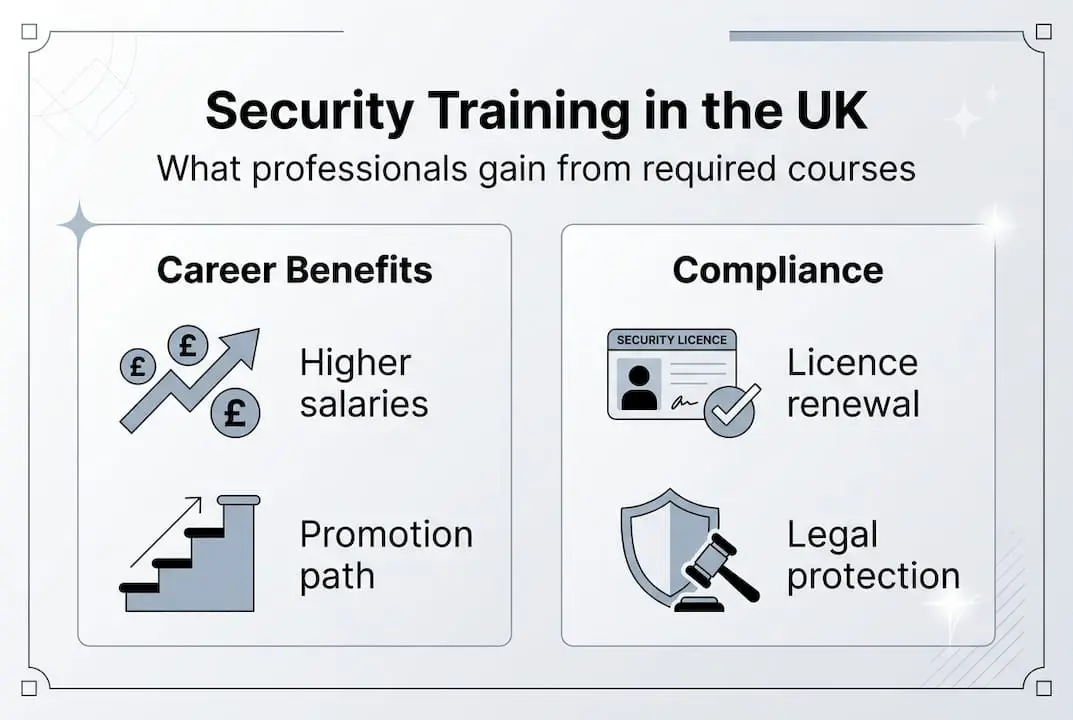
Specialist certifications open pathways to advanced roles unavailable to basic licence holders. Supervisory positions, cybersecurity analyst roles, and specialist functions like close protection or aviation security require additional qualifications beyond entry-level training. Apprenticeships combine workplace learning with formal education, enabling you to develop expertise whilst earning. These structured development programmes accelerate career progression compared to remaining in basic operative roles.
| Career stage | Typical role | Required training | Salary range |
|---|---|---|---|
| Entry | Security officer | SIA licence | £20k-24k |
| Intermediate | Supervisor | SIA + management training | £26k-32k |
| Advanced | Security manager | Degree/advanced certs | £35k-50k |
| Specialist | Cyber analyst | Industry certifications | £40k-65k |
Employers benefit substantially from investing in staff training beyond avoiding compliance penalties. Training reduces operational risks by ensuring staff handle situations competently, minimising incidents that create liability exposure. Well-trained teams demonstrate lower turnover rates, with security firms reporting 46.8% reduction in staff departures after implementing comprehensive training programmes. This retention saves recruitment costs whilst building experienced teams that deliver superior service.
Key organisational benefits include:
- Reduced insurance premiums through demonstrated risk management
- Enhanced reputation attracting quality clients and contracts
- Lower incident rates decreasing liability exposure
- Improved staff morale and job satisfaction
- Competitive advantage in tender processes requiring certified teams
Your training credentials signal professionalism that influences hiring decisions. Employers reviewing applications prioritise candidates holding current certifications, knowing these individuals can start work immediately without training delays. In competitive job markets, your qualifications differentiate you from uncertified applicants, often determining who receives interview invitations. Learn more about getting your SIA licence to understand the complete qualification process.
The security sector increasingly values continuous professional development. Professionals who pursue ongoing training and additional certifications demonstrate commitment that employers reward with promotions and salary increases. This creates a virtuous cycle where your investment in skills development generates returns through enhanced opportunities and compensation throughout your career.
Explore career opportunities with security jobs board
Your mandatory training qualifies you for numerous roles across the UK security sector. Security Jobs Board specialises in connecting trained professionals with employers seeking certified candidates for positions ranging from entry-level security officers to specialist cybersecurity analysts. Browse current security jobs in Northern Ireland and throughout the UK to discover opportunities matching your qualifications and career goals.

The platform’s career resources help you maximise your training investment. Access security job career advice covering CV optimisation, interview preparation, and career progression strategies tailored specifically for security professionals. These insights help you translate your certifications into compelling applications that stand out to employers seeking qualified candidates.
Frequently asked questions
What happens if security training is not completed?
Working in licensable security roles without completing mandatory training constitutes a criminal offence under the Private Security Industry Act 2001. You face prosecution, fines, and permanent disqualification from the industry. Non-compliance with HSE or SIA training requirements can lead to fines and licence revocation, whilst employers hiring uncertified staff face even heavier penalties including unlimited fines for serious breaches. Your career prospects disappear entirely without proper certification.
How often must security professionals renew their training?
Refresher training is mandatory for SIA licence renewals which occur every three years, though some roles require annual updates. Cybersecurity training follows yearly refresh cycles to address evolving threats and regulatory changes, with Cyber Essentials compliance requiring periodic staff awareness updates. Close protection operatives now face specific refresher requirements introduced in recent regulatory updates. Maintaining current certifications ensures continuous employability and compliance.
Can security training improve career prospects beyond compliance?
Absolutely. Certified professionals see salary uplifts and access to specialist roles unavailable to basic licence holders, enhancing career progression significantly. Employers actively seek trained staff for supervisory and management positions, meaning your certifications directly influence promotion opportunities. Advanced qualifications in areas like cybersecurity or close protection command premium salaries whilst opening pathways to consultancy and specialist roles that basic certification cannot access.
Does cybersecurity training apply to physical security roles?
Yes, increasingly so. Modern security systems integrate digital and physical components, from networked CCTV to electronic access control requiring cyber awareness. You’ll handle sensitive data subject to GDPR, operate connected devices vulnerable to cyber attacks, and implement authentication systems requiring technical knowledge. Understanding cyber threats helps you recognise when physical security measures face digital compromise, making this knowledge essential rather than optional for contemporary security professionals across all specialisations.
Recommended
- 7 Essential Skills Every UK Security Professional Needs
- UK Security Jobs – Careers, Requirements, and Risks
- Security Vetting in the UK: What Every Employer & Professional Should Know
- Role of Professional Bodies in UK Security Careers
- Earn a Security Awareness Training Certificate Easily
- Cybersecurity checklist for employees to prevent breaches


