UK security industry: job market & career outlook 2026

The UK security industry is far bigger than most people realise. Often dismissed as a fallback option, it is in fact one of the country’s most significant employment sectors, with the UK security industry employing over 450,000 licensed professionals in a market worth up to £22.5 billion. Whether you are considering your first role in security or looking to advance an existing career, understanding the structure, requirements, and opportunities within this sector is essential. This guide walks you through everything you need to know, from entry-level roles to specialist paths, so you can make informed decisions about your future.
Table of Contents
- Understanding the UK security industry: facts and figures
- Key roles, entry requirements, and career ladders explained
- Job market dynamics: opportunities, challenges and trends
- Industry nuances: regulation, compliance, and future skills
- Beyond the basics: advanced roles, public sector and cyber security
- Take your first step in the security industry
- Frequently asked questions
Key Takeaways
| Point | Details |
|---|---|
| Large sector | The UK security industry employs over 450,000 people with roles in various environments. |
| Diverse roles | Careers range from frontline guarding to advanced cyber security and public sector work. |
| Mandatory licensing | SIA licensing and ongoing training are essential for nearly all positions. |
| Mind the skills gap | Both traditional and cyber security fields face shortages, offering strong opportunities for job seekers. |
| Future-proof your career | Embracing new technology and compliance trends helps you stay competitive in the evolving industry. |
Understanding the UK security industry: facts and figures
To understand your place in the sector, it helps to look at how the UK security industry is structured and just how impactful it actually is.
The numbers are striking. There are over 519,000 SIA licences held across the country, and the market is valued at up to £22.5 billion. The Security Industry Authority (SIA) is the government body that regulates the industry, issuing licences to individuals working in roles such as door supervision, security guarding, CCTV operation, and close protection. Understanding the role of security guards gives you a clearer picture of what frontline work actually involves day to day.
| Sector metric | Figure |
|---|---|
| Licensed professionals | 450,000+ |
| Total SIA licences held | 519,000+ |
| Estimated market value | £12.4bn to £22.5bn |
| London’s share of workforce | 28% |
| Number of registered firms | 1,000+ |
According to market figures, the industry spans thousands of companies ranging from large national contractors to small independent operators. London alone accounts for 28% of the entire workforce, reflecting the capital’s density of commercial, retail, and event venues.
What makes this industry so large and complex?
- It covers physical guarding, electronic surveillance, event security, and retail loss prevention
- Demand is driven by both public and private sector clients
- Regulatory requirements create consistent baseline standards across all firms
- The sector operates around the clock, generating high volumes of shift-based employment
- Growth in urban development and public events continues to fuel demand
Key roles, entry requirements, and career ladders explained
With the industry’s size clear, the next step is to focus on the day-to-day reality and variety of jobs available, plus how you can get started.
The security sector offers a wider range of roles than most candidates expect. Door supervisors, security guards, CCTV operators, mobile patrol officers, and event security personnel all sit under the same regulatory umbrella but carry distinct responsibilities and pay scales.

| Role | Main duties | Qualification needed | Average salary |
|---|---|---|---|
| Door supervisor | Access control, conflict management | SIA Door Supervisor licence | £24,000 to £30,000 |
| Security guard | Premises protection, patrols | SIA Security Guard licence | £22,000 to £28,000 |
| CCTV operator | Monitoring, incident reporting | SIA CCTV licence | £22,000 to £26,000 |
| Mobile patrol officer | Multi-site checks, response | SIA licence plus driving | £23,000 to £29,000 |
| Event security | Crowd management, screening | SIA licence, First Aid | £25,000 to £32,000 |
Door supervisors account for 71% of SIA licences, with security guards at 37%, and salaries ranging from £22,000 to £32,000 depending on role and location. To get started, here is the typical path:
- Confirm you meet the age requirement (18 or over)
- Complete an SIA-approved training course for your chosen licence type
- Pass a criminal record check (DBS check)
- Obtain a valid First Aid certificate
- Submit your SIA licence application and pay the fee
- Begin applying for roles once your licence is issued
For a detailed walkthrough, the guide on how to get your SIA licence covers every step clearly. Career progression from here can lead into mobile supervision, team leadership, compliance management, or even cyber security and intelligence roles.
Pro Tip: Holding more than one SIA licence type, for example both a Door Supervisor and CCTV licence, significantly increases your employability and gives you access to a broader range of vacancies.
Job market dynamics: opportunities, challenges and trends
After understanding roles and requirements, it is crucial to realise how market forces and ongoing trends shape your chances and future in the industry.
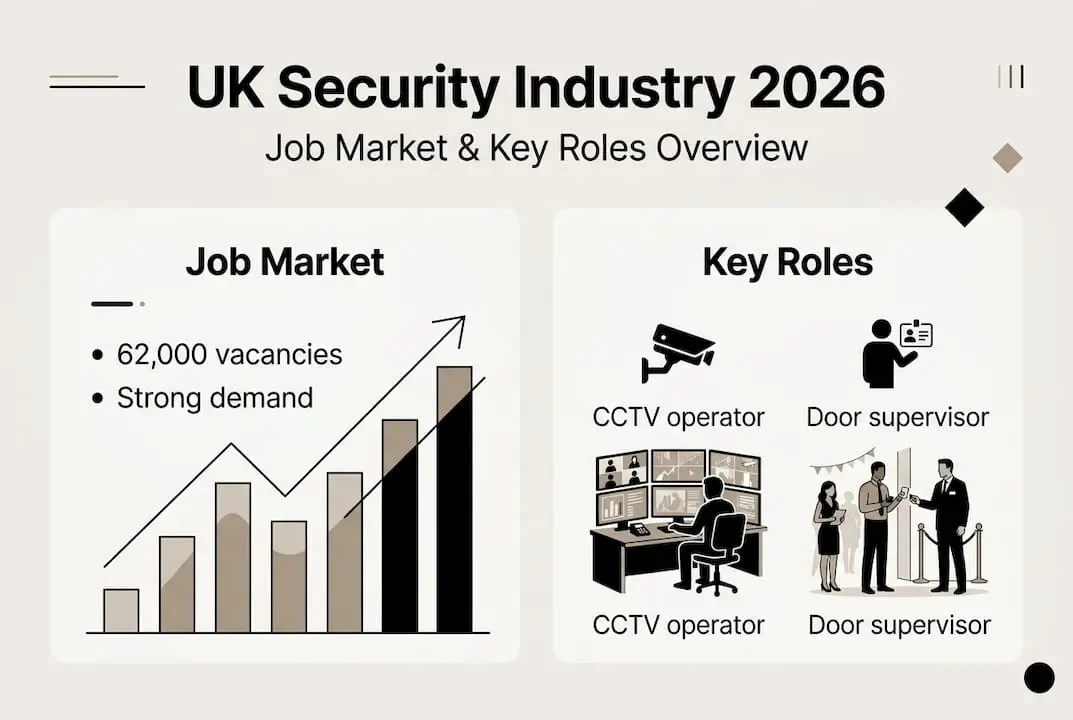
The security industry has a 3.2% growth rate but faces persistent labour shortages and high staff turnover. Around 62,000 new officers are needed to meet current demand, and vacancies take an average of 45 days to fill. That is a significant gap, and it works in your favour as a job seeker.
Five main challenges currently shaping the market:
- A declining pool of young entrants into the profession
- High turnover driven by unsociable hours and pay pressures
- Increasing compliance demands raising the bar for entry
- Gender imbalance, with women still underrepresented across most roles
- Regional shortages outside London and major cities
“High turnover remains one of the most persistent issues in the sector. Agencies report that many candidates leave within the first year, often citing shift patterns and limited progression visibility as key factors.”
For employers and candidates alike, understanding these dynamics is essential. The article on security recruitment trends breaks down how hiring patterns are shifting in 2026. The security sector outlook also points to growing investment in technology-led roles, particularly CCTV monitoring, AI-assisted surveillance, and body-worn camera operation.
Martyn’s Law, the new legislation requiring venues to have formal security plans in place, is also creating demand for trained personnel in event and public space security. Employers are actively seeking candidates who understand compliance as well as physical security.
Pro Tip: If you are already working in security, adding a technology-related qualification such as CCTV or IP surveillance training puts you ahead of candidates who only hold a basic guarding licence. Employers are actively seeking candidates who can attract top security talent by demonstrating multi-skilled profiles.
Industry nuances: regulation, compliance, and future skills
Looking at trends and hiring dynamics, it is important to address the laws, compliance requirements, and future-focused skills that impact your career and selection.
SIA licensing is mandatory for most frontline security roles. You must be at least 18, pass criminal record checks, hold a valid First Aid certificate, and complete refresher training to renew your licence every three years. The cost of initial training varies by licence type but typically ranges from £500 to £1,200.
Beyond individual licensing, firms operating in the sector are expected to meet standards set by the British Security Industry Association (BSIA) and may seek Approved Contractor Scheme (ACS) accreditation. These frameworks affect which companies you work for and how professionally they operate.
Core standards affecting job seekers in 2026:
- SIA licence validity and renewal requirements
- DBS (Disclosure and Barring Service) checks for all frontline roles
- First Aid at Work certification
- Compliance with the Working Time Regulations for shift workers
- Awareness of Martyn’s Law obligations for venue and event roles
Technology is reshaping what employers expect. Body-worn cameras, AI-assisted monitoring systems, and integrated access control platforms are now common in many workplaces. Candidates who understand these tools are more competitive. For a full breakdown of your rights and obligations, the guide on security employment law is worth reading before you start applying.
Pro Tip: Do not wait until your licence is about to expire to think about refresher training. Booking early keeps your profile active and shows employers you take compliance seriously.
Beyond the basics: advanced roles, public sector and cyber security
With compliance and new tech raising the bar, let us look at how you can aim higher and consider specialist or public sector routes in security.
Frontline guarding is just one part of a much larger picture. The public sector offers advanced paths through organisations such as MI5, MI6, and the Ministry of Defence (MOD), where roles in intelligence, counter-terrorism, and national security require higher vetting levels and specialist skills. Private security outpaces public police for frontline roles, but MI5 and MI6 represent genuinely advanced career paths for those with the right background.
Cyber security is a fast-growing adjacent field. Cyber security roles face a 3,800-person skills gap in the UK labour market, with a median salary close to £55,000. These roles require specialist IT knowledge, certifications such as CompTIA Security+ or CISSP, and a very different skill set from physical security work.
What you typically need for advanced or cyber security roles:
- Degree-level education or equivalent professional certifications
- Higher-level security vetting (SC or DV clearance for public sector)
- Experience in risk assessment, intelligence analysis, or IT systems
- Strong written communication for reporting and compliance documentation
- Willingness to undergo extensive background checks
The skills gap in cyber security means that candidates who invest in relevant training now are entering a market with strong demand and limited competition. Cross-sector agility, the ability to move between physical and digital security disciplines, is increasingly valued by large employers.
Take your first step in the security industry
Armed with a clear understanding of the industry, here is how you can take your next step as a candidate.
The Security Jobs Board is the UK’s dedicated platform for security sector job seekers, built specifically for this industry rather than adapted from a generic jobs site. Whether you are looking for security jobs in Northern Ireland or searching for roles across England, Scotland, and Wales, the platform connects you directly with employers who are actively hiring.

Creating a profile is free, and you can upload your CV, set job alerts, and apply to vacancies quickly from any device. The platform is BSIA-affiliated, which means the employers you find here operate to recognised industry standards. For guidance on building your career beyond the application stage, the security career advice section covers everything from interview preparation to licence renewal planning. The industry needs people. The question is whether you are ready to step into it.
Frequently asked questions
What qualifications do I need to work in the UK security industry?
SIA licensing is mandatory for most security jobs, and you will need to complete approved training, pass a DBS check, and hold a valid First Aid certificate before your licence is issued.
How much can I earn as a security guard or supervisor?
Most security guards earn between £22,000 and £32,000 a year, with salaries for security roles varying by licence type, location, and employer, and some positions paying up to £15 per hour.
Is there demand for security workers in 2026?
Yes, demand is strong. 62,000 new officers are needed to meet current shortfalls, and vacancies are taking an average of 45 days to fill, which means employers are actively competing for qualified candidates.
What is Martyn’s Law and how does it affect jobs?
Martyn’s Law is a piece of legislation that increases security requirements for public venues and events, and it is influencing legal requirements in ways that are likely to create new roles focused on compliance and public safety planning.
Do cyber security roles require different skills than traditional security jobs?
Yes, significantly so. Cyber security roles have a median salary near £55,000 and require specialist IT qualifications rather than an SIA licence, making them a distinct career path from physical security work.
Recommended
- Best sites for security jobs in the UK 2026 | Security Jobs Board
- Latest security roles in UK: advance your career in 2025|SJB
- UK Security Recruitment Trends 2025: 6.2% Growth Rate
- Planning your security engineer career path in the UK 2026|SJB
- Document security in finance for SMEs in 2026 - BankStatementFlow Blog


