Security guard responsibilities: your UK career guide

TL;DR:
- Security guard work in the UK involves diverse tasks like patrols, CCTV monitoring, and incident response, highlighting its demanding and rewarding nature. Sector-specific skills and solid legal knowledge, combined with strong soft skills such as communication and empathy, are vital for career advancement. The UK’s security industry offers substantial job opportunities, with continuous training and human skills giving professionals a competitive edge.
Security guard work is one of the most misunderstood careers in the UK. Many people picture someone leaning against a doorframe, watching the clock. The reality is far more demanding, far more varied, and far more rewarding than that image suggests. The UK’s manned guarding sector supports roughly 275,000 jobs and generates £5.4 billion in annual revenue, making it one of the largest private employment sectors in the country. If you want to build a genuine career in security, understanding the full scope of guard responsibilities is your essential first step.
Table of Contents
- What does a security guard actually do?
- Sector-specific duties: how environments shape the role
- Legal frameworks and edge cases every guard must know
- Skills and training: what sets top guards apart
- A fresh perspective: why mastering soft skills is your true edge
- Level up your security career with top UK job opportunities
- Frequently asked questions
Key Takeaways
| Point | Details |
|---|---|
| Role is multifaceted | Security guards handle diverse tasks well beyond ‘watching and waiting’, adapting to industry needs. |
| Sector shapes duties | Retail, logistics, events, and healthcare all demand unique approaches and specialist knowledge. |
| Legal knowledge is vital | Understanding edge-case scenarios and licence conditions is essential for responsible conduct. |
| Training drives success | Continuous upskilling, especially in soft skills and new tech, separates top professionals from the rest. |
| Career growth is achievable | Equipped with awareness and skills, security jobseekers can pursue meaningful and well-paid careers in the UK. |
What does a security guard actually do?
The popular image of a security guard as someone who simply “stands around” collapses the moment you examine a real shift. A typical day involves a rotating mix of physical patrols, monitoring CCTV systems, managing site access, responding to incidents, writing detailed incident reports, and sometimes administering first aid. No two shifts are identical, and no two workplaces demand exactly the same approach.
Security guards work across an enormous range of environments in the UK. You might find yourself patrolling a retail park in Manchester one month, managing visitor access at a corporate headquarters in London the next, or working overnight on a construction site in Birmingham. Each setting brings its own risk profile, its own protocols, and its own expectations from the client.
The static guarding duties involved in a corporate setting, for example, look very different from a busy events venue on a Saturday night. Both are security roles, but the competencies you draw on shift considerably. Here is a snapshot of typical core tasks across most guard positions:
- Foot and vehicle patrols to detect unauthorised activity and deter criminal behaviour
- CCTV monitoring and recording of suspicious or criminal incidents
- Access control, including verifying credentials and managing entry logs
- Crowd management at events, retail centres, and public spaces
- First aid response to medical incidents until emergency services arrive
- Written incident reports that could later be used in legal proceedings
- Key holding and alarm response for commercial premises
The understanding security guard roles picture gets richer when you factor in the salary and career data. UK security industry benchmarks show an average salary of £22,000 to £30,000 per year, with hourly rates ranging from £11.44 to £18, and higher rates available in London. Turnover across the sector ranges from 12.5% to 40%, which tells you something important: this is a profession where staying, growing, and building expertise genuinely sets you apart from the majority.
| Environment | Primary focus | Key daily tasks |
|---|---|---|
| Retail | Loss prevention | Shopfloor patrols, shoplifting intervention, customer liaison |
| Corporate | Access control | Visitor management, ID verification, CCTV monitoring |
| Construction | Asset protection | Perimeter checks, equipment logging, site access control |
| Events | Crowd safety | Entry screening, crowd flow management, emergency response |
| NHS/Healthcare | Patient safety | De-escalation, conflict management, safeguarding compliance |
This breadth is part of what makes detailed security guard duties so worth studying before you apply for your next role.
Sector-specific duties: how environments shape the role
Having covered the foundational responsibilities, it is crucial to recognise how your day-to-day may look very different depending on your work setting. The sector you work in does not just change your location. It reshapes your priorities, the risks you face, and the skills you need to draw on most frequently.
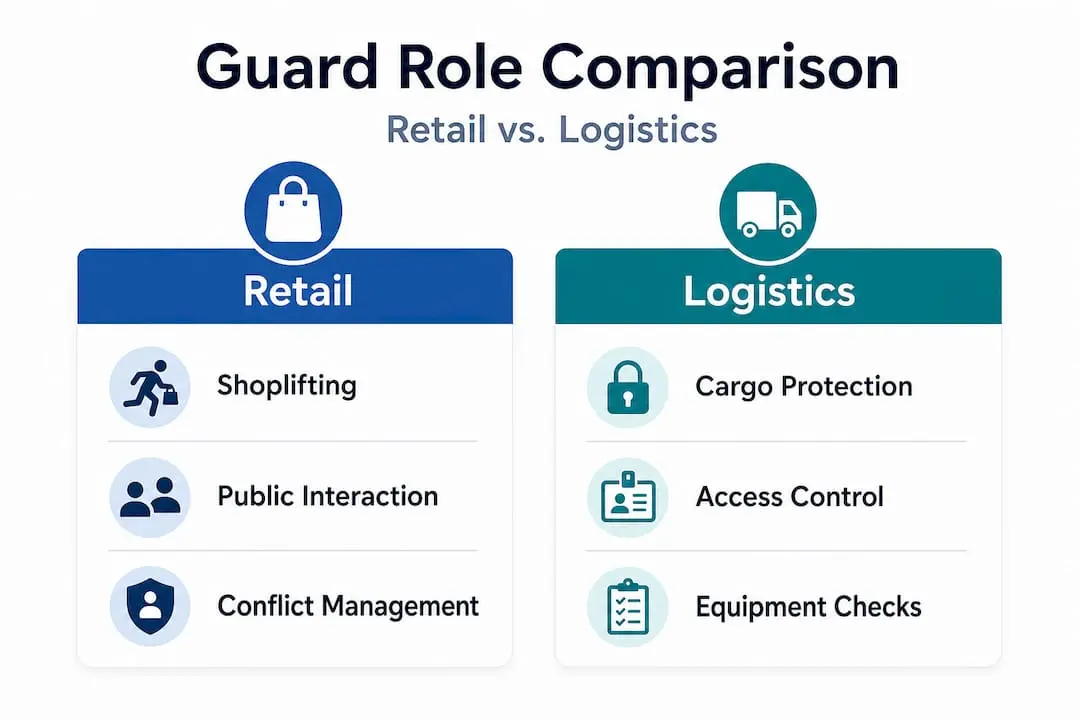
Retail security is among the most visible forms of the profession. Guards in this setting focus heavily on shoplifting prevention, customer service, and managing confrontational situations calmly. You are expected to observe suspicious behaviour without causing unnecessary alarm, and to intervene only when appropriate and proportionate. Communication skills matter enormously here because you are interacting with the public constantly.
Logistics and warehousing environments demand a different mindset. Here, the primary concern is protecting cargo, equipment, and site infrastructure. Patrols tend to be longer, environments are larger, and the risks often involve organised theft rather than opportunistic shoplifting. Guards in this sector need strong spatial awareness and the ability to work independently for extended periods.
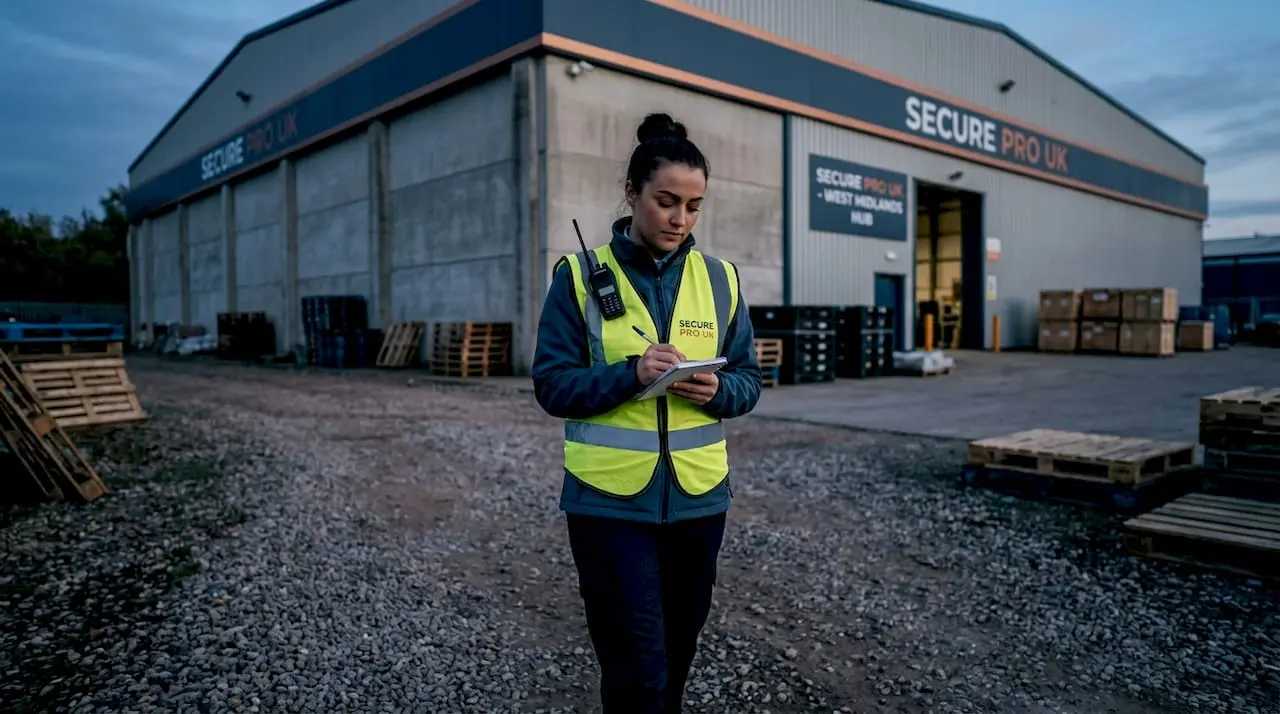
Construction sites present unique challenges. Equipment theft is a major financial drain on the industry, and guards are often the first and last line of defence. Your responsibilities include checking that site access logs are maintained accurately, that vehicles entering and leaving are authorised, and that perimeter fencing and locks remain secure overnight.
Events security is high-pressure and fast-moving. Whether it is a music festival, a sporting fixture, or a corporate conference, events guards must manage crowd flow, identify potential threats early, and respond calmly to emergencies. Bag searches, ticket verification, and coordination with police are all part of the role. The security roles examples in this sector are some of the most demanding in the industry.
NHS and healthcare settings require a particular kind of emotional intelligence. Guards here regularly encounter patients in distress, individuals experiencing mental health crises, and situations that require measured, empathetic responses. SIA-recognised duties across all these sectors include everything from shoplifting prevention and visitor management in retail and corporate settings to equipment protection, crowd control, and patient de-escalation in construction, events, and NHS environments.
A useful way to compare the security guard environments side by side:
| Sector | Primary risk | Soft skill priority | Technical requirement |
|---|---|---|---|
| Retail | Shoplifting, confrontation | Communication, patience | CCTV basic operation |
| Logistics | Organised theft, trespass | Vigilance, independence | Access control systems |
| Construction | Equipment theft, unauthorised access | Attention to detail | Perimeter security tech |
| Events | Crowd disorder, medical emergencies | Situational awareness | Screening equipment |
| Healthcare | Conflict, safeguarding | Empathy, de-escalation | Lone worker systems |
Understanding which sector suits your temperament and experience is not just good career planning. It actively helps you target your applications more precisely and present yourself more convincingly to employers.
Legal frameworks and edge cases every guard must know
Understanding your responsibilities is incomplete without knowing your legal duties and what to do in high-stakes situations. This is an area where many candidates feel underprepared, and where knowledge genuinely separates competent professionals from the rest.
Your SIA (Security Industry Authority) licence is the foundation of your legal position as a security guard in the UK. Licence conditions govern what you can and cannot do, including when you must display your badge and how your authority differs from that of a police officer. It is worth being precise about this: security guards hold no special police powers. Your authority derives from the same legal position as any ordinary citizen, with added contractual rights granted by the client or premises owner.
That said, there are important legal powers you do hold. Here are the key frameworks every guard should understand:
- Citizen’s arrest: Under the Police and Criminal Evidence Act 1984, you may detain a person without a warrant if you witness an indictable offence being committed and believe it is impractical for a constable to make the arrest. The force used must be reasonable and proportionate.
- Ejection from premises: As an agent of the property owner, you have the right to ask anyone to leave private premises and, if necessary, use reasonable physical force to remove them.
- Search powers: You have no automatic right to search a person. Any search must be consensual or enabled by a specific contractual agreement, such as a condition of entry at an events venue.
- Use of force: Any force you use must be necessary, reasonable, and proportionate to the threat. Excessive force can result in criminal charges against you personally.
- First aid obligations: While you are not legally required to administer first aid unless trained, many SIA-compliant employers expect it, and failing to act when you could have done so reasonably may carry civil liability.
SIA licence conditions also cover important edge cases, including covert security activity where your badge need not be visible, how to handle vulnerable individuals, how to respond to terror threats under current national guidance, and what your obligations are when you witness or suspect a medical emergency.
“A security guard who understands their legal boundaries is not just better protected personally. They are a significantly more valuable asset to any employer, because they act with confidence and avoid costly mistakes.”
Pro Tip: Whenever you are placed in a new site or sector, ask your employer or client for a written briefing on the specific legal agreements in place, including any bespoke search and ejection policies. This protects you and demonstrates professionalism from day one.
For practical crisis response examples that bring these legal principles to life, it is worth reviewing real-world scenarios that illustrate how experienced guards have navigated complex situations.
Skills and training: what sets top guards apart
Legal know-how alone is not enough. Real career progress comes from continually expanding your skill set, both in technical competencies and in the interpersonal capabilities that separate average guards from exceptional ones.
The core soft skills that employers consistently value include:
- Verbal communication: Clear, confident communication defuses tension and builds trust with the public and colleagues
- Observation and vigilance: Noticing what is out of place before it becomes a problem is a skill that develops over time
- De-escalation: Managing a confrontational individual calmly and safely, without resorting to force, is one of the highest-value skills in the profession
- Report writing: Accurate, detailed reports protect you legally and provide evidence when incidents escalate
- Teamwork and lone working: Depending on your setting, you may need to coordinate with colleagues or operate effectively in isolation for long periods
On the technical side, modern security work increasingly involves operating CCTV systems, using access control software, handling body-worn cameras, and in some settings, interpreting data from AI-driven monitoring tools. Biometric access systems are now common in corporate and government buildings, and familiarity with these platforms gives you a genuine edge.
High sector turnover is partly driven by the pressure of shift patterns and the monotony that can accompany static posts. The guards who stay, progress, and earn more are typically those who invest in continuous training including first aid refreshers, crisis simulation exercises, and emerging technology such as AI surveillance interpretation and biometric verification.
Security guard training options in the UK range from SIA-mandated courses to voluntary upskilling programmes offered by specialist providers. The qualities employers seek almost always include evidence of proactive learning, not just baseline compliance.
Pro Tip: Even a brief, documented first aid refresher or a short course in conflict management significantly strengthens your CV and signals to employers that you treat security as a profession rather than a job.
A fresh perspective: why mastering soft skills is your true edge
Let us look past the rulebook and consider what really elevates a top-performing security professional.
Most candidates entering the security industry focus heavily on procedure: getting the licence, learning the patrol routes, understanding the access control system. That is all necessary. But the guards who move into supervisory roles, earn the loyalty of clients, and avoid the churn that drives industry turnover rates towards 40% are almost always the ones who excel in the human dimension of the job.
Think about a scenario common in retail security. Two guards face the same situation: a person behaving erratically near the exit. One guard immediately moves to physically intercept. The other pauses, reads the body language, and initiates a calm, non-threatening conversation. The second approach resolves the situation without incident, without escalation, and without any paperwork. That guard has demonstrated something that no CCTV camera or biometric scanner can replicate.
Employers increasingly recognise this. The essential security qualities that appear most often in job descriptions now include problem-solving, adaptability, empathy, and communication alongside the expected technical requirements. Technology is changing the surveillance landscape rapidly, but the judgement calls that matter most, how to approach a vulnerable person, how to manage a gathering crowd, how to de-escalate without causing a scene, are irreducibly human.
We would argue that soft skills represent the single biggest untapped opportunity for security jobseekers in the UK right now. The technical training is standardised and widely available. The human skills are rarer, harder to teach in a classroom, and disproportionately rewarded by employers who have been burned by technically qualified but interpersonally underprepared staff. Invest in those skills deliberately, and you will not just keep your job. You will build a career.
Level up your security career with top UK job opportunities
Confident in your responsibilities and skills? Here is how to take your next step in the UK’s thriving security sector.
Knowing your duties, understanding the law, and investing in the right skills is genuinely powerful preparation. But knowledge needs to be matched with opportunity. Whether you are searching for security jobs in Northern Ireland or looking to step into a supervisory role anywhere across the UK, the Security Jobs Board connects you directly with employers who are actively hiring in your sector.

The Security Jobs Board is the UK’s dedicated security recruitment platform, affiliated with the BSIA and built specifically for professionals like you. Create your free profile, upload your CV, and set tailored job alerts so that the right roles come to you. Employers can also use the platform’s applicant tracker to identify and reach candidates efficiently. Every feature is free for jobseekers, GDPR-compliant, and optimised for mobile so you can manage your career search wherever you are.
Frequently asked questions
What is the average salary for security guards in the UK?
The typical UK security guard salary ranges from £22,000 to £30,000 per year, with hourly rates between £11.44 and £18, and London-based roles paying at the higher end of that range.
What legal powers do UK security guards have?
Security guards may make a citizen’s arrest with proportionate force and must follow SIA licence conditions, but they hold no police powers and their authority is essentially that of an ordinary citizen acting on behalf of a property owner.
Which sectors employ the most security guards in the UK?
Manned guarding accounts for approximately 275,000 jobs and 62% of the UK private security market’s revenue, with retail, logistics, and events being the largest individual sectors.
What are the main challenges security guards face?
The biggest challenges include demanding shift patterns, the pressure of lone working, and the mental strain of monotonous posts; continuous training in technology and crisis response is the most effective counter to burnout and high turnover.
How important are soft skills for security guard success?
Soft skills such as communication, empathy, and de-escalation are critically important for career progression, with employers increasingly prioritising these capabilities over technical competence alone because they cannot be replicated by technology or standardised through routine training.


