Security officer job duties: a complete UK guide

TL;DR:
- Security officers protect premises, people, property, and information through patrols, access control, and reporting.
- Incident response involves assessing situations, following procedures, alerting authorities, and documenting actions precisely.
- Career progression includes supervisory roles requiring skills in leadership, risk management, technology, and detailed reporting.
Most people picture a security officer standing quietly by a door. That image barely scratches the surface. Security officers are responsible for protecting premises, people, property, information, and assets across some of the most demanding environments in the UK. Whether you are preparing for your first role or eyeing a move into a supervisory position, understanding the full scope of what this job demands is essential. This guide breaks down every layer of the security officer role, from core duties and emergency response to sector differences and career progression, so you leave with genuine clarity.
Table of Contents
- The foundation: core security officer job duties
- Dealing with incidents: emergency response and conflict management
- Beyond the basics: supervisory, lead, and specialised roles
- Sector differences: private, public, and government security roles
- What most jobseekers overlook about UK security officer careers
- Advance your security career with the right opportunities
- Frequently asked questions
Key Takeaways
| Point | Details |
|---|---|
| Core responsibilities | Security officers protect people, premises, assets, and information from threats and unauthorised access. |
| Incident response | Effective emergency and conflict management are essential duties requiring training and composure. |
| Career progression | Supervisory, lead, and specialised roles offer expanded responsibilities and require advanced skills. |
| Sector variation | Duties and expectations differ significantly between private, public, and government positions. |
The foundation: core security officer job duties
Every security officer, regardless of employer or setting, operates within a defined set of core responsibilities. These are not vague expectations. They are structured obligations that employers, clients, and regulators all hold officers to account on. If you are applying for a role or reviewing a job description, knowing these duties helps you speak with authority during interviews and assess whether a position aligns with your strengths.
The Government Security Profession Career Framework defines it clearly: core duties include protecting premises, people, property, information, and assets from unauthorised access, damage, disorder, or threats. That single sentence covers an enormous range of daily tasks.
Here is what those duties typically look like in practice:
- Physical patrols: Walking assigned routes at scheduled intervals to detect irregularities, intrusions, or hazards.
- Access control: Managing entry points, verifying credentials, and refusing access where appropriate.
- CCTV monitoring: Reviewing live and recorded footage to spot suspicious behaviour or security breaches.
- Visitor management: Logging arrivals and departures, issuing passes, and maintaining accurate records.
- Reporting: Writing clear, factual accounts of incidents, near-misses, and anything unusual during a shift.
- Liaising with emergency services: Acting as a first point of contact for police, fire, or ambulance when required.
Duties shift depending on whether you work in the public or private sector. The table below gives you a useful comparison:
| Duty area | Private sector | Public sector |
|---|---|---|
| Primary focus | Customer experience and asset protection | National security and information protection |
| Visitor interaction | High, often customer-facing | Controlled and restricted |
| Patrol type | Mixed, often flexible | Structured and procedure-led |
| Uniform and identity | Branded, employer-specific | Often formal government-issue |
| Reporting requirements | Employer-led documentation | Statutory and audited |
For a broader look at what different positions involve, explore examples of security officer roles across the industry. If you are considering a fixed-post position, static guarding duties are worth reviewing in detail.
“Effectiveness in security is not about presence alone. It is about observation, communication, and the ability to act correctly under pressure.”
Officers who master routine tasks tend to respond better during incidents, because the discipline built through daily procedure transfers directly into high-pressure moments.
Dealing with incidents: emergency response and conflict management
Understanding routine duties is vital, but being prepared for incidents is what truly tests a professional. When things go wrong, a security officer is often the first person on scene, and what happens in those initial moments matters enormously.
The Career Framework guidance states that officers must respond to emergencies such as fire and burglary per established procedures, and de-escalate conflicts using SIA training. This is not optional. It is a core competency.
Here is the structured approach most trained officers follow during an incident:
- Assess the situation: Identify the nature and severity of the incident without placing yourself at unnecessary risk.
- Follow site procedures: Every site has emergency action plans. These must be followed, not improvised.
- Alert the relevant parties: Notify your supervisor, control room, or emergency services as the situation demands.
- De-escalate if safe to do so: Use calm communication, neutral body language, and verbal techniques learned through SIA-approved conflict management training.
- Contain or withdraw: Depending on the threat level, either manage the situation or create distance and wait for backup.
- Document everything: Write a full incident report immediately after the event while details are fresh.
Pro Tip: Your incident report is a legal document. Write only what you observed and did, in plain language, with exact times. Vague or inaccurate reports can create serious problems during investigations or legal proceedings.
For deeper reading on this topic, conflict management in security covers de-escalation techniques used across UK sites. You can also review emergency response protocols and guidance on alarm response procedures specific to the UK context.
One important statutory boundary: standard UK security officer roles do not include carrying firearms. Officers work within clearly defined legal limits, and stepping outside those limits carries serious consequences. Your power lies in procedure, communication, and preparation, not force.
Beyond the basics: supervisory, lead, and specialised roles
Not all security officers remain in entry-level positions. With time and training, responsibilities can expand dramatically, and the gap between an associate-level officer and a lead officer is considerable.
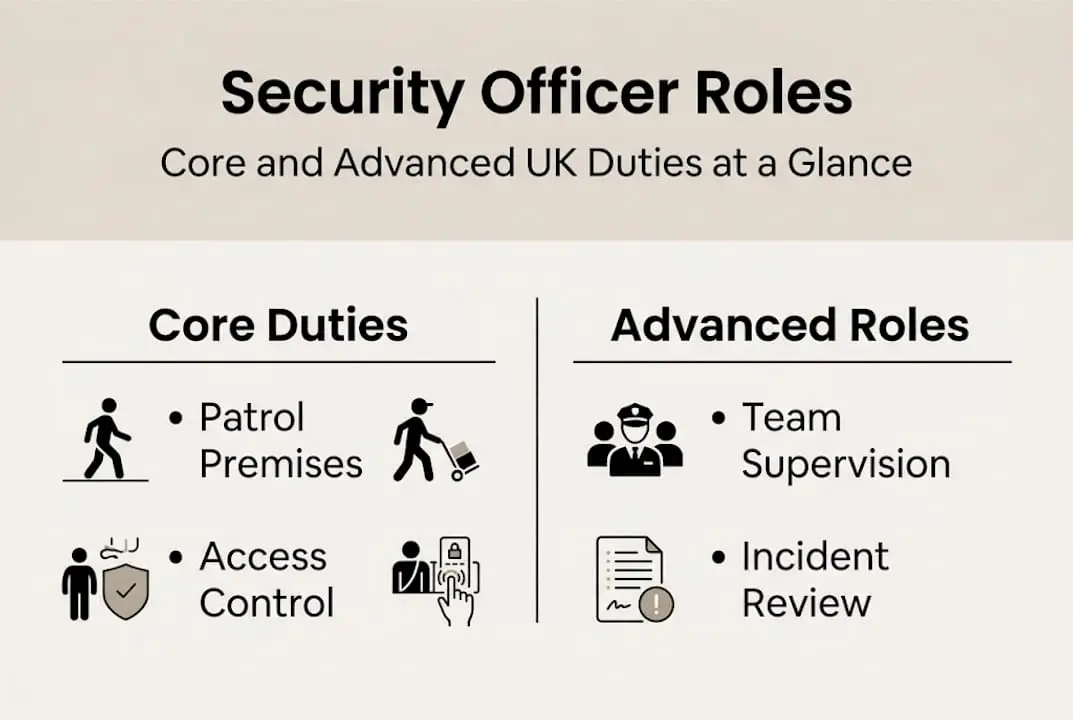
The Career Framework confirms that lead-level officers oversee teams and systems, review incidents, and require skills in protective security, risk management, and physical security techniques. This represents a genuine shift in focus, from executing tasks to managing outcomes.
Here is a comparison of how duties evolve across levels:
| Responsibility area | Associate officer | Lead/specialist officer |
|---|---|---|
| Patrols and access control | Daily execution | Supervision and audit |
| Incident response | First responder | Reviewer and coordinator |
| Team management | None | Oversight of junior staff |
| Technology systems | Basic CCTV use | Advanced system management |
| Risk reporting | Shift reports | Strategic incident analysis |
| Training involvement | Recipient | Contributor or trainer |
Skills that matter most for progression include:
- Communication: Leading a team requires clear, consistent instructions and the ability to give feedback constructively.
- Risk awareness: Senior officers must anticipate threats before they materialise, not just react to them.
- Technology proficiency: Access control systems, CCTV platforms, and reporting software are increasingly central to the role.
- Documentation accuracy: Reports at this level feed into client contracts and regulatory compliance, so precision is non-negotiable.
Pro Tip: If you are aiming for a supervisory role, start building a portfolio of detailed incident reports now. Employers promoting from within want evidence of your judgement and writing quality, not just your time served.
Understanding qualities employers seek in senior security staff gives you a clear picture of what development areas to focus on before applying for lead positions.
Sector differences: private, public, and government security roles
With core and advanced duties explained, let us examine how these responsibilities adapt between private and public sector employers. This distinction matters for your career planning because the working environment, expectations, and progression routes differ noticeably.
The Career Framework makes the split explicit: private sector roles emphasise customer service, while government roles focus on protecting assets and information. Both require vigilance, but the tone and priorities diverge.
Private sector security officers typically work in retail, hospitality, corporate offices, and events. Key characteristics include:
- High levels of public interaction, often requiring a welcoming and professional manner.
- Flexible shift patterns, including nights and weekends.
- Strong emphasis on customer service skills alongside security competencies.
- Opportunities in niche areas such as close protection or venue security.
Public and government sector security officers operate in settings such as courts, government buildings, infrastructure sites, and military establishments. Key characteristics include:
- Strict adherence to classified procedures and access protocols.
- Limited public interaction, with controlled visitor management.
- Formal vetting requirements, including Baseline Personnel Security Standard (BPSS) or Developed Vetting (DV) clearance.
- More structured career ladders with defined pay scales.
“The sector you choose shapes your daily experience more than the job title does. Know what environment you thrive in before committing.”
For a broader view of available career paths, types of security roles is an excellent starting point. You can also read more about understanding the security guard role across different UK settings.
What most jobseekers overlook about UK security officer careers
After examining duties and sectors, one honest observation stands out: the security profession still suffers from an image problem, and that image problem costs jobseekers real opportunities.
Many candidates focus solely on physical qualifications and SIA licensing, treating soft skills as secondary. That is a mistake. Employers consistently report that communication ability, adaptability, and professional conduct separate average officers from exceptional ones. A calm, articulate officer who writes a clear report and handles a difficult visitor with composure is worth considerably more than one who is physically capable but struggles in conversation.
Another overlooked factor is ongoing learning. Security threats evolve. Technology changes. Procedures are updated. Officers who treat their SIA licence as the end of their training rather than the beginning plateau quickly. The professionals who progress actively seek practical security training insights and pursue continuing professional development without being told to.
Career progression in security is not automatic. It rewards those who engage, document well, and build trust with supervisors over time.
Advance your security career with the right opportunities
You now have a thorough understanding of what UK security officers actually do, where those duties lead, and how sectors shape your day-to-day experience. The logical next step is finding a role that matches your skills and ambitions.

The Security Jobs Board connects security professionals across the UK with employers who understand the profession. Whether you are looking for security jobs in Northern Ireland or want to browse current security roles in your area, the platform makes it straightforward to filter by role type, location, and sector. Create a free profile, upload your CV, and set job alerts so the right opportunities find you without the unnecessary hassle.
Frequently asked questions
What are the main responsibilities of a security officer in the UK?
Core duties include protecting premises, assets, information, and people from unauthorised access and threats, alongside access control, patrolling, monitoring, and detailed incident reporting.
Can security officers in the UK carry weapons?
Standard UK security officer roles do not include firearms; officers operate within legal limits focused on observation, communication, and procedure-led incident response.
What skills help security officers progress to senior positions?
Lead officers require skills in risk management, team supervision, protective security, and clear communication, all of which employers weigh heavily when considering internal promotions.
How do public and private sector security officer roles differ?
Private sector roles emphasise customer service and public interaction, while government roles centre on asset and information protection with formal vetting requirements and structured procedures.
Recommended
- Why Work In Security Sector: Complete UK Guide | Security Jobs Board
- Why Choose Security Jobs: Complete Guide UK | Security Jobs Board
- Behind the Uniform: Understanding the Role of Security Guards Across the UK
- Complete Guide to Security Sector Jobs UK | Security Jobs Board
- Digital investigation workflow: complete UK guide 2026


