Essential duties of a security professional in the UK
TL;DR:
- UK security roles are diverse, each with specific licensing, responsibilities, and legal powers.
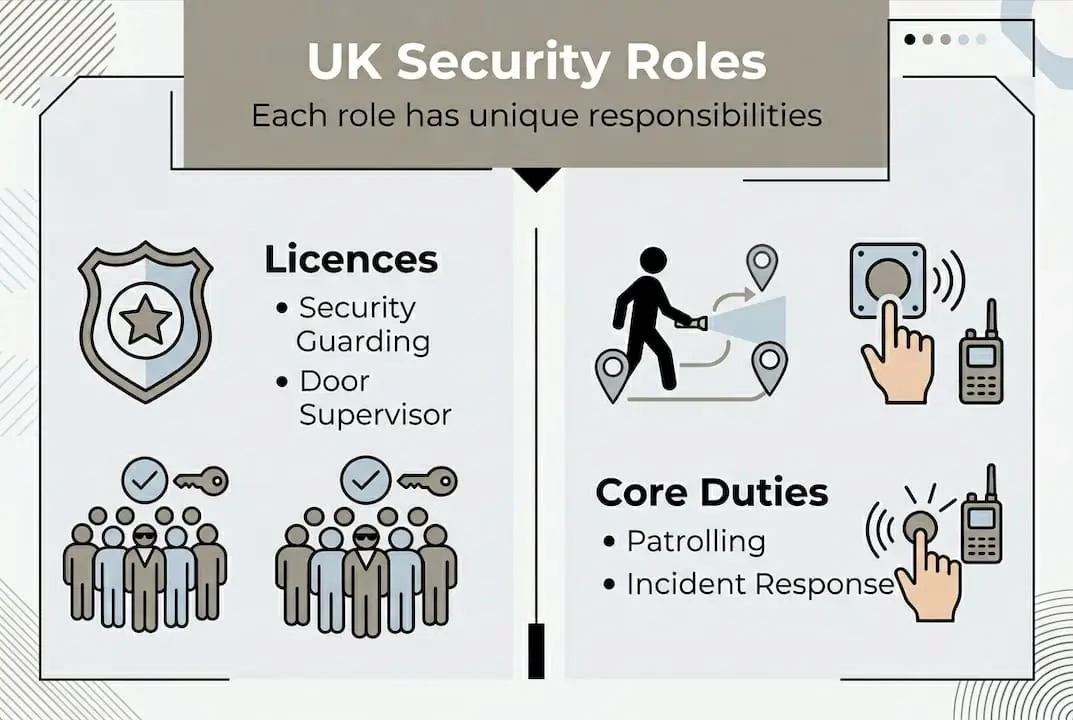
- Core duties include patrolling, access control, CCTV monitoring, incident response, and customer service.
- Physical intervention is restricted to Door Supervisors with appropriate training and licences.
Security professionals across the UK operate in roles that carry real legal weight, practical complexity, and public responsibility, yet widespread confusion persists about what those roles actually entail. Many employers post job adverts mixing up guard and officer duties, while candidates accept positions without fully understanding the scope of their licence. The core duties of UK security personnel span patrolling premises, controlling access, monitoring CCTV, responding to incidents, and handling emergencies. This guide cuts through the confusion, offering a clear, practical breakdown of what is expected at every level, from new recruits to seasoned professionals seeking to advance.
Table of Contents
- Understanding UK security roles and industry distinctions
- Core duties and responsibilities of security professionals
- Legal, licence, and training requirements
- Nuances, limitations, and edge cases in UK security work
- What most guides miss: evolving industry realities for UK security professionals
- Next steps for your security career
- Frequently asked questions
Key Takeaways
| Point | Details |
|---|---|
| Role distinctions matter | Understanding differences between guards, officers, and Door Supervisors is crucial for compliance and effectiveness. |
| Core duties defined | Typical responsibilities include patrols, access management, surveillance, and emergency response. |
| Legal compliance is essential | You must hold the correct SIA licence, meet age and training requirements, and keep your licence visible and up to date. |
| Nuances influence practice | Physical intervention, covert activity, and vehicle rules differ depending on your licence and job context. |
| Industry trends evolving | Customer service, risk assessment, and recruitment challenges are shaping modern security roles. |
Understanding UK security roles and industry distinctions
The UK security industry is not a single, uniform profession. It is a collection of distinct roles, each shaped by different licensing requirements, working environments, and legal powers. Getting this wrong can mean working without the correct SIA licence, which is a criminal offence. Understanding these distinctions is the first step towards performing duties confidently and lawfully.
Security guard vs security officer: what’s the difference?
The titles “security guard” and “security officer” are often used interchangeably, but they carry different professional connotations. A security guard typically refers to someone in a frontline, physical deterrence role, often stationed at a single site such as a construction yard, retail unit, or car park. A security officer, by contrast, tends to imply a more supervisory or multi-responsibility function, including reporting, managing junior staff, liaising with clients, and overseeing broader security protocols. In practice, the difference is largely contextual rather than legally defined. For a deeper breakdown, take a look at the full overview of security officer job duties and how they compare across environments.
Door Supervisors: a separate licence and distinct responsibilities
The Door Supervisor licence sits in a completely different category. These professionals work in licensed premises such as pubs, nightclubs, and concert venues, as well as at public events. They are trained in conflict management, search procedures, and, crucially, are legally authorised to refuse entry or physically manage persons where necessary. A standard Security Guarding licence does not permit this. Understanding SIA regulation and careers helps clarify how the two pathways diverge from the moment of training.
Licence types and where they apply
The Security Guarding SIA licence covers static and mobile guarding in environments such as retail stores, offices, and construction sites, but explicitly excludes licensed venues where alcohol is served, which require the Door Supervisor licence instead. Below is a quick comparison of the main role types:
| Role | Licence type | Typical environment | Physical intervention permitted? |
|---|---|---|---|
| Security guard | Security Guarding | Retail, offices, construction | No |
| Security officer | Security Guarding | Corporate, industrial, events (non-alcohol) | No |
| Door Supervisor | Door Supervisor | Pubs, clubs, public events | Yes (within legal limits) |
| CCTV operator | Public Space Surveillance | Control rooms, town centres | No |
Key distinctions to keep in mind:
- Security Guarding licence is the most common entry point into the industry
- Door Supervisors must hold a separate, additional qualification
- CCTV operators in public spaces require their own Public Space Surveillance licence
- Vehicle immobilisers (wheel clampers) require yet another specialist licence
- Role titles vary by employer, but the licence determines what you can legally do
This clarity matters because accepting a shift at a venue outside your licence scope is not just a professional risk, it is a prosecutable offence.
Core duties and responsibilities of security professionals
Security work involves far more than standing at a door or watching a screen. Every shift brings a set of structured responsibilities that require alertness, professionalism, and sound judgement. Whether you are on foot patrol at a warehouse or managing access at a corporate headquarters, the following duties form the backbone of daily security work.
Patrolling: the foundation of deterrence
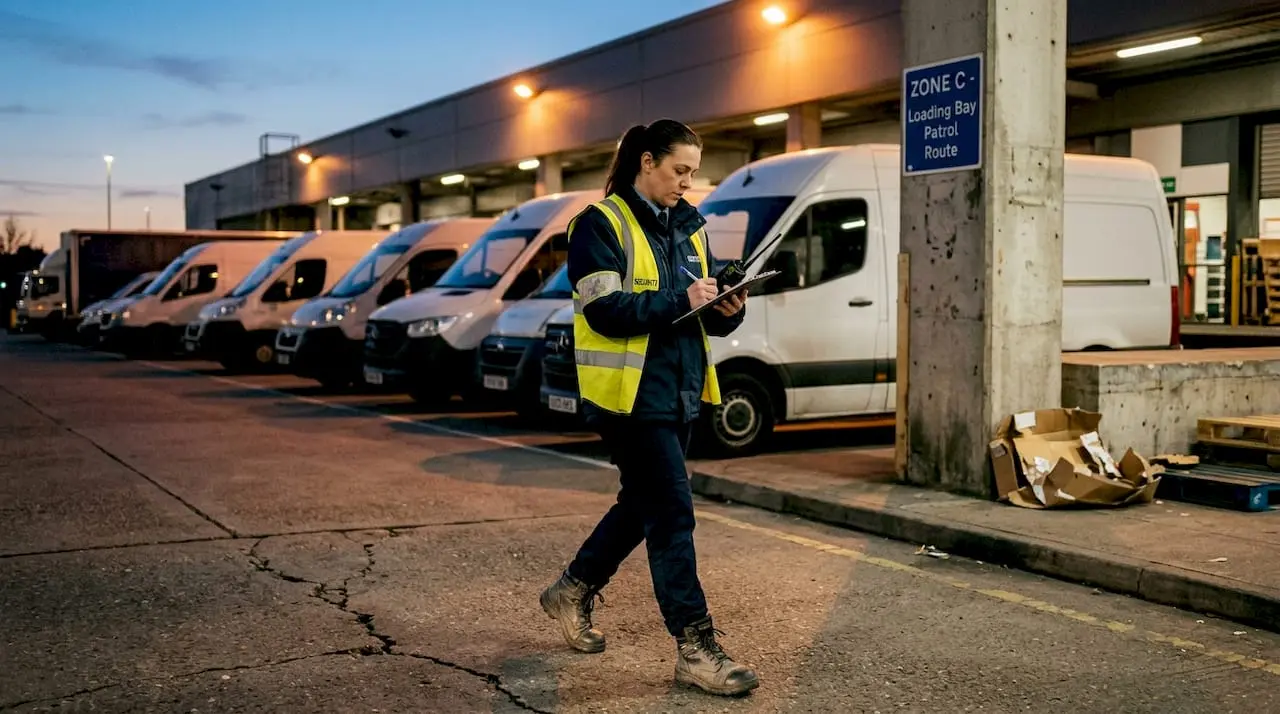
Patrols remain one of the most effective deterrents in security. Static patrols involve maintaining a visible presence at a fixed point, while mobile patrols cover a wider area, often using vehicles or bicycles. Both approaches signal to potential criminals that the site is actively monitored. Varying patrol routes and timings is critical, as predictable patterns are quickly identified and exploited. Learn more about best practice in mobile patrol security to understand how professional operators structure their routines.
Access control: verifying identity and managing entry
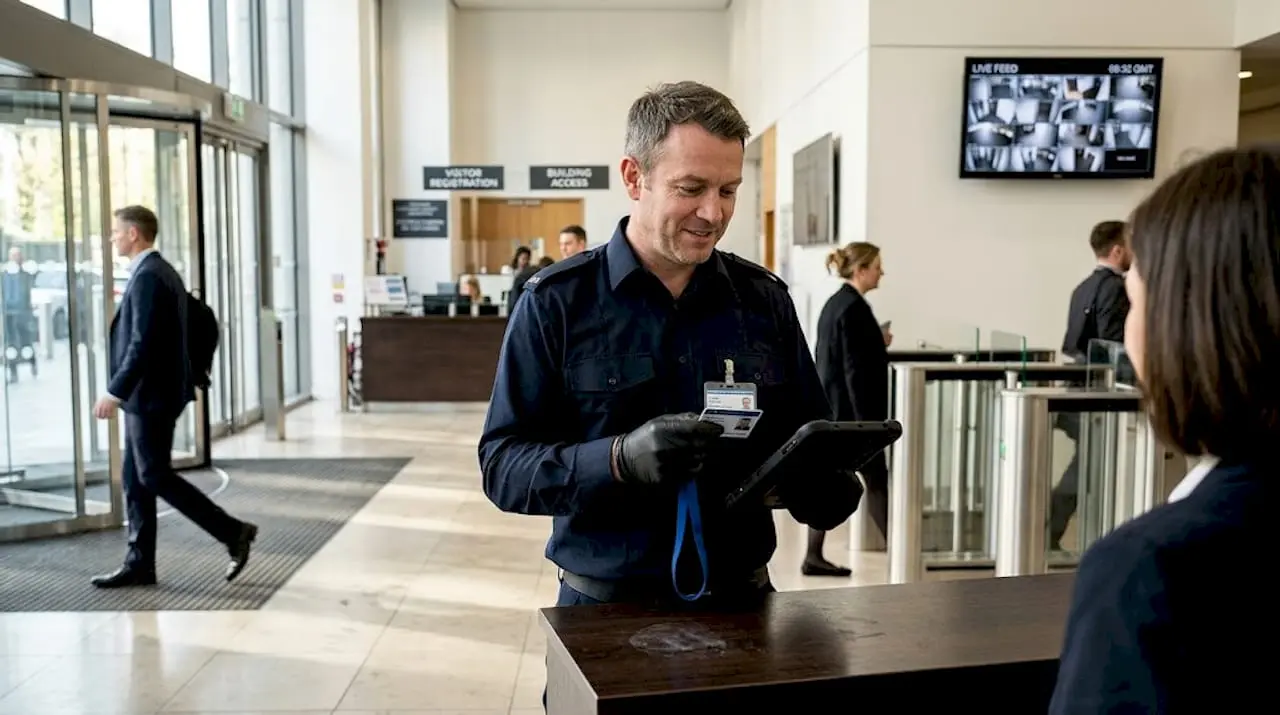
Controlling who enters and exits a premises is a fundamental duty. This involves checking credentials, operating electronic access systems, maintaining visitor logs, and denying entry to unauthorised individuals. In sensitive environments such as data centres or hospitals, access control failures can have serious consequences. Security officers must balance efficiency with thoroughness, particularly during peak entry times.
Surveillance: CCTV monitoring and reporting
Effective CCTV monitoring is both a technical and analytical skill. Officers must know how to operate camera systems, identify suspicious behaviour, document footage timestamps, and escalate concerns appropriately. Many security professionals underestimate the mental demand of sustained surveillance work. Attention to detail and accurate reporting are non-negotiable.
Incident response and emergency handling
When alarms trigger or incidents unfold, security personnel are usually first on the scene. The core responsibilities of UK security officers include incident response and emergency handling as central functions. This means assessing the situation quickly, following site-specific emergency procedures, coordinating with emergency services, and ensuring accurate post-incident reporting.
Customer service: an underestimated duty
Modern security work is as much about customer experience as it is about deterrence. Security staff regularly give directions, assist vulnerable individuals, and manage public-facing situations with tact. Poor interpersonal skills in a security officer create friction, escalate tensions, and damage client relationships.
Pro Tip: Prioritise de-escalation in every interaction before considering any physical response. Dynamic risk assessment, which means continuously reading the situation and adjusting your approach, is a core competency that separates good security professionals from great ones.
Core duties summarised:
- Regular foot and vehicle patrols to deter threats
- Managing and monitoring access points with precision
- Operating CCTV systems and maintaining surveillance logs
- Responding to alarms, incidents, and medical emergencies
- Writing accurate, timestamped incident reports
- Providing professional, visible customer service
Legal, licence, and training requirements
The legal framework behind UK security work is robust, and professionals who overlook it put themselves, their employers, and the public at risk. The SIA regulates the industry tightly, and compliance is not optional.
Getting licensed: the baseline requirements
To obtain an SIA licence, applicants must be at least 18 years old, pass a criminal record check (a Basic Disclosure in most cases), hold a relevant first aid qualification, and complete approved sector-specific training. Full details on licence conditions set out that holders must wear their licence visibly while on duty (with certain exceptions), report any changes to personal circumstances such as new convictions, and renew their licence every three years. Failure to comply with any of these conditions can result in licence revocation. For a step-by-step walkthrough, the SIA licence step guide offers clear, practical guidance.
What the training actually covers
SIA training for Security Guarding includes common knowledge units covering law, health and safety, and terrorism awareness, alongside conflict management and a set of specialist units covering roles and responsibilities, access control, protection systems, search procedures, patrolling techniques, and drugs awareness. This is not a box-ticking exercise. Each unit builds practical knowledge that translates directly to on-the-job performance. Training providers are approved by the SIA, so checking the status of your chosen provider before enrolling is essential.
Required steps to obtain a Security Guarding licence:
- Confirm eligibility (age 18+, right to work in the UK)
- Complete a Basic Disclosure criminal record check
- Obtain a valid first aid at work certificate
- Enrol with an SIA-approved training provider
- Complete all required training units and pass assessments
- Apply to the SIA with supporting documentation and the licence fee
- Await processing and receive your licence card
Licence statistics: where the industry stands in 2025
As of 2025, approximately 460,000 active SIA licences are held across the UK. Door Supervisors account for roughly 71% of all active licences, while Security Guarding represents around 11%, down from 13% in previous years. Around 79,000 first-time licences were issued in the most recent reporting period. These figures point to a maturing workforce increasingly concentrated in the Door Supervisor category, with fewer new entrants taking the Security Guarding route.
For those managing licence renewals, the licence renewal tips resource is worth bookmarking ahead of your expiry date to avoid any gaps in employment eligibility.
Nuances, limitations, and edge cases in UK security work
Even experienced security professionals can find themselves in unfamiliar territory when the rules become less clear-cut. The industry’s legal boundaries have specific exceptions and edge cases that are frequently misunderstood, and getting them wrong carries serious consequences.
Physical intervention: who can and who cannot
This is arguably the most misunderstood area of UK security law. Under a basic Security Guarding licence, physical intervention with members of the public is not permitted. Only Door Supervisors, who have completed the relevant conflict management and physical intervention training, are authorised to use reasonable force in appropriate circumstances. Even then, strict legal thresholds apply. Security guards who physically intervene without the correct licence risk criminal prosecution, civil liability, and immediate licence revocation. Developing strong conflict management skills is therefore not just desirable, it is the professional alternative to unlawful physical action.
The visible licence rule and its exceptions
Most security professionals know they must display their SIA licence while on duty. What many do not realise is that covert surveillance roles are exempt from the visible display requirement, though the licence must still be carried and produced on request. This is a meaningful distinction for those working in retail loss prevention or undercover monitoring.
Vehicle clamping and legal nuances
For those holding an Immobilisation licence:
Disabled badge holders’ vehicles and emergency service vehicles are exempt from clamping under UK law. Applying a clamp to either category creates immediate legal liability.
The licence coverage details confirm that no physical intervention is permitted under the basic Security Guarding licence, and that covert roles carry their own distinct obligations around licence display.
Common edge cases professionals should know:
- Working a licensed venue shift on a Security Guarding licence is unlawful, regardless of role title used by the employer
- Covert roles do not require visible display but the licence must be on your person
- Physical restraint by a non-Door Supervisor can result in assault charges
- Clamping exempt vehicles creates personal civil and potentially criminal liability
- Working with a lapsed or suspended licence, even briefly, is a criminal offence
Pro Tip: Before accepting any new posting, always confirm in writing exactly what duties your role entails. If the employer cannot clearly define whether the venue is licensed or the duties require physical intervention, that is a red flag. Seeking clarity upfront is far easier than managing the consequences of working outside your licence scope.
Understanding the qualities employers seek in security staff also helps professionals position themselves correctly for roles that match their licence and expertise.
What most guides miss: evolving industry realities for UK security professionals
Most articles about security duties focus purely on task lists and licensing rules. That is useful, but it misses something important: the industry itself is changing, and the professionals who thrive are those who recognise the shift and adapt accordingly.
The declining proportion of Security Guarding licences relative to Door Supervisor licences is telling. It reflects both market demand and a broader professionalisation of the industry. Clients expect more than a uniformed presence. They want professionals who can communicate effectively, assess risk dynamically, and de-escalate situations without ever reaching a point of physical confrontation. Customer service competence is now a core operational requirement, not a soft skill.
Yet de-escalation remains a genuine skills gap across the sector. Training programmes cover it, but the real-world application under pressure takes experience and deliberate practice. Security professionals who invest in this area consistently outperform peers who rely solely on their physical presence.
Recruiting into the industry is also becoming harder. Fewer first-time licences are being issued relative to the size of the workforce, which means experienced professionals hold real leverage. Understanding your security officer responsibilities fully and being able to articulate them to employers is a competitive advantage that many candidates still overlook. The professionals who will lead this industry over the next decade are those who treat their role as a career, not a stepping stone.
Next steps for your security career
Understanding your duties and legal obligations is only half the equation. Putting that knowledge to work in the right role is what moves your career forward. Whether you are applying for your first position or looking to step into a more senior posting, finding the right opportunity matters.

The Security Jobs Board connects UK security professionals with vetted employers across every sector of the industry, from retail and corporate to events and specialist roles. You can create a free profile, upload your CV, and set up job alerts so the right opportunities come to you. With BSIA affiliation and a focus on quality matches, it is the most focused job platform in the UK security sector. Browse current security officer vacancies and take the next step in your career today.
Frequently asked questions
What licence do I need to work as a security guard in the UK?
You need an SIA Security Guarding licence for most environments, and a separate Door Supervisor licence if your role involves licensed premises or public events where alcohol is served.
What are the top daily duties of a UK security officer?
Typical duties include patrolling premises, controlling access, monitoring CCTV, responding to incidents, and documenting all activities accurately, as outlined in the standard duty scope for UK security personnel.
Are security guards allowed to physically intervene in the UK?
No. Basic security guards cannot physically intervene; only Door Supervisors who hold the relevant licence and training are permitted to do so within strict legal limits.
What specialist training is required for security staff?
SIA training covers law, health and safety, conflict management, terrorism awareness, access control, searching, patrolling, and drugs awareness, providing a thorough foundation for frontline security work.
How many security licences are currently active in the UK?
As of 2025, approximately 460,000 SIA licences are active across the UK, with Door Supervisors accounting for around 71% and Security Guarding representing approximately 11% of the total.


