Security officer job responsibilities: Your essential UK guide
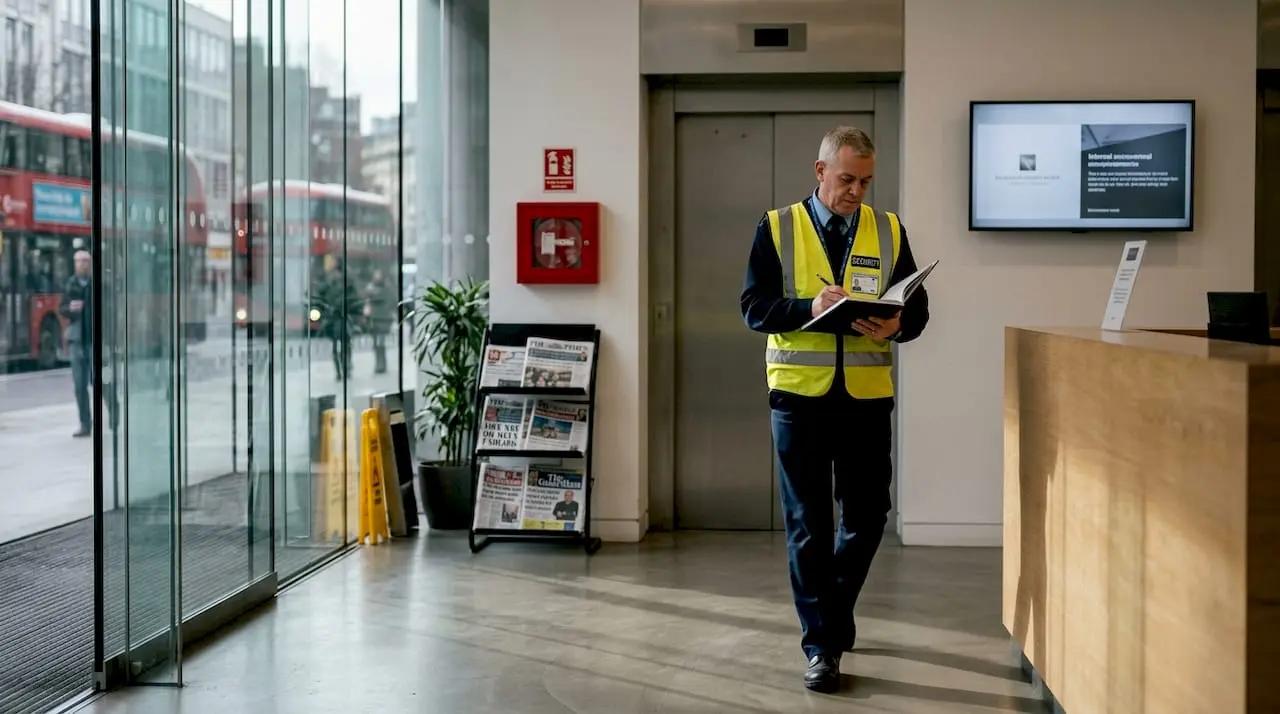
TL;DR:
- Security officers in the UK have diverse responsibilities including access control, incident response, and compliance.
- Effective communication, accurate record-keeping, and situational awareness are critical for career progression.
- Staying updated on legal and industry standards is essential for lawful and professional security practice.
Many people assume security officers spend most of their shift quietly watching CCTV screens or strolling between checkpoints. The reality is far more demanding. Security officers in the UK are expected to manage access control, handle emergencies, maintain compliance records, and interact professionally with staff and visitors throughout their working day. Whether you are eyeing your first role in the industry or looking to level up your career, understanding what the job genuinely involves will help you prepare, impress employers, and make confident decisions about your fit for the work.
Table of Contents
- Core responsibilities of security officers explained
- Access control and monitoring: The frontline for safety
- Incident response and reporting: Acting under pressure
- Legal and compliance responsibilities
- What most jobseekers miss about security officer responsibilities
- Explore more security job opportunities
- Frequently asked questions
Key Takeaways
| Point | Details |
|---|---|
| Wide-ranging responsibilities | Security officers protect people, property, and data using a mix of vigilance and practical measures. |
| Master access control | Controlling who enters and exits is central to a security officer’s daily work. |
| Incident response skills | Acting calmly and documenting accurately during incidents is critical for effective security management. |
| Stay legally compliant | Understanding laws and company policies ensures security officers fulfil their roles safely and lawfully. |
| Soft skills matter | Communication, attention to detail, and adaptability are just as important as physical security tasks. |
Core responsibilities of security officers explained
Security work rests on three core objectives: protecting people, protecting property, and protecting information. These might sound straightforward, but the daily reality involves juggling a wide variety of tasks that demand focus, professionalism, and adaptability. Security officer job duties confirm that officers protect assets, staff, and premises through both proactive and reactive measures, meaning the job requires both prevention and response in equal measure.
On any given shift, a security officer might be responsible for:
- Conducting regular patrols of the premises, either on foot or by vehicle
- Managing entry and exit points to prevent unauthorised access
- Checking identification and verifying visitor credentials
- Responding promptly to alarms, disturbances, or suspicious behaviour
- Writing detailed incident and activity logs
- Communicating with police, fire, or medical services when required
- Providing customer assistance and front-of-house support where relevant
Responsibilities shift depending on whether the role is static or mobile, and whether shifts fall during the day or at night. A static officer at a corporate building during business hours will face very different demands from a mobile patrol officer covering multiple retail sites overnight. Exploring the range of types of security roles in the UK reveals just how varied the expectations can be across sectors such as retail, construction, events, and healthcare.
Pro Tip: Situational awareness is one of the most valued skills you can demonstrate to a potential employer. It means noticing what is out of place before an incident develops, not just reacting after the fact. Practise this actively during your daily life to sharpen your instincts before your first interview.
Access control and monitoring: The frontline for safety
Access control is one of the most visible and critical duties a security officer carries out. It involves managing who enters and exits a building, site, or restricted area, and ensuring that only authorised individuals can do so. There are two broad categories to understand: physical access control and digital access control.
Physical access control includes everything from manned security checkpoints and visitor sign-in books to key card systems and turnstiles. Digital access control typically involves software-managed systems that log entry data, trigger alerts, and integrate with CCTV or alarm infrastructure. In practice, many sites use both, and a security officer must be comfortable working with each. A solid understanding of access control systems overview helps officers understand which tools they may encounter on site.
Here is a comparison of the most common access control methods you are likely to encounter:
| Method | How it works | Typical use |
|---|---|---|
| ID badge / key card | Swipe or tap to gain entry | Offices, hospitals, data centres |
| Biometric scanner | Fingerprint or facial recognition | High-security areas, research facilities |
| Sign-in / sign-out log | Manual paper or digital register | Visitor management, contractor access |
| PIN code entry | Numeric keypad access | Smaller sites, internal doors |
| Security officer checkpoint | Officer verifies identity in person | Events, gatehouse entry, VIP areas |
As highlighted in examples of security roles, comprehensive access management is a key preventative responsibility, meaning it is about stopping problems before they begin, not just dealing with them afterwards.
Common challenges in access control include tailgating (where an unauthorised person follows someone through a controlled entry point), lost or stolen access credentials, and visitors who do not follow sign-in procedures. Best practices include regular audits of access logs, clear signage at all entry points, and consistent enforcement of procedures regardless of who is entering. For further context on how these duties play out day to day, security guard roles and duties and manned guarding roles offer useful depth.
Incident response and reporting: Acting under pressure
Preventing security breaches is always the priority, but knowing how to act and report when things go wrong is equally critical. Incidents can range from minor disruptions such as a contractor in a restricted area, to serious events involving theft, assault, or fire. Security incident response is a disciplined process requiring calm and focus, and employers will assess your ability to maintain composure under pressure.
A structured approach to incident management typically follows these steps:
- Spot the incident, whether through direct observation, an alarm, or a report from another person
- Assess the severity and immediate risk to people or property
- React by following your site’s emergency procedures and alerting the relevant parties
- Report the incident thoroughly and accurately, both verbally and in writing
- Recover by supporting the return to normal operations and reviewing what occurred
The reporting stage is often underestimated by new security officers, yet it carries significant weight. Correct reporting is crucial for compliance and legal protection, meaning a poorly written or incomplete report can create real problems for both the officer and the employer.
“Organisations with structured incident response processes reduce operational disruption and maintain clearer audit trails, supporting both safety and compliance outcomes.” This matters because incident records can be used by insurers, solicitors, or regulatory bodies if a situation escalates.
Accurate documentation of who was involved, what happened, what time it occurred, and what actions were taken is not optional. It protects you professionally. It also provides the site manager with actionable data to improve safety measures. A well-maintained log of incidents can reveal patterns, such as a recurring issue at a particular entry point, that lead to meaningful improvements. Understanding incident response efficiency reinforces why structured process matters as much as instinct.

Legal and compliance responsibilities
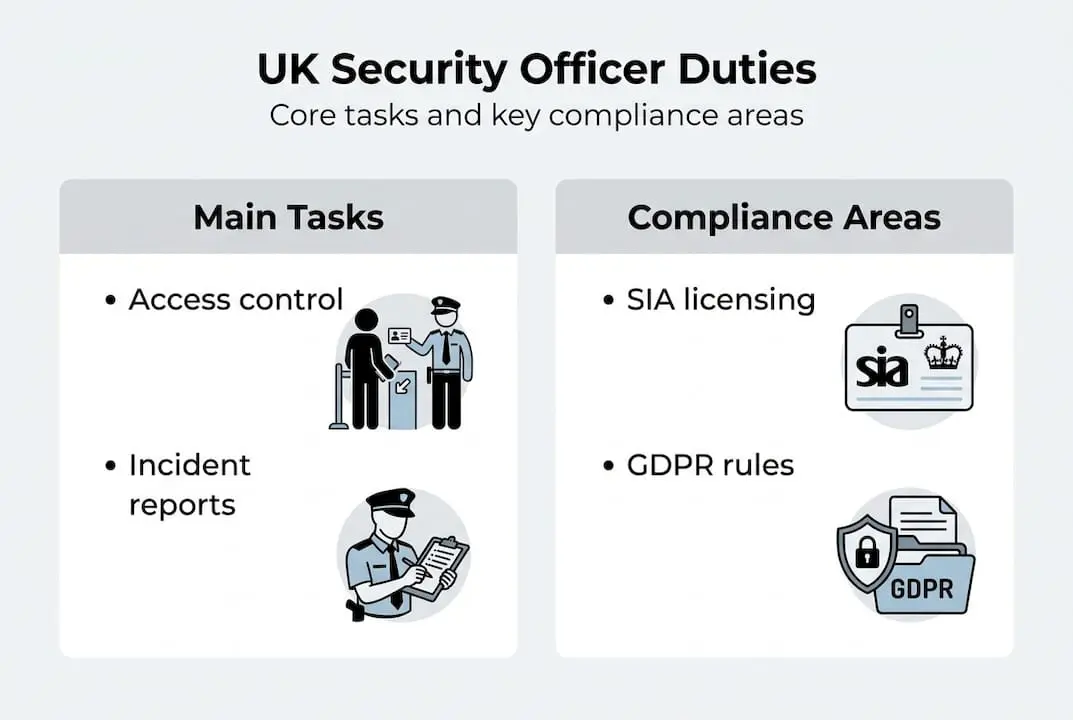
Incident management naturally leads to understanding the legal side of the job. Security officers in the UK operate within a clear legal framework, and ignorance of the rules is not a defence when things go wrong. At the most fundamental level, you are expected to hold a valid SIA licence, understand relevant health and safety legislation, and apply data protection principles under GDPR in your day-to-day duties.
Here is a comparison of legal versus policy-driven responsibilities:
| Responsibility type | Examples | Who sets the standard |
|---|---|---|
| Legal requirements | SIA licensing, GDPR compliance, Health & Safety at Work Act | UK Government and regulatory bodies |
| Employer policies | Uniform standards, site-specific access procedures, communication protocols | Individual employers or contractors |
| Industry standards | BS 7858 vetting, British Standard guidelines for security services | BSIA and accreditation bodies |
The legal requirements are non-negotiable. Employment law for security in 2026 makes clear that operating without a valid SIA licence is a criminal offence. Understanding GDPR is equally important: if you are reviewing CCTV footage or handling visitor data, you are processing personal information, and you must do so lawfully.
Compliance monitoring is fundamental for UK security staff, and this extends beyond simply having the right paperwork. It means actively keeping up with changes to regulations, attending refresher training, and understanding how to flag non-compliance when you spot it. Employers increasingly look for people who treat compliance as a mindset rather than a box-ticking exercise. Knowing the qualities employers seek in security staff will help you frame your compliance knowledge as a genuine asset in interviews.
Pro Tip: Set a monthly calendar reminder to review any updates from the SIA website and your employer’s policy documents. Fifteen minutes of reading each month keeps your knowledge current and demonstrates professional commitment that employers notice and value.
For a broader understanding of how regulatory risks for security are evolving, it is worth staying informed about how technology and legislation interact in modern security environments.
What most jobseekers miss about security officer responsibilities
Here is an uncomfortable truth: the majority of jobseekers prepare for security interviews by focusing almost entirely on physical presence and patrolling. They brush up on what to wear and how to describe a patrol route. What they rarely prepare for is the communication, record-keeping, and decision-making that employers actually test.
The reality is that a security officer who writes poor reports, struggles to communicate with distressed members of the public, or hesitates under pressure will not progress. The job demands soft skills every bit as much as physical fitness. Employers want officers who can de-escalate a tense situation with calm words before it ever becomes physical.
Experienced security managers will tell you that attention to detail in a logbook often reveals more about a candidate’s character than anything said in interview. The officers who advance are those who treat every log entry, every access check, and every handover note as important. If you want to demonstrate that you understand what the role truly demands, study the qualities valued by employers and articulate them with specific examples from your own experience. That is what separates memorable candidates from forgettable ones.
Explore more security job opportunities
Now that you understand what security officer roles genuinely involve, the next step is finding a position that matches your skills and location. The Security Jobs Board connects you directly with UK employers who are actively recruiting across a wide range of security specialisms.

Whether you are looking for security jobs in Northern Ireland or searching for roles closer to home, the platform makes it straightforward to set job alerts, upload your CV, and apply quickly to live vacancies. Browse the latest security vacancies today, create your free profile, and let the right employers find you. The industry is hiring, and your next role could be a few clicks away.
Frequently asked questions
What is the difference between a security officer and a security guard?
A security officer often has broader duties, such as overseeing policy compliance and incident reporting, while a guard typically focuses on site patrol and observation. As different security roles show, the level of responsibility varies significantly across specialisms.
Do security officers need a licence in the UK?
Yes, most UK security officer roles require an SIA licence, which ensures you meet legal and training standards. UK legal requirements make SIA licensing mandatory for frontline security professionals.
What are the main compliance challenges for a UK security officer?
Staying updated on regulations such as GDPR, health and safety legislation, and internal employer policies is essential. Compliance monitoring is key to operating lawfully and professionally in the UK security sector.
How important is incident reporting for career progression?
Accurate incident reporting proves your professionalism and supports advancement within the security industry. Correct reporting safeguards both your employer and your own professional reputation over time.
Which skills are most valued by employers for new security staff?
Employers seek strong communication, attention to detail, and the ability to remain calm during incidents. Essential qualities for security staff include both technical knowledge and interpersonal skills in equal measure.
Recommended
- Security officer job duties: a complete UK guide | Security Jobs Board
- Security guard roles and duties: What to expect and master|SJB
- Why Work In Security Sector: Complete UK Guide | Security Jobs Board
- Behind the Uniform: Understanding the Role of Security Guards Across the UK
- A Guide for Workplace Injury Insurance in 2025


