Practical security training examples for UK professionals

TL;DR:
- Effective security training should be sector-specific, tailored to career stage, and aligned with regulations.
- Scenario-based crisis simulations with structured debriefs develop transferable skills and real-world readiness.
- Continuous review and customization of training programs are essential to keep pace with evolving threats and improve performance.
Choosing the right security training is one of the most consequential decisions you will make for your career, yet most UK professionals find themselves wading through a sea of generic courses with little guidance on what actually works. The problem is not a shortage of options. It is knowing which examples translate into real job performance, regulatory compliance, and genuine career advancement. ProtectUK offers a rigorous risk assessment methodology tailored for effective, real-world security training, and it provides a useful benchmark when evaluating what good looks like. This article walks through practical, sector-specific training examples so you can make sharper decisions about where to invest your time and effort.
Table of Contents
- How to evaluate effective security training programmes
- Crisis management: Real-world incident simulation
- Transportation and logistics security: Training for layered risks
- Physical security: Patrol, alarm response, and surveillance training
- Why practical, scenario-based training outpaces generic courses
- Advance your security career with expert resources
- Frequently asked questions
Key Takeaways
| Point | Details |
|---|---|
| Framework matters | Choosing a structured, customisable training framework boosts real-world preparedness in UK security roles. |
| Scenario training works | Live exercises and incident simulations build skills that generic courses cannot match. |
| Tailored sector modules | Sector-specific modules, especially in transport and physical security, deliver better risk management. |
| Continuous improvement | Regular feedback and review cycles sustain the effectiveness of security training over time. |
How to evaluate effective security training programmes
Before you commit to any programme, you need a clear framework for judging its quality. Not all training is created equal, and the gap between a well-designed course and a box-ticking exercise can be enormous. Understanding why security training is needed for UK professionals is the starting point, but evaluating quality requires a more structured lens.
Three criteria matter most when assessing any security training example:
- Career stage alignment: Entry-level door supervisors need different content from senior control room managers. A programme that ignores your current role and ambitions wastes your time.
- Sector relevance: Training for transport security differs significantly from retail or critical infrastructure. Generic content rarely captures the specific threats you face day to day.
- Regulatory compliance: UK-specific frameworks, including SIA licensing requirements and sector regulations, must be reflected in the curriculum.
The ProtectUK five-stage model offers one of the clearest quality benchmarks available. It structures training around Identify, Assess, Treat, Record, and Review, ensuring that learning is not static but continuously improved. The best programmes customise content using structured methodologies, not one-size-fits-all approaches, and this distinction separates genuinely useful training from programmes that simply fill hours.
Scenario-based content is another strong quality indicator. If a course asks you to respond to a simulated threat rather than just read about one, it is building transferable skills. Look for programmes that include debrief sessions after each exercise. These structured reviews force you to articulate what worked, what failed, and why, which is where the deepest learning happens.
Feedback loops matter too. A quality programme will collect participant feedback, review it regularly, and update content to reflect emerging threats. If a course has not been revised in three years, treat that as a warning sign. Developing your essential security skills depends on training that keeps pace with the threat landscape.
Pro Tip: Ask any training provider directly when their scenario content was last updated and whether it reflects current UK threat intelligence. A confident, specific answer signals quality. Vague responses do not.
Crisis management: Real-world incident simulation
Once you know how to assess programmes, look for hands-on crisis training that translates directly to job performance. Incident simulation is arguably the most powerful format available, and it is where the gap between good and mediocre training becomes most visible.
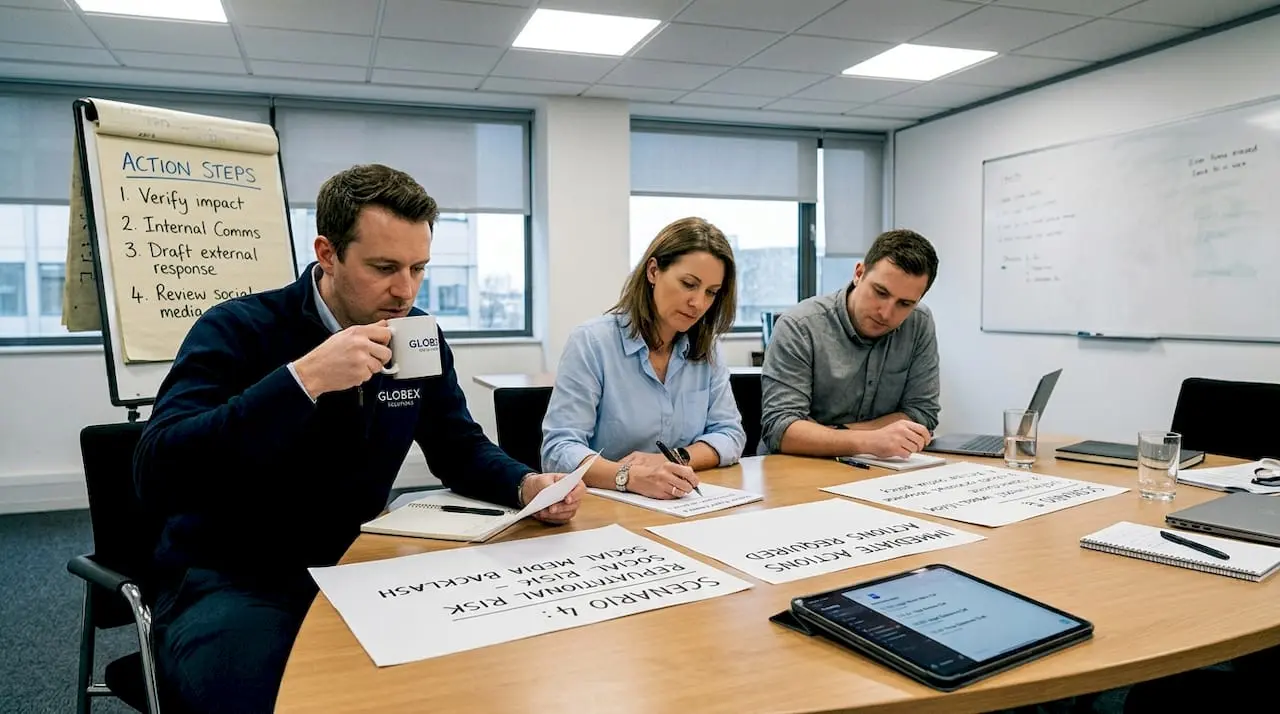
Effective crisis simulations target three core competencies: threat identification, team coordination, and rapid decision-making under pressure. These are not skills you can absorb from a slide deck. They require practice in conditions that replicate real stress.
Here is a step-by-step example of how a well-run tabletop exercise works:
- Scenario briefing: Participants receive a realistic incident scenario, such as an unauthorised access attempt at a transport hub, with limited initial information.
- Role assignment: Each team member takes a defined role, mirroring actual job responsibilities.
- Staged information release: Facilitators introduce new developments at intervals, forcing the team to adapt their response in real time.
- Decision logging: Every key decision is recorded, creating a clear audit trail for the debrief.
- Structured debrief: The team reviews decisions against the ProtectUK review stage, identifying gaps and improvements.
“Events-based training helps teams identify threats, assess impact, and apply mitigations following a proven 5-stage risk process.”
The debrief is where simulation training earns its value. Without it, participants leave with impressions rather than insights. A structured debrief tied to the ProtectUK review process transforms a one-off exercise into a repeatable improvement cycle. Pairing this with solid emergency response training gives you a well-rounded foundation for managing high-pressure situations.
Pro Tip: Record your tabletop exercises where possible. Reviewing your own decision-making on video is uncomfortable but extraordinarily revealing. Most professionals spot at least two or three critical gaps they were completely unaware of in the moment. For those working in alarm-heavy environments, combining simulation with a solid alarm response overview creates a more complete crisis readiness picture.
Transportation and logistics security: Training for layered risks
To see practical application, examine how core frameworks adapt to high-stakes sectors like transportation and logistics. This sector presents layered risks that generic training simply cannot address: theft, sabotage, terrorism, and supply chain vulnerabilities all intersect in ways that demand specific preparation.
Sector-specific risk assessment and control lists are vital for critical infrastructure such as transport, and tailored training ensures compliance and effective incident prevention. A transport security professional who has only completed a generic SIA course is significantly less prepared than one who has trained against sector-specific scenarios.
Effective transport security training typically covers:
- Passenger and vehicle screening techniques at entry points
- Perimeter patrol protocols for large logistics sites
- Emergency drills simulating vehicle-borne threats or cargo theft
- Communication procedures between security, operations, and law enforcement
The table below compares common transport security training modules by focus, method, and expected outcome:
| Training module | Method | Expected outcome |
|---|---|---|
| Screening and access control | Practical simulation | Faster, more accurate threat detection |
| Perimeter patrol procedures | Live exercise | Consistent patrol coverage and reporting |
| Emergency response drills | Tabletop and live | Coordinated incident management |
| Threat communication protocols | Role-play scenarios | Clear, timely escalation to authorities |
Using a structured security training checklist ensures you cover all critical modules without gaps. Combine this with up-to-date security screening tips and a thorough grounding in physical security principles, and you have a training foundation that genuinely reflects the complexity of transport environments.
Physical security: Patrol, alarm response, and surveillance training
Transport security overlaps with physical security details, so let us break down examples of core physical security training that apply across multiple sectors. These are the frontline skills that employers consistently prioritise, and they benefit enormously from structured, scenario-based delivery.
Physical security training must integrate threat identification and response protocols tailored to site-specific risks, underlined by ProtectUK’s emphasis on ongoing review. This means your training should never be identical to a colleague’s at a different site, even if you hold the same job title.
The following skills form the backbone of effective physical security training:
- Patrol observation: Systematic routes, anomaly recognition, and accurate incident logging
- Alarm response prioritisation: Distinguishing false alarms from genuine threats using predefined criteria
- Surveillance operation: Legal frameworks under RIPA, privacy considerations, and operational best practice
- Escalation procedures: Knowing when to act independently and when to call for support
The table below maps these skills to the relevant ProtectUK stage:
| Skill area | ProtectUK stage | Training format |
|---|---|---|
| Patrol observation | Identify | Live patrol exercise |
| Alarm response | Assess and Treat | Simulation with timed response |
| Surveillance operation | Assess | Legal briefing plus practical |
| Escalation and reporting | Record and Review | Scenario debrief |
For those building expertise in this area, a detailed security patrol overview provides useful context, while sharpening your physical surveillance skills adds a layer of professional credibility that stands out to employers.
Why practical, scenario-based training outpaces generic courses
Here is an uncomfortable truth that the training industry rarely admits: most generic security courses produce professionals who know the theory but freeze under real pressure. The knowledge is there. The muscle memory is not.
Scenario-based training, particularly when tied to frameworks like ProtectUK and grounded in UK-specific threat contexts, builds something qualitatively different. It creates automatic responses. When you have practised a threat scenario twenty times, your brain stops treating it as a novel problem and starts treating it as a familiar pattern. That shift is the difference between hesitation and effective action.
We would argue that the dominance of classroom-based, syllabus-driven courses in the UK security sector is one of the biggest barriers to professional development. They are cheap to deliver, easy to standardise, and simple to certificate. But they do not build the transferable, real-world skills that employers actually need. Understanding the importance of tailored programmes is not just an academic point. It is a career strategy. Push for bespoke modules in your next training cycle. Ask your employer to justify generic content. The professionals who do this consistently are the ones who advance.
Advance your security career with expert resources
The training examples covered in this article represent the standard you should be measuring every course against. Practical, scenario-based, sector-specific, and continuously reviewed. That combination is what separates professionals who progress from those who plateau.

The Security Jobs Board connects UK security professionals with employers who specifically value hands-on, up-to-date training. Whether you are looking for roles in Northern Ireland through security jobs in Northern Ireland or seeking broader guidance through our security career advice hub, we have the resources to support your next step. Browse current vacancies, build your profile, and connect with employers who recognise the value of the skills you are developing.
Frequently asked questions
What is the ProtectUK risk assessment approach in security training?
ProtectUK uses a five-step process for assessing and managing threats, focusing on events-based identification, control lists, and ongoing review. The five stages are Identify, Assess, Treat, Record, and Review.
How often should security training be refreshed?
Security training should be reviewed and refreshed at least annually, with more frequent updates if threats or regulations change. Sites with elevated or evolving risk profiles may require quarterly reviews.
Which sectors require the most specialised security training?
High-risk sectors like transport, critical infrastructure, and public venues require the most tailored, scenario-based training. Customised risk assessment is essential for these environments to ensure compliance and effective incident prevention.
Are scenario-based exercises really more effective than classroom learning?
Scenario-based exercises build practical, job-ready skills and outperform generic classroom learning for most security roles. They create automatic responses under pressure, which classroom instruction alone cannot replicate.
Recommended
- Why security training is required for UK professionals|SJB
- 7 Essentials for a Practical Security Training Checklist
- 7 Essential Skills Every UK Security Professional Needs
- Step by step job search strategy for UK security pros|SJB
- 7 esempi pratici di politiche sicurezza informatica per PMI - Security Hub


