Security guard roles and duties: What to expect and master
TL;DR:
- Security roles in the UK are diverse, including static guards, mobile patrols, event staff, and specialists.
- Successful security careers require skills such as observation, communication, incident management, and proper training.
- Progression from entry-level to senior positions can significantly increase earnings and responsibilities.
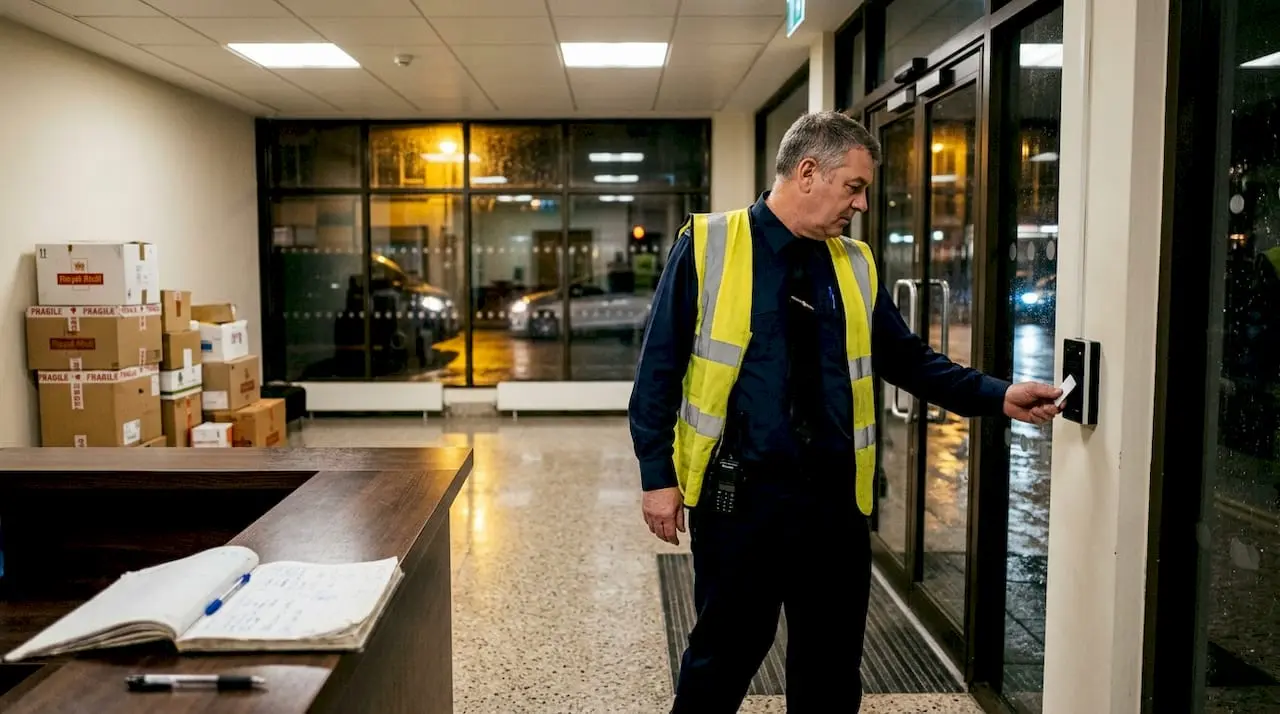
Most people picture a lone figure standing at a door when they think of a security guard. The reality is far more varied and professionally demanding. Across the UK, security personnel work in hospitals, corporate offices, government buildings, logistics hubs, and live events, each with genuinely different expectations, skills, and responsibilities. Whether you are exploring your first security role or looking to move up, understanding exactly what different positions involve will help you target the right opportunities, prepare better for interviews, and build a stronger career. This guide breaks down the roles, daily duties, earning potential, and progression paths you need to know.
Table of Contents
- Understanding security guard roles in the UK
- Typical duties and daily routines
- Skills, training and progression opportunities
- Pay rates and sector comparisons
- A fresh perspective: Why understanding these roles matters more than ever
- Find your next security job today
- Frequently asked questions
Key Takeaways
| Point | Details |
|---|---|
| Roles and career paths | Security guard roles in the UK range from basic guarding to advanced supervisory positions, with options to specialise. |
| Duties by setting | Daily responsibilities and skills requirements vary between sectors such as NHS, government, and logistics. |
| Skills and progression | Key skills include communication and conflict resolution, and further training creates opportunities for advancement. |
| Pay expectations | Entry-level salaries start around £10.50 per hour, with variation based on employer and experience. |
Understanding security guard roles in the UK
The security sector is not a single job. It is a collection of specialist functions that share a common goal: keeping people, property, and information safe. Before applying for any position, it pays to understand security guard roles explained in proper detail.
The four main categories you will encounter are static guards, mobile patrol officers, event security personnel, and specialist roles. Static guards remain at a fixed post, such as a reception desk, entrance gate, or server room. Mobile patrol officers cover multiple sites or zones during a shift, often by vehicle. Event security manages crowd safety at concerts, sports fixtures, and public gatherings. Specialist roles include close protection officers, CCTV operators, and NHS security staff.
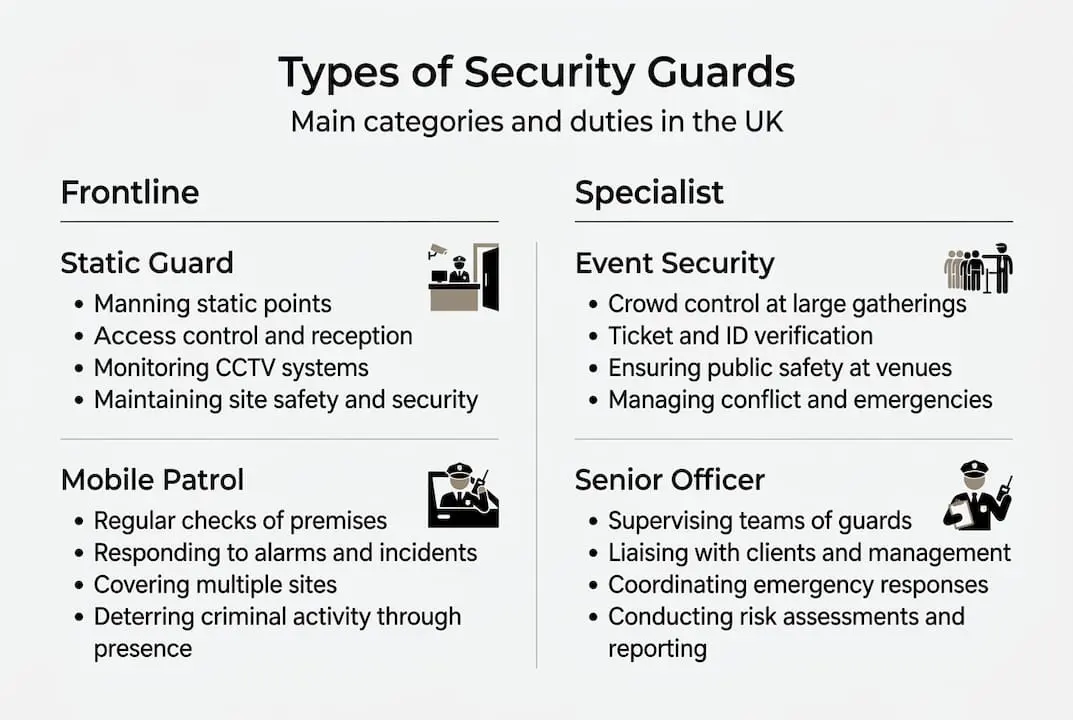
There is also a clear distinction between frontline guards and senior security officers. Frontline guards carry out physical patrols, access control, and first-response tasks. Senior security officers oversee teams, manage operations, create security plans, conduct risk assessments, handle staffing rosters, and perform advanced supervisory duties beyond frontline guarding. That is a significant jump in responsibility and accountability.
Key environments include corporate offices, NHS trusts, central government buildings, transport hubs such as rail stations, and large distribution centres. Each setting carries its own risk profile and operational culture.
Responsibilities common to all security guard roles:
- Access control and visitor management
- Patrolling assigned areas on foot or by vehicle
- Monitoring CCTV and alarm systems
- Writing detailed incident reports
- Responding to emergencies and liaising with police or fire services
- Maintaining a visible, professional presence
The table below gives a quick comparison between frontline and senior officer duties:
| Duty | Frontline guard | Senior security officer |
|---|---|---|
| Patrols and access control | Yes | Occasionally |
| CCTV monitoring | Yes | Oversees |
| Incident first response | Yes | Yes, plus coordination |
| Risk assessment | Basic awareness | Full written assessments |
| Team management | No | Yes |
| Staffing and rosters | No | Yes |
| Security planning | No | Yes |
Exploring the types of security roles available across the UK will help you identify where your skills and interests best fit before you start applying.
Typical duties and daily routines
Understanding categories is one thing. Knowing what an actual shift feels like is what prepares you for the job.
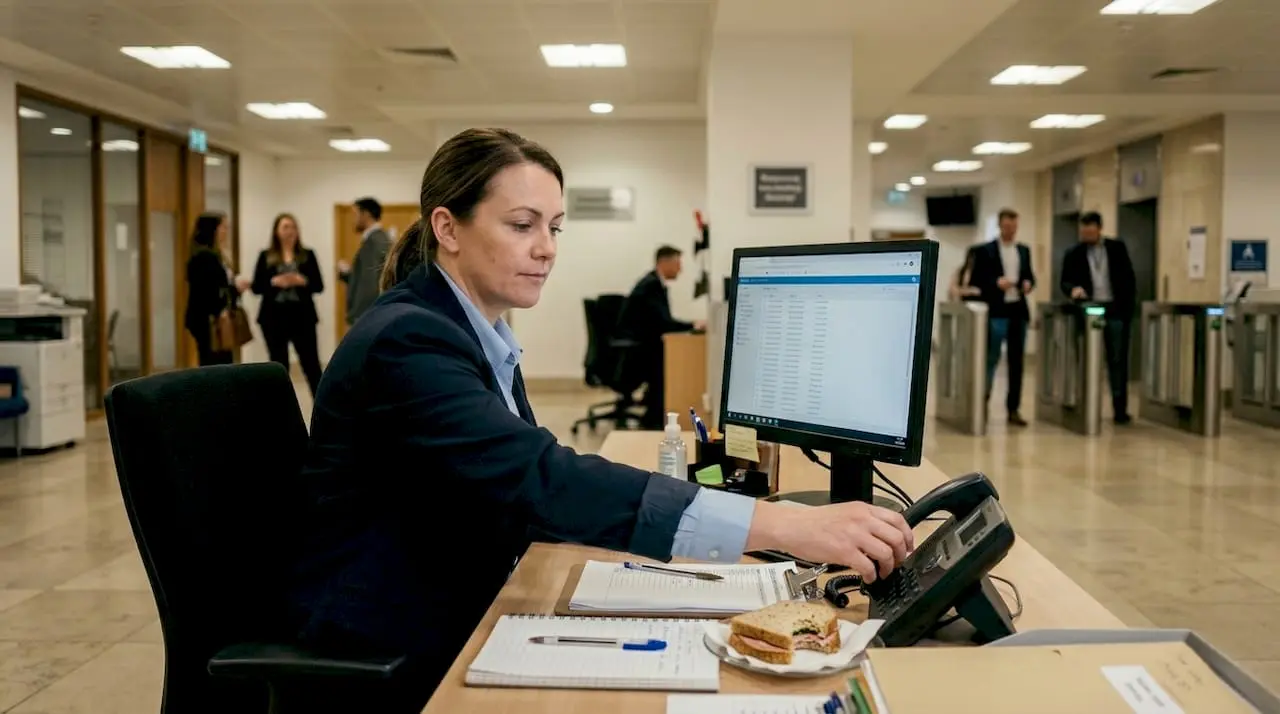
A static guard at a corporate office might begin a shift by checking access logs, briefing the outgoing officer, and reviewing any overnight alerts. The bulk of the day involves monitoring entry and exit points, verifying visitor credentials, responding to CCTV alerts, and writing up any minor incidents. It is methodical work that demands sustained attention rather than constant physical action.
A mobile patrol officer works differently. Shifts often involve driving between several client sites, conducting timed checks, testing locks and alarms, and logging findings on a handheld device. The variety can keep things interesting, but it also means working alone for long stretches, often at night.
NHS security roles carry their own set of expectations. Staff regularly encounter patients in distress, visitors in difficult emotional states, and occasionally volatile situations in emergency departments. The NHS approach to security prioritises compassion in mental health crises over confrontation, which shapes how officers are expected to communicate and respond.
“The best security officers in NHS settings resolve situations through calm communication long before physical intervention is ever considered.”
All security roles involve handling unexpected situations. A delivery driver becomes aggressive. An alarm sounds with no clear cause. A visitor collapses in a lobby. How you manage these moments defines your performance.
A typical shift in numbers:
- Handover and briefing from previous officer
- Initial site check or patrol
- Monitor access points and CCTV feeds
- Respond to alerts or incidents as they arise
- Conduct mid-shift patrol or equipment checks
- Write up incident logs and handover notes
- Final checks before end of shift
For a closer look at static guarding duties, including what employers specifically look for, it is worth reading further before applying to fixed-post roles.
Pro Tip: When you face a tense situation on shift, the instinct to act fast can work against you. Pause for three seconds, assess the environment, and speak first. Most incidents de-escalate before they intensify. Candidates who demonstrate this in interviews stand out immediately.
You can also browse security role examples to see how duties are framed across different employer types.
Skills, training and progression opportunities
Good security work requires more than a strong physical presence. The skills that matter most are often the ones candidates underestimate.
Essential skills for any security role:
- Observation: Spotting what is out of place before it becomes a problem
- Communication: Dealing with the public, colleagues, and emergency services clearly and calmly
- Incident management: Following procedures and staying composed under pressure
- Empathy: Especially critical in healthcare, government, and public-facing roles
- Report writing: Clear, factual, and timely documentation
The SIA (Security Industry Authority) licence is the baseline requirement for most roles in the UK. Door supervisor, CCTV operator, and close protection licences each require specific training courses and a criminal record check. Additional certifications such as conflict management, first aid, and counter-terrorism awareness (ACT Awareness) make candidates considerably more competitive.
As you gain experience, security careers and advancement open up through supervisory positions, specialist postings, and senior officer roles. Senior security officers oversee teams, manage operations, create security plans, conduct risk assessments, handle staffing rosters, and perform advanced supervisory duties, making the gap between entry-level and senior work genuinely significant.
| Level | Typical qualifications | Key skills |
|---|---|---|
| Entry-level guard | SIA licence, basic first aid | Observation, access control, reporting |
| Experienced officer | SIA + conflict management | Incident response, CCTV, customer service |
| Senior security officer | SIA + leadership training | Risk assessment, team management, planning |
| Specialist roles | Role-specific certification | Close protection, NHS protocols, counter-terrorism |
Pro Tip: Do not wait until you need a promotion to invest in training. Completing an add-on qualification such as ACT Awareness or first aid before your performance review signals ambition to employers and often accelerates progression by months.
Pay rates and sector comparisons
Pay in the UK security sector varies meaningfully depending on the role, sector, and location. Knowing the numbers helps you evaluate whether a vacancy genuinely matches your expectations.
For most entry-level positions in 2026, typical hourly rates sit between £10.50 and £14.60, which equates to roughly £27,000 a year for full-time hours. NHS Band 3 security roles offer £24,000 to £26,000 annually, with shift enhancements for nights and weekends adding meaningfully to take-home pay.
How earnings compare across sectors:
- Corporate offices: Often pay at the lower to mid range, but offer stable hours and professional working environments
- Logistics and warehouse sites: Shift premiums for overnight work push pay higher, though conditions can be demanding
- NHS and healthcare: Band 3 base rates with shift enhancements; structured pay progression under NHS terms
- Government buildings: Tend to offer competitive rates with stricter vetting requirements
- Events security: Rates vary widely; experienced staff at major venues can earn above average, but work is irregular
Career progression has a direct effect on earnings. Moving from frontline guard to senior officer or specialist role can increase annual salary by £5,000 to £10,000, particularly in NHS or government settings where pay grades are formalised.
Understanding security pay and compensation across different sectors gives you a clearer benchmark when comparing job offers. It is also worth reviewing security job benefits beyond base pay, including pension contributions, uniform allowances, and training support, which can substantially affect the total value of a role.
A fresh perspective: Why understanding these roles matters more than ever
There is a persistent myth in the UK jobs market that security work is simple, repetitive, and requires little beyond showing up. That view is outdated and costly to anyone who believes it.
The security sector is evolving quickly. Employers, particularly in NHS and government settings, increasingly prioritise emotional intelligence, situational awareness, and written communication alongside physical presence. Candidates who walk into interviews focused only on their ability to “deal with trouble” often lose out to those who can explain how they would de-escalate a distressed patient or write a precise incident report under time pressure.
What we see consistently is that the candidates who progress fastest are those who treat every shift as a learning opportunity. They study their environment, ask questions, and build relationships with colleagues. The ones who stagnate see the role as static.
The rise of advanced manned guarding roles reflects this shift. Modern security is about integrated responses, and the officers who understand that are the ones who move into senior positions, specialist postings, and, eventually, management. Do not undersell the breadth of what this career genuinely involves.
Find your next security job today
Now that you have a clear picture of what different security roles actually involve, you are better placed to target the right vacancies, prepare stronger applications, and enter interviews with genuine confidence. Knowledge of duties, pay expectations, and progression routes sets you apart from candidates who apply without that foundation.

The Security Jobs Board connects UK security jobseekers with verified employers across every sector, from corporate offices to NHS trusts. You can browse live vacancies, upload your CV, and set tailored job alerts for free. If you are based in or looking at opportunities in security jobs in Northern Ireland, or searching across the whole country, the UK security jobs board has current listings waiting for candidates like you. Start your search today.
Frequently asked questions
What does a typical day look like for a UK security guard?
A UK security guard may monitor CCTV, patrol assigned areas, manage access control, handle incidents, and support visitors, with duties shifting considerably depending on the setting. NHS roles, for example, place particular emphasis on compassionate crisis responses rather than physical intervention.
How much can security guards earn in the UK?
Entry-level guards can expect £10.50 to £14.60 per hour, while NHS Band 3 roles offer £24,000 to £26,000 a year, with shift enhancements on top for unsocial hours.
What qualifications do I need to become a security guard?
An SIA licence is the core requirement for most roles, alongside basic training in observation, communication, and incident reporting. Senior roles benefit from additional certifications; senior officers require leadership training and formal risk assessment qualifications.
Are there opportunities to progress beyond basic security roles?
Yes. Experienced guards can move into supervisory, specialist, and senior positions with further training. Senior officers manage teams, create security plans, and conduct risk assessments, representing a clear and rewarding step up from frontline guarding.


