Security guard duty descriptions: what UK roles involve

TL;DR:
- Security guards perform a wide range of legal, operational, and interpersonal duties beyond merely watching entrances or parking areas. Their core responsibilities include access control, observation, incident response, and record keeping, which collectively ensure security and safety across various environments. Understanding these duties in depth provides a competitive advantage, supporting career progression and effective operational planning.
Security guards are routinely dismissed as people who simply stand at a door or watch a car park. That assumption could not be further from reality. Modern security guard work in the UK covers a broad spectrum of legal, operational, and interpersonal responsibilities, and according to the Government Security Profession Career Framework, security officers protect people, property, information, and assets while actively managing incidents as they arise. Whether you are exploring your first role in the industry or looking to sharpen your career positioning, understanding what a duty description actually covers is the foundation of every smart move you make.
Table of Contents
- What is a security guard duty description?
- Core responsibilities: guarding, observation, and incident response
- Duties in different environments: site, retail, and public space
- Compliance, training, and professional standards
- Why understanding duty descriptions is your competitive advantage
- Discover and apply for your next security role
- Frequently asked questions
Key Takeaways
| Point | Details |
|---|---|
| Role clarity unlocks progression | Understanding precise duty descriptions lets you target the right roles and show value to employers. |
| Varied environments, core framework | Whether in retail or buildings, guarding duties centre on access control, observation, and incident response. |
| Compliance is essential | SIA licensing and training are necessary for legal work and advancing in UK security. |
| Proactive response matters | Top guards use incident response and situational awareness—not just presence—to ensure safety. |
What is a security guard duty description?
A duty description is the formal breakdown of what a security guard is expected to do, when, and to what standard. Think of it as a contract between the employer, the client site, and the professional on the ground. It is not just a list of tasks to tick off during a shift. It is the framework that shapes how you operate, how you are assessed, and how you progress in your career.
For jobseekers, reading a duty description carefully reveals whether a role suits your experience, what skills you need to develop, and how the employer values the position. For working guards, it is the reference point that keeps you compliant, focused, and prepared.
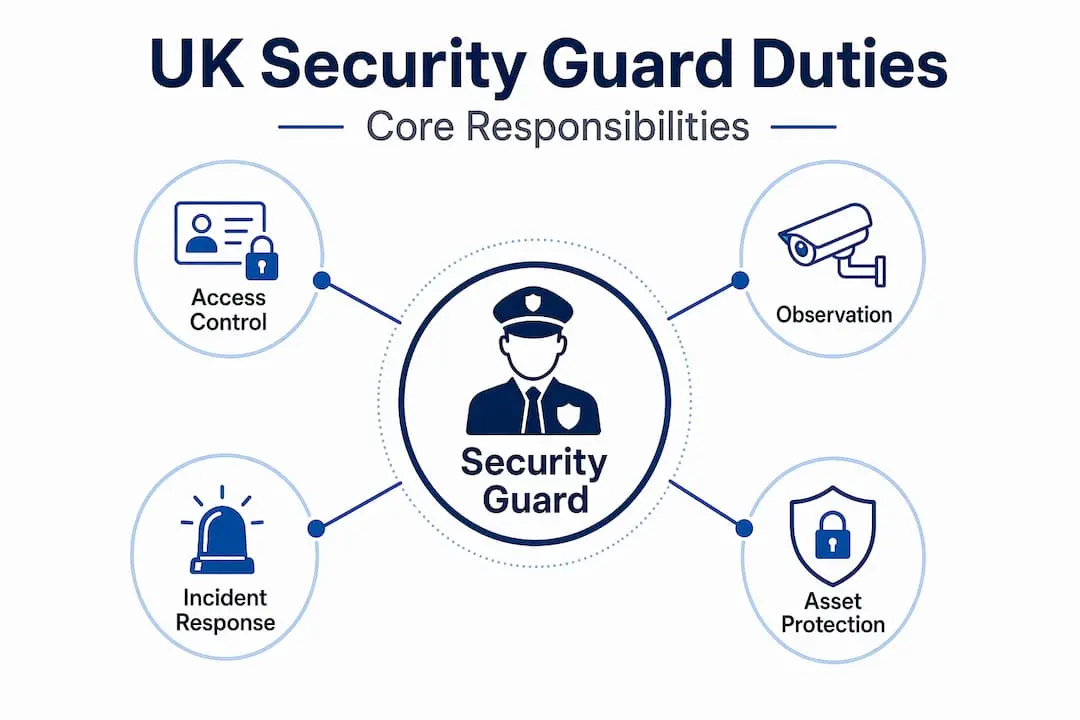
The Security Officer (private security) role confirms that duty descriptions consistently cover protecting property, information, and assets, alongside responding to incidents. Broadly, security guard duties fall into four core categories:
“A strong duty description is not a bureaucratic formality. It is a professional roadmap that tells you exactly where your responsibilities begin and end, and what excellence looks like on every shift.”
- Access and egress control: Managing who enters and exits a premises, including ID verification, visitor logging, and gate management
- Observation and monitoring: Patrolling assigned areas, watching CCTV feeds, and responding to alarm activations
- Incident response: Identifying threats or emergencies, taking initial action, and escalating appropriately
- Record keeping: Maintaining accurate logs, writing incident reports, and updating site documentation
Understanding these four pillars gives you a strong foundation for reading any roles and duties guide with genuine clarity.
Core responsibilities: guarding, observation, and incident response
Now that the framework is clear, it is worth examining how these duties play out in practice across different shifts and scenarios.
Access and egress control is one of the most visible responsibilities. In its simplest form, it means checking credentials at an entrance. In practice, it involves applying consistent procedures under pressure, dealing with confrontational individuals, operating electronic entry systems, and maintaining meticulous records. A guard who understands the why behind this duty, which is preventing unauthorised access and creating a verifiable audit trail, performs it with far greater competence than one just following a script.
Observation is where technology and human judgement intersect. UK Private Security Industry Standards confirm that security guards are tasked with preventing unauthorised access, conducting patrols, and using both electronic and physical systems. This covers everything from walking a timed patrol route to monitoring multiple CCTV screens simultaneously, interpreting body language, and recognising early signs of trouble before incidents escalate. Practising structured observation is a core skill that separates average guards from outstanding ones.
Incident response is arguably the most demanding duty in the description. It requires calm, decisive action when situations develop fast. Effective incident response involves:
- Assessing the situation quickly and accurately
- Following site-specific Standard Operating Procedures (SOPs)
- Communicating clearly with colleagues, emergency services, and management
- Preserving any scene for investigation where required
- Recording every detail in writing immediately after the event
Civil Service security guard job postings confirm that site safety and personnel protection are consistently highlighted as key duties, reinforcing that these are not optional extras but core professional obligations.
| Duty category | What it involves | Key skill required |
|---|---|---|
| Access control | ID checks, gate management, visitor logs | Attention to detail |
| Patrol and observation | Timed routes, CCTV, alarm response | Situational awareness |
| Incident response | SOP adherence, escalation, scene preservation | Decision-making under pressure |
| Record keeping | Incident reports, daily logs, handover notes | Written communication |
| System operation | Electronic access, intruder alarms, monitoring tools | Technical competence |
Reviewing monitoring activity best practices can sharpen your understanding of how observation duties translate into actionable intelligence on site.
Pro Tip: Always read the SOP document for any new site before your first shift. Knowing your escalation points and communication protocols in advance is what turns a good guard into a trusted one. Your security officer job guide can help you prepare the right questions to ask before you start.
Roles vary considerably depending on whether you are working in static guarding versus mobile or event-based positions, but the core competencies above remain constant across all of them.
Duties in different environments: site, retail, and public space
Building on the core duties, it is important to understand how the emphasis shifts depending on the workplace. A security guard protecting a construction site operates very differently from one working in a busy retail park or a public concert venue. The underlying responsibilities are the same, but the tools, priorities, and interactions change considerably.
Construction and industrial sites place the greatest emphasis on access control and asset protection. Unauthorised entry to a live construction site is a serious health and safety risk, not just a security issue. Guards here typically manage vehicle access, verify contractor credentials, conduct regular patrols of large perimeters, and monitor for theft of high-value equipment or materials. Visibility is crucial, as is knowledge of the site layout and emergency evacuation procedures.

Retail environments shift the focus towards theft prevention, customer safety, and de-escalation. Retail security duties confirm that visibility, theft prevention, and calm de-escalation are the defining priorities. Guards in retail settings often operate alongside Electronic Article Surveillance (EAS) systems, conduct plain-clothes observations, and interact regularly with members of the public. Communication skills matter enormously here, and the ability to manage a tense conversation without it becoming confrontational is a genuine professional skill.
Public events and venues bring a different set of challenges again. Crowd management, queue control, searching procedures, and emergency evacuation planning all become central. Guards at public events often work as part of larger teams and must coordinate responses across wide spaces with multiple potential risks happening simultaneously.
Here is a practical comparison of duty emphasis across the three main environments:
| Environment | Primary focus | Key tools used | Key challenge |
|---|---|---|---|
| Construction site | Access control, asset protection | Gate systems, vehicle logs, patrols | Large perimeters, lone working |
| Retail | Theft prevention, de-escalation | CCTV, EAS, customer interaction | High footfall, public confrontation |
| Public events | Crowd management, emergency response | Radio comms, search equipment | Dynamic risks, large team coordination |
- Identify the environment before applying. Your strengths in access control may suit industrial roles better than retail.
- Research the specific tools used in each setting. Familiarity with EAS systems or crowd management techniques is a direct employability advantage.
- Review any sector-specific training available. Retail security, for example, often has additional customer service components that differ from site guarding.
- Use job postings to map duty emphasis. The language used in a posting tells you exactly what the employer values most.
- Consider how security patrol importance varies by environment and how you would adapt your patrol style accordingly.
It is worth noting that the background check protocols required by security firms also vary by environment, with higher-risk settings often demanding more rigorous vetting procedures.
Industry data consistently shows that retail crime remains a significant pressure on UK businesses, with losses running into billions annually. This places retail security guards in a genuinely high-demand and commercially critical position. Your full responsibilities guide covers these environment-specific nuances in greater depth.
Compliance, training, and professional standards
Alongside environment-specific duties, professional standards in the UK actively shape what security guards do on a daily basis and how they progress in their careers.
The Security Industry Authority (SIA) is the regulatory body that governs most frontline security work in the UK. Holding a valid SIA licence is a legal requirement for the majority of professional security guard roles, and the training required to obtain it directly maps onto the duties described throughout this article.
UK Private Security Industry Standards confirm that SIA licensing covers access and egress management, security systems operation, incident and patrol methods, and the legal boundaries within which guards must operate. These are not abstract requirements. They are the practical building blocks of every shift.
Key compliance areas that shape duty descriptions include:
- Legal powers and limitations: Security guards in the UK do not have police powers. Understanding the precise boundaries of a citizen’s arrest, use of force, and lawful detention is not just legally required, it is professionally essential.
- Data protection: Handling CCTV footage, visitor records, and incident reports all fall under data protection legislation. Guards must know how to store, share, and dispose of sensitive information lawfully.
- Health and safety obligations: Security guards have both personal and site-wide responsibilities under health and safety law, particularly when responding to emergencies or managing crowds.
- First aid: Many employers now list first aid certification as either required or highly desirable, reflecting the reality that guards are often first on scene during medical incidents.
- Report writing: Accurate, timely written records are a legal requirement in many circumstances and form part of the evidence chain in any subsequent investigation.
Pro Tip: Review the SIA regulation guide before attending any job interview. Being able to speak fluently about your SIA licence conditions and what they mean in practice signals genuine professionalism to any employer.
If compliance is overlooked, the consequences can be serious. Operating without a valid SIA licence is a criminal offence carrying a substantial fine or imprisonment. Beyond individual consequences, non-compliance damages the reputation of the site, the security firm, and the industry as a whole.
Understanding how to get your SIA licence is the essential first step for anyone entering the profession, and staying current with security employment law is equally important for those already working in the sector.
Why understanding duty descriptions is your competitive advantage
Here is something most security professionals never discuss openly, but which makes an enormous difference to career outcomes. The guards who advance fastest are not always the ones with the most licences or the longest service records. They are the ones who genuinely understand their duty descriptions at an operational level and can connect each task to a broader security outcome.
Most jobseekers read a duty description just long enough to confirm they meet the basic requirements. That is a missed opportunity. When you study a duty description deeply, you start to see patterns. You notice which risks the employer is most concerned about, which skills they emphasise most strongly, and where the gaps in current provision might be. That knowledge is interview gold.
Mapping job duties to operational patterns aids both career planning and on-the-ground operational effectiveness, which is precisely why the Government Security Profession Career Framework uses it as a core planning tool.
In an interview, the difference between a candidate who says “I handle access control” and one who says “I manage access and egress by verifying credentials against the visitor log, operating the electronic gate system, and maintaining a real-time record to support any post-incident review” is immediately apparent to any experienced hiring manager. The second answer demonstrates not just competence but genuine ownership of the role.
On the job, duty mapping helps you anticipate rather than react. When you understand why you patrol at specific intervals, why records must be completed in a particular format, and what the escalation chain looks like in practice, your performance improves across every dimension. Your colleagues notice it. Your supervisors notice it. The duty mastery insights available through our blog explore this further for guards at every stage of their career.
The professional who treats a duty description as a living document rather than a formality is the one who moves from officer to supervisor to manager. That mindset shift is entirely within your control.
Discover and apply for your next security role
Now that you have a thorough grasp of what security guard duty descriptions cover and how they vary by environment, compliance requirement, and professional standard, the next logical step is putting that knowledge to work in your job search.

The Security Jobs Board is the UK’s dedicated platform for security industry recruitment, connecting qualified professionals with employers who understand exactly what the role demands. Whether you are searching for your first position, targeting a specific environment, or ready to take a step up, we make the process straightforward and free for jobseekers. Explore live security jobs in Northern Ireland or browse nationally by role type and sector. If you are an employer looking to recruit skilled security professionals, visit our employer hiring information to learn how we match you with the right candidates efficiently.
Frequently asked questions
Do I need an SIA licence for all security guard roles in the UK?
Most professional security guard positions in the UK require a valid SIA licence, as SIA licensing is essential for all regulated security guard roles. Some in-house or volunteer roles may differ, but any commercial frontline guarding work will require it.
What’s the difference between retail and site security guard duties?
Retail guards focus primarily on theft prevention, customer safety, and de-escalation, while site guards specialise in access control and asset protection. Retail security involves far greater public interaction, whereas site guarding tends to involve larger perimeters and stricter access management.
Which skills help you progress in a security guard career?
Strong communication, keen observation, and a solid grasp of incident response are the most valuable skills for advancement. The Security Guarding specification formally covers communication, observation, incident response, and security system use as core professional competencies.
Are security guards responsible for emergency response?
Yes, responding to security and emergency incidents is a defined part of the duty description, not an optional extra. Security guard duties explicitly include proactive incident response and appropriate escalation to emergency services or senior management when required.


