Streamline security CV screening: a guide to UK compliance

TL;DR:
- UK security hiring requires compliance with BS7858 standards and mandatory SIA licensing verification.
- A structured, human-led screening process reduces risks and ensures legal and regulatory adherence.
- Modern digital tools can significantly shorten vetting times while maintaining thoroughness.
Hiring the wrong person in a security role carries consequences far beyond a bad day at work. A single oversight in CV screening can expose your firm to regulatory penalties, reputational damage, and in worst cases, a serious security breach. UK employers operating under BS7858 and SIA requirements face a compliance landscape that is both detailed and unforgiving. This guide walks you through every stage of a structured, legally sound screening process, from writing the job description to resolving red flags, so you can hire with confidence and speed without cutting corners.
Table of Contents
- Understanding the essentials: Standards and legal compliance
- Before you start: Job design and pre-screening essentials
- Step-by-step CV screening: The compliant workflow
- Resolving CV discrepancies and red flags
- Modern screening tools: AI, automation, and efficiency gains
- Our view: Why a rigorous, human-led process still matters
- Connect with screened, compliant candidates
- Frequently asked questions
Key Takeaways
| Point | Details |
|---|---|
| BS7858 sets the standard | Follow BS7858 requirements for thorough CV vetting and legal compliance in UK security recruitment. |
| Pre-screen before interviews | Screen CVs for SIA licences, employment gaps, and red flags upfront to prevent wasted time and risk. |
| Adopt a step-by-step workflow | A structured CV screening process streamlines hiring and protects against compliance lapses. |
| Use technology wisely | Modern platforms speed up checks, but human oversight remains vital for risk management. |
| Document everything | Maintain auditable records for every hiring decision to support compliance and defend your process if challenged. |
Understanding the essentials: Standards and legal compliance
Before you review a single CV, you need to know exactly what the law and industry standards require of you. Two frameworks define the landscape for UK security employers.
BS7858 is the primary standard for CV screening in UK private security roles, covering a minimum five-year employment history verification, DBS criminal records checks, identity confirmation, right-to-work evidence, financial probity, character references, and sanctions or watchlist cross-checks. It applies to virtually all private security hires, not just front-line staff.
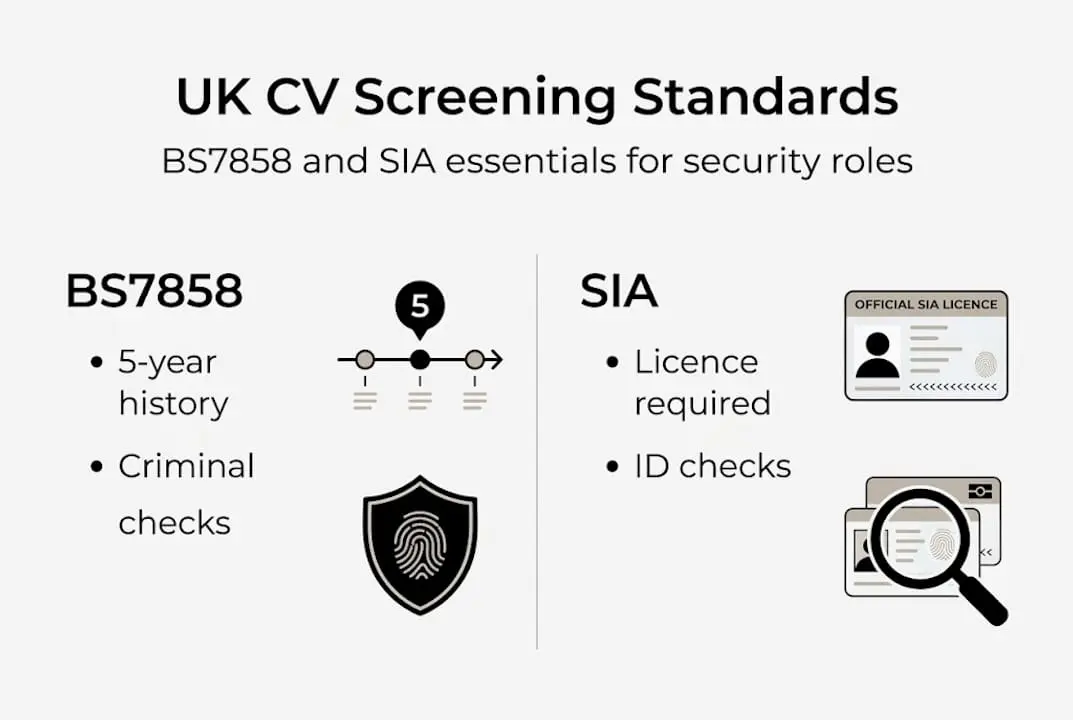
SIA licensing is mandatory for front-line security roles, and from December 2025, stricter verification requirements came into force. Checking a candidate’s SIA licence validity is a non-negotiable step alongside BS7858 vetting. You can learn more about why the SIA badge matters for both candidates and employers.
Key checks required under BS7858:
- Five-year employment history verification
- DBS criminal records check (standard or enhanced)
- Identity documents (passport, birth certificate)
- Right to work in the UK
- Financial probity assessment
- Character references from verifiable sources
- Sanctions and watchlist screening
| Requirement | BS7858 | SIA |
|---|---|---|
| Employment history | 5-year minimum | Not specified |
| Criminal records | Required | Required for licensing |
| Financial checks | Required | Not required |
| Licence verification | Not applicable | Mandatory |
| Record retention | Yes | Yes |
Documentation must be retained securely and be audit-ready. Many firms are now adopting annual rescreening as best practice, particularly for staff in high-risk or access-sensitive roles. This is not yet a legal requirement, but it is increasingly expected by clients and insurers. A solid background check checklist can help you standardise this across your team.
Pro Tip: Build your record retention policy before you start screening. GDPR requires you to justify how long you hold personal data, so document your rationale from day one.
You should also actively work to reduce unconscious bias during the screening process. Structured scoring criteria applied consistently across all candidates is both fairer and more legally defensible.
Before you start: Job design and pre-screening essentials
With a clear understanding of standards, it is vital to get your process right even before the first CV lands.
Recruitment for SIA-licensed roles follows a defined sequence: job design with BS7858 and SIA requirements built in, targeted advertising, pre-screening for licences and documents, scenario-based interviews, compliance checks, and structured onboarding. Skipping the job design stage is where many employers lose time later.
Your job description should explicitly state that the role requires a valid SIA licence and that the successful candidate will be subject to BS7858 vetting. This filters out unqualified applicants immediately and sets clear expectations. It also gives you a legal basis for withdrawing offers if checks fail.
Documentation to collect at application stage:
- SIA licence number (for front-line roles)
- Proof of identity (passport or driving licence)
- Right-to-work documentation
- Self-declaration of criminal record history
- Contact details for references covering the last five years
Knowing how to get an SIA licence helps you recognise valid documentation quickly and spot candidates who may be in the process of renewing. A lapsed licence is a red flag, not a minor admin issue.
Common pre-screening red flags include unexplained gaps in employment history, inconsistencies between the CV and the application form, and indicators of financial stress such as county court judgements mentioned in passing. None of these are automatic disqualifiers, but each requires follow-up before you proceed. Familiarise yourself with employment law for security roles to ensure your pre-screening questions remain lawful.

Pro Tip: Create a pre-screening checklist that maps directly to your BS7858 obligations. When a candidate submits their application, a quick scan against this list tells you within minutes whether they are worth progressing.
Step-by-step CV screening: The compliant workflow
Once you have strong applicants and the right information, it is time to screen thoroughly.
A compliant workflow is not just good practice; it is your protection if a hire goes wrong and your process is ever scrutinised. Follow these steps in order:
- Initial CV filter: Check for completeness, five-year history coverage, and presence of required documents.
- SIA licence check: Verify the licence number on the SIA public register. Confirm it is current and covers the correct activity.
- Five-year employment verification: Contact each employer listed. Confirm dates, job titles, and reasons for leaving.
- DBS criminal records check: Submit through an umbrella body or directly. Enhanced checks apply to roles involving vulnerable people.
- Financial probity check: Use a credit reference agency to identify county court judgements, insolvency, or significant debt.
- Reference checks: Speak to referees directly where possible. Written references alone are insufficient under BS7858.
- Sanctions and watchlist screening: Cross-check against OFAC, UN, and UK government sanctions lists.
“Thorough vetting is not a bureaucratic hurdle. It is the foundation of trust between your firm, your clients, and the public.”
BS7858 screening traditionally takes between two and twelve weeks, but modern digital platforms can reduce this to as little as six days. The table below shows how timelines compare.
| Screening step | Traditional timeline | Digital platform timeline |
|---|---|---|
| Employment verification | 2-4 weeks | 2-3 days |
| DBS check | 2-8 weeks | 1-5 days |
| Financial check | 3-5 days | Same day |
| Sanctions screening | 1-2 days | Minutes |
Conditional employment is permissible while final checks are being completed, provided you document the rationale and set a clear deadline. Review the full hiring workflow for security and the step-by-step hiring process for detailed guidance on managing this period compliantly. Full details on the vetting standards process are also worth reviewing before you finalise your internal procedure.
Resolving CV discrepancies and red flags
Not every CV will be straightforward. Here is what to do when things do not add up.
Discrepancies are common and not always sinister. A candidate might have forgotten an exact end date, or a former employer may have changed its name. The key is to investigate proportionately and document everything. These edge cases require structured handling: unexplained gaps, inconsistent timelines, and financial stress signals are all classified as high-risk indicators under BS7858 and require formal gap explanations, additional referee verification, and in some cases, a delayed start date.
Common discrepancies and recommended responses:
- Employment gap of more than one month: Request a written explanation with supporting evidence such as a P45, redundancy letter, or medical documentation.
- Inconsistent job titles or dates: Contact the employer directly to verify. Do not rely solely on the candidate’s account.
- Unverifiable employer: Search Companies House. If the business cannot be confirmed, treat the period as unverified and escalate.
- Financial stress indicators: Obtain a credit report. A single county court judgement may not disqualify, but a pattern of debt is a material risk.
- Conflicting referee accounts: Where two referees give contradictory information, request a third referee and document the conflict.
Conditional employment can be offered while you resolve discrepancies, but set a firm deadline and make the conditions explicit in writing. If a candidate refuses to provide clarifying documentation, that refusal is itself a red flag.
Pro Tip: Keep a discrepancy log for every candidate, even those who are ultimately hired. If a complaint or incident arises later, your documented reasoning demonstrates due diligence.
For broader guidance on managing complex hires, the security sector hiring tips resource covers practical scenarios in detail.
Modern screening tools: AI, automation, and efficiency gains
For greater efficiency, technology is rapidly changing how screening gets done.
Digital screening platforms now handle much of the administrative burden: automated employment verification requests, instant sanctions checks, and integrated DBS submission portals. For volume hiring, these tools can dramatically reduce time-to-hire without compromising compliance.
Traditional vetting takes 8-12 weeks compared to as little as six days on modern platforms, a reduction of roughly 90%. That is a meaningful competitive advantage when you are trying to fill roles quickly.
| Feature | Manual process | AI-assisted platform |
|---|---|---|
| Speed | 8-12 weeks | 6 days |
| Consistency | Variable | High |
| Audit trail | Manual | Automated |
| Bias risk | Higher | Lower (if configured well) |
| Human oversight | Full | Partial |
However, AI in security screening carries real limitations. Automated systems can miss contextual nuance, and in defence and high-security environments, accountability for decisions must remain with a human. An algorithm cannot explain a judgement call to a tribunal.
Pro Tip: Use technology to accelerate the administrative steps, but keep human review at the decision points. Licence verification, reference calls, and risk assessments should always involve a person.
When evaluating tools, a recruitment platforms comparison will help you identify which solutions are genuinely built for the security sector rather than adapted from generic HR software.
Our view: Why a rigorous, human-led process still matters
There is a temptation, particularly under pressure to fill roles quickly, to let automation carry more weight than it should. We understand that pressure. But the firms that get into trouble are rarely those that screened too carefully.
Automation is excellent at reducing admin time and standardising data collection. It is poor at interpreting a candidate’s tone during a reference call, or recognising that a gap explanation does not quite ring true. Those judgements require experience and accountability, and they cannot be delegated to a platform.
The full recruitment workflow for security roles exists precisely because the stakes are high. Detailed documentation and clear rationale protect your firm if a decision is ever challenged. Annual rescreening keeps your workforce current. Diversity-aware processes help you build stronger, more resilient teams over time.
The firms that treat CV screening as a compliance tick-box will eventually face the consequences. The firms that treat it as a genuine risk management tool will not.
Connect with screened, compliant candidates
Ready to streamline your hiring and boost your compliance record? Finding candidates who already understand BS7858 requirements and hold valid SIA licences saves you significant screening time from the outset.

The Security Jobs Board is built specifically for UK security employers. You can post security jobs directly to a database of sector-specific candidates, browse CVs filtered by licence type and location, and manage your recruitment pipeline in one place. Whether you are hiring in London or looking for security jobs in Northern Ireland, the platform connects you with candidates who are ready to be screened and placed. Backed by BSIA affiliation and built for GDPR compliance, it is the most efficient starting point for any compliant security hire.
Frequently asked questions
How long should it take to screen a security CV in the UK?
Traditional BS7858 vetting takes between two and twelve weeks, but modern digital platforms can reduce this process to under a week in some cases.
What is the difference between SIA and BS7858 screening?
SIA licensing confirms legal authorisation to work in front-line security roles, while BS7858 covers comprehensive checks including employment history, identity, references, financial probity, and criminal records for all private security hires.
What if there are gaps or discrepancies in a candidate’s CV?
Request written explanations and additional references. Major unexplained gaps are high-risk under BS7858 and may be grounds for rejection or a conditional employment offer pending further verification.
How often should security staff be rescreened?
Annual rescreening is recommended as best practice to ensure continuing compliance and mitigate emerging risks, particularly for staff in sensitive or access-critical roles.
Recommended
- Security Screening: Crucial Checks for UK Security Roles
- Optimising Security Job Searches for Fast UK Career Moves
- Security Vetting in the UK: What Every Employer & Professional Should Know
- Job Posting Workflow for UK Security Employers Made Easy
- Streamline security questionnaire completion in 2026
- 7 Essential Steps for a Security Compliance Checklist


