
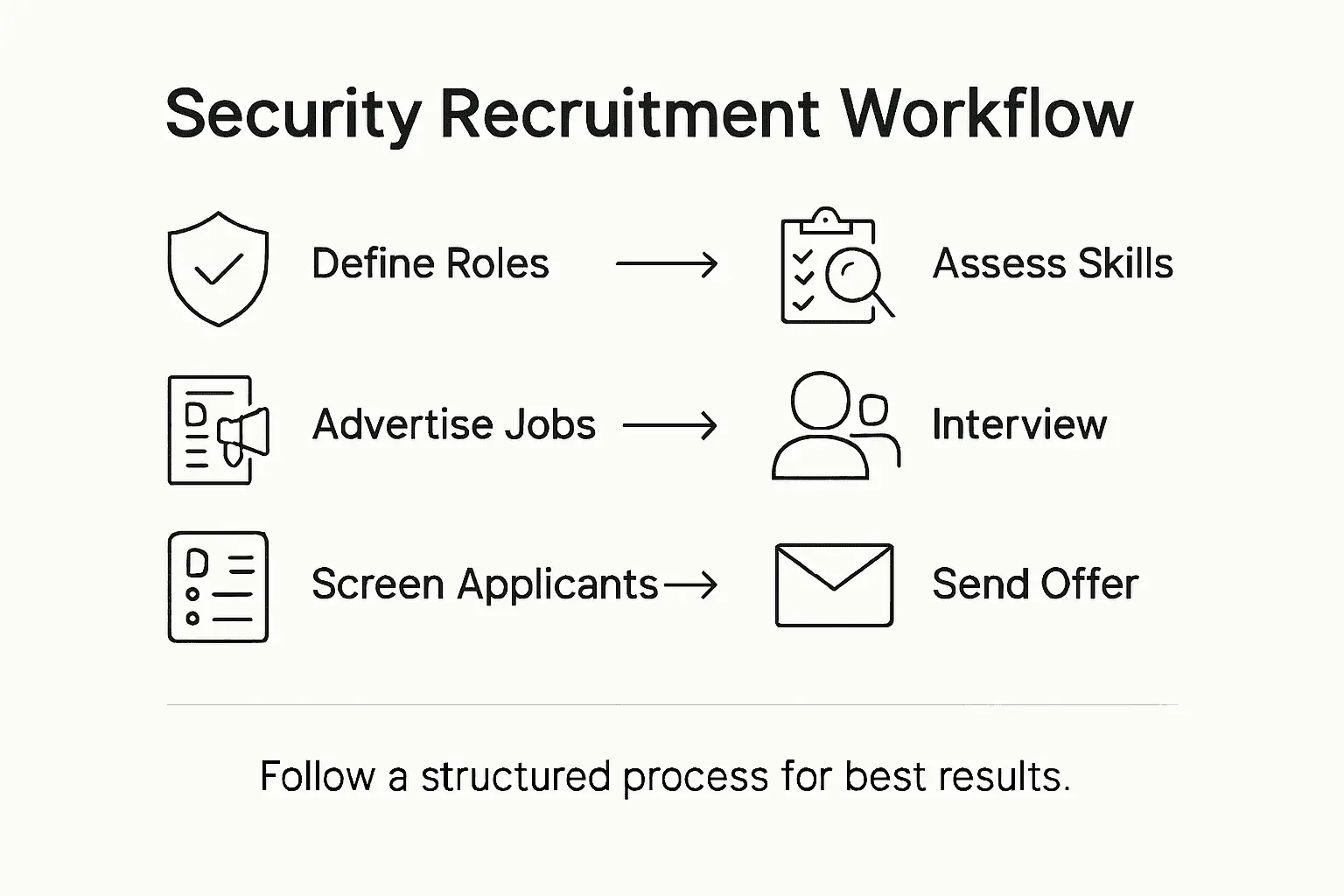
Over half of British security managers report lost time and increased risk when recruitment steps are unclear. In a field where every hire profoundly affects organisational safety, fine tuning your hiring process means more than just filling vacancies. A streamlined approach not only attracts qualified talent but also protects sensitive data under strict British and European GDPR rules. This guide breaks down each hiring stage, from defining precise security roles to GDPR compliant onboarding, helping you meet the high standards of the British security sector.
Table of Contents
- Step 1: Define Precise Security Role Requirements
- Step 2: Prepare GDPR-Compliant Recruitment Tools
- Step 3: Advertise Roles on Targeted Security Platforms
- Step 4: Screen Candidates for Essential Qualifications
- Step 5: Conduct Structured Interviews and Assessments
- Step 6: Verify Compliance and Finalise Job Offers
Quick Summary
| Key Point | Explanation |
|---|---|
| 1. Define Specific Security Role Requirements | Clearly outline job roles to attract qualified candidates aligned with security objectives and competencies. |
| 2. Ensure GDPR Compliance in Recruitment Tools | Implement stringent data protection measures to safeguard candidate information throughout the hiring process. |
| 3. Advertise on Targeted Security Platforms | Use specialised channels to reach candidates with the necessary skills and certifications for security roles. |
| 4. Conduct Comprehensive Candidate Screenings | Verify essential qualifications and background details to ensure candidates meet role-specific requirements. |
| 5. Standardise Interview Processes | Develop structured interviews to objectively evaluate candidate capabilities and enhance selection fairness. |
Step 1: Define precise security role requirements
Defining precise security role requirements is the critical foundation for successful recruitment in the security sector. This step ensures you create a targeted job description that attracts qualified candidates while aligning with organisational security objectives.
Start by conducting a comprehensive skills assessment that maps the exact competencies needed for the specific security position. Agreeing security role responsibilities requires a systematic approach that considers technical capabilities, risk management skills, and organisational context. Break down the role into specific functional requirements including mandatory qualifications, necessary certifications, technical knowledge, and behavioural competencies.
Ensure your role definition integrates mandatory security obligations by consulting key stakeholders across departments. This collaborative approach helps create a nuanced job description that reflects real operational needs. Consider factors such as physical security experience, cybersecurity knowledge, communication skills, and adaptability to different security environments. Document each requirement with clear, measurable criteria that will guide your candidate screening and selection process.
Top Tip: Create a weighted scoring matrix for each role requirement to objectively evaluate candidate suitability during the recruitment process.
Step 2: Prepare GDPR-compliant recruitment tools
Preparing GDPR-compliant recruitment tools is essential for protecting candidate data and maintaining legal integrity throughout the hiring process. This step focuses on implementing robust data protection mechanisms that safeguard personal information while enabling efficient recruitment.
Begin by auditing your current recruitment technologies and ensuring they meet comprehensive UK data protection requirements. Your recruitment tools must incorporate principles of data minimisation, secure processing, and transparent consent. This means selecting platforms that allow granular control over data collection, enable easy candidate consent management, and provide clear mechanisms for data access and deletion.

Implement strict access controls and encryption protocols across all recruitment platforms. Verify that each tool provides robust audit trails, enables secure data storage, and supports individual rights such as subject access requests. Consider tools that automatically anonymise candidate data, restrict unnecessary information gathering, and include built-in compliance tracking features. Train your recruitment team on proper data handling procedures and ensure they understand the importance of maintaining candidate privacy throughout the selection process.
Here is a summary of essential GDPR compliance features for recruitment tools and their practical benefits:
| Compliance Feature | Description | Business Benefit |
|---|---|---|
| Data minimisation | Collect only necessary candidate information | Reduces data breach risk |
| Encryption of data | Protects personal data during storage and transfer | Enhances candidate trust |
| Consent management | Transparent candidate consent for data use | Demonstrates legal accountability |
| Access controls | Limits who can view or edit candidate data | Prevents unauthorised access |
Top Tip: Conduct a quarterly review of your recruitment technology stack to ensure ongoing GDPR compliance and address any emerging data protection challenges.
Step 3: Advertise roles on targeted security platforms
Advertising security roles requires a strategic approach to reach qualified candidates who possess the specific skills and certifications needed in this specialised sector. Your goal is to maximise visibility while attracting highly skilled professionals through carefully selected recruitment channels.
Begin by exploring targeted security career networks that connect employers with specialised talent pools. These platforms offer direct access to candidates with relevant government security backgrounds, cyber expertise, and professional certifications. Select platforms that cater specifically to security professionals, such as industry-specific job boards, professional security associations, and government career networks. This targeted approach ensures your job advertisements reach candidates with precisely matched skill sets and security clearance levels.
Craft compelling job descriptions that highlight unique role requirements, potential career progression, and specific technical skills needed. Utilise multiple channels including professional networking sites, security industry forums, and specialist recruitment platforms to broaden your candidate reach. Consider partnering with professional security organisations and attending industry events to supplement your digital recruitment strategy. Ensure your job advertisements are clear, concise, and provide comprehensive information about role expectations, required qualifications, and potential career opportunities.
Top Tip: Develop a consistent employer brand narrative that resonates with security professionals by showcasing your organisation’s commitment to professional development and cutting edge security technologies.
Step 4: Screen candidates for essential qualifications
Screening candidates for essential qualifications is a critical process that ensures only the most suitable security professionals progress through your recruitment workflow. This stage requires meticulous verification of professional credentials, background checks, and alignment with specific role requirements.
Begin by implementing a comprehensive screening process that follows rigorous employment screening standards. Your verification should cover multiple dimensions including professional certifications, academic qualifications, previous employment history, criminal record checks, and right to work status. Develop a systematic checklist that captures all essential documentation required for security roles, ensuring each candidate undergoes consistent and thorough assessment.
Pay particular attention to industry specific requirements such as security clearance levels, professional licencing, and specialised technical certifications relevant to the specific security role. Cross reference candidate submitted documents with official issuing bodies, conduct detailed background verifications, and maintain comprehensive records of all screening activities. Create a standardised scoring mechanism that objectively evaluates candidates against predefined qualification criteria, enabling transparent and fair candidate selection while maintaining legal compliance and organisational security standards.
The table below compares core screening stages and their significance for security recruitment:
| Screening Stage | Purpose | Importance |
|---|---|---|
| Certification check | Confirm professional and technical skills | Ensures role-specific competence |
| Criminal record screening | Verify legal suitability for sensitive roles | Maintains organisational integrity |
| Employment history review | Validate previous experience | Confirms accuracy of candidate claims |
| Security clearance verification | Meet specific clearance requirements | Essential for regulated environments |
Top Tip: Develop digital verification workflows that automate document checks and streamline the candidate screening process while maintaining strict confidentiality.
Step 5: Conduct structured interviews and assessments
Conducting structured interviews and assessments represents a pivotal stage in identifying top security talent through systematic evaluation techniques. Your objective is to develop a robust selection process that objectively measures candidate capabilities, professional competencies, and cultural alignment.
Implement comprehensive interviewing standards that ensure consistent candidate assessment across all security roles. Design interview protocols with predefined questions addressing technical skills, behavioural competencies, scenario based problem solving, and role specific expertise. Incorporate multiple assessment methods including competency based interviews, practical skills tests, psychometric evaluations, and job simulation exercises that provide holistic insights into candidate potential.
Establish a standardised scoring mechanism that allows objective comparison between candidates while minimising individual interviewer bias. Train your interview panel to follow structured evaluation frameworks, use consistent scoring rubrics, and document assessment outcomes transparently. Focus on gathering evidence of candidate capabilities through direct questioning, practical demonstrations, and comprehensive skills verification. Create a collaborative assessment environment that enables candidates to showcase their full professional potential while maintaining rigorous selection standards.
Top Tip: Develop a digital assessment tracking system that allows real time collaboration between interview panel members and enables consistent candidate performance documentation.
Step 6: Verify compliance and finalise job offers
Verifying compliance and finalising job offers represents the culmination of your rigorous recruitment workflow in the security sector. This critical stage ensures that selected candidates meet all organisational and regulatory requirements before formal employment commences.
Begin by conducting comprehensive verification checks aligned with the UK Government Baseline Personnel Security Standard. Confirm candidate identity, right to work status, criminal record history, and professional references with meticulous attention to detail. These checks are essential for maintaining the integrity of your security recruitment process and protecting organisational interests.
Carefully review all documentation to ensure full compliance with data protection regulations and employment law. Prepare formal offer letters that clearly articulate role expectations, compensation, start date, and any conditional elements such as security clearance or additional background checks. Communicate transparently with successful candidates, providing comprehensive information about next steps and onboarding procedures. Maintain detailed records of all verification activities while ensuring strict adherence to data privacy principles and regulatory requirements.
Top Tip: Create a standardised compliance checklist that can be systematically applied across all security recruitment processes to ensure consistent and thorough verification.
Streamline Your Security Recruitment with a Trusted Platform
Navigating the complex security recruitment workflow requires precision, GDPR compliance, and access to qualified candidates who meet your specific role requirements. The challenges of defining exact security role competencies, preparing GDPR-compliant recruitment tools, and screening candidates thoroughly can be overwhelming. If you want to accelerate your hiring process while maintaining the highest standards of security and confidentiality, a specialised recruitment solution is essential.

Discover how The Security Jobs Board simplifies your search by offering a focused platform dedicated to security professionals within the UK. With a user-friendly interface designed for fast job posting and CV browsing, it supports your structured recruitment efforts from advertising roles to verifying qualifications. Take advantage of GDPR-compliant tools, targeted job alerts, and access to a candidate pool tailored to your security sector needs. Empower your hiring team today by visiting The Security Jobs Board homepage and explore how our solutions can perfectly complement your recruitment workflow. Start connecting with qualified security candidates now to build a stronger, safer organisation.
Frequently Asked Questions
How do I define security role requirements in recruitment?
Defining security role requirements involves conducting a skills assessment to identify specific competencies needed for each position. Break down the role into mandatory qualifications, certifications, technical knowledge, and behavioural skills to create a targeted job description.
What are the essential GDPR-compliant recruitment tools?
Essential GDPR-compliant recruitment tools include platforms that ensure data minimisation, secure processing, and transparent consent management. Audit your current technologies and select those that offer strict access controls and enable anonymisation of candidate data.
How can I advertise security roles effectively?
To advertise security roles effectively, use targeted career networks and specialised job boards that cater to security professionals. Craft clear and engaging job descriptions outlining role expectations, qualifications, and career progression opportunities to attract suitable candidates.
What should I include in the candidate screening process?
The candidate screening process should include verification of professional certifications, background checks, and previous employment history. Develop a checklist to ensure all essential documentation is consistently reviewed for compliance with security role requirements.
How do I conduct structured interviews for security roles?
To conduct structured interviews, create predefined questions addressing technical and behavioural competencies relevant to the role. Implement multiple assessment methods, such as practical skills tests and scenario-based evaluations, to thoroughly assess candidate capabilities.
What are the final steps before making a job offer?
Before making a job offer, verify candidate compliance with identity checks, work status, and criminal record history. Prepare formal offer letters detailing role expectations and communicate each step transparently to successful candidates.


