Security sector recruitment explained: hiring success in the UK

Hiring a security operative is not as simple as checking a badge and handing over a uniform. Many employers still treat security recruitment like any other staffing exercise, posting a generic advert and picking the first available candidate. That approach carries serious consequences. A poor hire in a security role can expose clients to risk, damage your company’s reputation, and in some cases, create legal liability. This guide walks you through exactly what security sector recruitment involves, the stages you need to follow, the qualities that matter most, and how to stay ahead of the trends shaping hiring in 2026.
Table of Contents
- Defining security sector recruitment
- Key stages in the security recruitment process
- Essential qualities for security candidates
- Adapting to current trends in UK security recruitment
- A fresh perspective: why true recruitment success goes beyond the checklist
- Looking for your next great security hire?
- Frequently asked questions
Key Takeaways
| Point | Details |
|---|---|
| Specialised recruitment is vital | Security sector hiring demands rigorous screening and sector-specific knowledge. |
| Multi-stage processes ensure quality | Structured steps and compliance checks reduce risks and improve fit. |
| Both hard and soft skills matter | Success hinges on identifying traits like communication, vigilance, and adaptability. |
| Adapting to trends is essential | Employers must use modern platforms and strategies to find top talent in 2026. |
Defining security sector recruitment
Security sector recruitment is the process of identifying, attracting, screening, and appointing candidates for roles that protect people, property, and assets. It sounds straightforward, but the reality is far more demanding than most standard hiring processes. The importance of specialist security recruitment cannot be overstated, because as the sector itself states, specialised recruitment is essential for protecting assets in security roles.
Unlike recruiting for a retail or administrative position, security hiring carries regulatory obligations, public safety considerations, and a duty of care that extends well beyond the employment contract. Employers must navigate Security Industry Authority licensing requirements, criminal record checks, and a range of compliance frameworks that are unique to the sector.
The UK security industry covers an enormous range of settings. From door supervisors at licensed premises and CCTV operators in town centres, to close protection officers and security staff at critical national infrastructure, each role demands a specific combination of skills, clearances, and temperament. A candidate who is perfectly suited to retail security may be entirely wrong for a corporate environment.
Here is how security sector recruitment differs from general hiring:
- Mandatory SIA licensing for most front-line roles
- Enhanced background checks including DBS and financial history
- Physical and psychological suitability assessments
- Strict reference verification going back five years or more
- Ongoing compliance obligations once staff are in post
- Sector-specific induction and training requirements
“Recruitment in the security industry is not simply about filling a vacancy. It is about placing the right individual in a position of trust, where their decisions can directly affect the safety of others.”
This elevated standard of scrutiny is what separates effective security recruitment from a rushed staffing exercise. Getting it right from the outset protects your clients, your business, and the public.
Key stages in the security recruitment process
With a solid definition in hand, it is crucial to understand how the recruitment process is structured in the UK security sector. Each stage builds on the last, and skipping any one of them creates gaps that can prove costly.
The qualities employers seek from candidates must be defined before a single advert goes live, because vague job descriptions attract unsuitable applicants and waste everyone’s time. Equally, understanding training and skills for security roles helps you set realistic expectations and design better role profiles.
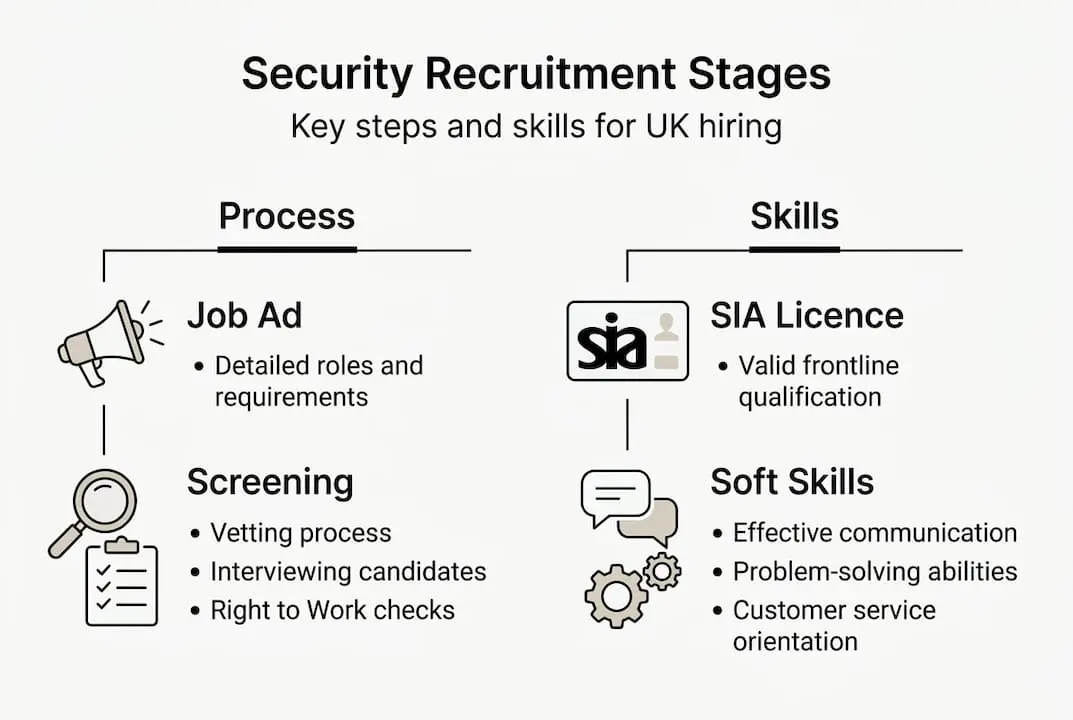
Here are the key stages every security employer should follow:
- Job design. Define the role clearly, including the specific SIA licence required, physical demands, shift patterns, and reporting structure.
- Advertising. Use specialist channels rather than generic job boards. Targeted platforms reach candidates who already hold the right credentials.
- Pre-employment screening. Collect applications and filter against non-negotiable criteria such as valid SIA licensing and right-to-work documentation.
- Interviews. Conduct structured interviews that test both technical knowledge and behavioural competencies. Scenario-based questions reveal how candidates think under pressure.
- Compliance checks. Run DBS checks, verify references, and confirm licence validity through the SIA’s online portal.
- Onboarding. Provide a thorough induction covering site-specific procedures, reporting lines, and expectations. A weak onboarding process undermines even the best hire.
The essential UK security skills required at each stage vary by role, but the process itself should remain consistent across your organisation to ensure fairness and legal compliance.
Pro Tip: Many employers focus so heavily on licence checks that they forget to assess soft skills during interviews. A candidate who holds every required certificate but struggles to communicate calmly under pressure will create problems on site. Build scenario-based questions into every interview to test judgement and interpersonal ability alongside technical competence.
Essential qualities for security candidates
Knowing the stages is vital, but the real key is understanding which qualities turn a candidate into an asset. Both technical and soft skills are required for effective security staff, and the best employers assess both with equal rigour.

The following table compares the two skill categories and illustrates what each looks like in practice:
| Skill type | Examples | How to assess |
|---|---|---|
| Technical skills | SIA licence, first aid, CCTV operation, report writing | Licence verification, practical tests |
| Soft skills | Communication, conflict resolution, vigilance, reliability | Scenario questions, references, probation review |
The key qualities for security staff that consistently separate high performers from average hires include situational awareness, professionalism under pressure, and the ability to de-escalate conflict without aggression. These are not traits you can teach in a one-day induction. They are deeply embedded behaviours that need to be identified at the selection stage.
During interviews, use realistic scenarios drawn from your actual operational environment. Ask candidates how they would handle an aggressive visitor, a suspicious package, or a colleague behaving inappropriately. Their answers reveal far more than a rehearsed response to “tell me about your experience.”
The importance of soft skills becomes even clearer during the probationary period. Use structured check-ins and supervisor feedback to assess whether a new hire’s behaviour on site matches what they presented at interview.
Watch out for these red flags during the selection process:
- Gaps in employment history that cannot be satisfactorily explained
- Inconsistencies between the CV and verbal responses at interview
- Dismissive or aggressive responses to hypothetical conflict scenarios
- Reluctance to provide references from previous security employers
- Overconfidence about physical confrontation as a first response
A single red flag does not automatically disqualify a candidate, but a pattern of them should prompt serious caution before any offer is made.
Adapting to current trends in UK security recruitment
To stay ahead, employers must keep pace with fast-shifting industry trends and adapt their strategies accordingly. The UK security sector is growing, and that growth is creating both opportunity and competition for the best candidates.
The UK security sector has seen a 6.2% growth rate recently, which means demand for qualified operatives is outpacing supply in several regions. Understanding recent recruitment growth patterns helps employers plan their pipelines more effectively.
| Trend | Impact on recruitment | Recommended response |
|---|---|---|
| 6.2% sector growth | Increased competition for candidates | Broaden sourcing channels |
| Digital screening tools | Faster shortlisting | Adopt applicant tracking systems |
| Candidate shortages in specialist roles | Longer time-to-hire | Build talent pipelines in advance |
| Employer branding | Candidates choose employers carefully | Invest in your online presence |
The key trends in security jobs for 2026 point clearly toward digital-first recruitment. Candidates increasingly search and apply via mobile devices, so employers who rely on paper-based or slow processes lose out before the first conversation happens.
Knowing how to attract security talent in a competitive market means thinking beyond salary. Career progression, training opportunities, and a clear company culture are significant factors for experienced operatives choosing between offers. Inclusivity also matters. Broadening your recruitment to reach underrepresented groups expands your talent pool and strengthens your team’s ability to engage with diverse client environments.
Security recruitment platforms that specialise in the sector give employers a meaningful advantage by connecting them with pre-screened, licence-holding candidates rather than a general audience.
Pro Tip: Review your job adverts against the language and tone that experienced security professionals actually respond to. Overly corporate or vague adverts underperform. Clear, direct descriptions of the role, the site, the shift pattern, and the pay rate attract serious candidates and reduce time-to-hire significantly.
A fresh perspective: why true recruitment success goes beyond the checklist
Most articles on security recruitment focus on process, and process matters enormously. But there is something that checklists cannot capture, and it is the single biggest predictor of long-term team performance: what happens after the hire.
Too many security employers invest heavily in selection and then treat onboarding as an afterthought. The result is high turnover, disengaged staff, and a constant cycle of rehiring that costs far more than a structured retention programme ever would. The qualities employers seek in candidates must be actively nurtured once those candidates are in post, not simply assumed to sustain themselves.
Building a high-trust security team means investing in regular upskilling, honest performance conversations, and a culture where operatives feel valued rather than interchangeable. Security work is demanding, often thankless, and frequently isolating. The employers who acknowledge that reality and respond to it with genuine support retain their best people. Those who treat their workforce as a commodity find themselves back at the start of the process every few months.
The uncomfortable truth is that recruitment success is not measured at the point of hire. It is measured twelve months later.
Looking for your next great security hire?
Putting these principles into practice is far easier when you have the right tools and resources behind you. Security Jobs Board is the UK’s specialist platform for connecting security employers with qualified, licence-holding candidates across every sector and region.

Whether you are hiring door supervisors in London or seeking experienced operatives for security jobs in Northern Ireland, Security Jobs Board gives you access to a targeted candidate database, flexible posting options, and practical security career advice to support both employers and jobseekers. Post your vacancy today and start building the team your clients deserve.
Frequently asked questions
What makes security sector recruitment different from other industries?
Specialised security sector recruitment is vital for protecting assets, and it involves stringent vetting, regulatory compliance, and an emphasis on both technical and soft skills that most other industries simply do not require.
What role does SIA licensing play in security sector hiring?
SIA licensing is a legal requirement for most front-line security roles in the UK, and key recruitment stages must include licence verification and compliance checks before any offer is confirmed.
How can employers attract top security talent in 2026?
Current recruitment trends show that showcasing strong values alongside genuine opportunities for training, upskilling, and career progression is what appeals most to experienced security candidates.
Which qualities are essential for UK security staff?
Both technical and soft skills are required, with vigilance, reliability, communication, and strong conflict resolution ability consistently ranking as the most critical attributes for front-line security roles.
Where can I find support for security recruitment in the UK?
Specialist job boards such as Security Jobs Board offer targeted listings, a searchable CV database, and sector-specific advice that generic recruitment platforms simply cannot match.
Recommended
- Hiring for Security Roles Guide: Effective UK Recruitment Steps
- Step by Step Recruitment Process for Security Firms UK
- Security Job Posting Guide: Attract Top UK Candidates
- Complete Guide to Security Sector Jobs UK | Security Jobs Board
- Why prioritising candidate potential drives better hiring | We Are Over The Moon


