Step by Step Recruitment Process for Security Firms UK

Recruiting for British security roles without a clear process can result in missed talent and unnecessary delays. For HR managers and recruiters, knowing exactly how to define job requirements and assess candidate criteria is the cornerstone of effective hiring. This guide uncovers a step-by-step recruitment approach that helps you attract the right applicants while maintaining full compliance with United Kingdom employment law and modern best practices.
Table of Contents
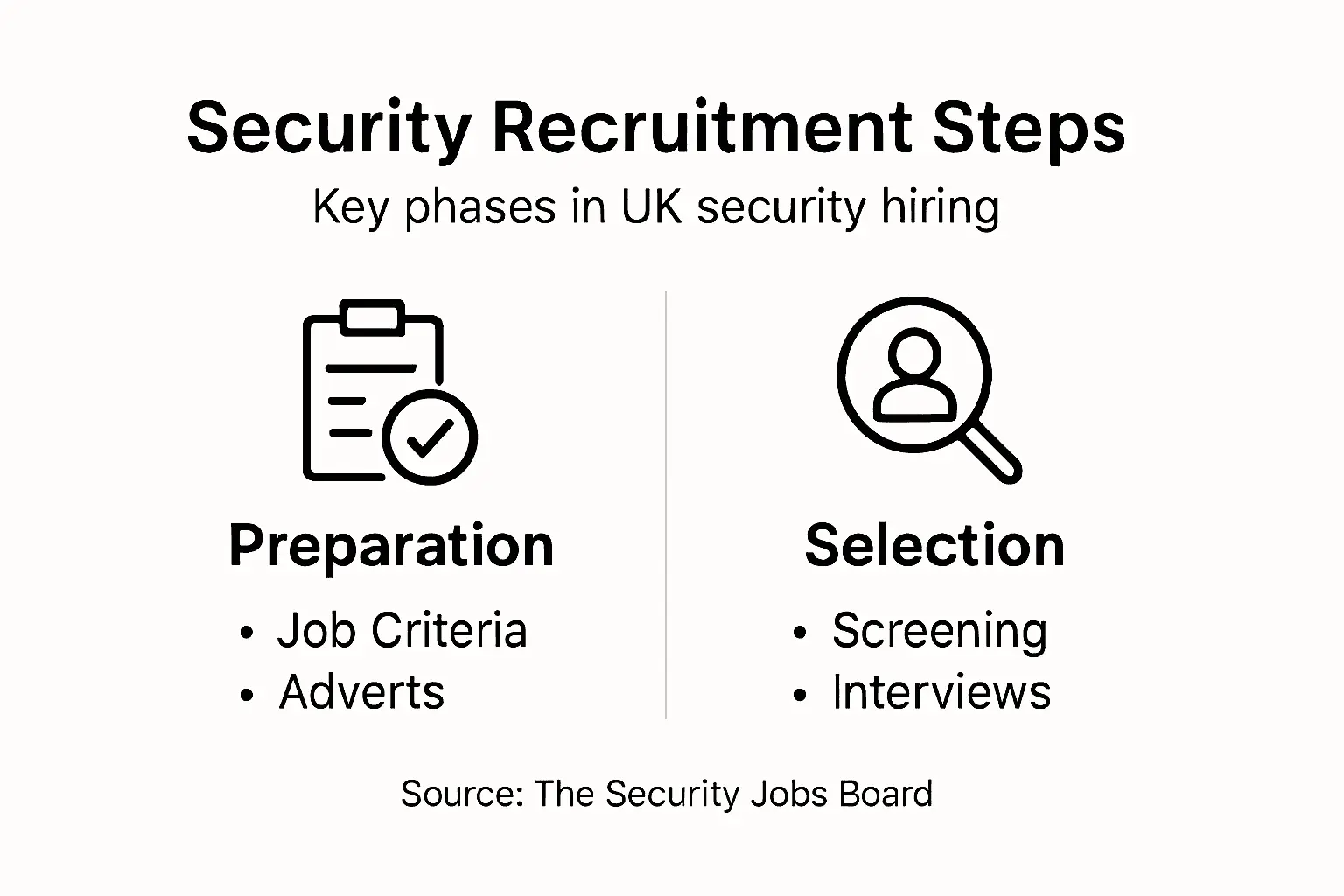
- Step 1: Define Job Requirements And Candidate Criteria
- Step 2: Create Effective Job Adverts And Promote Vacancies
- Step 3: Screen Applications And Shortlist Top Candidates
- Step 4: Conduct Interviews And Assess Suitability
- Step 5: Verify Credentials And Confirm Successful Placement
Quick Summary
| Key Point | Explanation |
|---|---|
| 1. Define job requirements precisely | Knowing the exact role and criteria shapes your recruitment process and attracts quality candidates. Be specific in job descriptions. |
| 2. Create compelling job adverts | A well-crafted advert should clearly communicate the role and attract the right candidates. Use engaging language and clear structure. |
| 3. Use objective criteria for screening | Apply uniform evaluation against defined essential and desirable criteria to ensure fairness and avoid bias in shortlisting candidates. |
| 4. Prepare structured interviews | Consistent interview structures help assess all candidates fairly. Combine competency and technical questions to evaluate their skills effectively. |
| 5. Verify candidate credentials thoroughly | Conduct comprehensive checks on identity, qualifications, and employment history to prevent hiring fraud and ensure candidate suitability. |
Step 1: Define job requirements and candidate criteria
Before you post anything or start reviewing applications, you need to know exactly who you’re looking for. This step sets the foundation for your entire recruitment process and directly impacts the quality of candidates you attract.
Start by conducting workforce planning to understand what your security firm actually needs right now and in the near future. Are you replacing someone who’s left, or are you expanding your team? The answer shapes everything that follows. You’ll want to evaluate whether you genuinely need a new hire or if existing staff could be redeployed.
Once you’ve confirmed the need is real, define the job description with precision. This document outlines the core responsibilities, day-to-day tasks, and reporting structure. Don’t make it vague. Instead of writing “various security duties,” specify exactly what the role entails. Will they be conducting site patrols, managing CCTV systems, handling access control, or responding to alarms? Be specific.
Next, create a person specification that lists the essential and desirable criteria candidates must meet. According to workforce planning and role definition guidance, this document should outline skills, qualifications, and attributes required for success in the post. Separate these into two categories:
-
Essential criteria: Qualifications and experience non-negotiable for the role. A SIA licence? Essential. Five years of security experience? Perhaps essential. Driving licence? Depends on your location and patrol requirements.
-
Desirable criteria: Nice-to-have skills that strengthen a candidate’s application but aren’t deal-breakers. Advanced first aid certification, specific software experience, or local knowledge might fall here.
Remember that all recruitment decisions must comply with UK employment law and equality legislation. This means you cannot include discriminatory requirements. Age, gender, marital status, or ethnic background have no place in your criteria. Focus on what candidates can actually do in the role.
Define essential and desirable criteria separately so you don’t accidentally screen out strong candidates who lack nice-to-haves but excel at the core requirements.
When creating your person specification, think about the actual work environment. A site-based role demands different attributes than a control room position. One requires physical stamina and outdoor resilience; the other demands focus and attention to detail during long shifts.
Here is a summary of key differences between site-based and control room security roles:
| Attribute | Site-Based Role | Control Room Role |
|---|---|---|
| Work environment | Outdoor, physically demanding | Indoors, monitoring environment |
| Key skills required | Physical stamina, resilience | Attention to detail, focus |
| Typical responsibilities | Patrolling, incident response | CCTV, alarm monitoring |
| Common challenges | Weather, variable hours | Shift work, continuous vigilance |
Pro tip: Create a ranking system within your essential criteria so you know which qualifications are truly non-negotiable versus those you could compromise on slightly. This flexibility helps you find strong candidates when ideal matches are scarce.
Step 2: Create effective job adverts and promote vacancies
Your advert is your first impression. It needs to grab attention, communicate the role clearly, and convince the right candidates to apply. A poorly written advert wastes everyone’s time; a sharp one attracts your ideal hire.

Start by crafting a compelling job title. “Security Officer” is bland. “Site Security Officer – London Retail” is specific and searchable. Candidates want to know exactly what they’re applying for, and search algorithms reward precision.
Your advert should be concise and clear. Use simple language that speaks directly to candidates. Avoid jargon or corporate speak. Instead of “responsible for the implementation of security protocols,” say “patrol the site and respond to security incidents.” The difference matters.
Structure your advert with these core elements:
- A brief, engaging opening that tells the story of the role and organisation
- Location (be specific if it’s site-based; mention flexibility if remote options exist)
- Salary range (transparency attracts serious candidates and saves everyone time)
- Key responsibilities using bullet points for easy scanning
- Essential and desirable skills and qualifications you defined earlier
- How to apply and your application deadline
Use bullet points and direct language to improve readability and candidate engagement. People scan adverts quickly; make key information jump out.
Promotion matters as much as creation. Digital advertising now outperforms print significantly. Post your vacancy on Security Jobs Board, industry job boards, and your own website if you have one. Each platform reaches different candidate segments. A school leaver might find you on Indeed; an experienced manager might check dedicated security recruitment platforms.
Consider your audience when choosing platforms. Are you recruiting locally or nationally? Time-sensitive roles need immediate visibility; planned hires have more flexibility. Your promotion strategy should match your urgency and budget.
A well-written advert tells the story of your organisation and role, helping attract candidates who genuinely fit your culture and growth plans.
Set your application deadline clearly. Two weeks is standard; give yourself realistic time to review applications without losing momentum.
Pro tip: Post your advert early in the week (Tuesday or Wednesday) to maximise visibility during peak job-searching times, and refresh it weekly on platforms that allow it to stay visible longer and attract returning candidates.
Step 3: Screen applications and shortlist top candidates
You’ve posted your advert and applications are flooding in. Now comes the critical work of separating strong candidates from those who don’t fit. This step determines who gets invited to interview and directly impacts your hiring success.
Wait until your application deadline has passed before you start reviewing. This prevents bias towards early applicants and gives you the full candidate pool to assess. Once the deadline arrives, it’s time to work systematically through every submission.
Pull out your person specification from Step 1. This is your assessment checklist. Every candidate gets measured against the same essential and desirable criteria you defined. No exceptions, no gut feelings. When measuring candidates against person specifications, apply your criteria uniformly to avoid inconsistency.
Set up a shortlisting panel with at least two people reviewing applications independently. This matters more than you might think. One person’s bias or oversight can eliminate a brilliant candidate. Two perspectives catch what one misses. Have them score each candidate separately, then compare notes. Where they disagree, discuss and agree on a final score.
Consider these screening approaches:
- Score each candidate objectively against essential criteria first (yes/no for each essential requirement)
- Then evaluate desirable criteria to differentiate between candidates who meet all essentials
- Document your reasoning for each decision (required for legal compliance and future reference)
- Create a shortlist of your top candidates, typically 5 to 10 depending on role demand
If possible, use anonymised applications during initial screening. Remove names and dates of birth to reduce unconscious bias. Focus purely on skills, experience, and qualifications. Some candidates’ backgrounds naturally stand out; your role is to ensure you’re not filtering people out based on irrelevant factors like their name’s origin or age.
Assessing candidates objectively against the same criteria ensures fair treatment and helps you identify genuinely strong performers rather than those who simply impress you personally.
Provide feedback to candidates who don’t make the shortlist. A brief, professional response costs little but builds goodwill and your employer brand.
Pro tip: Create a simple scoring spreadsheet where each panel member rates candidates 1 to 5 against essential and desirable criteria, making the comparison process faster and the final decisions clearly defensible.
Step 4: Conduct interviews and assess suitability
You’ve shortlisted your top candidates. Now it’s time to meet them and determine who truly fits the role. Interviews reveal how candidates think, communicate, and handle pressure. They’re your chance to go beyond what’s written on paper.
Prepare thoroughly before the first interview. Plan your interview structure so every candidate faces the same questions and process. Consistency prevents bias and makes comparisons fair. Create a mix of competency-based and technical questions that reveal both how candidates behave and what they know.
Competency-based questions ask candidates to describe situations from their past. Instead of asking “How do you handle conflict?”, ask “Tell me about a time you disagreed with a colleague about security procedures. What happened and what did you do?” Their real examples show genuine capability far better than hypothetical answers.
Technical questions test security-specific knowledge. Ask about SIA licence requirements, how they’d respond to specific incidents, or their understanding of data protection laws relevant to the role. This separates candidates who understand the sector from those who simply applied to any security job.
Use structured interviews with a trained interview panel of at least two people. Each panel member should assess candidates using the same scoring criteria. This approach reduces bias and provides multiple perspectives on suitability.
Consider these interview best practices:
- Ask open questions that invite detailed answers rather than yes/no responses
- Take notes during interviews to support fair assessment later
- Avoid asking discriminatory questions about age, marital status, disability, or family plans
- Allow candidates to ask questions about the role and your organisation
- Provide clear information about next steps and timelines
Structured interview processes that blend behavioural and technical assessment help you evaluate candidates comprehensively. After interviews conclude, compare panel notes and score candidates against your suitability criteria. Document your reasoning for selecting or rejecting each candidate.
Thorough interview preparation and consistent assessment across all candidates ensures you’re making hiring decisions based on genuine capability, not first impressions or gut feeling.
Communicate outcomes promptly. Offer the role to your top candidate while keeping runners-up warm in case your first choice declines.
Pro tip: Record your interview scores and comments immediately after each candidate leaves so memories are fresh and your assessments reflect actual performance rather than impressions formed later in the day.
Step 5: Verify credentials and confirm successful placement
You’ve selected your candidate. Before you hand them a contract, you need to verify they are who they claim to be and that their qualifications are genuine. This step protects your firm, your clients, and your reputation.
Pre-employment screening is non-negotiable in security recruitment. Your candidate might be perfect in interview, but verification catches discrepancies before they become problems. Start this process immediately after making your offer conditional on successful checks.
Begin with identity verification. Request original documents proving their identity and Right to Work in the UK. Check their passport or driving licence against your records. This confirms they are a real person with legal permission to work in Britain.
Next, verify their qualifications. If they claim an SIA licence, check the SIA register directly. If they mention security certifications or first aid training, request certificates and verify them with the issuing bodies. Don’t assume; confirm. A candidate might have completed training but not yet received their certificate, so clarify the timeline.
Check their employment history by contacting previous employers. Ask about dates worked, job title, responsibilities, and performance. Request references from at least two former managers. Be specific in your questions. A short employment gap might have a legitimate explanation; ask about it directly with the candidate.
Run a criminal records check through Disclosure and Barring Service (DBS) if your role requires it. Most security positions demand at least a Standard DBS check; some require Enhanced. Pre-employment screening including criminal records verification reduces organisational risk and ensures compliance with security industry standards.
Verification steps to complete:
Here is a comparison of typical screening methods and their primary benefits in security recruitment:
| Screening Method | Main Objective | Benefit to Security Firms |
|---|---|---|
| Identity verification | Confirm candidate identity and legality | Prevents right to work and ID fraud |
| SIA licence checking | Ensure legal compliance for the role | Reduces risk of illegal employment |
| Reference and employment | Validate work history and experience | Detects possible false information |
| DBS criminal records | Assess candidate’s background | Ensures only suitable individuals hired |
| Qualification verification | Confirm genuine training/credentials | Validates professional competence |
- Identity checks using original documents
- SIA licence confirmation via the official register
- Right to Work verification
- Employment history and reference checks
- DBS check (Standard or Enhanced as required)
- Any professional qualifications relevant to the role
Once all checks pass successfully, you can proceed with finalising the employment contract. Document every check completed and store records securely for compliance purposes.
Thorough credential verification protects your firm from hiring fraudsters and ensures every new employee genuinely meets the standards your clients expect.
Inform your candidate of all checks upfront so there are no surprises. Most genuine candidates welcome this transparency.
Pro tip: Create a pre-employment verification checklist that you work through systematically for every hire; this ensures nothing gets missed and provides clear documentation if issues ever arise later.
Streamline Your Security Recruitment with Expert Support
Recruiting the right security professionals in the UK involves clearly defining job requirements, crafting precise adverts, thorough candidate screening, structured interviews and meticulous credential verification. These essential steps protect your organisation and ensure compliance but can feel overwhelming and time-consuming. By leveraging trusted specialised platforms like The Security Jobs Board, you gain powerful tools designed specifically for UK security firms to simplify your recruitment journey. Benefit from features such as targeted job posting, access to a verified CV database and GDPR-compliant communication channels that put quality candidates right at your fingertips.

Don’t let recruitment challenges delay your growth or compromise standards. Visit The Security Jobs Board now to post your vacancies with confidence, find candidates who meet your essential criteria, and secure your next hire faster. Experience a seamless recruitment process that aligns perfectly with all the steps outlined in your guide.
Frequently Asked Questions
How do I define job requirements for security roles?
To define job requirements, start by conducting workforce planning to assess whether you need to replace an employee or expand your team. Then, create a detailed job description and person specification that outlines essential and desirable criteria to attract the best candidates.
What should I include in a job advert for security positions?
A job advert should include a compelling title, the role’s location, a clear salary range, key responsibilities in bullet points, and both essential and desirable skills. Ensure the language is straightforward and engaging to capture the interest of potential applicants.
How do I objectively screen applications for security jobs?
To objectively screen applications, use a person specification to evaluate candidates against defined essential and desirable criteria. Establish a shortlisting panel to review applications independently, ensuring that bias is minimised and that you document all reasoning for candidate selections.
What are effective interview techniques for security recruitment?
Effective interview techniques include preparing a structured format with competency-based and technical questions that allow candidates to demonstrate their experience and knowledge. Maintain consistency by having the same interview panel and scoring criteria for each candidate to ensure fair comparisons.
How can I verify a candidate’s credentials in security recruitment?
To verify a candidate’s credentials, conduct identity checks, confirm SIA licences, and request references from previous employers. Thoroughly check qualifications and run criminal record checks to ensure compliance and mitigate any hiring risks.
What should I communicate to candidates during the recruitment process?
Communicate clearly about each stage of the recruitment process, including application deadlines, interview timelines, and the steps for verifying credentials. Ensure that candidates know what to expect at every phase to build trust and professionalism in your hiring practices.


