What is compliance monitoring: a guide for UK security professionals

A surprising truth: companies with robust compliance monitoring reduce regulatory breaches by over 60% compared to those treating compliance as a yearly tick-box exercise. Yet many UK security firms still misunderstand compliance monitoring as a one-time event rather than an ongoing commitment. This guide demystifies compliance monitoring for security professionals and compliance officers, covering essential UK frameworks, legal requirements, technology solutions, and actionable implementation steps that transform compliance from burden into competitive advantage.
Table of Contents
- Introduction To Compliance Monitoring
- Legal And Regulatory Framework In The UK Security Industry
- Best Practices Frameworks For Compliance Monitoring
- Technology And Tools To Enhance Compliance Monitoring
- Practical Steps To Implement Compliance Monitoring In UK Security Firms
- Explore Security Careers And Compliance Roles In The UK
- FAQ
Key takeaways
| Point | Details |
|---|---|
| Ongoing process | Compliance monitoring is continuous assessment, not a single audit event |
| UK legal drivers | Private Security Industry Act 2001 and GDPR mandate rigorous monitoring |
| Best practice frameworks | ISO 19600 and risk-based approaches enhance accountability and effectiveness |
| Technology advantage | Automation tools improve accuracy, reduce errors, and provide real-time oversight |
| Practical roadmap | Implementation involves risk assessment, audits, training, and continuous improvement |
Introduction to compliance monitoring
Compliance monitoring is the systematic, ongoing assessment of whether your security organisation adheres to laws, industry regulations, internal policies, and professional standards. Unlike a single audit that captures a moment in time, compliance monitoring operates continuously to identify gaps, prevent violations, and support accountability across your operations.
For UK security firms, this monitoring spans three critical levels. Legal compliance ensures you meet statutory requirements like licensing and data protection. Policy compliance verifies adherence to industry standards and internal procedures. Operational compliance confirms daily activities align with approved practices and contractual obligations.
Why does continuous monitoring matter? Risks evolve constantly. A quarterly audit might miss emerging vulnerabilities or spot problems too late to prevent harm. Regular monitoring catches issues early, protects your reputation, and demonstrates due diligence to regulators and clients.
The compliance monitoring cycle includes four core components:
- Risk identification and assessment to prioritise monitoring efforts
- Regular data collection through audits, reviews, and system checks
- Analysis and reporting to identify trends and non-conformities
- Corrective action and continuous improvement based on findings
Beyond avoiding legal penalties, effective compliance monitoring delivers tangible benefits. It strengthens operational efficiency by standardising processes. It builds client trust through demonstrated accountability. It reduces insurance costs by proving risk management capability. Most importantly, it creates a culture where compliance becomes embedded in daily operations rather than an afterthought.
Pro Tip: Start small by monitoring your highest-risk areas first, then expand coverage as processes mature. This risk-based approach maximises early impact without overwhelming your team.
Legal and regulatory framework in the UK security industry
The Private Security Industry Act 2001 establishes the foundation for UK security sector regulation. This legislation mandates individual licensing through the Security Industry Authority (SIA) for frontline operatives and sets operational standards for security businesses. Compliance monitoring ensures your firm maintains current licences, follows approved training requirements, and operates within lawful boundaries.

GDPR regulations affecting data handling create additional compliance obligations. Security operations routinely process personal data through CCTV systems, access control records, and incident reports. Failure to properly manage this data triggers substantial fines and reputational damage. Regular monitoring verifies data handling practices meet lawful basis requirements, maintain appropriate security measures, and respect individual rights.
Non-compliance carries severe consequences. GDPR violations can result in fines up to £17.5 million or 4% of global turnover, whichever is higher. SIA licence revocations prevent you from operating legally. Beyond financial penalties, compliance failures damage client relationships and competitive positioning in a sector where trust is paramount.
Compliance monitoring mitigates these legal exposures through systematic verification. Regular checks confirm security screening processes meet standards. Audits validate security checks procedures remain current. Documentation reviews ensure evidence exists to demonstrate compliance if challenged.
Key regulatory areas requiring ongoing monitoring include:
- SIA licence validity and renewal tracking for all operatives
- Data protection impact assessments for surveillance activities
- Incident reporting and record retention requirements
- Subcontractor vetting and compliance verification
- Training delivery and competency maintenance records
UK security firms operating without structured compliance monitoring face elevated risks. A single data breach or licensing lapse can unravel years of reputation building and trigger enforcement action that threatens business viability.
Best practices frameworks for compliance monitoring
International standards provide proven frameworks for building effective compliance monitoring systems. ISO 19600 offers comprehensive guidance on compliance management systems, emphasising risk-based approaches and continuous improvement. BS 31100 focuses specifically on risk management principles that underpin effective monitoring prioritisation.
These frameworks share common elements: senior leadership commitment, clear accountability structures, documented processes, regular reviews, and integration with business operations. They transform compliance from a separate function into embedded practice.
Risk-based prioritisation forms the foundation of efficient monitoring. Not all compliance areas carry equal consequence. Focusing resources on high-impact, high-likelihood risks ensures monitoring delivers maximum protection. A risk matrix helps categorise compliance obligations and allocate appropriate monitoring frequency and depth.
Internal audits serve as structured monitoring tools. Scheduled reviews verify adherence to policies and identify improvement opportunities. Audit frequency depends on risk levels: high-risk areas might require monthly checks whilst stable, low-risk processes need only annual review. Security audit practices adapted to compliance monitoring create systematic verification.
| Framework | Primary focus | Key benefit |
|---|---|---|
| ISO 19600 | Compliance management systems | Comprehensive approach integrating compliance across operations |
| BS 31100 | Risk management principles | Prioritisation framework ensuring efficient resource allocation |
| Internal audits | Systematic verification | Regular checks identifying gaps before they become violations |
Frameworks support accountability by defining clear roles and responsibilities. Compliance officers coordinate monitoring activities. Department heads ensure their teams follow procedures. Auditors provide independent verification. This distributed accountability prevents compliance becoming siloed.
Common pitfalls avoided through framework adoption include:
- Reactive compliance addressing only known violations rather than proactive monitoring
- Inconsistent monitoring creating coverage gaps
- Documentation failures leaving no evidence of compliance efforts
- Lack of continuous improvement allowing repeated issues
Pro Tip: Adopt framework elements incrementally rather than attempting complete implementation immediately. Start with risk assessment and basic audit schedules, then layer additional framework components as capability grows.
Technology and tools to enhance compliance monitoring
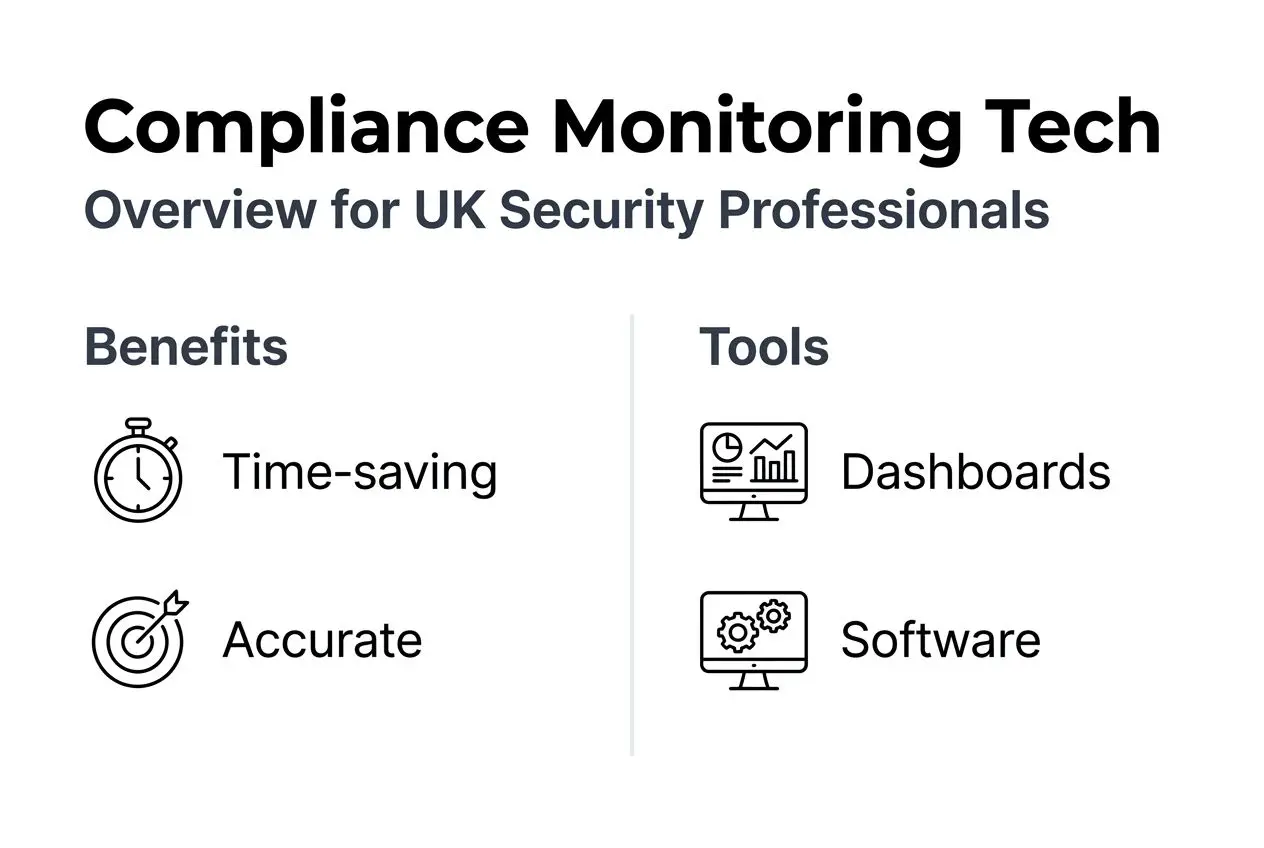
Modern technology transforms compliance monitoring from manual, time-consuming tasks into efficient, accurate processes. Automation handles routine checks, freeing compliance teams to focus on analysis and improvement rather than data collection.
Compliance management software centralises monitoring activities. These platforms track regulatory requirements, schedule audits, assign tasks, and generate reports from a single interface. Integration with operational systems creates automatic data feeds, eliminating manual entry errors and ensuring real-time accuracy.
Real-time dashboards provide instant visibility into compliance status. Traffic-light indicators highlight areas requiring attention. Trend analysis reveals patterns suggesting emerging risks. Automated alerts notify relevant personnel when thresholds are breached or deadlines approach.
Audit trails embedded in digital systems document who did what and when. This automatic record-keeping proves invaluable during regulatory inquiries or client audits. Remote monitoring technology principles apply equally to compliance monitoring, enabling oversight without constant manual intervention.
Comparing approaches clarifies technology’s value:
- Manual monitoring: time-intensive, error-prone, limited scalability, delayed insights
- Automated monitoring: efficient, consistent, scales easily, provides real-time visibility
Technology recommendations vary by organisation size. Small security firms benefit from cloud-based compliance platforms offering affordable subscriptions and minimal IT requirements. These solutions provide professional-grade monitoring without enterprise costs or complexity.
Larger organisations justify custom integrations connecting compliance systems with existing operational platforms. API connections create seamless data flow between HR systems, training databases, incident reporting tools, and compliance dashboards.
Essential technology features for security sector compliance monitoring:
- Licence expiry tracking with automated renewal reminders
- Training completion monitoring linked to competency requirements
- Incident logging with regulatory reporting workflows
- Document version control ensuring current policies are accessible
- Secure data storage meeting GDPR requirements
- Configurable reporting supporting both internal reviews and external audits
Technology enhances accuracy but doesn’t eliminate human judgement. Compliance officers still interpret findings, assess risk significance, and determine appropriate responses. Technology handles the mechanical work, allowing professionals to focus on strategic compliance management.
Practical steps to implement compliance monitoring in UK security firms
Successful implementation follows a structured approach. These steps create sustainable compliance monitoring programmes tailored to your security firm’s specific risks and resources.
- Conduct comprehensive risk assessment identifying compliance obligations across legal, regulatory, and contractual commitments. Categorise risks by likelihood and impact to prioritise monitoring efforts.
- Define clear metrics and monitoring criteria for each compliance area. Establish what “good” looks like and how you’ll measure it consistently.
- Schedule regular monitoring activities matching risk levels. High-risk areas require frequent checks; stable processes need less intensive monitoring.
- Assign accountability ensuring someone owns each monitoring task. Clear ownership prevents gaps and supports follow-through.
- Train staff on compliance importance and their role in the monitoring programme. Frontline operatives often spot issues first but need awareness to escalate concerns.
- Deploy appropriate technology automating routine checks and centralising monitoring data. Even simple spreadsheets improve consistency over ad hoc approaches.
- Review findings regularly, identifying trends and systemic issues requiring corrective action. Monthly reviews keep monitoring responsive.
- Continuously improve the programme based on lessons learned. Compliance monitoring itself needs periodic evaluation and refinement.
A UK security firm reduced GDPR-related breaches by 60% after implementing an ISO-based compliance monitoring programme with automated tracking. The transformation involved three phases. Initially, manual quarterly audits identified baseline compliance levels. Next, automated monitoring tools provided continuous oversight. Finally, integrated dashboards enabled proactive management preventing issues before they escalated.
Critical success factors include:
- Senior leadership visibly supporting compliance monitoring initiatives
- Adequate resources allocated to monitoring activities
- Clear escalation paths when issues are identified
- Regular communication celebrating compliance successes and learning from failures
Integrate monitoring into recruitment processes from the start. New hires should understand compliance expectations and monitoring procedures during induction. Regular refresher training reinforces compliance culture.
Documentation proves monitoring effectiveness. Maintain records of monitoring schedules, audit findings, corrective actions, and verification that corrections worked. This evidence demonstrates due diligence if regulatory questions arise.
Start implementation with a pilot programme in one high-risk area. Learn lessons, refine processes, then expand coverage systematically. This phased approach builds capability without overwhelming teams unaccustomed to structured monitoring.
Explore security careers and compliance roles in the UK
Compliance monitoring expertise opens rewarding career paths in the UK security sector. As regulatory requirements intensify, firms increasingly seek professionals who combine security knowledge with compliance capability.

Browse current security opportunities spanning compliance officer roles, audit positions, and operational management requiring regulatory knowledge. Specialised positions increasingly demand understanding of both security operations and legal frameworks governing the industry.
The Security Jobs Board connects UK security professionals with employers valuing compliance expertise. Whether you’re seeking compliance-focused roles or operational positions requiring regulatory awareness, relevant opportunities await. Regional opportunities like Northern Ireland positions offer diverse career options across the UK.
Advancing your compliance monitoring knowledge enhances career prospects and supports professional growth in a sector where regulatory competence increasingly differentiates candidates. Explore opportunities aligned with your developing expertise today.
FAQ
What challenges do UK security firms face when implementing compliance monitoring?
Resource constraints top the list, particularly for smaller firms balancing operational demands with monitoring requirements. Staff training gaps create inconsistency, whilst keeping pace with evolving regulations requires ongoing effort. Effective programmes address these through risk-based prioritisation and phased implementation.
How often should compliance monitoring audits be conducted in security companies?
Audit frequency depends on risk assessment outcomes. High-risk areas typically require monthly or quarterly reviews, whilst stable processes may need only annual verification. Continuous improvement demands flexibility, adjusting schedules as risks change or new regulations emerge.
Can small security firms benefit from automated compliance monitoring tools?
Absolutely. Affordable cloud-based solutions now provide enterprise-grade monitoring capability at small business prices. Automation significantly improves accuracy and efficiency even for small teams. Many firms start with hybrid approaches, automating routine checks whilst handling complex assessments manually.
What qualifications help security professionals specialise in compliance monitoring?
Relevant certifications include ISO 19600 Lead Implementer, GDPR Practitioner, and professional security qualifications emphasising regulatory knowledge. Practical audit experience combined with security operations understanding creates valuable expertise. Continuous professional development keeps skills current as regulations evolve.


