Roles and responsibilities of security guard: 2026 guide

TL;DR:
- Security guards perform core functions of observation, deterrence, and reporting to ensure safety across various sectors. They actively patrol, monitor surveillance systems, control access, and respond promptly to emergencies, emphasizing thorough training and situational awareness. Accurate documentation and strong communication skills are essential for effective security management and career advancement.
Security guards protect people, property, and assets through three core functions: observation, deterrence, and reporting. These are not informal descriptions. Industry data confirms these three pillars appear in 95% or more of professional security guard job descriptions as of 2026. Whether you are considering a career in retail security, corporate premises, or event management, the fundamental duties of a security guard remain consistent across sectors. This guide breaks down exactly what the role involves, what skills you need, and what to expect on the job.
What are the primary duties a security guard performs on site?
The day-to-day responsibilities of security personnel are more varied than most people expect. A security guard is not simply a visible presence. The role demands active engagement with the environment, the people in it, and the systems designed to keep it safe.
Patrolling and monitoring
Patrols follow unpredictable patterns that focus on vulnerable areas and are vital for detecting forced entry, safety hazards, and suspicious behaviour. Randomised patrol intervals are deliberate. Predictable routes give potential offenders a window to act undetected. Foot patrols are often combined with vehicle patrols and CCTV monitoring to create overlapping layers of coverage.
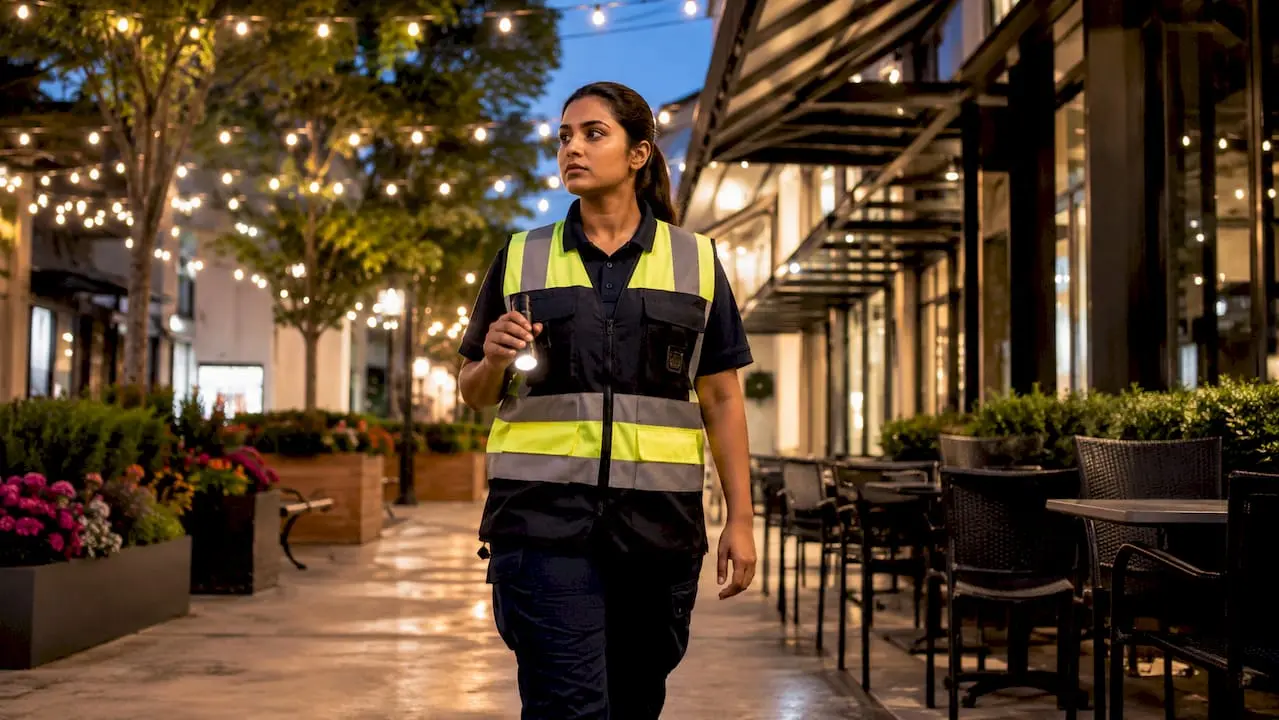
Monitoring CCTV systems is a core part of the security guard job description in most fixed-site roles. Guards watch live feeds, review footage following incidents, and flag anomalies to supervisors or emergency services. Physical security best practices, including surveillance and access layering, are now standard expectations in professional security roles.
Access control
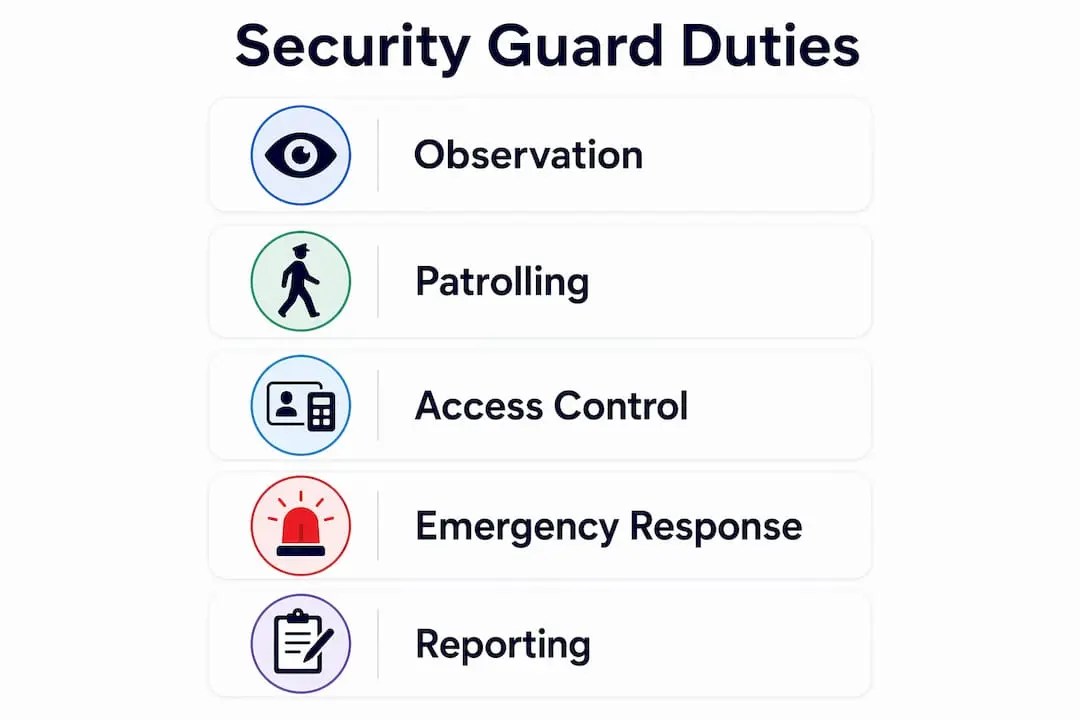
Controlling entry points is one of the most visible functions of security guards. This includes verifying visitor identification, managing sign-in procedures, issuing temporary passes, and refusing access to unauthorised individuals. Access control is not just about stopping threats. It creates a documented record of everyone on site, which becomes critical during emergencies or investigations. You can read more about access control responsibilities and how they apply across different UK roles.
Incident response
Security guards are expected to respond immediately and appropriately when something goes wrong. This includes confronting suspicious individuals, managing disturbances, and contacting emergency services. The response must be proportionate and professional. Overreaction carries legal risk. Underreaction allows situations to escalate.
- Patrol premises at irregular intervals to cover vulnerable access points
- Verify visitor identity and manage entry logs at all controlled access points
- Monitor CCTV feeds and alarm systems for signs of intrusion or hazard
- Respond to disturbances, suspicious activity, and alarms in real time
- Communicate clearly with site management, colleagues, and emergency services
Pro Tip: When starting a new posting, walk the entire site before your first patrol. Knowing the layout, blind spots, and alarm panel locations before an incident occurs is one of the most practical things you can do.
How do security guards contribute to emergency response and safety management?
Security guards are typically the first people on the scene when an emergency occurs. Effective action within the first 3–5 minutes prevents escalation in the majority of incidents. That window is short, and it places real responsibility on the guard.
Emergency duties are not improvised. They are learned through structured training and regular drills. A guard who has never practised an evacuation procedure will hesitate when it matters most.
Here are the key emergency responsibilities a security guard carries:
- Initiate evacuations. When a fire alarm activates or a threat is identified, guards direct staff and visitors to assembly points using pre-planned evacuation routes.
- Operate emergency equipment. Guards are trained to use fire panels, duress alarms, and first aid kits. Knowing where equipment is located and how to use it correctly is non-negotiable.
- Liaise with emergency services. When police, fire, or ambulance services arrive on site, the guard is their first point of contact. Providing accurate information quickly is part of the role.
- Secure the scene. After an incident, guards preserve the area to protect evidence and prevent further harm until authorities take over.
- Maintain composure. Calm, decisive action reassures others and prevents panic from spreading.
Site-specific emergency procedures including evacuations and interfacing with emergency services require methodical action learned through training. This is why the essential training for security staff matters so much before you step into a live role.
Pro Tip: Ask your employer for a copy of the site emergency plan on your first day. Read it before your first shift, not during one.
Why is reporting and documentation vital in security guard responsibilities?
Reporting is not administrative box-ticking. Accurate documentation provides liability protection for clients and is regularly used by insurers and legal teams when assessing claims. A guard who responds well to an incident but fails to document it correctly can leave their employer exposed.
The security guard tasks related to reporting include:
- Incident reports. Written accounts of any event that deviates from normal operations, including the time, location, people involved, and actions taken.
- Patrol logs. Records confirming that patrols were completed, when, and by whom. These logs demonstrate due diligence.
- Visitor and access records. Logs of everyone who entered and exited the site, including the purpose of their visit.
- Handover notes. A written summary passed to the incoming guard at shift change, covering anything relevant from the previous shift.
Report logs and documented guard presence directly influence how site management assesses security risks and makes operational decisions. A pattern of incidents logged in the same location, for example, might prompt a client to install additional lighting or CCTV.
| Document type | Purpose |
|---|---|
| Incident report | Records details of events for legal, insurance, and operational review |
| Patrol log | Confirms coverage and demonstrates due diligence to clients |
| Access control record | Tracks all site entries and exits for audit and investigation |
| Handover notes | Maintains continuity between shifts and flags unresolved issues |
For a deeper look at documentation standards, the Securityjobsboard guide on incident reporting in UK security covers best practice in detail.
What skills and situational judgement do security guards need?
The misconception that security guards mainly stand guard undermines the complex, data-driven judgement required for effective security work today. The role demands active thinking, not passive presence.
Situational awareness
Effective guards act proactively. They read environments, notice changes in behaviour, and identify risks before they escalate. Data-driven situational judgement is now an expectation in professional security roles, not a bonus skill. This means observing patterns, not just reacting to obvious threats.
Communication and de-escalation
Strong communication skills are required for de-escalation, customer service, and managing confrontations professionally. Security guards interact with staff, visitors, contractors, and members of the public every shift. How they handle those interactions reflects directly on the organisation they represent. A guard who can calm a difficult situation through conversation is far more valuable than one who relies solely on physical presence.
Technology proficiency
Modern security roles require comfort with CCTV systems, access control software, alarm panels, and digital reporting tools. Site-specific training covers these systems, but a willingness to learn new technology is increasingly expected. Reviewing practical security training examples gives you a realistic picture of what that preparation looks like.
Adaptability
No two shifts are identical. A guard might spend one night managing a quiet corporate lobby and the next responding to a medical emergency. The ability to shift from routine to high-pressure situations without losing composure is what separates competent guards from exceptional ones.
Pro Tip: Keep a personal notebook during your first few months in a role. Logging what you observe, how you responded, and what you would do differently builds situational awareness faster than any formal training alone.
Key takeaways
The roles and responsibilities of a security guard require observation, deterrence, reporting, and active situational judgement across every shift and setting.
| Point | Details |
|---|---|
| Three core pillars | Observation, deterrence, and reporting form the basis of nearly every professional security role. |
| Emergency response | Guards are first on scene and must act within 3–5 minutes to prevent escalation. |
| Documentation matters | Accurate incident reports and patrol logs protect clients legally and inform management decisions. |
| Skills beyond presence | Communication, situational awareness, and technology proficiency are now standard expectations. |
| Training is non-negotiable | Site-specific training and regular drills prepare guards for real-world emergencies and unpredictable situations. |
The security role is more demanding than most people realise
I have spoken with hundreds of people considering a career in security, and the same assumption comes up repeatedly. They expect the job to be straightforward: show up, look the part, walk around occasionally. That assumption does not survive contact with the actual role.
What strikes me most about security work in 2026 is how much it has shifted toward professional accountability. Guards are now expected to produce accurate written records, operate digital systems, manage public interactions with composure, and make sound judgements under pressure. That is a genuine skill set, not a placeholder job.
The career pathways are real too. Many people enter as a static guard or retail security officer and progress into supervisory roles, close protection, or specialist areas like cyber-physical security. The role of security staff across the UK has expanded considerably, and the demand for qualified, professional guards is not slowing down.
My honest advice: treat the training seriously from day one. The guards who advance are not the ones who are physically imposing. They are the ones who communicate clearly, document thoroughly, and stay calm when others do not.
— Rob
Find your next security role with Securityjobsboard

If this guide has given you a clearer picture of what a security career involves, the next step is straightforward. Securityjobsboard connects jobseekers with verified security employers across the UK, with no fees and no unnecessary steps. You can create a profile, upload your CV, and set job alerts in minutes. For those based in or open to relocating, there are active security jobs in Northern Ireland available right now. Securityjobsboard is affiliated with the BSIA, which means every listing meets professional industry standards. Start your search today at Securityjobsboard.
FAQ
What does a security guard do on a typical shift?
A security guard patrols the site, monitors CCTV and alarm systems, controls access points, responds to incidents, and completes written reports. The exact tasks vary by site and assignment.
Is a security guard licence required to work in the UK?
Yes. Security guards in the UK must hold a valid SIA (Security Industry Authority) licence before working in a licensable role. Training and a background check are required to obtain one.
How important is reporting in a security guard’s role?
Reporting is as important as physical presence. Accurate incident reports and patrol logs provide legal and insurance protection for clients and directly inform site management decisions.
What is the difference between a static guard and a mobile patrol guard?
A static guard is assigned to a fixed location such as a building entrance or reception. A mobile patrol guard covers multiple sites or a larger area, typically by vehicle, checking each location at irregular intervals.
Can security guard experience lead to career progression?
Yes. Many security professionals move into supervisory roles, specialist areas such as close protection or event security, or management positions. Consistent performance, strong documentation habits, and continued training are the most reliable routes forward.


