Duties and responsibilities of a security officer explained
TL;DR:
- A UK security officer’s role involves complex duties, legal compliance, and effective conflict management, beyond just wearing a uniform. They must respond swiftly to incidents, control access, patrol unpredictably, document actions accurately, and de-escalate conflicts verbally, all within a regulated framework. Developing professional judgment through reflection and understanding the interconnectedness of responsibilities advances career prospects in the security industry.
The duties and responsibilities of a security officer are far more layered than most people assume. A uniform and a clipboard is not the job. Across the UK, security professionals work within a tightly regulated framework that demands physical presence, legal awareness, conflict management, and meticulous documentation, often simultaneously. Whether you are new to the sector or looking to sharpen your understanding of what is actually expected on site, this guide breaks down the core obligations, regulatory requirements, and role-specific variations that define professional security work in the UK today.
Table of Contents
- Core duties of a security officer in the UK
- Regulatory requirements and standards shaping security duties
- Conflict management and de-escalation techniques for security professionals
- Variations in duties across different security roles and environments
- Practical application: executing and balancing duties effectively
- Rethinking the security officer’s role: beyond checklist compliance
- Advance your career with expert guidance and job opportunities
- Frequently asked questions
Key Takeaways
| Point | Details |
|---|---|
| Five core responsibilities | Security officers must master access control, patrolling, incident response, conflict de-escalation, and reporting to be effective. |
| Licence compliance | Displaying your SIA licence visibly and correctly is legally mandatory during licensable activity. |
| Integrated skills | Effective security work depends on combining communication, observation, judgement, and legal knowledge. |
| Role-specific duties | Security duties vary by environment, requiring role-specific knowledge from retail to corporate to door supervision. |
| Patrol variation | Changing patrol routes and timings alongside CCTV usage enhances site security and threat detection. |
Core duties of a security officer in the UK
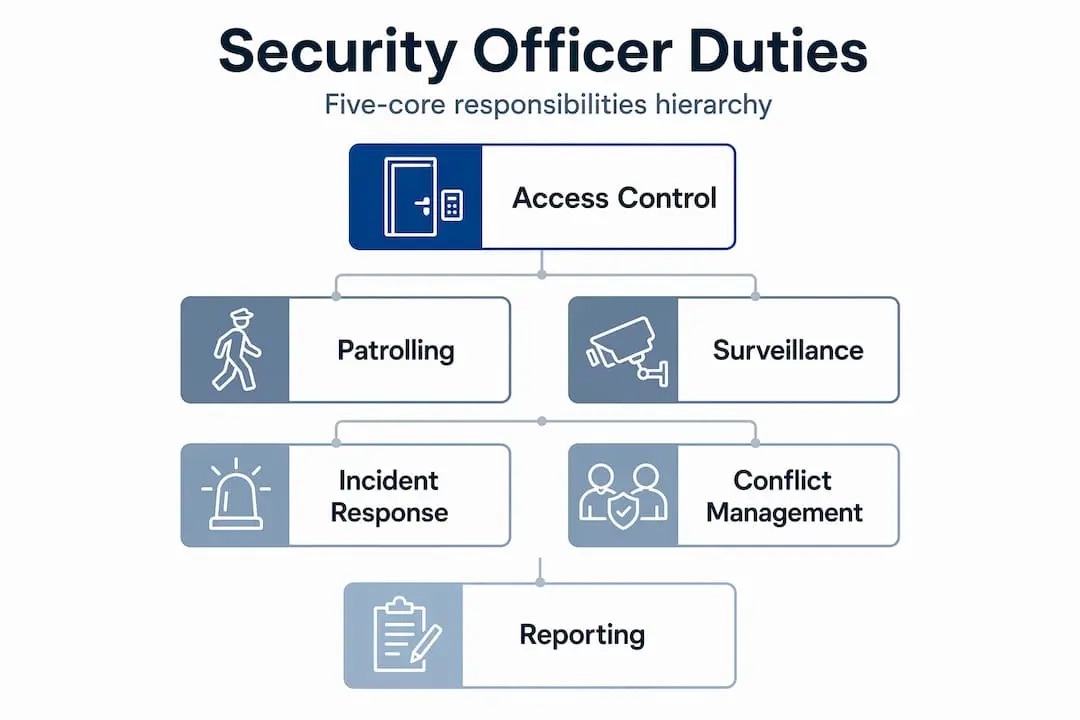
When people picture a security officer, they usually picture someone standing at a door. The reality is considerably more demanding. Security officers must respond to incidents within the first 60 seconds, covering access control, patrolling, surveillance, conflict de-escalation, and reporting as the five interconnected areas of daily work.
These are not isolated tasks. Each one feeds into the others, and a gap in any single area weakens the entire security operation on site.
Here is how each core duty breaks down in practice:
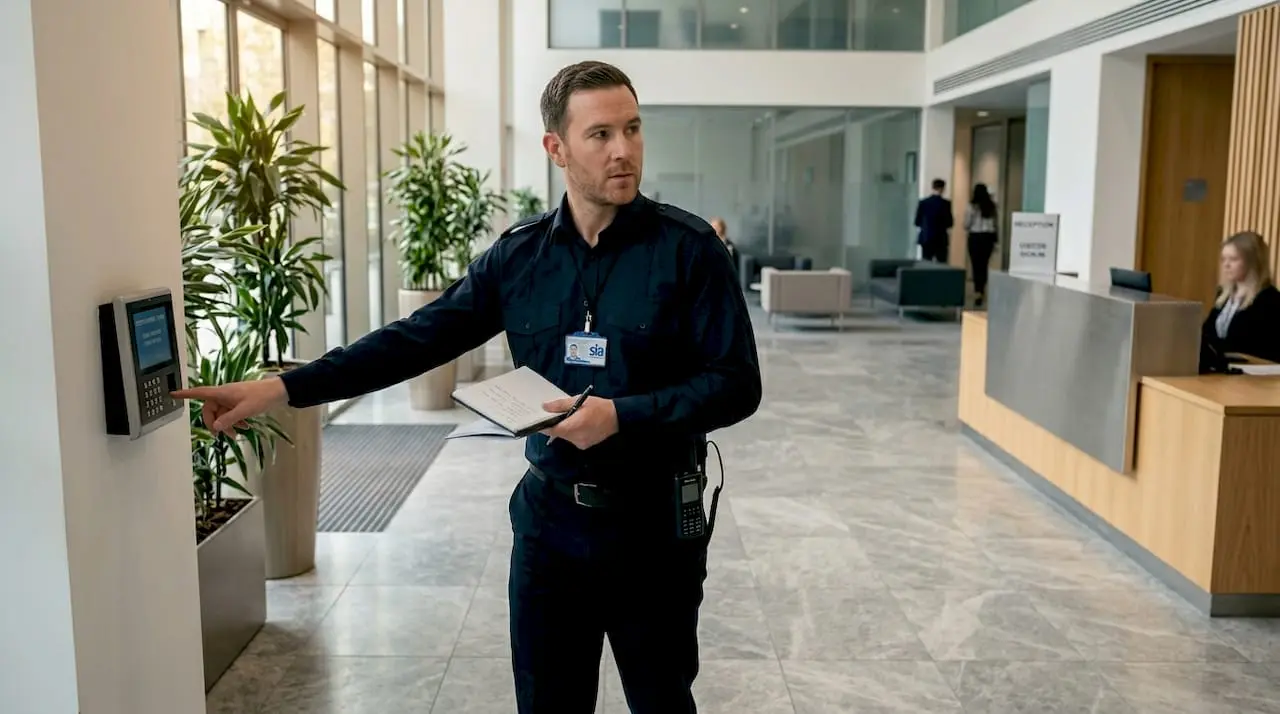
- Access control - This goes beyond checking an ID. It includes verifying credentials against an approved access list, managing the flow of people through entry points, and recording arrivals and departures. During shift changeovers or high-footfall periods, this duty demands sustained concentration.
- Patrolling and surveillance - A patrol is only effective if it is unpredictable. Covering the same route at the same time every hour creates an exploitable pattern. Effective patrols vary timing, change routes, and are paired with CCTV monitoring to cross-reference activity across the site.
- Incident response - The first 60 seconds matter most. Officers must assess the nature of the incident and either contain it or summon the appropriate assistance. Hesitation at this stage can allow a situation to escalate beyond control.
- Conflict de-escalation - Verbal communication is the primary tool. Physical intervention follows only when all other options have been exhausted. The SIA training framework is explicit on this point.
- Accurate reporting - Every incident, however minor, should be logged with precise timestamps, descriptions, and witness details. This documentation supports legal proceedings and internal reviews, and it protects you professionally if your conduct is ever questioned.
“A security officer who cannot write a clear, accurate incident report is only doing half the job. Documentation is where accountability lives.”
For a closer look at how these duties translate into specific job roles, the security officer duties and responsibilities guide on this platform is worth bookmarking.
Regulatory requirements and standards shaping security duties
Having established what general security officers do, understanding the legal and regulatory frameworks that shape these duties is equally important.
The Private Security Industry Act 2001 is the foundation. It governs who can legally perform licensable security activities in England, Wales, Scotland, and Northern Ireland. Under this legislation, SIA licence holders must display their licence visibly at all times unless covert or exempted conditions apply.
Before you can work in the industry, the pre-employment screening process must be completed to BS7858 standards. BS7858 requires verification of five years’ employment history, DBS checks, and financial probity before employment in security guarding. This is not a tick-box exercise. Any employment gap exceeding one month during the verification period must be explained and evidenced, or the application can be rejected outright.
Key regulatory obligations include:
- Displaying your SIA licence above all clothing so it remains visible during any licensable activity
- Carrying proof of identity during every shift
- Maintaining a clean conduct record to avoid licence suspension or revocation
- Ensuring your BS7858 screening is up to date when moving between employers
- Understanding that covert roles carry specific licence exemptions but do not remove the obligation to hold a valid licence
Pro Tip: Before applying for any security role, check the exact expiry date on your SIA licence. Many applicants fail employment checks not because of screening issues, but because they have let their licence lapse by even a few days. Keeping a calendar reminder three months before renewal avoids an entirely avoidable gap in your employment eligibility.
If you are working towards obtaining an SIA licence for the first time, or renewing after a break from the industry, understanding the full process will save you significant time. The security screening checks involved are more thorough than most candidates anticipate.
Conflict management and de-escalation techniques for security professionals
Beyond basic duties and legal mandates, conflict management is arguably the skill that separates competent security professionals from exceptional ones.
Security officers prioritise communication, tone, body language, and space management for conflict de-escalation. Physical force is a last resort, and the SIA is unambiguous on this point. An officer who reaches for physical intervention before exhausting verbal options is not only creating a safety risk but is also exposing themselves and their employer to serious legal liability.
Practical de-escalation techniques include:
- Calm, measured tone - A raised voice signals aggression and triggers defensive reactions. A steady, unhurried tone signals control.
- Open body language - Arms uncrossed, non-confrontational stance, and avoiding prolonged direct eye contact in highly agitated situations all reduce perceived threat.
- Maintaining safe distance - Staying approximately two arm lengths from an agitated individual gives both parties breathing room and reduces the risk of sudden physical contact.
- Offering exit routes - Giving someone a way to disengage without losing face resolves situations far more often than backing them into a corner, literally or figuratively.
- Using a colleague’s presence - Having a second officer visible, but not crowding the subject, reinforces authority without escalation.
When physical intervention does become necessary, SIA-compliant training covers non-pain-compliant holds and safe escort techniques. These are designed to manage a subject without causing injury, reducing the risk of complaint or prosecution after the fact.
Pro Tip: After any tense situation, even one resolved without incident, write a brief account of what happened and the techniques you used. Reviewing these notes over time reveals personal patterns, both strengths and habitual gaps, that formal training alone does not always surface.
For those wanting to understand how SIA conflict management training fits into the broader regulatory picture, the connection between licence requirements and practical skill development is well worth understanding.
Variations in duties across different security roles and environments
Having considered interpersonal skills in security work, the practical reality is that duties shift considerably depending on the environment you are working in.
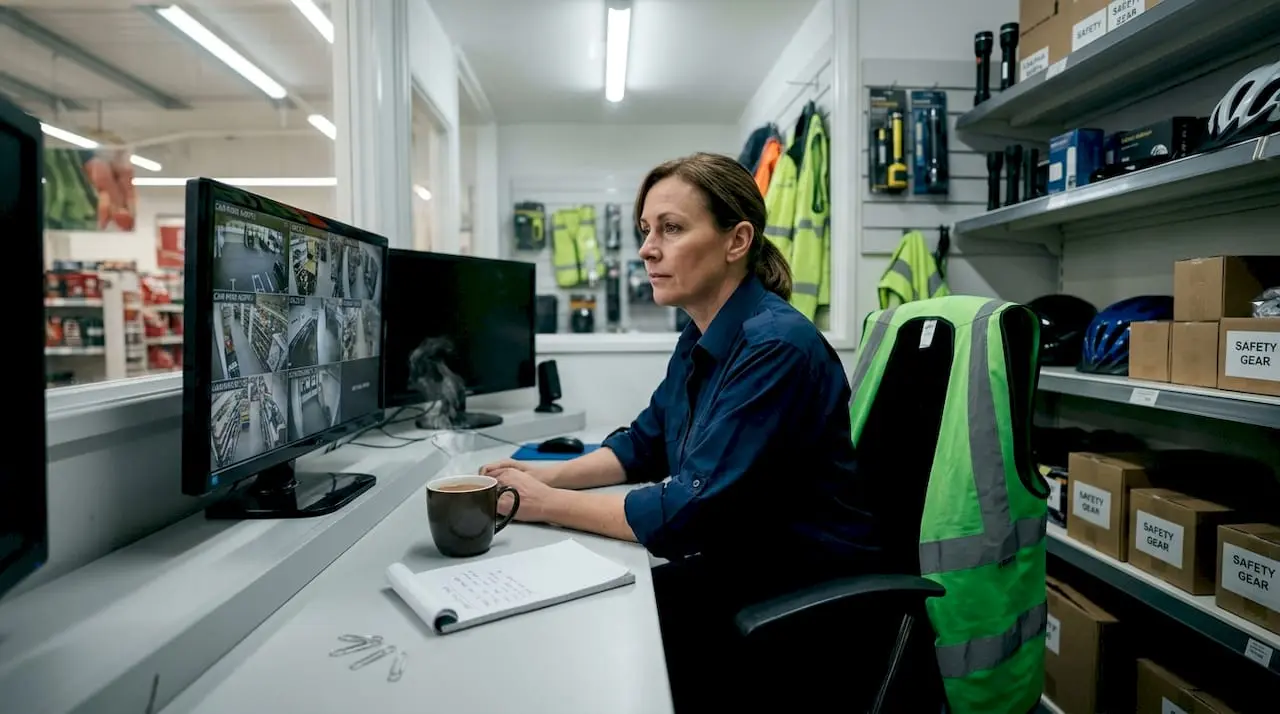
Retail security officers focus on loss prevention and stockroom monitoring, while door supervisors manage licensed premises under the Licensing Act 2003. These are not just different sites; they are genuinely different jobs with different legal obligations, risk profiles, and required skills.
| Security role | Primary focus | Key obligation |
|---|---|---|
| Retail security | Loss prevention, CCTV monitoring | Customer behaviour observation, high-theft zone surveillance |
| Corporate security | Access control, visitor management | Safety drill response, employee safety |
| Construction security | Perimeter control, asset protection | Preventing theft of plant and materials overnight |
| Door supervision | Crowd management, search procedures | Licensing Act 2003 compliance, handling intoxicated persons |
| Keyholding and alarm response | Vacant property security | Authorised access verification, alarm investigation |
Each environment carries its own demands. Construction site security, for example, requires comfort with lone working at night, an understanding of what plant and materials represent high-value targets, and the ability to manage large perimeters often with limited CCTV coverage. Corporate security, by contrast, demands a professional client-facing manner and a detailed understanding of building access systems.
Door supervisors hold a specific SIA licence category and must complete dedicated training in search procedures and the management of intoxicated customers. The skills required here overlap only partially with those of a standard security officer.
Understanding these distinctions helps you make informed decisions about which roles suit your skills now and where you want to develop next. The range of varied security roles and duties across the UK industry is broader than most candidates entering the sector realise.
Practical application: executing and balancing duties effectively
Understanding these role distinctions sets the stage for practical application of responsibility frameworks in daily security work.
Knowing your obligations on paper is one thing. Executing them consistently across a full shift, often in demanding conditions, is another matter entirely. Here is a practical framework for keeping your key duties of security staff aligned throughout your working day:
- Vary your patrol pattern every shift - Patrols should vary timing and routes paired with CCTV checks to avoid security blind spots. If someone has been watching your movement over several days, a predictable routine is an invitation.
- Wear your SIA licence visibly at all times - The SIA licence must be worn above clothing and visible. An improperly displayed licence risks revocation and creates grounds for your employer to question your professionalism.
- Document everything with timestamps - Time, location, names, descriptions, and actions taken. Every entry in your incident log is potential evidence. Write it as though a solicitor will read it, because sometimes one will.
- Coordinate with emergency services calmly and clearly - When escalation is necessary, your role is to brief responding officers efficiently, not to manage the situation past your remit. Know what to hand over and when.
- Maintain professional conduct throughout - Public trust in the security industry is built one interaction at a time. How you behave on site reflects on your employer, your licence, and the sector’s broader reputation.
Pro Tip: Keep a personal log separate from your official site records. Note what you observed, decisions you made, and your reasoning at the time. This is invaluable when reviewing your performance and is essential if an incident later becomes the subject of a formal investigation.
Understanding best security vetting practices and reviewing a background check checklist before joining a new employer also ensures you are prepared for the screening process without surprises.
Rethinking the security officer’s role: beyond checklist compliance
Most articles on the duties and responsibilities of a security professional treat those duties as a list to be completed. That framing misses something important.
A security officer is not a human checklist. The five core duties work as a system. Weakness in any one core duty exposes the performance of all the others, requiring integrated training and judgement rather than seeing duties as checklists. An officer who patrols diligently but writes poor incident reports is creating gaps that will surface eventually. An officer who handles conflict brilliantly but neglects access control is leaving the front door open.
What the best security professionals develop over time is instinct. Not the vague kind, but a trained, experience-based ability to read environments, anticipate behaviour, and adapt their response before a situation becomes critical. That instinct only develops through active reflection on your own work. Reviewing incidents you attended, even ones that resolved easily, and asking yourself whether your response was optimal builds the kind of professional judgement that no training course alone can deliver.
This also matters for career development. Employers at the serious end of the UK security market are not looking for officers who follow procedures. They are looking for officers who understand why those procedures exist and can make sound decisions when reality does not match the training scenario. Understanding the full picture of integrated security responsibilities is where that development starts.
The shift from procedure-follower to professional is not a leap. It is a series of small, deliberate decisions to engage with your role at a deeper level than the minimum required.
Advance your career with expert guidance and job opportunities
If this guide has clarified the scope of what is genuinely expected of security professionals in the UK, the next step is putting that understanding to work.

The Security Jobs Board connects UK security professionals with employers who value qualified, licence-holding officers across all sectors. Whether you are exploring your options after reading this security responsibilities overview or ready to apply for your next role, the platform gives you access to current vacancies, practical security career advice, and region-specific opportunities. If you are based in or considering security job openings in Northern Ireland, there are targeted listings available now. Create a free profile, upload your CV, and set job alerts tailored to your licence category and preferred location.
Frequently asked questions
What are the five main duties of a UK security officer?
The five main duties are access control, patrolling and surveillance, incident response within 60 seconds, conflict de-escalation, and accurate reporting. Each duty supports the others, and neglecting any one weakens the overall security operation on site.
When must an SIA licence be displayed visibly?
An SIA licence must be visible at all times during licensable activities, with the only exceptions being covert operations or cases where the licence has been lost, stolen, or is held by the SIA during an investigation.
What checks are required before employing security staff in the UK?
BS7858 mandates verification of identity, criminal records, employment history covering five years, financial probity, and right to work. Any unexplained employment gap over one month can result in the application being rejected.
How do security officers safely manage conflict without physical intervention?
Officers use calm communication, open body language, space management, and offer clear exit routes to resolve confrontations verbally. Physical force is a last resort and must be lawful and proportionate when it does occur.
Why is dynamic patrolling important in security?
Varying patrol timing and routes paired with CCTV monitoring prevents predictable patterns that bad actors can exploit, reducing the risk of undetected breaches across the site.


