Master access control security guard duties for career success

TL;DR:
- Access control security guards hold regulated, legally accountable roles crucial to organizational safety.
- Core duties include credential checks, system operation, incident reporting, and enforcing SOPs.
- Mastery of technology, procedures, and legal responsibilities enhances career progression in security.
Access control security guards are frequently misunderstood as little more than people who open doors and wave visitors through. The reality is starkly different. In the UK, access control is a regulated, technically demanding, and legally accountable profession where every decision you make can directly affect the safety of an organisation, its staff, and its assets. Whether you are just entering the security industry or looking to advance into senior roles, understanding the full scope of access control duties is one of the most powerful steps you can take for your career.
Table of Contents
- Legal standards and certification requirements
- Core duties of access control security guards
- Understanding access control technologies and methods
- Applying UK national security standards and best practices
- Why access control duties matter more than ever for your security career
- Advance your prospects with top security roles
- Frequently asked questions
Key Takeaways
| Point | Details |
|---|---|
| Certification is essential | Holding the SIA Security Guarding licence is mandatory for access control roles in the UK. |
| Master core responsibilities | Excelling at access verification, SOPs, and incident handling is vital for both security and career growth. |
| Leverage technology and logs | Understanding both digital and physical systems, plus maintaining audit trails, sets you apart professionally. |
| National standards guide practice | Applying UK security frameworks and proactively upskilling ensures consistent performance and advancement. |
Legal standards and certification requirements
Building on the introduction’s focus on career advancement, it is vital to understand the legal entry point for the profession before anything else. You cannot simply turn up to an access control post and expect to be handed the keys. The UK private security industry is regulated through the Security Industry Authority, and operating without the correct licence is a criminal offence.
Access control security guards in the UK must hold an SIA Security Guarding licence, which requires completion of a Level 2 Award for Security Officers in the Private Security Industry. This qualification covers three critical competency areas that define what you will actually do on the job every single day.
Here is what the Level 2 Award must cover for a Security Guarding licence:
- Access and egress control: Understanding how people and vehicles should enter and leave a site lawfully
- Protection systems: Operating physical barriers, electronic locks, alarm systems, and intercom equipment
- Search procedures: Conducting searches of persons, bags, and vehicles in accordance with legal and site-specific protocols
- Emergency response: Knowing how to escalate incidents correctly and communicate with emergency services
- Legal powers and responsibilities: Understanding your authority and the limits of what you can and cannot do under UK law
“Holding an SIA Security Guarding licence is not just a box-ticking exercise. It signals to employers that you are legally competent, professionally trained, and ready to be trusted with real responsibility on a live site.”
Understanding SIA regulation and careers in detail puts you well ahead of candidates who treat certification as an afterthought. If you are unsure where to begin, a clear guide on how to get your SIA licence will walk you through the application, training, and payment process step by step. And once you are licensed, do not neglect security licence renewal, because lapsing on your renewal can immediately disqualify you from employment and cause serious career disruption.
Pro Tip: When applying for roles, do not simply list your SIA licence on your CV. Note the specific competencies you trained in, particularly if you have additional endorsements such as CCTV operation or close protection awareness. It makes your application noticeably stronger.
Core duties of access control security guards
Once certified, it is essential to grasp what is truly expected of you each shift from a professional standpoint. Access control is not reactive. It is a continuous, active discipline that demands both technical competence and strong people skills working in parallel.
The following table gives a clear picture of the daily duties involved and the specific skills each one draws upon:
| Duty | Primary skill required | Frequency |
|---|---|---|
| Credential verification | Attention to detail, protocol knowledge | Every entry/exit |
| Barrier and gate management | Technical operation, system awareness | Continuously |
| CCTV monitoring | Observation, threat recognition | Throughout shift |
| Incident reporting | Written communication, accuracy | As required |
| Visitor management | Communication, customer service | Every visitor arrival |
| SOP implementation | Procedural compliance, judgement | Every shift |
UK government standards published through the NPSA and Security.gov.uk emphasise protecting against unauthorised access, using SOPs for systems, and proactive incident response as the three pillars of effective security officer performance. These are not optional extras. They are the foundation of professional practice.
Here is a numbered breakdown of how a well-trained access control guard approaches a standard shift:
- Pre-shift briefing: Review any changes to the access list, new contractor arrivals, or site alerts from the previous shift
- System checks: Confirm all barriers, electronic locks, turnstiles, and intercom systems are fully operational before any personnel arrive
- Credential verification: Check ID, passes, biometric data, or appointment confirmations for every individual before permitting entry
- Ongoing CCTV monitoring: Keep visual awareness of all entry and exit points in real time, noting any suspicious behaviour or tailgating
- Visitor logging: Record all visitor arrivals and departures with accurate timestamps in physical or digital logs
- Incident response: Escalate any access refusals, confrontations, or security breaches immediately and correctly following site SOPs
- End-of-shift handover: Provide a thorough verbal and written briefing to your relief officer, flagging anything that needs follow-up
It is worth emphasising that communication and diplomacy are frequently undervalued in access control. Refusing entry to someone who believes they have a valid reason for access requires confidence, clarity, and professionalism. Doing it badly can escalate minor situations into serious incidents. Doing it well reinforces your authority and protects the organisation. Understanding both physical and digital access systems in depth means you can explain decisions calmly and accurately because you genuinely understand the systems you are managing.
Pro Tip: Keep a personal duty log in addition to the official site record. Note anything unusual, even if it does not trigger a formal incident report. Patterns matter in security, and your own records demonstrate professional diligence if questions arise later.
Understanding access control technologies and methods
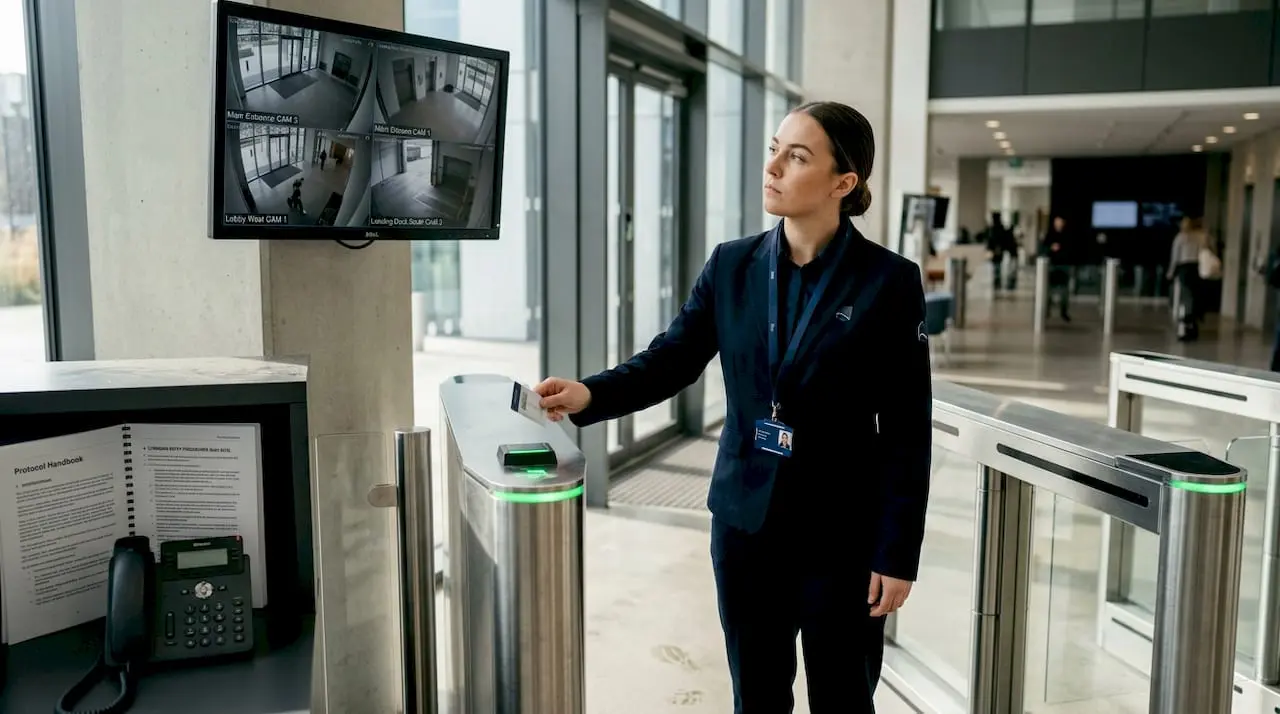
With an understanding of the duties comes the need to get tech-savvy about the core systems you will operate. Modern access control is not just a swipe card and a turnstile. The technology landscape is sophisticated, and employers increasingly expect guards to be confident across multiple system types.
| System type | Examples | Security level |
|---|---|---|
| Physical barriers | Turnstiles, rising bollards, vehicle barriers | Medium to high |
| Proximity cards | RFID keycards, fobs | Medium |
| Biometric systems | Fingerprint, iris scan, facial recognition | High |
| PIN-based entry | Keypads, combination locks | Low to medium |
| Smart integration | Mobile credentials, cloud-managed access | High with audit trail |
One of the most important concepts you will encounter is Role-Based Access Control, commonly known as RBAC. RBAC means that access permissions are determined by a person’s role in the organisation, not just by their physical presence or possession of a badge. A delivery driver might have access to the loading bay but not the server room. A senior manager might have 24-hour access to all floors. As a guard, you need to understand these permission structures because you are the last line of defence when a system permits someone through who should not be there.
UK survey data reveals a striking gap: 92% of organisations report they can prevent unauthorised access to sensitive areas, yet only 62% restrict access by role, just 60% restrict by time or day of the week, 54% restrict by zone, and 38% lack full audit trails. This is a significant vulnerability. It means that in most UK organisations, technical systems alone are not providing robust protection, and the human element of access control is what bridges that gap.
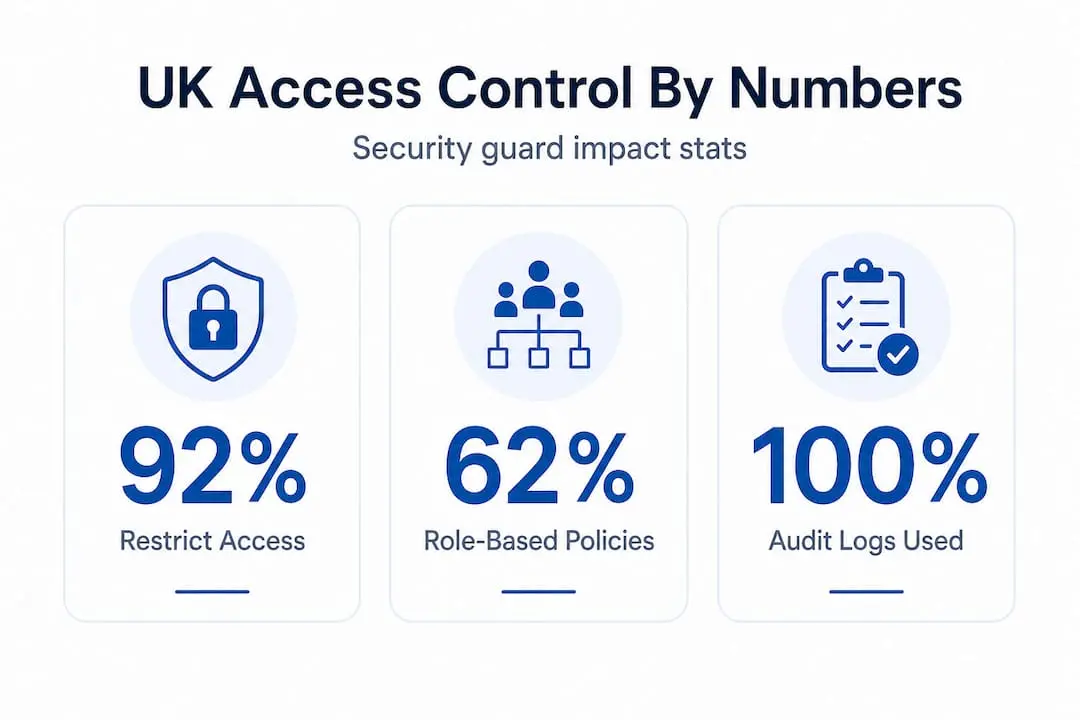
This is where your expertise directly adds organisational value. When you understand UK workplace access control at a systems level, you can flag configuration weaknesses to your supervisor, spot patterns of misuse in audit logs, and make smarter real-time decisions. Guards who understand RBAC, audit trails, and zone restrictions are genuinely more employable at senior and specialist levels.
The audit trail point deserves special attention. Every entry and exit event logged by an access control system creates a timestamped record. These records are used in investigations, disciplinary proceedings, and legal cases. As a guard, your responsibility is to ensure that logging systems are functioning, to flag any gaps or anomalies, and to maintain your own records with precision. Gaps in an audit trail are a serious security failing.
Applying UK national security standards and best practices
Having explored the tools and methods, the next step is to align your everyday actions with national standards and employer expectations. The UK government security profession career framework provides a structured guide for what physical security officers are expected to know, do, and demonstrate at each career level.
Standard operating procedures are the backbone of professional access control. Every site you work on will have a set of SOPs that govern precisely how you should manage entry, exit, visitors, contractors, emergencies, and incidents. These are not bureaucratic documents. They are the organisation’s agreed response to risk, developed with legal and security expertise. Following them consistently protects you as much as it protects the site.
Here is how to apply national standards effectively in practice:
- Read every SOP before your first shift at a new site, and ask your supervisor to clarify anything ambiguous before it becomes a live issue
- Document every incident even if it seems minor, using the site’s official incident report format and your own personal log
- Report system faults immediately and follow up in writing to create a clear record that you identified the fault and escalated it
- Participate in drills and training updates to stay current with changing site requirements and regulatory expectations
- Seek feedback actively from supervisors after incidents, because every event is a learning opportunity that can sharpen your professional judgement
UK security training requirements go beyond the initial SIA qualification. Continuing professional development is increasingly recognised as a marker of serious career intent. Qualifications in CCTV operation, conflict management, first aid, and fire safety all make you more versatile and more valuable to employers. The UK government standards specifically note that proactive professional development is a characteristic of high-performing security officers at every career level.
Pro Tip: Request copies of incident reports you have written and keep them in a secure personal portfolio. They form concrete evidence of your competence and your ability to handle real-world situations, which is far more persuasive to employers than a bare CV.
Why access control duties matter more than ever for your security career
There is a persistent myth in and around the security industry that access control is one of the simpler roles available. The reasoning usually goes: you check IDs, you press a button, you wave people through. It is a perception that underestimates both the risk involved and the skill required, and it is one that experienced security professionals consistently reject.
The guards who advance into supervisory, senior officer, or specialist roles share a common characteristic. They treated every aspect of their access control duties as genuinely important, not just to tick a compliance box, but because they understood that access control is where organisational risk becomes real. The moment an unauthorised individual gains access to a sensitive area, the consequences can be severe. Data breaches, physical assaults, theft of assets, and reputational damage to an organisation all frequently trace back to a failure at the access control point.
Think about what you are actually managing when you control access to a large corporate site, a government facility, or a healthcare environment. You are the point at which identity, authority, and permission converge. Technology supports you but does not replace you. The 38% of UK organisations lacking full audit trails, the gap between 92% claiming to prevent unauthorised access and only 62% actually restricting by role, these figures confirm that human judgement remains irreplaceable in modern security.
Career leverage comes from demonstrating mastery at three levels simultaneously. Technical mastery means you understand the systems and can operate them competently. Procedural mastery means you follow SOPs precisely and document everything accurately. Legal mastery means you understand your authorities, your limits, and the regulatory framework that governs every decision you make. Guards who can evidence all three are the ones promoted to team leader, site supervisor, and security manager positions.
If you are serious about your progression, mastering UK security clearances is also worth your attention. Many of the highest-value access control posts, particularly in government, defence, and critical infrastructure, require personnel with active security clearances. Pursuing clearance proactively signals ambition and readiness for greater responsibility.
Advance your prospects with top security roles
You have seen the depth and skill involved in access control. Now it is time to turn that expertise into tangible career progress.

The Security Jobs Board connects UK security professionals with employers who genuinely value access control expertise. Whether you are looking for roles in corporate, government, or specialist environments, you can search live vacancies tailored to your experience and location, including security jobs in Northern Ireland and across the rest of the UK. Creating a free profile takes minutes, and you can upload your CV, set job alerts for access control vacancies, and apply directly to UK security employers who are actively recruiting. The platform is BSIA-affiliated, GDPR-compliant, and built specifically for the security sector, so every vacancy you see is relevant to your profession. Do not wait for the right opportunity to find you.
Frequently asked questions
What certification do I need to work as an access control security guard in the UK?
You must hold an SIA Security Guarding licence, which requires completion of a Level 2 Award for Security Officers in the Private Security Industry covering access, egress, search procedures, and protection systems.
What are the main duties of an access control security guard?
Key duties include verifying credentials, monitoring entry and exit points, implementing SOPs, managing and recording incidents, and operating access control systems. Government standards confirm that proactive incident response and procedural compliance are central expectations.
What percentage of UK organisations have robust access restriction policies?
A UK survey shows 92% of organisations can prevent unauthorised access in principle, but only 62% restrict by role and just 38% maintain full audit trails, highlighting significant gaps that skilled guards help to close.
How can I improve my chances of advancing in security?
Enhance both your technical and procedural skills, pursue continuing professional development beyond your initial SIA licence, demonstrate strict compliance with SOPs, and build a portfolio of documented incidents that evidence your competence and professional judgement.


