Which jobs require an SIA licence in the UK?
TL;DR:
- UK private security roles requiring an SIA license include guarding, door supervision, CCTV surveillance, close protection, cash transit, key holding, and vehicle immobilization in Northern Ireland. Whether a license is needed depends on the specific task performed, not the job title, and verification must be checked before deployment. Licenses are valid for three years, and proper compliance involves checking duties, categories, and maintaining documentation.
In UK private security, the roles that require an SIA licence are: security guarding, door supervision, public space surveillance (CCTV), close protection, cash and valuables in transit, key holding, and vehicle immobilisation (Northern Ireland only). The Security Industry Authority (SIA) regulates all of these under the Private Security Industry Act 2001. The British Security Industry Association (BSIA) sets the professional standards that underpin them, and Securityjobsboard is the specialist UK platform where licensed candidates and employers connect.
Quick next steps before you go any further:
- Candidates: check the post orders for your target role and confirm which SIA licence activity they describe.
- Hirers: verify every operative’s licence on the SIA register before deployment.
- Both: confirm right to work in the UK and that any DBS check is current.
Pro Tip: Whether a licence is needed depends on the tasks performed, not the job title on the contract. A “concierge” who monitors live CCTV and controls access is doing licensable work.
Table of Contents
- Which SIA licence does each security job actually need?
- Why tasks, not job titles, decide whether you need a licence
- How to get an SIA licence — a step-by-step checklist
- What employers and recruiters must check before hiring
- Costs, licence validity and what to do when a licence expires
- Common mistakes that lead to illegal deployment
- Key takeaways
- A practical note from Securityjobsboard
- Securityjobsboard: find licensed security roles and candidates across the UK
- Official sources and further reading
- FAQ
Which SIA licence does each security job actually need?
The table below maps the most common UK private-security vacancies to the correct SIA licence category. Use it to check a job advert or post orders before hiring or applying.
| Job role | SIA licence category required |
|---|---|
| Static security guard (contracted) | Security Guarding |
| Door supervisor at licensed premises | Door Supervision |
| CCTV operator (public space surveillance) | Public Space Surveillance (CCTV) |
| Close protection operative | Close Protection |
| Cash-in-transit operative | Cash and Valuables in Transit |
| Key-holder / alarm response | Key Holding |
| Vehicle immobiliser (Northern Ireland) | Vehicle Immobilisation |
A few points worth noting alongside that table:
- A door supervisor licence covers security guarding duties, so a door supervisor can legally work a static guarding post. The reverse is not true: a security guarding licence does not permit door supervision at licensed premises.
- Receptionists, event stewards, and concierge staff who do not perform any licensable activity — no access control, no live CCTV monitoring, no physical intervention — do not need an SIA licence.
- Event stewarding is a common grey area: stewarding without licensable duties is usually unlicensed, but door supervision at a licensed venue always requires a licence regardless of what the contract calls the role.
Why tasks, not job titles, decide whether you need a licence
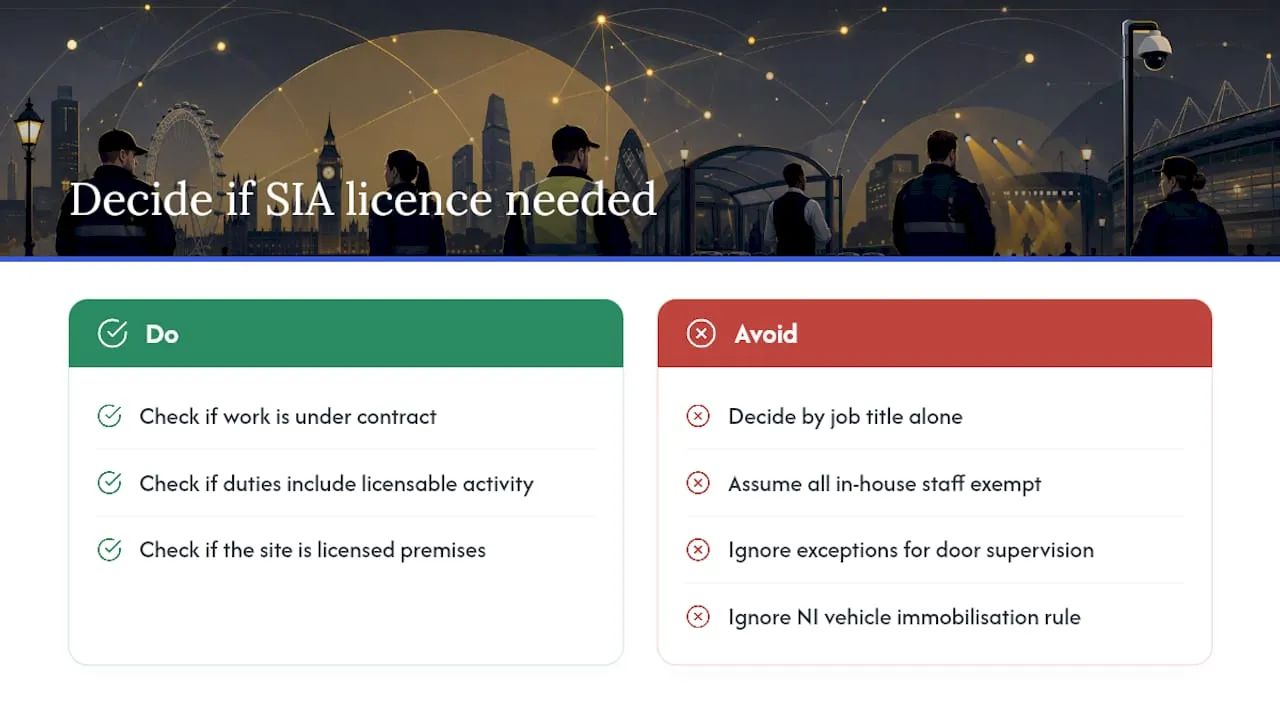
The SIA’s position is clear: licensable activity and the contractual arrangement determine whether a licence is required, not whatever name appears on a business card or job advert.
“Licensable activity” covers things like actively guarding premises, controlling access, monitoring live CCTV footage, physically removing people, or holding keys and responding to alarms. The moment a worker does any of those things under a contract for services, a licence is required. In-house staff are generally exempt from most categories — with two firm exceptions: door supervision at licensed premises and vehicle immobilisation in Northern Ireland always require a licence, whether the worker is contracted or directly employed.
A practical example: a shopping centre might employ an in-house “security coordinator” who only manages rotas and never touches access control. No licence needed. The same centre’s contracted operative who monitors CCTV and escorts shoplifters off site? That person needs a Public Space Surveillance licence and potentially a Security Guarding licence too, depending on the post orders.
Pro Tip: Run three quick questions against any job description: Is this work supplied under a contract for services? Does it include a licensable activity? Is the site a licensed premises? If the answer to any of those is yes, a licence almost certainly applies.
How to get an SIA licence — a step-by-step checklist
Follow these steps in order. Skipping one typically means a rejected application.
- Check eligibility. Confirm you have the right to work in the UK and that your identity documents are valid. The SIA will not process an application without both.
- Complete SIA-approved training. Enrol on a licence-linked qualification for the specific activity you want to work in. Training is delivered by independent providers; the government does not set the fees. Crucially, training certificates have a validity window — if your certificate is too old, the SIA will not accept it and you will need a refresher course before applying.
- Obtain a DBS check. The SIA assesses criminal records as part of vetting. Certain convictions are disqualifying; the SIA’s Get Licensed guidance sets out exactly which offences apply and how spent convictions are treated.
- Submit your application via GOV.UK. Applications go through the GOV.UK portal, where the SIA performs its vetting. Once approved, your licence appears on the public SIA register and you receive a photocard.
For a detailed walkthrough of each stage, the step-by-step SIA licence guide on Securityjobsboard covers training providers, DBS timelines, and what to do if your application stalls.
What employers and recruiters must check before hiring
Hiring an operative without the correct licence exposes your organisation to prosecution under the Private Security Industry Act 2001. The checklist below keeps you compliant.
- Search the operative’s name on the official SIA register and confirm the licence is current and active.
- Check that the licence category matches the duties in the post orders — a Security Guarding licence does not cover door supervision.
- Verify the photocard is genuine: check the photograph, expiry date, and the holographic security features.
- Confirm the contractual arrangement: in-house or contract for services? That distinction changes the legal requirement for most categories.
- If your organisation is an SIA Approved Contractor, you may assist staff with licence applications or apply on their behalf in certain circumstances — a useful option for larger security firms onboarding multiple operatives at once.
Pro Tip: Screenshot the SIA register entry on the day of deployment and store it with the operative’s file. If a compliance audit or incident investigation arises later, that timestamped screenshot is your evidence of due diligence.
For broader compliance obligations, the employment law compliance guide on Securityjobsboard covers right-to-work checks, IR35 considerations, and record-keeping requirements.
Costs, licence validity and what to do when a licence expires
The SIA does not set training fees; those are agreed between candidates and independent training providers and vary by course and region. The application fee is paid through the GOV.UK portal directly to the SIA.
Key practicalities on validity and renewal:
- SIA licences are valid for three years from the date of issue.
- Renewal applications should be submitted before the current licence expires to avoid a gap in authorisation.
- If a photocard is lost or stolen, report it to the SIA and request a replacement through the GOV.UK service.
- If your training certificate has aged out of the SIA’s acceptance window, you must complete refresher training before a renewal or new application will be processed.
Pro Tip: Budget for refresher training well before your renewal date, not after. Certificates issued more than a few years ago may fall outside the SIA’s permitted window, and leaving it late can create a gap in your licence that makes you undeployable.
The licence renewal guide on Securityjobsboard explains the renewal timeline in detail and flags the common mistake of letting a certificate lapse before starting the renewal process.
Common mistakes that lead to illegal deployment
Most licensing breaches in UK private security come down to a handful of recurring errors.
- Relying on job titles instead of duties. A “concierge” or “receptionist” performing access control at a licensed premises is doing door supervision work and needs the licence to match.
- Hiring unlicensed contractors for licensable activities. Under a contract for services, the operative must hold the correct licence before starting work — not after.
- Mismatching licence category to post orders. Deploying a Security Guarding licence holder to a door supervision post at a pub or club is a criminal offence for both the operative and the employer.
- Failing to check the SIA register. A licence that looks valid on a photocard may have been suspended or revoked. The register is the only authoritative source.
Operating without the required licence breaches the Private Security Industry Act 2001 and can result in prosecution, fines, and reputational damage that affects future contract bids. Sites that knowingly use unlicensed operatives face the same exposure as the operatives themselves.
Pro Tip: If you discover an unlicensed operative already on site, suspend their licensable duties immediately, reassign them to non-licensable tasks if possible, verify their status on the SIA register, and document the incident with a written record of the steps you took. That paper trail matters if the matter escalates.
Key takeaways
Every SIA licence requirement in UK private security comes down to one principle: the tasks in the post orders, not the job title, determine which licence applies.
| Point | Details |
|---|---|
| Tasks, not titles | Check post orders against SIA licence categories before hiring or applying. |
| Door supervisor flexibility | A door supervisor licence covers security guarding; a guarding licence does not cover door supervision. |
| Training certificate age | Certificates outside the SIA’s validity window must be refreshed before an application is submitted. |
| Employer due diligence | Screenshot the SIA register entry on deployment day and retain it for compliance audits. |
| Securityjobsboard | Use Securityjobsboard to find licence-matched vacancies and candidates across the UK. |
A practical note from Securityjobsboard
The single biggest source of hiring friction in UK private security is a mismatch between the licence category on a candidate’s photocard and the duties in the post orders. It happens more often than most recruiters admit, and it usually comes from job adverts that describe a title without specifying the licensable activities involved.
Securityjobsboard is built around fixing that. Employers posting on the platform are encouraged to state the required licence category and the specific duties in every vacancy, which means candidates can self-screen before applying. On the candidate side, listing your exact licence category and expiry date prominently on your Securityjobsboard profile, rather than burying it in a CV attachment, puts you in front of the right hirers faster. The platform’s BSIA affiliation means the employers using it understand what licence compliance actually requires.
The broader point: the SIA licence is not a formality. It is legal authorisation to perform work in a position of trust. Treating it as a box to tick after hiring, rather than a prerequisite that shapes the job advert itself, is where most compliance failures begin.
Securityjobsboard: find licensed security roles and candidates across the UK
Securityjobsboard gives candidates and employers in UK private security a faster, more focused route than a general job board. Candidates get free CV upload, job alerts filtered by licence category, and one-click applications to vacancies that already specify the required SIA activity. Employers get access to a CV database of licence-verified candidates, tools to post detailed role requirements, and the credibility of a platform affiliated with the BSIA.

For hirers filling roles in Northern Ireland, including vehicle immobilisation posts, the Northern Ireland security vacancies page lists current openings with licence requirements stated upfront.
Candidates: upload your CV and set a licence-matched job alert at https://www.securityjobsboard.co.uk today. Employers: post your vacancy with full post orders and start receiving applications from appropriately licensed operatives.
Official sources and further reading
| Source | What it covers |
|---|---|
| Find out if you need an SIA licence | Definitive GOV.UK guidance on licensable activities, contract types and in-house exemptions |
| Apply for an SIA licence | Application process, GOV.UK portal steps, Approved Contractor scheme |
| SIA Get Licensed (PDF) | Full SIA criteria for licensing decisions, including criminal record thresholds |
| Check if you need a licence for event work | Specific guidance on stewarding versus door supervision at events |
| SIA licence training specifications | Qualification requirements for each licence-linked training course |
| Securityjobsboard blog | SIA regulation overview and career guidance for UK security professionals |
FAQ
Which private-security jobs always need an SIA licence?
Security guarding (contracted), door supervision, public space surveillance (CCTV), close protection, cash and valuables in transit, key holding, and vehicle immobilisation in Northern Ireland all require an SIA licence under the Private Security Industry Act 2001.
Do in-house security staff need an SIA licence?
Most in-house staff are exempt, but two roles always require a licence regardless of employment type: door supervisors at licensed premises and vehicle immobilisers in Northern Ireland.
Can a security guarding licence cover door supervision work?
No. A security guarding licence does not permit door supervision at licensed premises. A door supervisor licence, however, does cover security guarding duties, making it the more flexible of the two categories.
How long does an SIA licence last?
SIA licences are valid for three years. Renewal applications should be submitted before the licence expires to avoid any gap in authorisation.
Where can I find licensed security jobs in the UK?
Securityjobsboard lists licence-matched vacancies across the UK, including roles in Northern Ireland, and allows candidates to upload CVs and set alerts by licence category.


