
TL;DR:
- To work legally as a security guard in the UK, you must obtain an SIA Security Guard licence. The process requires passing eligibility checks, completing mandatory training, and submitting accurate documents online.
To become a security guard legally in the UK, you need a valid SIA Security Guard licence issued by the Security Industry Authority. This single requirement drives everything else: the training you must complete, the checks you must pass, and the documents you must submit. Approximately 450,000 people hold an SIA licence, which shows this is a structured and accessible career path rather than an informal one. Understanding what the process involves from the start saves you time, money, and frustration.
What do I need to become a security guard: eligibility criteria
The first gate you must pass is eligibility. The Security Industry Authority sets clear rules, and failing any one of them stops your application before it starts.
The core requirements are:
- Age: You must be at least 18 years old to apply for a Security Guard licence.
- Right to work: You must have the legal right to work in the UK, proven by recognised documents such as a British or Irish passport, a biometric residence permit, or a share code from the Home Office online checking service. Read more about right to work checks for security staff.
- Identity verification: The SIA requires documents from two groups. Group A documents include a valid passport or UK driving licence. Group B documents include a utility bill or bank statement dated within three months.
- Criminal record check: All applicants undergo a DBS criminal record check through the Disclosure and Barring Service. Certain past offences disqualify applicants entirely.
- SIA suitability standards: The SIA assesses your full history, not just convictions. Cautions, warnings, and pending charges all factor into the decision.
The DBS check is the part most applicants underestimate. Spent convictions for serious offences, including violence, dishonesty, and drug trafficking, typically result in refusal. The SIA publishes a full list of relevant offences on its website, and reviewing it before you apply is a practical first step.
Pro Tip: Check the SIA’s published list of disqualifying offences before you pay for any training. Discovering an eligibility issue after completing a course means losing both time and money.
What training and qualifications do I need before applying?
Training is the most time-intensive part of becoming a security guard. The SIA mandates a specific qualification, and you cannot substitute it with general security experience or unrelated certificates.
The mandatory qualification is the Level 2 Award for Security Guards, which must be delivered by an SIA-recognised, Ofqual-regulated training provider. The course covers:
- The legal framework for security guarding, including powers of arrest and use of force
- Conflict management and communication skills
- Physical intervention techniques
- Emergency procedures and fire safety
- First aid application in a security context
Before you begin the main course, you must hold a valid Emergency First Aid at Work (EFAW) certificate from an Ofqual-regulated provider. This certificate must have at least 12 months of validity remaining when your main training starts. Many candidates book their EFAW course and their Level 2 Award simultaneously, which creates a timing problem if the EFAW certificate is issued too close to the training start date.
Pro Tip: Complete your EFAW course at least two weeks before your Level 2 Award begins. This gives you a buffer if the certificate takes time to arrive and confirms it meets the 12-month validity rule.

For those who qualified before april 2021, the SIA introduced mandatory ‘Top-Up’ refresher training as a condition of licence renewal. This refresher covers updated legislation and revised physical intervention standards. If you hold an older qualification, you cannot simply renew without completing it. Explore your security guard training options to find approved providers near you.
How do I apply for an SIA licence and what does it cost?
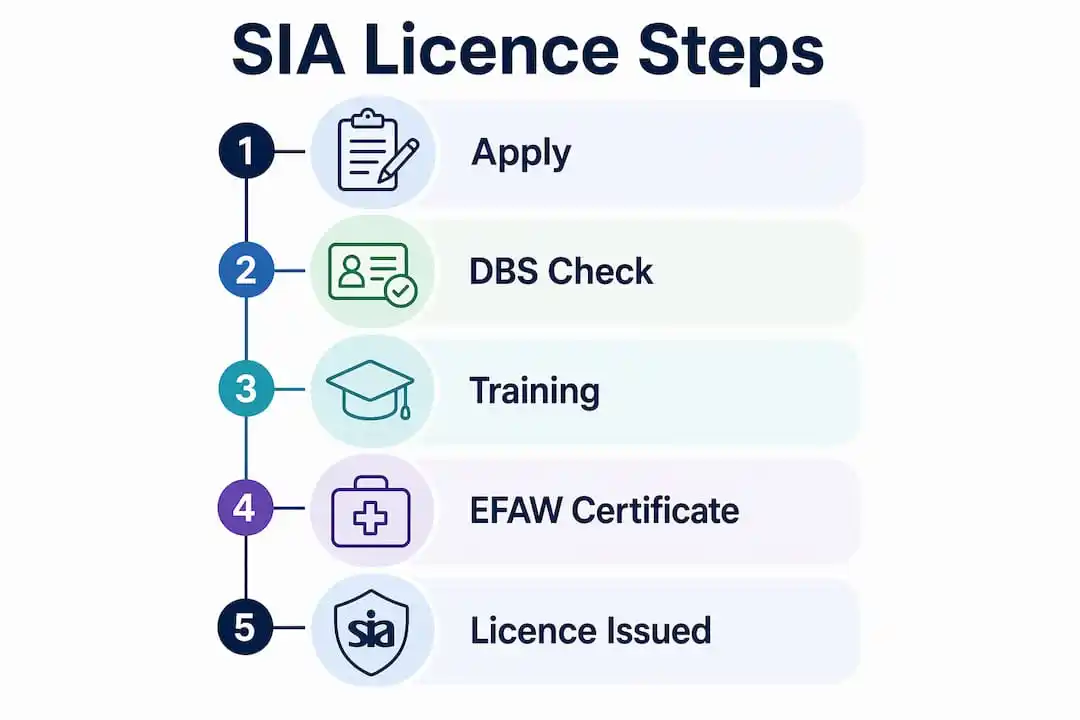
Once you hold your Level 2 Award and a valid EFAW certificate, you can apply for your SIA licence. The process is entirely online.
- Create an SIA online account at the official SIA website. Use your legal name exactly as it appears on your identity documents.
- Upload your documents: identity documents from Group A and Group B, proof of address, your Level 2 Award certificate, and your EFAW certificate.
- Pay the licence fee: the current SIA licence fee is £204, as of april 2026. If you apply for a supplementary licence at the same time, an additional £102 applies. Both fees are non-refundable.
- Wait for processing: the SIA processes most applications within a few weeks, though complex cases take longer. Submitting accurate, consistent information speeds this up considerably.
- Receive your licence card: once approved, the SIA posts your licence card. You must carry it on your person during all working hours.
Submitting accurate personal data early, with consistent names, dates, and addresses across all documents, is the single most effective way to avoid delays.
| Stage | What you need | Typical cost |
|---|---|---|
| EFAW first aid training | Ofqual-regulated provider, valid 12+ months | Varies by provider |
| Level 2 Award for Security Guards | SIA-recognised, Ofqual-regulated course | Varies by provider |
| SIA licence application | Online account, documents, certificates | £204 |
| Supplementary licence (if applicable) | Additional licence type applied simultaneously | £102 |
The SIA licence lasts three years and must be renewed before it expires. Working without a valid licence is a criminal offence. Both the worker and the employer face prosecution if unlicensed guarding takes place. The licence is personal and non-transferable, meaning no employer can hold it on your behalf.
For a detailed walkthrough of the full process, the step-by-step SIA licence guide on Securityjobsboard covers each stage clearly.
What licence types exist and which one do I need?
Not all SIA licences are the same. Choosing the wrong one means you cannot legally perform the role you are hired for.
| Licence type | Who needs it | Key permissions |
|---|---|---|
| Security Guard (front line) | Guards performing active guarding duties | Patrolling, access control, monitoring |
| Door Supervisor (front line) | Staff working at venues licensed to sell alcohol | Entry control, searching, ejection |
| Security Guard (non-front line) | Managers and supervisors not performing guarding duties | Oversight and administration only |
The door supervisor licence covers additional permissions beyond the standard Security Guard licence. If you work at a nightclub, pub, or any venue with an alcohol licence, you need a door supervisor licence, not a security guard licence. Applying for the wrong licence and working in the wrong role is a legal offence, not just an administrative error.
Only front line licences permit active guarding duties. A manager who oversees a security team but does not personally patrol or control access does not need a front line licence. This distinction matters for career progression, as moving into a supervisory role changes your licensing obligations. The duty of a security supervisor guide on Securityjobsboard explains these differences in practical terms.
Key takeaways
Becoming a licensed security guard in the UK requires an SIA Security Guard licence, a Level 2 Award for Security Guards, a valid EFAW certificate, and clear eligibility checks covering age, right to work, and criminal record.
| Point | Details |
|---|---|
| SIA licence is mandatory | Working as a security guard without a valid SIA licence is a criminal offence in the UK. |
| EFAW certificate comes first | Your first aid certificate must be valid with at least 12 months remaining before your main training begins. |
| Licence fee is £204 | The SIA application fee is non-refundable; budget for this before starting the process. |
| Licence lasts three years | Renew before expiry to avoid a gap in legal working status. |
| Licence type must match your role | Door supervisors and security guards require different licences; applying for the wrong one creates legal risk. |
What I have learnt from watching candidates get this wrong
The biggest mistake I see is candidates treating the EFAW certificate as an afterthought. They book their Level 2 Award, pay the course fee, then realise their first aid certificate expired or has fewer than 12 months left. The training provider cannot legally start the course. The candidate loses their course deposit and has to rebook everything. This is entirely avoidable with a single check before you spend any money.
The second most common error is inconsistent personal details across documents. The SIA is strict about this. If your passport shows one version of your name and your utility bill shows a shortened version, the application stalls. Use your full legal name on every document and every online form, without exception.
Selecting a training provider deserves more attention than most candidates give it. Not every provider advertising SIA training is on the approved list. Completing a course with an unapproved provider means your qualification is worthless for licensing purposes. Always verify the provider against the SIA’s official register before paying.
Finally, licence renewal catches experienced guards off guard more often than you would expect. Three years passes quickly, and the consequences of an expired licence are serious for both you and your employer. Set a calendar reminder 12 weeks before your expiry date. That gives you enough time to complete any required Top-Up training and submit your renewal without a gap.
— Rob
Security job opportunities on Securityjobsboard
Once your SIA licence is in hand, the next step is finding the right role. Securityjobsboard connects licensed security professionals with employers across the UK, from retail and events to corporate and residential sites.

The platform is free for jobseekers and lists vacancies updated regularly across all regions. If you are based in or considering work in Northern Ireland, browse current security jobs in Northern Ireland directly. For broader guidance on building your career after licensing, the career advice section on Securityjobsboard covers CV writing, interview preparation, and progression routes into supervisory and specialist roles.
FAQ
Do I need any previous experience to apply for an SIA licence?
No previous security experience is required. You must complete the Level 2 Award for Security Guards and hold a valid EFAW certificate, but the qualification is open to beginners.
How long does it take to get an SIA Security Guard licence?
The process typically takes several weeks from submitting your application, assuming all documents are accurate and complete. Training adds additional time before you can apply.
Can I work as a security guard while my licence application is being processed?
No. Working without a valid SIA licence is a criminal offence, regardless of whether an application is pending. You must wait until your licence card arrives before starting work.
What happens if my SIA licence expires?
An expired licence means you cannot legally work as a security guard. Both you and your employer face criminal prosecution if you continue working. Renew at least 12 weeks before expiry to avoid any gap.
Is the SIA licence fee refundable if my application is refused?
The £204 SIA licence fee is non-refundable, even if your application is unsuccessful. Check your eligibility carefully before applying.


