Duty of a security guard: the complete UK guide

TL;DR:
- Security guards in the UK are trained professionals responsible for protecting people, property, and assets through patrols, access control, alarm response, and accurate incident reporting. Their duties are regulated by the SIA license and site-specific instructions, which define their daily tasks and legal boundaries. Proper documentation, including incident and routine logs, is essential for accountability and legal protection in this role.
The duty of a security guard is to protect people, property, and assets through observation, access control, patrolling, alarm response, and accurate reporting. In the UK, this role is regulated by the Security Industry Authority (SIA) under the Private Security Industry Act 2001, which sets the legal foundation for every licensed operative. Security guards are not simply a visible presence. They are trained professionals whose core functions span deterrence, documentation, and emergency response, all shaped by site-specific instructions and formal risk assessments.
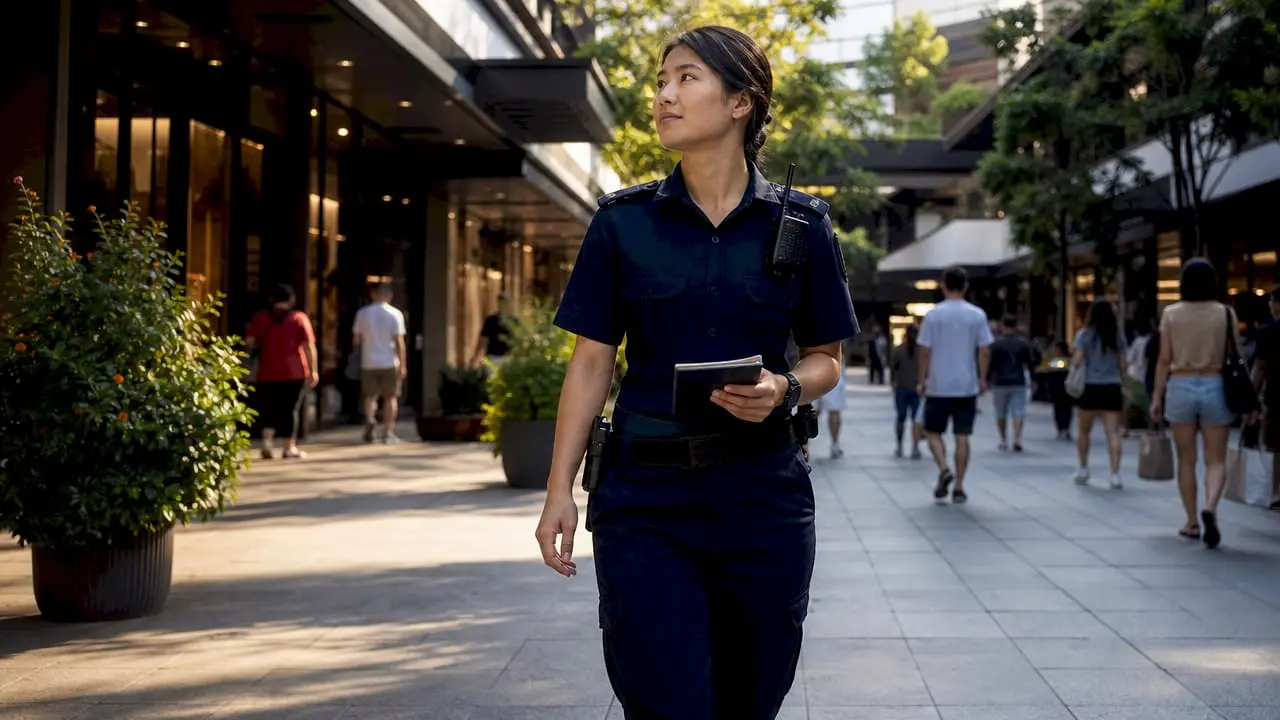
What are the key duties of a security guard in the UK?
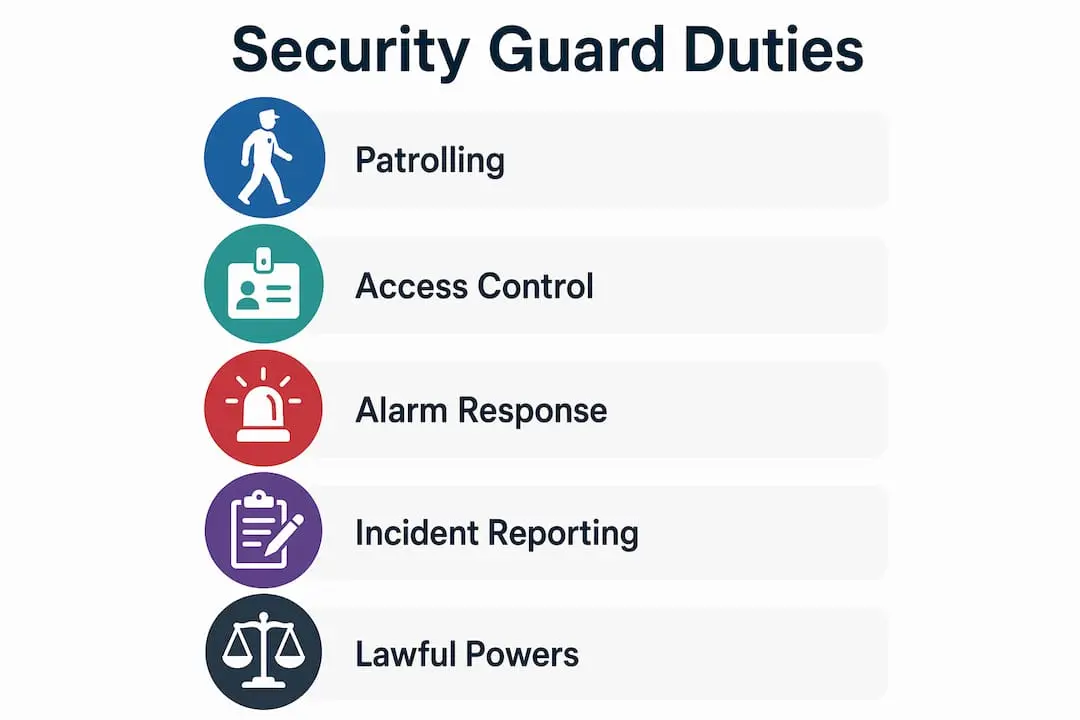
The typical duties of a security guard cover patrolling, access control, alarm response, incident reporting, and the lawful exercise of citizen’s powers. These responsibilities are not interchangeable. Each one serves a distinct purpose within a site’s overall security plan.
Patrolling
Patrolling is the most visible duty a security guard carries out. Guards follow set routes at defined intervals, checking for signs of intrusion, fire hazards, vandalism, or unauthorised access. Patrol frequency is determined by the site’s risk assessment, not personal judgement. A logistics warehouse, for example, may require hourly external checks, while a corporate office may need only periodic internal walkthroughs.
Access control
Access control means managing who enters and exits a site. Guards check identification, verify visitor credentials, operate physical barriers such as gates and turnstiles, and maintain visitor logs. This duty is the first line of defence against unauthorised entry. A retail centre guard and a construction site guard both carry out access control, but the tools and procedures differ significantly between the two environments.
Alarm response
When an alarm activates, the guard’s job is to attend the location, assess the situation, and follow the site’s escalation procedure. That may mean contacting the police, notifying a control room, or securing the area pending investigation. Guards do not act on instinct alone. They follow written instructions that specify exactly what to do for each alarm type.
Incident reporting and documentation
Every security guard must document events accurately and completely. This includes routine checks as well as incidents. Incident reports provide the official record of what happened, when, and what action was taken. That record carries the guard’s name and may be used in legal proceedings, insurance claims, or internal investigations.
Lawful powers
Security guards in the UK operate within the limits of their SIA licence and the law. They hold the same citizen’s arrest powers as any member of the public under the Police and Criminal Evidence Act 1984. They do not have police powers. Any use of force must meet the legal tests of necessity and proportionality.
Pro Tip: Before your first shift at any new site, ask to read the full post orders and the site risk summary. These documents define your specific duties and protect you if your actions are ever questioned.
How does the SIA licence regulate security guard duties?
The SIA regulates the UK’s private security industry under the Private Security Industry Act 2001. Every guard working in a licensable role must hold a valid SIA licence. Without one, working as a security guard is a criminal offence.
SIA licensing covers manned guarding, door supervision, close protection, CCTV operations, and cash and valuables in transit. Each licence category requires specific training and a criminal record check. The licence confirms that an operative is fit and proper to carry out designated security tasks.
The licence sets the minimum standard. It does not define every duty a guard will perform on a given site. That is the job of assignment instructions and post orders, which are written by the employer or client and tailored to the specific location and risk profile.
Here is what the SIA licensing process requires of every applicant:
- Complete a relevant SIA-approved first aid qualification.
- Pass the Level 2 Award for Door Supervisors or Security Guards (depending on role).
- Submit a licence application with identity documents and a Disclosure and Barring Service (DBS) check.
- Pay the licence fee and await SIA approval before starting work.
- Renew the licence every three years, meeting any updated training requirements.
Understanding SIA regulation is not optional for anyone entering the security sector. It is the legal baseline from which every other duty flows.
Why is accurate incident reporting essential?
Incident reports are the official version of events, and the guard’s name is on them. That single fact makes accuracy non-negotiable. A poorly written report can undermine a criminal prosecution, expose a guard to personal liability, or leave an employer without evidence during an insurance dispute.
A quality report does more than record what happened. It reconstructs the event for anyone who was not present, including police officers, solicitors, and insurance investigators. Structured reports must include the date and time, location, identities of those involved, a clear description of the incident, actions taken, notifications made, and any evidence collected.
The legal test for any use of force is necessity and proportionality. A well-written report demonstrates both. It shows that the guard acted because there was no reasonable alternative, and that the level of force matched the threat. Quality incident reports can protect a guard years after an event by providing an accurate, contemporaneous account.
“The incident report is not just a formality. It is the only document that tells your version of events in your words, at the time it happened. Write it as if a judge will read it.”
Routine logs matter just as much as incident reports. Patrol sign-offs, visitor logs, and equipment checks all form part of the audit trail. They demonstrate that a guard was present, active, and following instructions throughout the shift.
Here is what every incident report must cover:
- Who: Names and descriptions of all individuals involved.
- What: A factual account of what occurred, without opinion or assumption.
- When: Exact date and time, including the duration of the incident.
- Where: Precise location on the site.
- How: The sequence of events leading to and following the incident.
- Evidence: CCTV references, photographs, witness details.
- Actions taken: What the guard did and why, including any use of force.
- Notifications: Who was informed, and when.
How do site-specific instructions shape day-to-day duties?
Assignment instructions and risk assessments define what a security guard actually does beyond the licence’s minimum standards. Two guards holding identical SIA licences can have very different daily duties depending on where they are deployed.
The table below shows how duties vary across common site types in the UK.
| Site type | Primary focus | Typical patrol frequency | Key access control method |
|---|---|---|---|
| Retail centre | Theft deterrence, customer safety | Continuous floor presence | CCTV monitoring, bag checks |
| Construction site | Perimeter security, equipment protection | Hourly external patrol | Visitor log, ID verification |
| Residential complex | Resident safety, visitor management | Regular internal and external | Intercom, fob access systems |
| Logistics warehouse | Asset protection, vehicle management | Hourly internal and external | Vehicle registration checks |
| Corporate office | Staff safety, access management | Periodic internal walkthrough | ID badges, reception sign-in |
Patrol routes, access control rules, and alarm response procedures are all specified in assignment instructions. Deviating from them without good cause is treated as a failure of duty. This is not a minor administrative point. It has direct consequences for a guard’s employment and, in serious cases, their licence.
Risk assessments determine how often patrols happen, which areas require the most attention, and what escalation steps apply in different scenarios. A guard working a construction site at night faces different risks than one working a shopping centre on a Saturday afternoon. The written instructions reflect those differences.
Pro Tip: Keep a copy of your site’s post orders accessible during your shift. If you are ever asked to justify a decision, your first line of defence is that you followed the written instructions you were given.
Key takeaways
The duty of a security guard is defined by SIA licensing, site-specific post orders, and the legal requirement to observe, deter, and report accurately.
| Point | Details |
|---|---|
| SIA licence is mandatory | Every UK security guard must hold a valid SIA licence before starting work in a licensable role. |
| Core duties follow a clear structure | Observe, deter, and report covers patrolling, access control, alarm response, and documentation. |
| Incident reports carry legal weight | Reports must be accurate, complete, and written as if they will be read in court. |
| Post orders define the actual job | Site-specific instructions go beyond the licence and set the precise duties for each deployment. |
| Routine logs are as important as incident reports | Daily patrol logs and visitor records build the audit trail that protects guards and employers alike. |
What new security guards get wrong about this job
Most people entering security assume the duties are straightforward. They are not wrong, but they underestimate how much the job depends on documentation and process rather than physical presence alone.
I have spoken with guards who were excellent on the ground but had never been properly trained to write an incident report. When something serious happened, their accounts were vague, out of sequence, and missing key details. That is not a minor gap. It can cost a guard their licence and leave an employer exposed.
The SIA licence is the starting point, not the finish line. What actually shapes your day is the post orders document sitting in the site office. I have seen guards skip reading it because they assumed one site was the same as another. Every site is different. The patrol route, the alarm codes, the escalation contacts, the access rules: all of it is written down, and all of it is your responsibility to know.
Professionalism in this sector means treating paperwork as seriously as physical presence. A guard who patrols diligently but logs nothing is harder to defend than one who documents every routine check. Routine logs are as important as incident reports for maintaining accountability and detecting patterns over time. That is the part of the job description that most job adverts do not emphasise enough.
If you are new to the sector, prioritise your SIA training, read every post order you are given, and write every report as if it will be read by a judge. That discipline will protect you throughout your career.
— Rob
Security roles worth exploring on Securityjobsboard
Securityjobsboard is a specialist UK platform connecting security jobseekers with employers across the country. Whether you are working towards your SIA licence or already qualified and ready to apply, the site lists active vacancies across a range of environments, from retail and logistics to residential and corporate sites.

Jobseekers can browse security jobs in Northern Ireland and across the UK, set up job alerts, and apply directly without any fees. The platform is affiliated with the BSIA, which adds credibility for both candidates and employers. For those still building their career, the career advice section covers everything from obtaining your SIA licence to understanding what employers look for in a security guard job description. Securityjobsboard is built specifically for the security sector, which means every listing is relevant and every resource is tailored to the industry.
FAQ
What is the main duty of a security guard?
The main duty of a security guard is to protect people and property by observing, deterring, and reporting security issues. This includes patrolling, managing access, responding to alarms, and documenting all incidents and routine activities.
Do security guards in the UK need a licence?
Yes. Every security guard working in a licensable role in the UK must hold a valid SIA licence issued under the Private Security Industry Act 2001. Working without one is a criminal offence.
What should a security guard include in an incident report?
An incident report must cover who was involved, what happened, when and where it occurred, what actions were taken, who was notified, and what evidence was collected. Exact timelines and factual language are required.
How do post orders differ from an SIA licence?
An SIA licence sets the legal minimum standard for a security operative. Post orders are site-specific written instructions that define the exact duties, patrol routes, access rules, and escalation procedures for a particular deployment.
Can a security guard use force?
A security guard can use force, but only when it is necessary and proportionate to the threat. Guards hold the same citizen’s arrest powers as any member of the public and do not have police powers. Any use of force must be documented in a full incident report.


