Hiring for Security Roles Guide: Effective UK Recruitment Steps

Finding experienced security personnel remains a top priority for British employers as recent reports show that nearly 60 percent of security firms in the United Kingdom face talent shortages. Without a focused approach, key roles can remain unfilled or mismatched, leaving organisations exposed to risk. Discover how clear role definitions, targeted job descriptions, thorough background checks, and industry-specific onboarding can transform your recruitment process and help secure the right professionals for your team.
Table of Contents
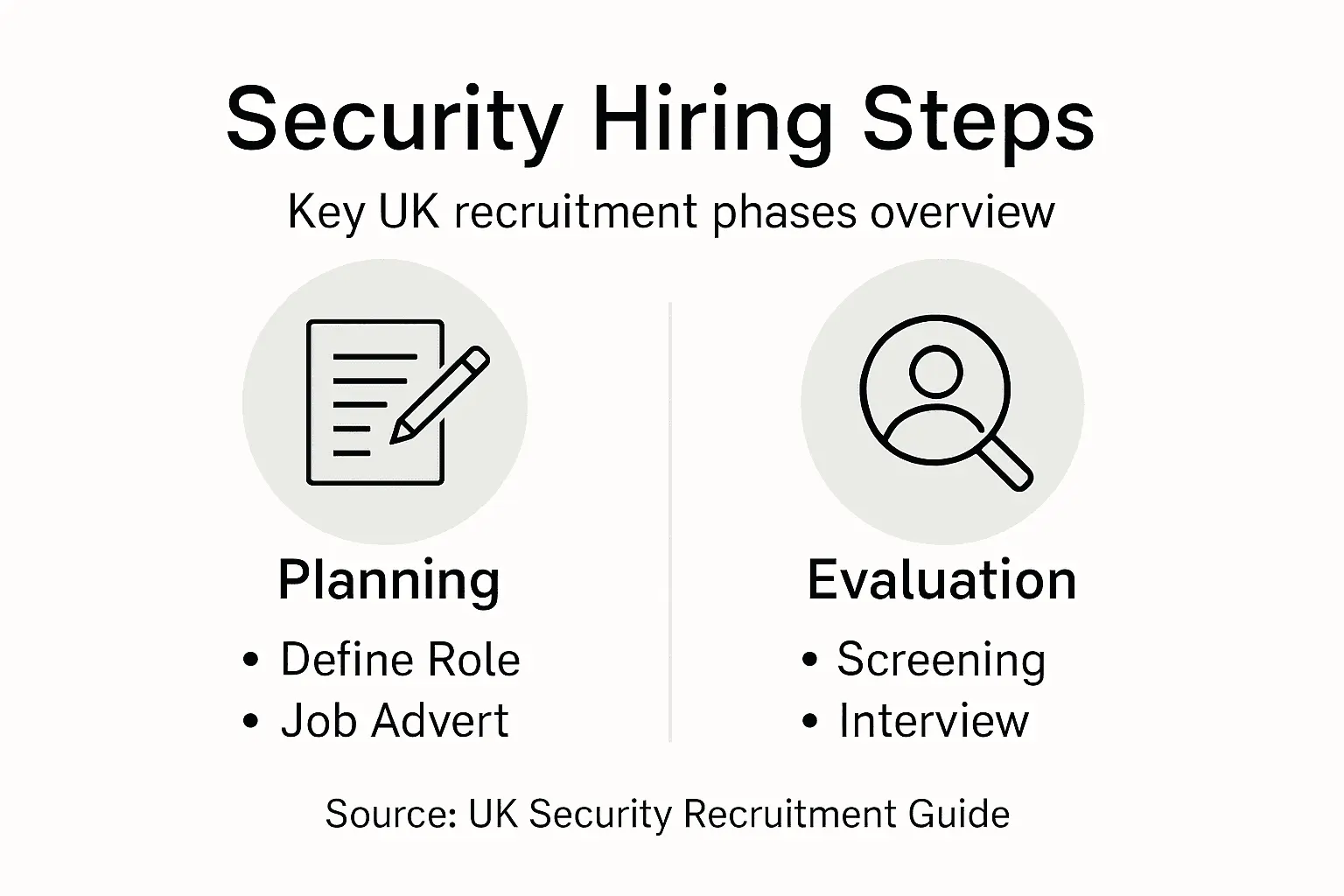
- Step 1: Define Key Security Role Requirements
- Step 2: Prepare Targeted Job Descriptions And Adverts
- Step 3: Screen Candidates For Credentials And Experience
- Step 4: Conduct Structured Interviews And Assessments
- Step 5: Verify Backgrounds And Confirm Compliance
- Step 6: Onboard New Hires With Sector-Specific Training
Quick Summary
| Key Message | Explanation |
|---|---|
| 1. Define Role Requirements Clearly | Outline required skills and competencies to target suitable candidates effectively in security recruitment. |
| 2. Craft Compelling Job Descriptions | Create clear, engaging job adverts highlighting organisational culture and growth opportunities to attract top talent. |
| 3. Implement Rigorous Credential Screening | Conduct thorough checks on candidates’ credentials to ensure compliance and organisational security standards. |
| 4. Use Structured Interviews | Employ a systematic interview process to objectively assess candidates’ skills and alignment with the role. |
| 5. Prioritise Effective Onboarding | Develop a thorough onboarding programme to equip new hires with necessary skills, enhancing their operational effectiveness. |
Step 1: Define key security role requirements
Defining precise security role requirements is crucial for successful recruitment in the UK security sector. This step helps organisations identify the exact skills, responsibilities, and competencies needed for specific security positions.
Begin by consulting the Government Security Profession Career Framework to understand comprehensive role profiles. This framework provides detailed insights into skills and responsibilities across various security functions. Identify the specific role family relevant to your recruitment needs whether that involves physical security, information security, or specialist security practitioner roles.
Break down the role requirements systematically by examining core competencies, technical skills, and behavioural attributes. Consider security clearance levels, technical knowledge, communication capabilities, and specific experience required. Document these requirements precisely to create a clear job description that attracts suitable candidates.
Practical Advice: Cross reference your role requirements with industry standards and recent security recruitment trends to ensure your job specification remains competitive and attracts top talent.
Step 2: Prepare targeted job descriptions and adverts
Crafting precise and compelling job descriptions is essential for attracting top security talent in the competitive UK recruitment landscape. Your job advert serves as the first point of contact with potential candidates and must effectively communicate the role’s requirements and opportunities.
When developing job descriptions, focus on creating clear and non-discriminatory specifications that outline educational qualifications, core skills, experience requirements, and personal competencies. Break down the role into specific sections such as primary responsibilities, required technical skills, necessary certifications, and desired behavioural attributes. Be explicit about security clearance levels, technical knowledge expectations, and specific experience needed to attract candidates who precisely match your organisational requirements.
Ensure your job advert goes beyond a simple list of requirements by highlighting your organisation’s unique culture, career development opportunities, and potential for professional growth. Use engaging language that speaks directly to security professionals and differentiates your opportunity from standard job postings. Include information about potential training programmes, specialisation pathways, and the broader impact of the role within your security ecosystem.
Practical Advice: Review and update your job specifications regularly to maintain alignment with evolving security sector standards and emerging recruitment trends.
Step 3: Screen candidates for credentials and experience
Screening candidates thoroughly is a critical step in securing the right talent for security roles in the United Kingdom. Your screening process must balance comprehensive evaluation with legal compliance and candidate privacy.

Begin by implementing rigorous recruitment compliance procedures that validate each candidate’s professional credentials. This involves meticulously checking Security Industry Authority licenses, academic qualifications, professional certifications, and past employment records. Verify each candidate’s background carefully, ensuring all documentation meets current UK legal standards and data protection regulations. Pay special attention to specific security sector requirements such as advanced background checks, security clearance levels, and professional references that substantiate a candidate’s claimed experience.
Develop a systematic approach to credential verification that goes beyond surface level checks. Conduct in depth interviews that probe candidates professional experiences, analyse their practical skills through scenario based assessments, and cross reference their claimed competencies with documented evidence. Remember that in security recruitment, thoroughness is not just recommended it is essential for maintaining organisational integrity and safety standards.
Practical Advice: Create a standardised screening checklist to ensure consistent and comprehensive evaluation of all candidate credentials.
Step 4: Conduct structured interviews and assessments
Structured interviews represent a critical phase in your security recruitment process ensuring you select candidates with the right skills, mindset, and professional capabilities. Your approach must be systematic and comprehensive to effectively evaluate potential security professionals.
Employ structured selection techniques that encompass multiple assessment methods. Design your interview process to include competency based questioning, scenario analysis, and practical skill demonstrations. This multifaceted approach allows you to assess candidates beyond their written credentials examining their problem solving abilities, communication skills, and behavioural responses in realistic security environments. Develop a standardised interview framework with predetermined questions that explore technical knowledge, situational judgment, and professional ethics specific to security sector requirements.
Implement a scoring system that objectively evaluates candidates across multiple dimensions. Create assessment criteria that measure technical competence, interpersonal skills, stress management, decision making capabilities, and alignment with organisational values. Use a combination of structured interviews, practical assessments, role play scenarios, and psychometric evaluations to gain a holistic understanding of each candidates potential performance in complex security environments.
Practical Advice: Rotate interview panel members to reduce individual bias and ensure a more comprehensive candidate evaluation.
The following table compares common assessment methods for security recruitment:
| Assessment Method | What It Evaluates | Benefits |
|---|---|---|
| Competency Interview | Technical/behavioural skills | Reveals real-world abilities |
| Scenario-Based Exercise | Problem-solving approach | Tests response under pressure |
| Psychometric Evaluation | Personality/work style | Highlights team fit |
| Role-Play Assessment | Practical skill application | Demonstrates on-the-job readiness |
Step 5: Verify backgrounds and confirm compliance
Background verification represents a critical safeguard in security recruitment ensuring you select professionals who meet the highest standards of integrity and legal compliance. Your verification process must be rigorous comprehensive and aligned with UK regulatory requirements.
Conduct comprehensive background verification checks that thoroughly validate candidate credentials and legal eligibility. This involves multiple layers of validation including criminal record checks right to work verification professional license authentication and comprehensive reference confirmation. Pay particular attention to mandatory Security Industry Authority license verification ensuring each candidate possesses the requisite legal documentation to operate within security roles. Systematically document each verification stage maintaining meticulous records that demonstrate your organisations commitment to due diligence and legal compliance.
Implement a structured verification workflow that protects candidate privacy while meeting stringent data protection regulations. Utilise authorised background checking services that understand the nuanced requirements of security sector recruitment. Cross reference information from multiple sources including official government databases professional registries and verified employment records. Develop clear protocols for handling sensitive personal information ensuring full compliance with General Data Protection Regulation standards throughout the verification process.
Practical Advice: Create a standardised verification checklist that ensures consistent and legally compliant background assessment across all candidate applications.
Step 6: Onboard new hires with sector-specific training
Onboarding security professionals requires a structured approach that transforms recruitment success into operational excellence. Your training strategy must equip new hires with the precise skills and knowledge necessary to excel in their security roles.
Develop a comprehensive onboarding programme following the Security Industry Authority training specification which outlines mandatory training modules. These should include critical areas such as legal powers health and safety protocols conflict management techniques and customer service standards. Design interactive training sessions that combine theoretical knowledge with practical scenario based learning ensuring new hires can translate classroom insights into real world security responses. Incorporate structured assessments that validate learning comprehension and practical skill application throughout the training process.
Implement a phased onboarding approach that gradually builds competence and confidence. Begin with foundational legal and operational training then progress to role specific technical skills and organisational protocols. Pair new hires with experienced mentors who can provide contextual guidance and support during the initial integration period. Ensure all training aligns with current SIA licensing requirements and includes comprehensive documentation to demonstrate professional development and compliance.
Practical Advice: Create modular training materials that can be easily updated to reflect evolving security sector standards and regulatory requirements.
Here is a summary of key considerations at each stage of security sector recruitment:
| Recruitment Stage | Core Focus | Risks if Overlooked |
|---|---|---|
| Role Definition | Accurate skill profiling | Misaligned hires, inefficiency |
| Job Description Creation | Targeted, clear adverts | Fewer suitable applicants |
| Candidate Screening | Credential verification | Compliance breaches, unsafe hires |
| Interviews & Assessment | Structured evaluation | Subjectivity, missed warning signs |
| Background Verification | Legal and regulatory checks | Legal issues, reputational damage |
| Onboarding & Training | Sector-specific induction | Underprepared staff, regulatory gaps |
Streamline Your Security Recruitment with Expert Support
Recruiting the right security professionals in the UK means tackling complex challenges like defining precise role requirements, conducting thorough candidate screening, and ensuring full compliance with legal and sector standards. This guide highlights critical steps such as crafting targeted job descriptions, implementing structured interviews, and onboarding with sector-specific training to build a trustworthy team. Finding candidates who not only meet strict credential checks but also align with your organisation’s values can feel overwhelming and time consuming.

Take control of your recruitment process with Security Jobs Board – the UK’s dedicated platform for security industry employment. Benefit from easy job posting tools, access to a vast CV database, and GDPR compliant candidate management designed specifically for security roles. Start today to connect with qualified professionals more quickly, reduce recruitment risks, and build a compliant, well-trained security workforce. Visit Security Jobs Board now to post your vacancies and streamline your hiring journey with trusted, BSIA affiliated expertise.
Frequently Asked Questions
How do I define the key security role requirements for recruitment?
Defining key security role requirements involves identifying specific skills, responsibilities, and competencies needed for the position. Begin by consulting the Government Security Profession Career Framework and document these requirements to create a clear job description.
What should I include in a job description for security roles?
A well-crafted job description should include educational qualifications, core skills, experience requirements, and personal competencies. Ensure clarity by breaking down the role into sections and highlighting your organisation’s culture and opportunities for career growth.
How can I effectively screen candidates for security positions?
To screen candidates, implement rigorous procedures to validate credentials, including checking industry-specific licenses and qualifications. Create a standardised checklist for comprehensive evaluation to ensure consistency and compliance with legal standards.
What makes structured interviews essential in the recruitment process?
Structured interviews are crucial because they allow for a systematic evaluation of candidates based on predetermined questions and assessment criteria. Develop a scoring system to objectively measure technical and interpersonal skills, ensuring you make well-informed hiring decisions.
How do I verify backgrounds and ensure compliance in my hiring process?
Conduct comprehensive background verification checks that validate candidate credentials and legal eligibility, including criminal record checks and professional licence authentication. Maintain meticulous records to demonstrate compliance and due diligence throughout the verification process.
What training should I include in the onboarding process for new security hires?
Incorporate a comprehensive onboarding programme that includes mandatory training modules such as legal protocols and conflict management. Use interactive training sessions to reinforce skills, ensuring new hires are adequately prepared for their roles within the first 30 days.


