
Security recruitment is not like hiring for any other job. It demands deeper scrutiny and sharper judgement from the very first step. Imagine this: background checks and screening in security roles are now considered essential by over 80 percent of organisations. It might sound like a headache for recruiters, but the real surprise is that these added steps do not slow things down as much as you would think. They actually create a foundation that makes organisations safer and more resilient right from the start.
Table of Contents
- Defining Security Recruitment: Key Concepts And Terminology
- The Importance Of Security Recruitment In Today’s Landscape
- How Security Recruitment Works: Processes And Practices
- Evaluating Candidates: What Employers Look For
- Trends In Security Recruitment: Challenges And Innovations
Quick Summary
| Takeaway | Explanation |
|---|---|
| Thorough background checks are essential. | Comprehensive background verification is critical for ensuring candidates possess integrity and suitability for security roles. |
| Advanced skills assessment techniques are necessary. | Employing technical tests and scenario-based evaluations helps identify candidates with the right competencies and situational judgment. |
| Emphasise psychological resilience in candidates. | Candidates must demonstrate the ability to handle pressure and make swift decisions, making psychological evaluations a priority. |
| Leverage technology for smarter recruitment. | Using AI and machine learning can enhance candidate screening and performance predictions, addressing modern recruitment challenges. |
| Continuous learning is vital for security professionals. | Organizations should foster ongoing skill development to adapt to evolving security threats and technological advancements. |
Defining Security Recruitment: Key Concepts and Terminology
Security recruitment represents a specialized hiring process focused specifically on identifying, attracting, and selecting professionals who will protect people, assets, and critical information systems. According to professional recruitment standards, this process goes beyond traditional recruitment by requiring deeper background checks, specific skill assessments, and rigorous vetting procedures.
Core Components of Security Recruitment
The process encompasses multiple critical elements that distinguish it from standard recruitment approaches. Security recruitment demands a comprehensive understanding of both human capabilities and technical competencies. Professionals must evaluate candidates not just on technical skills, but also on their integrity, psychological resilience, and potential alignment with stringent security protocols.
The table below summarises the core components evaluated during the security recruitment process, providing a concise reference for the key focus areas in candidate assessment.
| Component | Purpose/Focus |
|---|---|
| Background verification | Ensures integrity and confirms absence of disqualifying history |
| Technical skill assessments | Determines capability to perform required security tasks |
| Psychological profile screening | Assesses resilience, emotional stability, and suitability |
| Security clearance compatibility | Validates alignment with organisational and regulatory requirements |
| Physical and mental fitness | Confirms ability to meet demanding nature of security roles |
Key Evaluation Areas Include:
- Candidate’s background verification
- Technical skill assessments
- Psychological profile screening
- Security clearance compatibility
- Physical and mental fitness requirements
Specialized Skill Matching
Effective security recruitment requires matching precise skill sets with specific security roles. Whether recruiting for physical security positions like guards and surveillance specialists or cybersecurity roles involving network protection, recruiters must understand nuanced job requirements. These roles demand professionals who can demonstrate exceptional situational awareness, quick decision making, and unwavering commitment to protecting organisational interests.
For those interested in exploring more about the recruitment process, check out our recruiter resources for additional insights into effective security sector hiring strategies.
Understanding security recruitment is not just about filling positions, but about building a robust protective ecosystem that safeguards an organisation’s most valuable assets through strategic human capital management.
The Importance of Security Recruitment in Today’s Landscape
Research from professional compliance organisations indicates that security recruitment has become increasingly critical in an era of complex global threats and evolving technological risks. Modern organisations face unprecedented challenges that demand sophisticated approaches to protecting their human and digital assets.
Mitigating Organisational Vulnerabilities
Security recruitment serves as a strategic defence mechanism against potential risks.
 By carefully selecting professionals who possess not just technical skills but also exceptional judgment and integrity, organisations can create robust protective layers. Background verification and comprehensive screening are no longer optional but essential strategies for maintaining organisational safety.
Critical Risk Prevention Elements:
- Identifying potential insider threats
- Preventing unauthorized information access
- Maintaining comprehensive security protocols
- Reducing potential human error vulnerabilities
- Ensuring regulatory compliance standards
Strategic Talent Acquisition in Security
Effective security recruitment transcends traditional hiring practices. It requires understanding complex risk landscapes, technological vulnerabilities, and human behavioural patterns. Recruiters must assess candidates through multidimensional lenses that evaluate psychological resilience, technical competence, and ethical standards.
For organisations seeking comprehensive guidance on building robust security teams, explore our employer recruitment resources for advanced strategies and insights.
Ultimately, security recruitment represents a critical investment in an organisation’s long-term stability, protecting not just physical and digital assets but also preserving institutional reputation and operational integrity.
How Security Recruitment Works: Processes and Practices
Professional recruitment standards reveal that security recruitment represents a highly specialised process requiring meticulous planning and sophisticated candidate evaluation techniques.
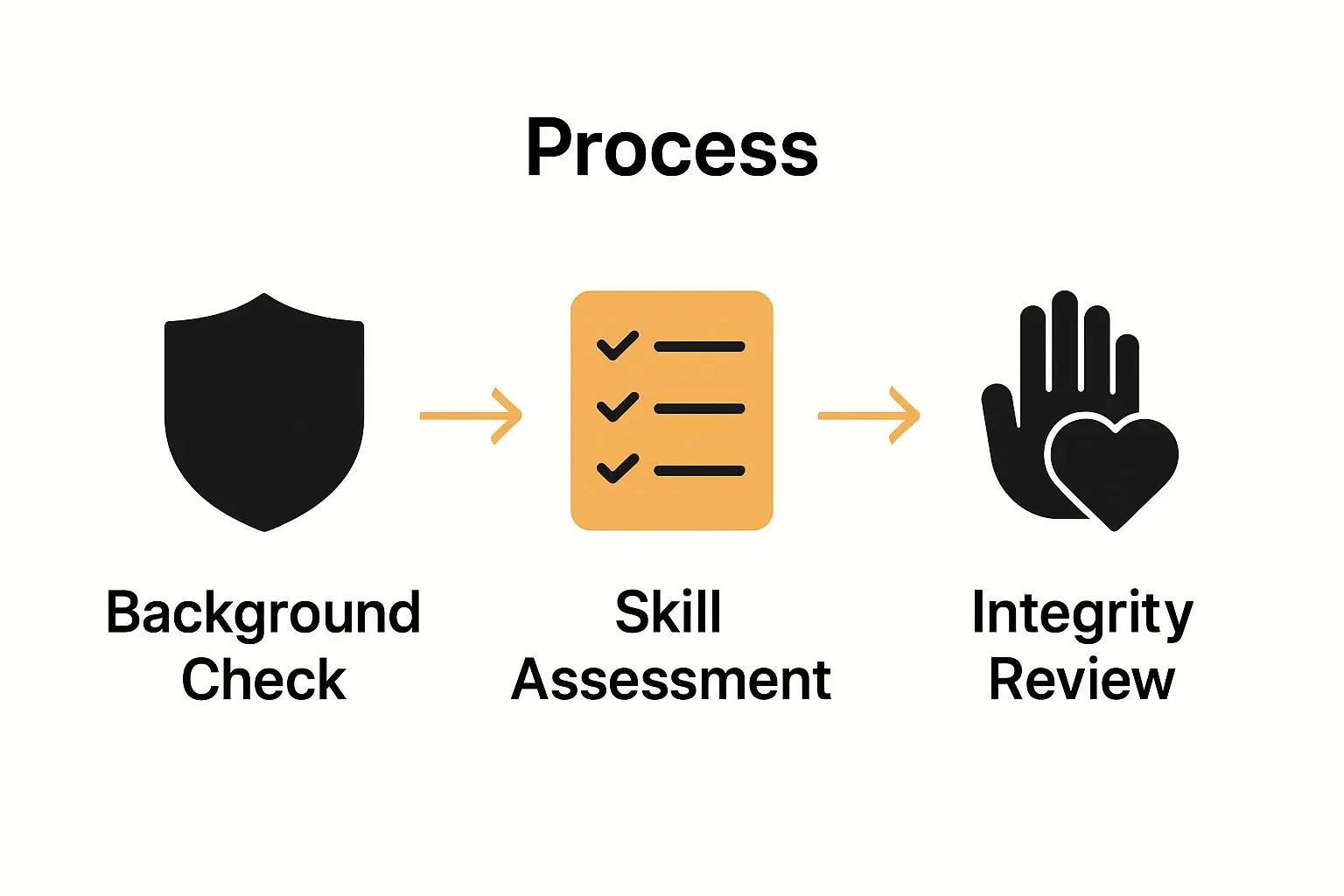 Unlike traditional hiring approaches, security recruitment demands comprehensive strategies that thoroughly assess a candidate’s suitability for protecting organisational assets.
Comprehensive Candidate Assessment
The security recruitment process involves multiple intricate stages designed to evaluate candidates beyond standard professional qualifications.
Recruiters employ advanced screening methods that examine technical competencies, psychological profiles, and ethical standards. Background investigations play a crucial role, encompassing criminal record checks, employment history verification, and detailed reference examinations.
Key Screening Components:
- Detailed criminal background checks
- Professional credentials verification
- Psychological proficiency assessments
- Security clearance validation
- Personal integrity evaluations
Advanced Selection Methodologies
Recruiters utilise sophisticated selection techniques that go beyond conventional interview processes. This involves scenario-based assessments, technical skills tests, and comprehensive psychological evaluations. Candidates must demonstrate not just professional expertise but also exceptional situational judgment, emotional resilience, and unwavering ethical standards.
For organisations seeking streamlined candidate management, explore our advanced applicant tracking solutions that simplify complex recruitment workflows.
Ultimately, security recruitment is an intricate process that balances technical skill assessment with deep understanding of human behavioural dynamics, ensuring that only the most suitable professionals are entrusted with critical security responsibilities.
Evaluating Candidates: What Employers Look For
Professional security recruitment research demonstrates that candidate evaluation in the security sector goes far beyond traditional hiring criteria. Employers seek multifaceted professionals who can navigate complex security environments with precision, integrity, and adaptability.
Core Professional Competencies
Beyond technical qualifications, security employers prioritise holistic candidate assessment. Psychological resilience and situational judgment emerge as critical differentiators. Candidates must demonstrate an ability to remain calm under pressure, make rapid decisions, and maintain professional composure in high-stress scenarios.
Essential Candidate Attributes:
- Strong ethical decision making capabilities
- Advanced problem solving skills
- Exceptional communication abilities
- Proven adaptability in dynamic environments
- Demonstrated commitment to continuous learning
Psychological and Behavioural Screening
Employers utilise sophisticated assessment techniques that evaluate candidates’ psychological profiles. This involves understanding an individual’s potential responses to complex security challenges, their emotional intelligence, and their capacity to maintain professional boundaries. Psychological evaluations help identify candidates who can effectively manage potential interpersonal conflicts and maintain strategic focus.
For security professionals seeking to understand employer expectations, explore our comprehensive employer resources for deeper insights into recruitment strategies.
Successful security recruitment ultimately hinges on identifying professionals who blend technical expertise with exceptional human qualities, creating a robust defence against emerging organisational vulnerabilities.
Trends in Security Recruitment: Challenges and Innovations
Professional recruitment research indicates that security recruitment is undergoing significant transformations driven by technological advancements, evolving threat landscapes, and changing workforce dynamics. Modern organisations must adapt their recruitment strategies to address increasingly complex security challenges.
Technological Disruption in Recruitment
Digital technologies are revolutionising how security professionals are identified, assessed, and onboarded. Artificial intelligence and machine learning algorithms now play pivotal roles in candidate screening, enabling more nuanced and comprehensive evaluations that go beyond traditional recruitment methodologies. These technologies can rapidly analyse candidate profiles, predict potential performance, and identify subtle behavioural indicators.
This table presents the main technological innovations currently disrupting security recruitment, highlighting how each tool or method contributes to more robust candidate screening and selection processes.
| Technological Innovation | Description |
|---|---|
| AI-powered candidate matching | Uses artificial intelligence to align candidates to specific roles |
| Advanced psychological assessment | Incorporates technology-driven psychometric and behavioural evaluations |
| Blockchain credential verification | Ensures authenticity of candidates’ qualifications and histories |
| Predictive analytics | Forecasts candidate performance based on data patterns |
| Virtual reality simulation | Assesses candidate reactions and skills in simulated scenarios |
Emerging Technological Recruitment Innovations:
- AI-powered candidate matching systems
- Advanced psychological assessment tools
- Blockchain-based credential verification
- Predictive analytics for candidate performance
- Virtual reality simulation assessments
Addressing Skills Gaps and Emerging Challenges
The security recruitment landscape faces significant challenges in addressing rapidly evolving technological and human skill requirements. Organisations must now recruit professionals who can seamlessly integrate technical expertise with advanced adaptive capabilities. This requires a more holistic approach to talent acquisition that emphasises continuous learning and flexible skill development.
For professionals seeking to enhance their marketability, explore our security skills development resources to stay ahead of industry trends.
Ultimately, successful security recruitment now demands a dynamic, forward-thinking approach that anticipates emerging threats and cultivates adaptable, multiskilled security professionals capable of navigating increasingly complex global security environments.
Build Your Security Career or Team With Confidence
Struggling to find candidates who truly fit your high security standards? Worried about missing critical steps like background verification or psychological assessments discussed in our article? At Security Jobs Board, we understand that genuine security recruitment involves more than just filling roles. You need access to a trusted network, reliable tools, and a platform designed for the strict demands of the industry.

Join thousands across the UK who use Security Jobs Board every day to connect skilled candidates and employers. Benefit from quality match-making, BSIA affiliation, a mobile-first site, and a secure process for building your team or advancing your own career. Ready to secure your future and meet today’s security recruitment challenges head-on? Create your profile now and explore greater peace of mind in your hiring or job search experience.
Frequently Asked Questions
What is security recruitment?
Security recruitment is a specialised hiring process focused on identifying, attracting, and selecting professionals tasked with protecting people, assets, and information systems. It involves deeper background checks, skill assessments, and rigorous vetting compared to traditional recruitment.
Why is security recruitment important?
Security recruitment is crucial in today’s landscape due to complex global threats and evolving technological risks. Effective security hiring helps mitigate organisational vulnerabilities and creates a robust protective layer in organisations, safeguarding both physical and digital assets.
What key components are evaluated in security recruitment?
Core components include background verification, technical skill assessments, psychological profile screenings, security clearance compatibility, and evaluations of physical and mental fitness requirements. This comprehensive assessment ensures that candidates possess both the required skills and personal integrity.
How do technological advancements impact security recruitment?
Technological advancements are transforming security recruitment by employing tools such as artificial intelligence and machine learning to enhance candidate screening and evaluation processes. These innovations enable more effective matching of candidates to roles while addressing emerging security challenges efficiently.


