How to network in the security industry for career growth

TL;DR:
- Building a strategic, layered network in the UK security sector accelerates career growth by fostering genuine relationships.
- Most roles are filled through trusted contacts and peer communities before reaching public listings, highlighting the importance of active networking.
- Engaging in professional bodies, attending targeted events, and contributing through mentorship and speaking increases visibility and opens unadvertised opportunities.
You could have every qualification on the list, a spotless SIA licence record, and years of solid experience behind you, yet still watch less-qualified colleagues land better roles simply because they know the right people. It is a frustrating reality for many UK security professionals, and it happens more often than anyone in the industry likes to admit. The good news is that networking is a learnable skill, not a personality trait, and when you apply it strategically within the UK security sector, it can shift your career momentum faster than any single certification ever will. This guide gives you a practical, proven roadmap to build the connections that genuinely open doors.
Table of Contents
- Understand the value of networking in the UK security sector
- Start with the right communities and membership organisations
- Make first contact: Structured events, mentorship, and ongoing conversations
- Level up: Speaking, volunteering, and adding value to your network
- Verify and nurture: Tracking progress and troubleshooting common pitfalls
- Our perspective: Why strategic, layered networking outperforms casual connections
- Next steps: Advance your career through leading UK security job boards
- Frequently asked questions
Key Takeaways
| Point | Details |
|---|---|
| Join reputable communities | Choose industry-leading groups and professional bodies for access to genuine peer networks and mentors in UK security. |
| Prioritise structured events | Engage actively at conferences, forums, and webinars to build meaningful relationships and unlock hidden job opportunities. |
| Embrace mentorship and volunteering | Leveraging mentorship and giving back through volunteering or speaking increases your industry visibility and career momentum. |
| Verify and nurture your connections | Regularly assess and maintain your network to ensure ongoing career benefits and opportunities for advancement. |
Understand the value of networking in the UK security sector
Before you attend a single event or send a single LinkedIn request, it helps to understand exactly what you stand to gain. Networking in security is not just about collecting contacts. It is about accessing a living ecosystem of knowledge, opportunity, and trust that sits largely beneath the surface of public job listings.
Consider this: a significant proportion of roles in the UK security industry are filled before they ever appear on a job board. Hiring managers reach out to people they already know, or ask trusted contacts to recommend someone. Some valuable security roles circulate through trusted professional networks rather than public listings, meaning that candidates without strong community ties simply never hear about them. Your security job search strategies need to account for this reality.
“The most valuable job leads in UK security often travel through trusted peer communities long before they reach any public platform. If you are not in those conversations, you are not in the running.”
Here is a quick summary of what a strong professional network delivers for security practitioners:
- Access to unadvertised roles shared by hiring managers within trusted communities
- Peer learning that keeps your technical knowledge and industry awareness current
- Career visibility so that decision-makers recognise your name before you apply
- Mentorship opportunities that accelerate your progression through senior-level guidance
- Referrals and endorsements that carry real weight with recruiters and employers
| How roles are typically filled | Approximate proportion |
|---|---|
| Via personal referral or network recommendation | 60 to 70% |
| Through public job boards and advertisements | 25 to 35% |
| Via agency-only introductions | 5 to 10% |
These figures illustrate why treating job searching as a purely transactional, application-based exercise leaves so much opportunity on the table. Your career advancement tips should sit alongside a deliberate networking plan, not replace it.
Start with the right communities and membership organisations
Now that you understand why networking matters, let us look at where to start building connections. The UK security sector has a rich ecosystem of professional bodies, associations, and online communities. The challenge is choosing the right ones for your career stage, rather than spreading yourself too thin.
UK security professionals can grow their network by joining large, established communities like the Security Industry Group (SIG), which brings together practitioners across physical and electronic security. For those in cybersecurity, bodies such as ISACA, CIISec, and BCS offer structured membership with genuine networking programmes. Professional bodies and membership organisations help you build peer networks that include both mentors and mentees, which creates a two-way flow of learning and opportunity. This kind of peer exchange is particularly valuable when you are navigating a career change or stepping into a specialist discipline for the first time.
| Community or body | Size | Cost | Peer level | Mentorship options | Events frequency |
|---|---|---|---|---|---|
| Security Industry Group (SIG) | Large | Free to join | Mixed | Informal | Regular online |
| ISACA (UK chapters) | Large | Paid membership | Mid to senior | Structured | Monthly+ |
| CIISec | Medium | Paid membership | Mid to senior | Formal programme | Quarterly+ |
| SASIG | Medium | Free for qualifying practitioners | Senior and specialist | Peer-led | Monthly |
| BCS Security group | Large | Paid (BCS membership) | All levels | Informal | Variable |
How do you match the right community to your ambitions? If you are early-career or making a transition from physical to cyber security, look for communities with open knowledge exchange and low barriers to entry. If you are established and seeking visibility among senior leaders, prioritise bodies that offer speaking panels and structured mentorship.
Here is how to make a strong initial impression when you join:
- Read recent discussions before posting so you understand the community’s tone and focus areas.
- Introduce yourself clearly, including your current role, your speciality, and what you are hoping to learn or contribute.
- Respond thoughtfully to at least three existing threads before starting your own.
- Offer something useful in your first contribution, whether that is a resource, a perspective, or a relevant experience.
- Connect directly with two or three members whose comments resonated with you.
Pro Tip: Before your first engagement in any new community or event, write a two-sentence professional introduction for yourself. It should cover who you are, what area of security you work in, and what you are actively seeking. Having it written means you will deliver it confidently rather than fumbling under pressure.
Your career progression workflow should include a scheduled review of which communities are active enough to be worth your ongoing time and which are fading. Membership is not a one-time decision; it is an ongoing commitment.

Make first contact: Structured events, mentorship, and ongoing conversations
After you have identified and joined relevant communities, focus on making those initial contacts meaningful and sustainable. Events are one of the fastest ways to convert a passive membership into a real professional relationship.
Trade association events in the UK provide a structured setting to meet peers working across physical security, close protection, and systems integration. The BSIA Spring Forum, for example, brings together professionals from across the industry who share a common stake in security standards and best practice. These gatherings fast-track introductions that might take months to arrange informally.
Different event formats serve different purposes:
- In-person forums and conferences build deep rapport quickly and are ideal for senior-level introductions
- Webinars and virtual roundtables offer regular access to specialist speakers and lower commitment, making them excellent for building familiarity over time
- Networking drinks and informal socials create a relaxed setting where authentic conversations happen naturally
- Panel discussions and Q&A sessions let you demonstrate knowledge in public, which builds credibility even among people you have not yet met individually
SASIG hosts networking forums where up to 200 or more delegates gather in a trusted peer environment built around cybersecurity leadership and intelligence-sharing. The sheer volume of practitioners in a single room, combined with the trusted format, creates an environment where meaningful introductions happen rapidly. Attending just two or three of these events per year can build more relevant connections than a year of passive LinkedIn browsing.
Mentorship is the long game. Mentorship programmes like those run by WiCyS convert introductions into ongoing career conversations and create structured accountability between participants. Rather than one-off interactions that fade within weeks, mentorship creates a rhythm of regular contact that keeps you visible and supported over months or even years.
Pro Tip: After every event conversation, follow up within 24 to 48 hours. Reference something specific from your discussion, a topic you debated, a challenge they mentioned, or a shared contact you both know. Generic follow-ups are ignored. Specific ones are remembered.
Your job search strategy should include at least four in-person or online networking events per year, combined with one mentorship relationship that gives you consistent access to senior perspective. These two elements together improve employability far more than simply applying to advertised roles in isolation.
Level up: Speaking, volunteering, and adding value to your network
Once you have connected with peers and leaders at events or through mentorship, it is time to transform from a passive attendee into a recognised contributor. This is where networking moves from surface-level socialising to genuine career acceleration.
“The professionals who advance fastest in the UK security sector are rarely those who showed up the most. They are those who contributed the most. Speaking once at a relevant forum can generate more lasting connections than attending ten events as a delegate.”
Speaking and volunteering at industry events is an evidence-backed mechanism for networking impact. When you present or moderate, you are visible to everyone in the room simultaneously, which collapses the time it would normally take to introduce yourself individually to each person. People approach you after sessions, not the other way around.
Here are practical ways to start contributing, even if you have never spoken publicly before:
- Write a short summary of an event you attended and share it on LinkedIn, tagging the organisers and speakers. This often leads to direct responses and new connections.
- Volunteer to help organise a community webinar or chapter meeting. Logistics work introduces you to every speaker and organiser on the programme.
- Offer to host a peer discussion within your existing community on a topic where you have hands-on experience, even if your experience is relatively recent.
- Raise a thoughtful question during a public Q&A session. A well-framed question positions you as a serious practitioner, not just a passive listener.
- Share resources actively in member forums, whether that is a new piece of industry guidance, a useful tool, or a job lead someone else might benefit from.
A practical networking strategy for UK security roles combines membership-based communities, event attendance, and relationship-building through mentorship and contribution. The connections you build by giving value persist far longer than those formed through passive attendance alone, and they are far more likely to result in a recommendation when a role opens up unexpectedly.
You can also look at hiring tips for security professionals from the employer perspective to understand exactly what recruiters and hiring managers notice when a trusted contact recommends someone from their network.
Verify and nurture: Tracking progress and troubleshooting common pitfalls
With these strategies, you are ready to network intentionally and verify your progress. Building a network is only half the challenge. Maintaining it is where most professionals fall short.
Maintaining a network of peers, mentors, and mentees is recognised as a core professional skill in the UK security sector, not a soft or optional one. Treat it with the same rigour you would apply to renewing a certification or reviewing your professional development plan.
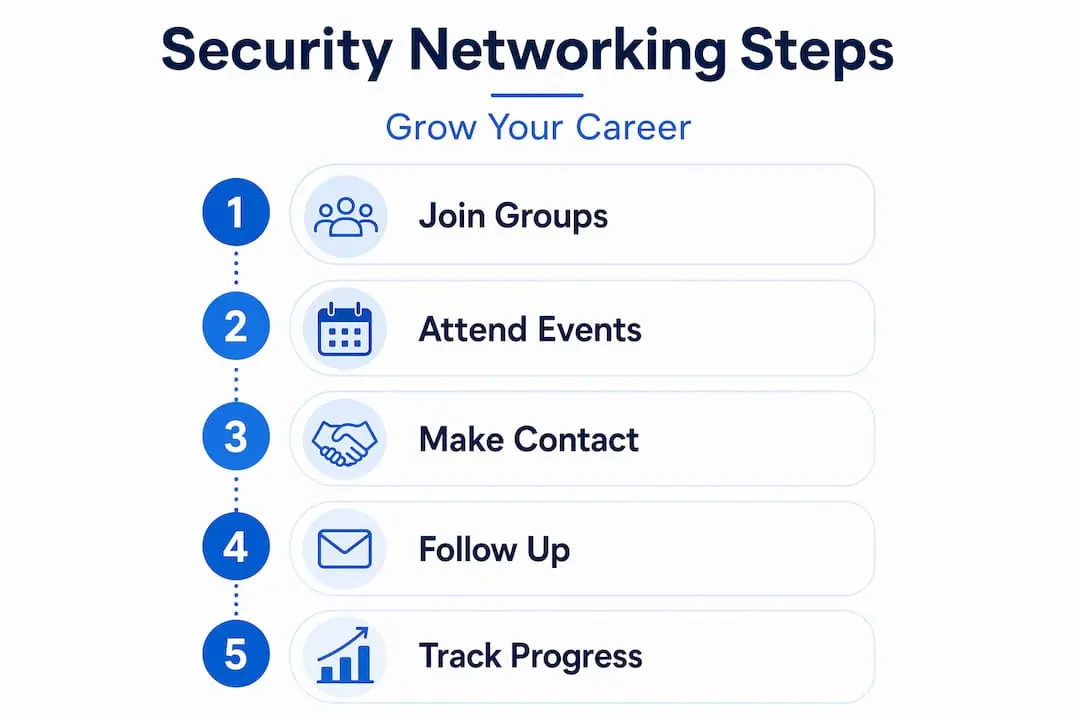
Signs your network is actually working for you include a steady trickle of new introductions from existing contacts, conversations that arise without you initiating them, and job leads or project enquiries coming through people rather than platforms. If none of these are happening, it is time to review your approach.
Common pitfalls that stall networking progress:
- Only engaging when you need something, such as job hunting after redundancy. Contacts notice the pattern and it erodes trust quickly.
- Failing to follow up after initial conversations, which means warm introductions cool off and disappear entirely within weeks.
- Forgetting to add value consistently, treating every interaction as an opportunity to ask rather than to give, which makes you forgettable or worse, avoidable.
- Spreading too thin across too many communities without going deep in any of them.
- Never measuring whether your networking is producing results, leaving you in a cycle of activity without impact.
Pro Tip: Set a recurring calendar reminder every three months to review your key contacts. Pick five people you have not spoken to recently and reach out with something useful: a relevant article, a connection you think they would benefit from, or a note on something you have achieved. This keeps relationships warm without being transactional.
If you are planning specific security engineer career paths, map your networking efforts to the communities and events where those roles are most visible. Targeted networking within the right sector saves you considerable time and produces far better results than generic professional socialising.
Our perspective: Why strategic, layered networking outperforms casual connections
There is a persistent myth in the UK security industry that networking means turning up to events and handing out business cards. It does not. The professionals we see making the most significant career leaps are almost never the ones with the largest contact lists. They are the ones who have built layered, reciprocal relationships within specific communities over time.
The difference is contribution. When you give consistently, whether that is knowledge, referrals, introductions, or even just encouragement to a peer navigating a difficult transition, you become someone people actively want to help. Opportunities flow towards people who are known as givers within their professional circles, not towards those who appear only when they need something.
We have spoken with security professionals who spent years applying to roles through public boards with modest success. Once they joined the right communities, started attending events regularly, and began contributing through mentorship and speaking, their trajectory shifted noticeably within 12 months. Not because they gained new qualifications, but because the right people now knew who they were and what they stood for.
The overlooked benefit of this approach is that it attracts opportunities you were not even searching for. Clients approach you. Recruiters reach out. Peers recommend you for panels, projects, and positions that never get advertised. Your career progression strategies become self-reinforcing once your reputation starts working on your behalf.
A CV tells an employer what you have done. A strong professional network tells them who you are, validated by people they already trust. In a sector built on trust, that distinction matters enormously.
Next steps: Advance your career through leading UK security job boards

Networking opens doors, and a strong profile makes sure you walk through them with confidence. The Security Jobs Board is the UK’s specialist platform for security sector jobseekers, built specifically around the needs of professionals like you. Whether you are searching for security jobs in Northern Ireland or looking for roles across the entire country, the platform connects you directly with employers actively recruiting right now. Create your free profile, upload your CV, and set tailored job alerts so that when an opportunity arises through your growing network or through direct recruitment, you are ready to act immediately. Visit the UK security careers and jobs board today and take the next practical step in your career.
Frequently asked questions
What is the best first step for networking in the UK security industry?
Join an established, security-focused community or professional body and introduce yourself via member forums to access peer and mentorship opportunities. Large, established communities like the Security Industry Group are a strong starting point for practitioners at all levels.
How can I find security jobs not advertised publicly?
Many UK security roles are shared through trusted community networks rather than public job boards, so staying active in forums and events boosts your visibility to employers. Some valuable security roles circulate exclusively through professional community channels before any public advertisement appears.
Do mentorship programmes help with networking?
Yes, mentorship programmes turn introductions into ongoing career conversations and create mutual learning opportunities that passive networking cannot replicate. Structured mentorship programmes provide the kind of consistent, purposeful contact that builds genuine career momentum over time.
Can volunteering or speaking at security events boost my network?
Volunteering and speaking at industry events makes you visible and connects you with peers, leaders, and recruiters simultaneously, rather than one person at a time. The speak and volunteer approach is an evidence-backed mechanism for accelerating professional visibility at industry gatherings.
How often should I follow up with my network?
Aim to re-engage with your key contacts at least quarterly, using updates, relevant articles, or shared job leads to keep relationships warm and mutually beneficial.


