Build a career progression workflow in UK security 2026

TL;DR:
- UK security career progression relies on understanding industry frameworks and developing transferable skills.
- Building genuine relationships and informal sponsorship are key to career advancement in security roles.
- Securing the right qualifications, managing vetting processes, and targeted networking are essential for job success.
Career stagnation is one of the most common frustrations among UK security professionals, yet the path forward is rarely mapped out clearly. Unlike many industries, security advancement depends on a specific blend of regulated qualifications, vetting requirements, and sector relationships that simply do not exist elsewhere. Whether you work in physical security, cyber, or governance, the steps you take now will determine the roles available to you in two or three years. This article walks you through a practical, structured workflow covering frameworks, skills, networking, and applications so you can move forward with confidence.
Table of Contents
- Understand security career frameworks and pathways
- Essential skills and qualifications for UK security roles
- Strategic networking to unlock security career opportunities
- Navigating the job application process in UK security
- What most security professionals overlook in career progression
- Take the next step in your UK security career
- Frequently asked questions
Key Takeaways
| Point | Details |
|---|---|
| Know your options | Understand frameworks and specialisms to map your next strategic career move. |
| Upgrade skills continually | Focus on sector-specific skills and certifications, where shortages offer the most opportunity. |
| Leverage key networks | Engage with both formal and informal networks for advice, referrals, and opportunities. |
| Master application processes | Be ready for UK-specific requirements, including vetting and competency interviews. |
| Value informal experience | Cultivate a reputation and track record through real projects and informal mentorship. |
Understand security career frameworks and pathways
Before you can plan your next move, you need to understand how the UK security industry is actually structured. Many professionals assume progression is straightforward, but the reality is far more varied and, frankly, more interesting.
The Government Security Profession Career Framework organises the profession into distinct specialisms including Cyber, Physical, and Governance, each with defined skills levels that guide advancement. This framework is particularly useful because it removes guesswork. You can see exactly which competencies are expected at each level and plan your development accordingly.
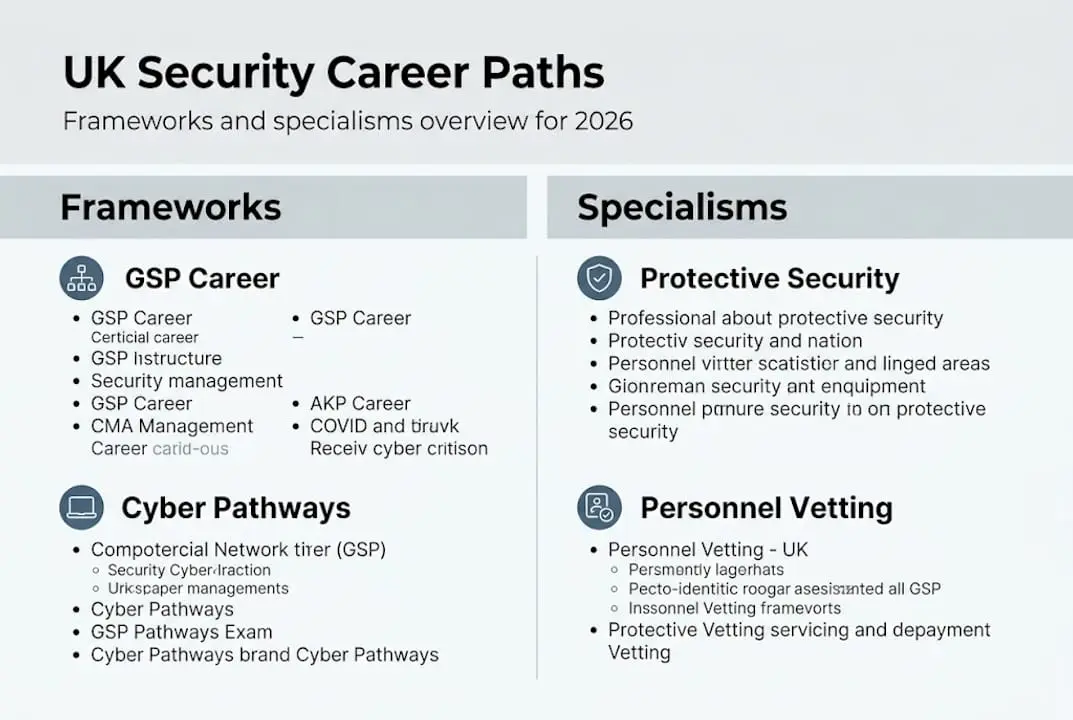
One of the most important things to understand is that progression is non-linear. Transferable skills and hands-on experience carry significant weight, often more than formal degrees. This means a physical security officer with strong risk management experience can move into a governance role if they build the right evidence base.
Here is a quick comparison of the main specialisms and what they typically require:
| Specialism | Common entry qualifications | Key skills | Typical next step |
|---|---|---|---|
| Physical security | SIA licence | Surveillance, incident response | Team leader, security manager |
| Cyber security | CREST, CompTIA Security+ | Threat analysis, forensics | SOC analyst, penetration tester |
| Governance and risk | CISSP, ISO 27001 | Auditing, compliance, policy | Risk manager, CISO |
Key transferable skills that cross all specialisms include:
- Risk assessment and management
- Incident reporting and documentation
- Communication under pressure
- Stakeholder engagement
- Analytical thinking
Understanding where you sit within this structure is the first step. From there, you can make targeted decisions about qualifications and experience rather than collecting credentials that do not serve your specific direction. If you are considering roles that require higher clearance levels, our security clearances guide is a useful starting point, and you can also explore UK clearance types to understand what different roles demand.
Essential skills and qualifications for UK security roles
With the framework in mind, the next step is understanding exactly which skills and qualifications will move the needle for your career. The market data here is striking.
The UK cybersecurity workforce sits at approximately 143,000, with a median salary of £55,000, yet job postings have dropped by 33% while skills gaps persist in auditing, forensics, and cryptography. That combination tells a clear story: employers are being selective, and niche technical skills are your strongest differentiator.

| Qualification | Best suited for | Time to achieve | Industry recognition |
|---|---|---|---|
| SIA licence | Physical security roles | 4 to 12 weeks | Mandatory for many roles |
| CREST certifications | Penetration testing, cyber | Months to years | High in technical roles |
| CISSP | Senior cyber and governance | 6 to 12 months study | Global and UK standard |
| ISO 27001 Lead Auditor | Governance and compliance | Weeks to months | Strong in corporate sector |
Beyond technical credentials, the following skills are consistently sought across security roles:
- Digital forensics and evidence handling
- Cryptography fundamentals
- Compliance auditing and gap analysis
- Clear written and verbal communication
- Project and risk management
Pro Tip: Do not wait until you feel fully ready before pursuing a new qualification. Enrol while you are still working in your current role. The overlap between learning and doing accelerates understanding faster than either approach alone.
Apprenticeship routes and on-the-job experience are increasingly valued, particularly for those entering the profession without a traditional degree background. It is also worth noting that only around 17% of the security workforce is female. There are growing initiatives to address this, and if you are looking for guidance on entry and progression as a woman in the sector, our article on pathways for women in security covers the landscape in detail. You can also browse latest security roles to see what employers are actively seeking right now.
Strategic networking to unlock security career opportunities
Skills and qualifications open doors, but relationships are often what get you through them. Networking in UK security is not about collecting business cards at conferences. It is about building genuine, mutual value over time.
Networking via conferences, alumni groups, professional bodies, and online communities is considered vital in the UK security industry. The key venues and communities to prioritise include:
- BSides events across UK cities, which attract technical practitioners and are excellent for peer learning
- SASIG (Security Awareness Special Interest Group), particularly strong for governance and awareness professionals
- CIISec (Chartered Institute of Information Security), which offers structured membership and CPD pathways
- The Security Institute, well regarded for physical and management-level professionals
- LinkedIn groups and specialist forums, useful for visibility and staying current
“The most influential connections in UK security are rarely made in public. They happen in closed alumni networks, Signal groups, and informal peer circles that outsiders rarely see.”
Informal networks such as alumni groups and closed communities often carry more real influence than formal professional bodies. A referral from a trusted peer in a closed group can carry more weight with a hiring manager than a polished application from an unknown candidate.
Pro Tip: When approaching senior professionals at events, lead with a genuine question or observation rather than a request. People remember those who made them think, not those who asked for favours.
Online engagement matters too. Posting thoughtful commentary on industry topics, sharing useful resources, and engaging with others’ content builds a quiet but consistent professional reputation. Avoid self-promotion. Focus on being genuinely helpful, and your profile will grow naturally. Our article on job search strategy covers how to align your networking efforts with active job searching.
Navigating the job application process in UK security
With your skills built and your network active, the application process itself requires careful preparation. Security roles have requirements that most other industries simply do not.
UK security roles require SIA licensing for physical positions and Developed Vetting for senior government roles, with most government and public sector applications processed through the NSVS portal. Structured, competency-based interviews are the norm rather than the exception.
Here is a step-by-step overview of what to prepare:
- Gather your documents early: SIA licence, DBS certificate, proof of address history, employment records going back five to ten years
- Complete vetting forms accurately: Errors or omissions are among the most common reasons for delays or rejections
- Register on the NSVS portal: Familiarise yourself with the interface before you need it urgently
- Prepare competency-based answers: Use the STAR method (Situation, Task, Action, Result) for every likely interview question
- Follow up professionally: After interviews, a brief, courteous follow-up reinforces your interest and professionalism
Common pitfalls to avoid:
- Incomplete vetting forms: Every gap in your history needs an explanation
- Missed deadlines: Vetting can take weeks or months; start early
- Generic CVs: Tailor each application to the specific role and specialism
- Underselling transferable skills: Explicitly connect your past experience to the role’s requirements
“Treat the vetting process as part of the interview. How you handle paperwork and respond to requests tells employers a great deal about your attention to detail.”
For a more detailed walkthrough, our job application workflow guide and step-by-step applications resource cover the full process. If you have just secured a role, our onboarding process guide will help you hit the ground running.
What most security professionals overlook in career progression
Here is something the formal frameworks will not tell you: the majority of meaningful career moves in UK security happen through informal sponsorship, not applications. Someone in a position of influence recommends you for a project, vouches for you in a closed conversation, or pulls your name forward when a role is not yet advertised.
Qualifications matter, but they are table stakes. What creates real momentum is your reputation within the circles that count. Professionals who focus exclusively on certifications while neglecting peer relationships often find themselves well-qualified but overlooked.
Mentorship is another underused lever. Being mentored accelerates your learning, but mentoring others builds your reputation as someone worth knowing. Both directions matter. If you want practical guidance on optimising UK job searches alongside your broader career strategy, that combination of visibility and targeted searching is what separates those who progress quickly from those who wait.
Take the next step in your UK security career
You now have a clear workflow: understand the frameworks, build the right skills, cultivate genuine relationships, and apply with precision. The next move is yours.

The Security Jobs Board is built specifically for UK security professionals, with roles across every specialism and region. Whether you are looking for your next contract in physical security or a senior cyber position, you will find opportunities matched to your background. If you are based in or considering roles in security jobs in Northern Ireland, we have dedicated listings there too. Create your free profile, set up job alerts, and let the right opportunities come to you.
Frequently asked questions
What are the most valued qualifications in the UK security industry?
SIA, CREST, and CISSP certifications are highly regarded across the sector, alongside practical on-the-job experience that demonstrates real-world competence.
How important is networking for UK security career advancement?
Networking is critical, particularly through alumni groups and informal closed communities, which frequently surface opportunities before they are publicly advertised.
What is the typical process for applying to security roles in the UK?
You will generally need sector-specific qualifications, must pass vetting through the NSVS portal, and should expect competency-based interviews as the standard format.
Are women underrepresented in UK security roles?
Yes, women currently make up only around 17% of the security workforce, though a growing number of initiatives are actively supporting female entry and progression across all specialisms.


