How to build a network security engineering career in the UK

TL;DR:
- A strong foundation in networking, device configuration, and traffic analysis is essential before focusing on security methods.
- Practical experience, like hands-on placements, outweighs certifications in securing employment as a UK network security engineer.
Most people assume you begin a network security career by studying attacks and defences. That assumption leads thousands of aspiring engineers straight into the wrong starting point. The reality is that strong networking fundamentals, device configuration, and traffic analysis come first, and security methodology builds on top of that practical base. UK employers are consistently clear about this expectation, and the job market data backs it up. If you want a credible, well-paid career as a network security engineer, the path is structured, evidence-backed, and very achievable with the right approach.
Table of Contents
- Understanding the role: What does a network security engineer do?
- Building your foundation: Skills and certifications required
- Pathways to entry: Career routes and UK early-career programmes
- Progression and emerging roles: Levelling up to senior engineer
- What most guides miss: Practical experience trumps credentials
- Find your next step: Explore UK network security jobs and employer resources
- Frequently asked questions
Key Takeaways
| Point | Details |
|---|---|
| Foundation before security | Mastering networking fundamentals precedes specialising in security tasks for sustained career growth. |
| Certifications plus experience | Vendor-backed certificates open doors but hands-on placements and practical skills are vital for UK job success. |
| UK entry routes | Programmes like CyberFirst, apprenticeships, and degree tracks accelerate early-career progression in network security. |
| Mid-level readiness | UK employers target practical experience and threat-informed defence for mid-level network security roles. |
| Practical skills dominate | Employers value hands-on competence over credentials, so prioritise real-world training and placements. |
Understanding the role: What does a network security engineer do?
Before you invest time and money in training, you need a precise picture of what this job actually involves. The title sounds broad, but the day-to-day responsibilities are quite specific.
A network security engineer is responsible for securing network devices, monitoring performance, and maintaining defences against both internal and external threats. According to the Network engineer occupation overview, core duties include configuring firewalls, managing VPNs, analysing network traffic, and responding to security incidents as they arise. You are, in essence, the person who keeps data moving safely across an organisation’s infrastructure.
In the UK context, this role often sits within a security operations team or reports directly to a Chief Information Security Officer (CISO). You will frequently work alongside compliance teams to implement frameworks such as Secure Access Service Edge (SASE) and Zero Trust architecture. SASE consolidates networking and security functions into a single cloud-delivered service. Zero Trust means no user or device is automatically trusted, even inside the network perimeter.
Key responsibilities typically include:
- Configuring and hardening routers, switches, and firewalls
- Monitoring network traffic for anomalous behaviour
- Conducting vulnerability assessments and penetration testing support
- Implementing access controls and identity management policies
- Responding to and documenting security incidents
- Ensuring compliance with UK regulations such as the Network and Information Systems (NIS) Regulations
“The role demands both technical depth and situational awareness. You are not just building walls; you are watching everything that moves through them.”
Understanding these responsibilities early helps you align your training choices with real employer expectations. Our security sector jobs guide provides further context on how this role fits within the broader UK security industry, and our security jobs requirements page breaks down what employers specifically look for when hiring.
Building your foundation: Skills and certifications required
Once you understand what the job demands, the next question is obvious: what do you actually need to learn? The answer falls into two categories, technical skills and soft skills, and both matter more than most guides admit.
Technical skills and certifications
The most respected certifications in this field come from Cisco. Cisco lists CCNP Enterprise and CCNP Security as among the most popular credentials for security engineer roles. These are not entry-level qualifications; they require you to demonstrate genuine competence in network design, troubleshooting, and security policy implementation.
Here is a comparison of core versus advanced skills to help you plan your learning journey:
| Skill area | Core level | Advanced level |
|---|---|---|
| Firewall management | Basic rule configuration | Policy optimisation and audit |
| Network monitoring | Traffic analysis tools | Intrusion detection systems (IDS) |
| Incident response | Logging and escalation | Forensic investigation and remediation |
| Identity management | Role-based access control | Zero Trust implementation |
| Certifications | CompTIA Security+, CCNA | CCNP Security, CISSP, CEH |
| Scripting | Basic Python or Bash | Automation of security workflows |
Starting with CompTIA Security+ gives you a broadly recognised baseline. Moving to CCNA (Cisco Certified Network Associate) builds the networking fundamentals that underpin everything else. Only then does it make sense to pursue CCNP Security or Certified Ethical Hacker (CEH) credentials.
Soft skills that employers value
Technical ability alone will not get you hired or promoted. Social engineering, where attackers manipulate people rather than systems, is one of the most common threat vectors in the UK. Understanding how it works, and being able to train colleagues to resist it, is a genuine differentiator.

Communication matters enormously. You will regularly need to explain complex security risks to non-technical stakeholders, write incident reports, and justify budget requests. The ability to translate technical findings into plain business language is a skill worth developing early.
If you are considering outsourced security arrangements, this security outsourcing guide offers useful context on how managed security services interact with in-house engineering teams, which is increasingly relevant for UK mid-market organisations.
Pro Tip: Build a home lab using free virtualisation tools such as GNS3 or Packet Tracer. Practising real configurations in a safe environment accelerates your learning far faster than reading alone, and gives you concrete examples to discuss in interviews.
Our security job market outlook provides current data on which skills are commanding the highest salaries and most employer interest across the UK in 2026.
Pathways to entry: Career routes and UK early-career programmes
Knowing what skills you need is one thing. Knowing how to acquire them affordably, with real employer support, is quite another. The UK offers several structured routes into network security engineering, and some of them come with financial support attached.
The main entry routes
-
University degree in computer science, cybersecurity, or network engineering. A three or four year degree provides theoretical depth and often includes placement years with industry partners. Many UK universities now offer NCSC-certified degrees, which carry additional credibility with employers.
-
Cyber security apprenticeships allow you to earn while you learn. Level 4 and Level 6 cyber security apprenticeships are available across the UK, combining on-the-job training with structured study. Employers fund the training costs, making this a financially accessible route.
-
Conversion courses and bootcamps suit career changers with degrees in unrelated disciplines. Several NCSC-certified providers offer intensive programmes that can take you from beginner to job-ready in 12 to 18 months.
-
Self-study with vendor certifications is viable but requires discipline. Starting with CompTIA Network+ and Security+, then progressing to Cisco qualifications, gives you a credible credential pathway without a degree.
CyberFirst: The UK’s flagship support programme
The most powerful resource for UK students is the NCSC’s CyberFirst initiative. CyberFirst combines bursary support, paid placements, and summer training while you study for a qualifying degree. The bursary covers a portion of tuition and living costs, and the paid summer placements give you real-world experience with government and industry partners before you graduate.
Here is a summary of the main entry routes and their key features:
| Route | Duration | Cost | Practical experience |
|---|---|---|---|
| University degree (NCSC-certified) | 3 to 4 years | Tuition fees apply | Optional placement year |
| CyberFirst bursary + degree | 3 to 4 years | Partially funded | Paid summer placements included |
| Cyber security apprenticeship | 2 to 3 years | Employer-funded | Full-time on-the-job training |
| Conversion bootcamp | 12 to 18 months | Variable, some funded | Project-based learning |
| Self-study + certifications | 1 to 2 years | Exam fees only | Requires self-arranged experience |
Pro Tip: Apply for CyberFirst early in your A-level or equivalent year. Places are competitive and the application process requires time. The combination of financial support and guaranteed placements makes it significantly more valuable than a standard degree route.
Explore our security sector career guide for a broader look at why the UK security industry offers strong long-term career prospects and what makes it a compelling professional choice.
Progression and emerging roles: Levelling up to senior engineer
Entry-level roles are the starting line, not the destination. Understanding what progression looks like helps you make deliberate choices about where to invest your energy as your career develops.
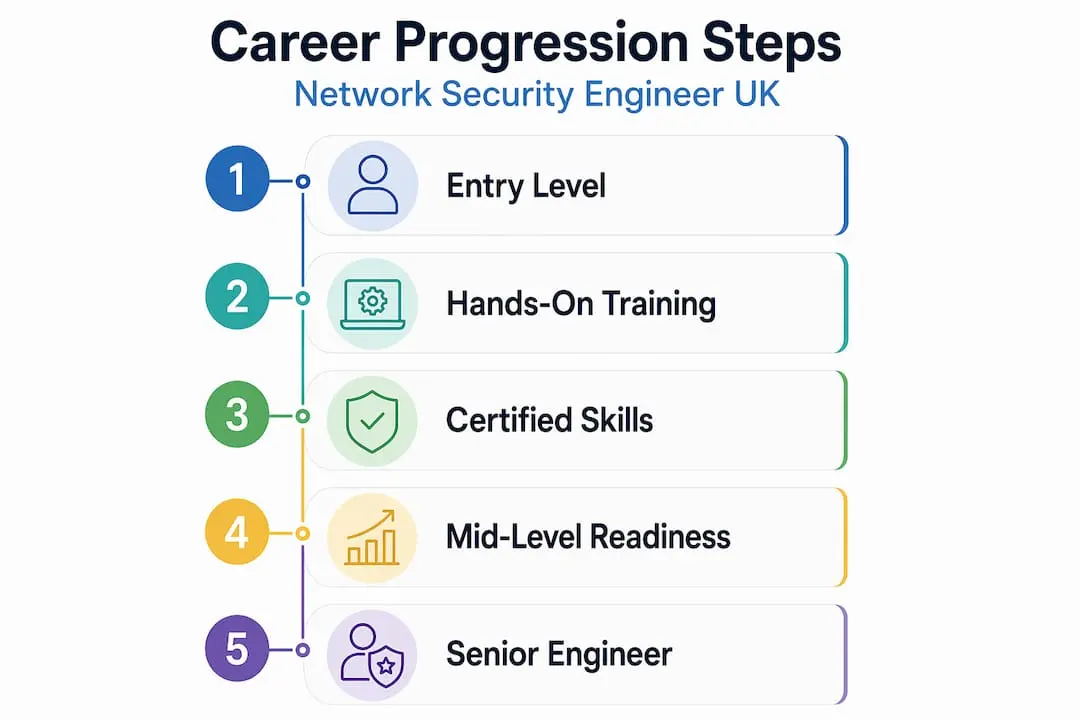
At the junior level, you will typically spend your time monitoring alerts, maintaining documentation, and supporting senior engineers during incident response. This phase is about building pattern recognition and learning your organisation’s specific environment. Most engineers spend one to three years at this stage.
Moving to mid-level means taking ownership of specific systems or security domains. You might lead firewall management, own the vulnerability scanning programme, or become the subject matter expert for a particular technology stack. This is where specialisation begins to pay off financially.
Senior roles involve strategic thinking, team leadership, and engagement with emerging threats. The toolsets at this level are more sophisticated:
- MITRE ATT&CK framework: A globally recognised knowledge base of adversary tactics and techniques. Senior engineers use it to map threats against their defences and identify gaps.
- Network Detection and Response (NDR): Tools that use machine learning to identify unusual traffic patterns that signature-based systems miss.
- Intrusion Detection Systems (IDS) and Intrusion Prevention Systems (IPS): Core monitoring technologies that flag and block suspicious activity in real time.
- Zero Trust Network Access (ZTNA): Replacing traditional VPNs with identity-verified, least-privilege access models.
SANS SEC511 training explicitly emphasises threat-informed defence and network-centric detection tooling, including MITRE ATT&CK and Zero Trust, as the benchmark for advanced practitioners. This is the standard that senior UK employers are increasingly measuring candidates against.
The Internet of Things (IoT) is creating new attack surfaces that senior engineers must understand. Industrial control systems, smart building technology, and connected medical devices all introduce vulnerabilities that traditional network security approaches were not designed to handle. Reviewing current IoT defence strategies is worthwhile as this area grows rapidly within UK critical infrastructure.
NCSC workforce planning guidance strongly emphasises practical skills and the use of NCSC Certified Training as the benchmark for upskilling. Employers who follow this guidance actively look for engineers who can demonstrate applied competence, not just theoretical knowledge.
Our security job search strategy guide walks you through how to position yourself effectively when applying for mid and senior level roles in the UK market.
What most guides miss: Practical experience trumps credentials
Here is the uncomfortable truth that most career guides sidestep. Credentials are a ticket to the interview room, not a guarantee of employment. The UK security job market is increasingly sophisticated, and hiring managers can tell within minutes whether a candidate has genuinely worked with the tools on their CV.
The NCSC is explicit about this. Their workforce planning guidance states clearly that putting someone through a training course does not make them a cyber security expert. Practical, hands-on competence is what matters. A candidate who has spent six months in a real security operations centre, even in a junior support role, will almost always outperform someone with more certifications but no applied experience.
There is also a structural reality in the UK job market that most guides ignore entirely. The UK cyber security skills labour market report 2025 shows that Security Engineer remains one of the top categories in core cyber job postings, but entry-level posting share is notably lower than mid-level. This means the market is not waiting for you to arrive as a beginner. It wants people who are ready to contribute from day one.
The implication is clear: aim for mid-level readiness before you start applying for permanent roles. Use placements, internships, apprenticeships, and volunteer projects to build a portfolio of real work. Document everything. When you can walk into an interview and describe a specific incident you helped resolve, a firewall policy you rewrote, or a vulnerability you discovered and escalated, you become a genuinely compelling candidate.
Overspecialising too early is another trap. Engineers who spend their first two years focused exclusively on one vendor’s ecosystem can find themselves poorly positioned when employers want broader competence. Build width first, then depth. Our guide on optimising job searches covers how to present this breadth effectively in applications.
Find your next step: Explore UK network security jobs and employer resources
You now have a clear picture of the role, the skills, the entry routes, and what progression looks like. The next step is connecting with real opportunities.

The Security Jobs Board is the UK’s specialist platform for security industry careers, affiliated with the BSIA for added credibility. Whether you are looking for your first placement, a mid-level engineering role, or a senior position with a major employer, you can browse network security vacancies and set up job alerts so the right roles come to you. Creating a profile and uploading your CV is completely free, and the platform is built specifically for the UK security sector, meaning every listing is relevant to your career path. Employers actively search the CV database, so a strong profile works in your favour even when you are not actively applying.
Frequently asked questions
What GCSEs or A-levels are best for aspiring network security engineers in the UK?
GCSEs or A-levels in mathematics, computing, or physics provide the strongest foundation for future degree study and job applications in network security engineering. These subjects develop the logical reasoning and analytical thinking that underpin technical security work.
How long does it take to become a network security engineer in the UK?
It typically takes three to five years, including degree study, hands-on training, and entry-level work placements, to reach mid-level engineer status. The CyberFirst programme can accelerate this timeline by combining bursary funding with paid summer placements during your degree.
Are certifications or practical experience more important to UK employers?
Practical hands-on experience and placements carry greater weight than certifications alone for network security engineer roles. NCSC workforce guidance is explicit that completing a training course does not, by itself, create a cyber security expert.
Can you enter network security engineering in the UK via apprenticeships?
Yes, cyber security apprenticeships at Level 4 and Level 6 provide a fully recognised entry route with practical training and employer support, and the training costs are funded by the employer rather than the candidate.


