Boost your security career: how to improve employability in the UK

TL;DR:
- The UK security industry now prioritizes verifiable, practical competence over basic credentials due to evolving threats and regulatory updates. Building targeted, demonstrable skills through modern training and real-world experience helps candidates stand out and accelerate career progression. Showing tangible evidence of doing rather than just listing certifications is key to gaining trust and advancing in the sector.
You’ve got your SIA licence, maybe a qualification or two, and you’re ready to work — yet the applications aren’t converting into interviews. Sound familiar? The UK security job market has grown sharply more competitive, and employers are raising the bar beyond basic credentials. This guide gives you a direct, practical route through the noise: from understanding what today’s security employers actually want, to identifying the skills that genuinely set you apart, to making your competence visible and verifiable. Follow these steps and you will not just apply more confidently — you will interview better, progress faster, and build a career that lasts.
Table of Contents
- Understand today’s security employer demands
- Identify practical skills that set you apart
- Prioritise future-proof training and entry routes
- Demonstrate assessable competence and stand out
- Why proven action beats certificates: an industry perspective
- Find your ideal security job and keep progressing
- Frequently asked questions
Key Takeaways
| Point | Details |
|---|---|
| Ongoing skills matter | Staying updated with practical skills is key to employability in the UK security sector. |
| Flexible entry routes | Apprenticeships and flexible cyber training open doors for newcomers and career changers. |
| Demonstrate your value | Employers hire who can prove real, assessable competence—not just who hold certificates. |
| Showcase practical achievements | Logbooks, portfolios, and assessed projects make your abilities stand out. |
Understand today’s security employer demands
The security industry is not the same place it was five years ago. Employers have become significantly more selective, and the days when a valid SIA licence alone would open most doors are fading. Hiring managers now look for verifiable, up-to-date competence. They want to see that you understand current threats, can operate within modern protocols, and are committed to continuous improvement.
One of the biggest shifts is at the regulatory level. The SIA is actively reviewing security licence qualifications to keep licence-linked training aligned with modern protective security needs, including reducing exam cheating risk and raising training provider quality requirements. This means the qualifications landscape is changing, and jobseekers who stay ahead of these updates will have a distinct edge over those relying on older credentials.
Technology is also reshaping employer expectations. Cyber awareness, digital incident reporting, and even basic data protection knowledge are now frequently listed as desirable attributes in physical security roles. Employers running integrated security operations expect guards, supervisors, and managers to understand how digital and physical threats intersect. If you are exploring the latest UK security roles, you will notice this shift reflected across almost every job category.
What employers consistently prioritise:
- Verifiable, practical competence rather than certificate collection
- Awareness of cyber and digital threats alongside physical security
- Communication skills and the ability to write clear, accurate reports
- Adaptability and evidence of continued professional development
- Knowledge of relevant legislation, including the Protect Duty
“The security sector is moving towards a competence-led model. Employers want to see what you can actually do, not just what qualifications you hold.” — Recurring theme across UK security recruitment discussions
| Employer priority | Why it matters | How to address it |
|---|---|---|
| Updated SIA qualifications | Regulatory alignment and credibility | Monitor SIA announcements regularly |
| Cyber awareness | Integrated security operations | Pursue short online courses |
| Report writing | Operational accuracy | Practise structured incident reports |
| Continued development | Shows commitment and adaptability | Log CPD activities formally |
| Legislation knowledge | Compliance and liability reduction | Study Protect Duty and relevant guidance |
Using targeted job search strategies that match your skills to specific employer requirements will sharpen your applications and dramatically improve your response rate.
Identify practical skills that set you apart
Knowing what employers want is only half the equation. You also need to know precisely which practical skills will make you stand out, and how to build them in a structured way. The word “practical” here is important. It means skills you can demonstrate under pressure, not just list on a CV.
For physical security roles, practical skills include access control management, CCTV operation and monitoring, conflict resolution, first aid, and dynamic risk assessment. For personnel security, they involve screening procedures, interviewing techniques, and document verification. For cyber security, they include threat intelligence, network monitoring, vulnerability assessment, and incident response.

The strongest candidates combine foundational knowledge with role-specific depth. A great example is the Level 4 Protective Security Adviser qualification, which covers physical, personnel, technical, and cyber security within a single structured learning route. This kind of joined-up, job-linked approach signals to employers that you understand how the disciplines connect, which is exactly what integrated security operations require.
Apprenticeships and work-based learning routes deserve particular attention here. They build skills in a real working environment, which produces demonstrable competence rather than theoretical knowledge. If you are newer to the sector, exploring practical security training examples will show you how other professionals have structured their development journeys.
Top practical skills that appeal to UK security employers:
- Dynamic risk assessment in live environments
- CCTV operation and evidence handling
- Conflict management and de-escalation techniques
- First aid at work certification
- Cyber Essentials awareness and basic network hygiene
- Security screening and vetting procedures (see security screening checks for context)
- Report writing and incident documentation
- Data protection principles under UK GDPR
For roles with any data or digital responsibility, reviewing corporate data protection tips will give you a practical framework that you can apply and reference in interviews.
Pro Tip: Keep a logbook or digital portfolio of your practical work. Note specific incidents you handled, decisions you made, and the outcomes. Concrete examples from real situations are far more persuasive to employers than a generic skills list.
| Skill area | Foundational level | Specialist level |
|---|---|---|
| Physical security | SIA Door Supervision or Security Guard licence | CCTV operations, conflict management diploma |
| Personnel security | Basic screening awareness | DS screening, BS 7858 vetting experience |
| Cyber security | Cyber Essentials awareness | CompTIA Security+, NCSC Cyber Advisor |
| Emergency response | First aid at work | Emergency planning, fire safety management |
Prioritise future-proof training and entry routes
You know what skills to build — but where and how do you gain them efficiently? The UK security sector now offers a broader range of training models than ever before, and choosing the right route will accelerate your career development considerably.
Apprenticeships remain one of the most underused routes in security. They combine structured learning with paid employment, and they produce exactly the kind of verifiable, on-the-job competence that employers trust. If you are new to the sector or looking to shift from a different discipline, an apprenticeship pathway is worth serious consideration alongside traditional short courses.
Cyber security deserves its own spotlight. It is one of the fastest-growing areas of demand within the broader UK security sector, and it welcomes professionals from physical security backgrounds who are willing to retrain. The NCSC provides professional skills and training along with collaborative opportunities for both new and experienced cyber professionals, making it an accessible starting point regardless of your background.
For those ready to move quickly, the UK Cyber Security Council highlights flexible entry routes including short courses, online platforms, bootcamps, and industry-recognised options that focus on building practical skills without requiring years of full-time study.
“Cyber security is not just for computer scientists. It is increasingly a core competency for anyone working in protective security, and the routes in are more accessible than most people realise.” — UK Cyber Security Council guidance
Training routes worth prioritising in 2026:
- SIA-aligned qualification updates (watch for new standards following the ongoing review)
- Level 3 and Level 4 apprenticeships in security management and protective security
- NCSC-backed cyber security short programmes
- Cyber Essentials certification (foundational but highly valued)
- Online platforms offering flexible, self-paced cybersecurity modules
- Bootcamps for career changers entering cyber operations
Using a structured security job search checklist will help you align your training choices with specific job targets, making each qualification you earn directly relevant to your applications. Mapping out your career progression workflow from where you are now to where you want to be will clarify exactly which training investments will pay off fastest.
For a thorough grounding in the technical side of modern security, reviewing established cybersecurity best practices will give you a solid foundation that translates directly into both job interviews and workplace performance.
Demonstrate assessable competence and stand out
Armed with in-demand skills and current training, your final challenge is making your employability visible and verifiable to hiring managers. This is where many security professionals fall short. They have the skills, but they cannot prove them in a way that resonates with a recruiter scanning dozens of applications.
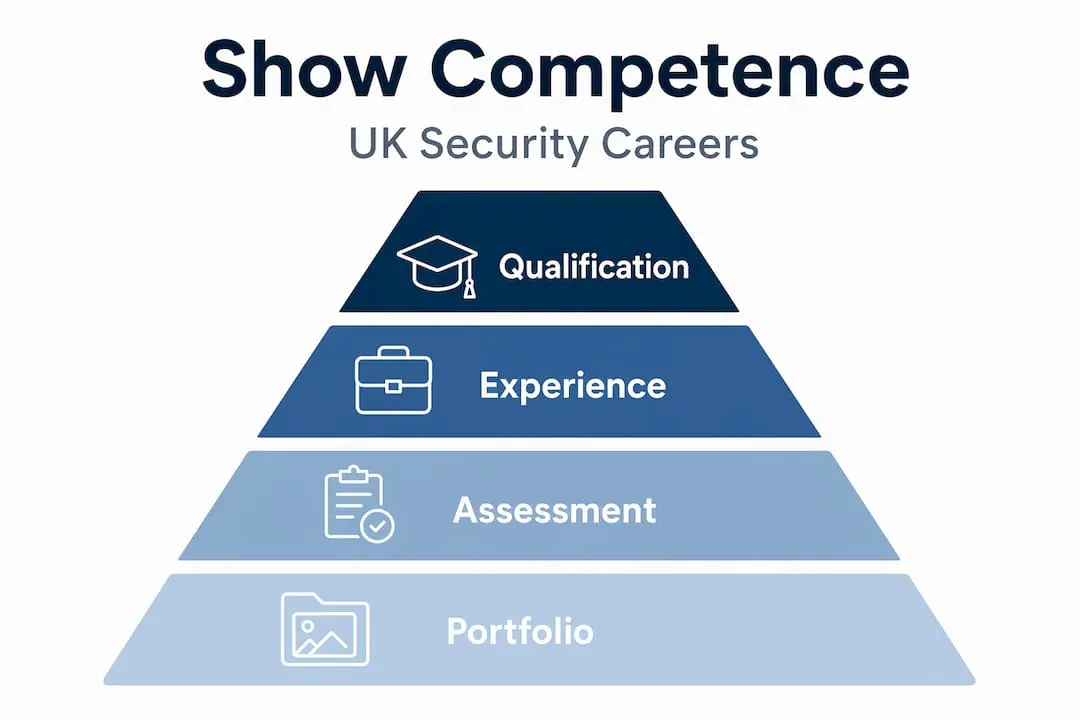
The most powerful shift you can make is moving from claiming competence to demonstrating it. A CV that says “experienced in incident response” is far weaker than one that includes a specific example: the type of incident, the actions taken, the outcome achieved, and any formal feedback received.
The NCSC’s Cyber Advisor pathway assessment emphasises skills that may not be tested elsewhere, including Cyber Essentials knowledge, competence designing security solutions for SMEs, and the ability to explain cyber security in plain English. Achieving this certification gives employers an independently verified signal that your skills are genuine and assessable, not just self-reported.
For those pursuing careers in security operations, structured progressive models matter enormously. The concept of a SOC career pipeline uses on-the-job training that moves systematically from basics like ticketing and incident response through to first-line defence responsibilities, creating a clear, verifiable track record that employers can evaluate at each stage.
Six practical ways to demonstrate assessable competence:
- Build a portfolio of real incidents, projects, and documented outcomes
- Pursue formal assessments such as the NCSC Cyber Advisor pathway
- Collect written references from supervisors or clients for specific work
- Complete structured apprenticeships that record progress formally
- Achieve recognised certifications with practical assessment components
- Volunteer for security-relevant projects that generate documented results
When you are optimising your job search, presenting evidence-backed skills alongside your qualifications will consistently outperform candidates who rely on credentials alone.
Pro Tip: Create a simple evidence folder, either physical or digital, containing logbook entries, commendation letters, project summaries, and assessment results. Update it after every significant piece of work. When an interview opportunity arises, you will have ready-made examples for every competency question.
Reviewing a practical cybersecurity checklist can also help you identify any knowledge gaps worth addressing before your next application.
Why proven action beats certificates: an industry perspective
Here is something the typical careers advice article will not tell you directly. Certificates are entry tickets, not career guarantees. The UK security sector is full of qualified professionals who are not progressing, and a significant reason is that they have confused accumulating credentials with building genuine capability.
Experienced hiring managers in this sector are remarkably good at spotting the difference. They ask a simple question in interviews: can this person tell me what they actually did, not just what course they attended? The professionals who answer that question fluently, with specific examples and clear outcomes, almost always move forward. Those who recite qualification titles without connecting them to real work usually do not.
The career progression insights that consistently emerge from the UK security sector point to one pattern: the professionals who advance fastest are those who proactively seek out roles and projects where their skills are tested, documented, and visible. They are not waiting for the next course. They are applying what they know, recording what they achieve, and building a body of evidence that speaks for itself.
Cyber security, in particular, rewards demonstrable doing over passive learning. The NCSC’s Cyber Advisor framework exists precisely because the industry recognised that paper qualifications were not reliably predicting real-world performance. Employers in this space want to see projects, assessments, and results.
So challenge yourself to ask a different question. Not “what certificate should I get next?” but “what can I prove I can do, right now?” That reframe will change how you approach both your training and your job applications. It will also make you significantly more compelling to the employers who matter.
Find your ideal security job and keep progressing
The steps in this article give you a clear pathway: understand what employers want, build the right practical skills, pursue modern training routes, and demonstrate your competence in ways that are visible and verifiable. Taking all three steps consistently is what separates candidates who progress from those who stall.

The Security Jobs Board connects UK security professionals with employers who are actively hiring across every discipline, from physical security and close protection to cyber operations and security management. Whether you are searching for roles in security jobs in Northern Ireland or anywhere across the UK, you can create a free profile, upload your CV, and apply directly to relevant vacancies. Employers can browse the CV database and post security-specific listings to reach qualified candidates efficiently. Start building your profile today and put your skills in front of the employers looking for exactly what you offer.
Frequently asked questions
What qualifications do I need for a UK security job in 2026?
You will need to meet SIA licence requirements, which are actively being reviewed to align with modern protective security demands, including both formal qualifications and practical skill assessments.
Is cyber security a good career route for existing security professionals?
Yes, cyber security offers flexible entry options for both new and experienced professionals, and the NCSC provides training and collaborative opportunities that make the transition genuinely accessible.
How can I prove my security skills to employers?
Documenting real experience, passing recognised practical assessments, and building a portfolio are the most effective methods. The NCSC Cyber Advisor pathway is a strong example of an independently verifiable assessment that employers recognise.
What entry routes exist if I’m new to security?
Apprenticeships, short courses, online platforms, and work-based learning are all effective starting points. The UK Cyber Security Council specifically highlights bootcamps and industry-recognised options designed to build practical skills quickly.


