How to Choose a Security Employer for Career Growth

Choosing your next security employer is about more than chasing a higher salary or a fancier job title. Deciding where to invest the next stage of your career shapes your daily experience and future prospects in the British security industry. By defining your own priorities and knowing how to spot a truly reputable organisation, you set yourself up for genuine career growth and job satisfaction in a company that shares your values and ambition.
Table of Contents
- Step 1: Define Your Key Security Career Priorities
- Step 2: Research Reputable Security Employers Thoroughly
- Step 3: Evaluate Company Benefits And Workplace Culture
- Step 4: Verify Industry Accreditations And Employee Reviews
- Step 5: Assess Long-Term Career Prospects And Support
Quick Summary
| Key Point | Explanation |
|---|---|
| 1. Define Your Security Career Priorities | Identify specific work outcomes and environment that genuinely satisfy you for the next 3 to 5 years. |
| 2. Research Reputable Security Employers | Investigate companies for industry certifications, employee development opportunities, and stability to find aligned employers. |
| 3. Evaluate Workplace Culture and Benefits | Assess cultural fit, benefits offered, and the support systems in place to ensure job satisfaction and wellbeing. |
| 4. Verify Accreditations and Employee Reviews | Keep objective checks on accreditations and read employee reviews thoroughly to gauge company reputation and practices. |
| 5. Assess Long-Term Career Prospects | Understand the company’s commitment to your long-term development and upward mobility to avoid stagnation in your career. |
Step 1: Define your key security career priorities
Before you start evaluating potential employers, you need to get crystal clear on what actually matters to you in your next role. This isn’t about what sounds impressive on paper or what your mates think you should want. It’s about identifying the specific outcomes, work environment, and development opportunities that will genuinely satisfy you over the next 3 to 5 years.
Start by doing some honest self-assessment. What are your core strengths in security work right now? Where are the gaps you want to fill? Do you want to specialise deeper in your current area, or pivot toward something completely different like asset protection, security management, or strategic planning? Ask yourself what kind of work environment energises you versus what drains you. Are you someone who thrives in fast-paced operations, or do you prefer methodical, structured work? Do you want regular client interaction, or would you rather focus on technical delivery and systems? Think about your learning style too. Some professionals want hands-on mentorship from experienced leaders, whilst others prefer formal training programmes and certifications. Your ideal employer should support whichever approach works best for you.
Consider your work-life balance and lifestyle preferences as well. How much travel are you willing to do? Do you need flexibility for personal commitments, or are you comfortable with structured on-site hours? What salary range actually meets your needs, and is career progression through pay increases important to you, or would you prioritise other benefits like professional development budgets, flexible working, or genuinely interesting projects? Research shows that understanding your career ambitions and how they fit within an organisation’s structure makes a significant difference in long-term satisfaction. You might also explore different career paths in security to see which directions genuinely appeal to you, not just which ones pay the most.
Write down your top 5 to 7 priorities. Be specific. Instead of “career growth”, write “progression to team lead role within 18 to 24 months with formal management training”. Instead of “good salary”, write “£55,000 to £65,000 plus annual bonuses”. Instead of “learning opportunities”, write “employer-sponsored security certifications like CISSP or CPP, with study time allocated during work hours”. This clarity becomes your evaluation framework when you’re assessing actual job offers and employers. You’ll know immediately whether a company’s offer aligns with what you actually want, not just what you think you should want.
Practical tip Write your priorities down before you search for roles, and don’t adjust them just to fit a job advert that looks appealing. Your first instinct about what matters is usually correct. Staying true to your priorities is how you end up in roles that genuinely advance your career rather than just paying the bills.
Step 2: Research reputable security employers thoroughly
Now that you know what you’re looking for, it’s time to investigate potential employers with genuine rigour. You’re not just looking for any company that’s hiring. You’re searching for organisations that actually practise what they preach about professional standards, employee development, and industry credibility. This research phase separates candidates who drift between random opportunities from those who deliberately build careers with employers that matter.
Start by checking whether companies hold ACS Approved Contractor Scheme certification, which demonstrates they meet stringent UK industry standards for security service delivery and business management. If a company has ACS approval, it tells you they’ve voluntarily submitted to rigorous assessment and compliance checks. It’s not a guarantee of perfection, but it’s a strong signal they’re serious about professionalism. Look also at their membership with professional bodies like the Security Institute, which represents the largest professional membership body for security professionals in the UK. Companies that actively participate in professional networks typically invest more in staff development and stay updated with industry best practices.
Search for company reviews on Glassdoor, Indeed, and Google, but read them with a critical eye. Look for patterns rather than taking individual reviews as gospel. Are people consistently mentioning opportunities for progression? Do they describe the company as stable, or are there lots of complaints about constant restructuring? Pay attention to what’s said about training and development specifically. Search LinkedIn for current and former employees from companies you’re interested in. Check their career progression. Did people stay with the organisation for multiple years and move upward? Or did they leave quickly? Speaking to people you already know in the security industry is invaluable too. Ask your network which employers they respect, which companies are known for nurturing talent, and which ones have good reputations for supporting professional certifications and qualifications.
Visit company websites and read their career pages carefully. Look beyond the marketing speak. Do they outline clear progression routes? Do they mention investment in training and development? Check their social media presence and company news. Are they posting about employee achievements, industry involvement, or professional initiatives? Companies that are genuinely committed to their people usually make that visible. Request information from their HR department if it’s not obvious. A good employer will welcome your questions about development, progression opportunities, and how they support employee growth. If they’re dismissive or vague when you ask about career development before you’ve even joined, that’s worth considering as a warning sign.
Practical advice Create a simple spreadsheet comparing your top 5 candidate employers against your key priorities from Step 1. Score each company on factors like ACS certification, professional body membership, employee reviews, progression opportunities, and training investment. This objective comparison removes emotion from the decision and shows you immediately where companies align or fall short.
Here is a comparison of key factors to consider when evaluating security employers:
| Evaluation Factor | Why It Matters | What to Look For |
|---|---|---|
| Industry Accreditations | Indicates adherence to standards | ACS approval, ISO 27001, CREST membership |
| Employee Development | Supports your career progression | Structured training, clear pathways |
| Reviews and Reputation | Reveals actual employee experience | Consistent feedback, positive trends |
| Benefits and Support | Enhances wellbeing and retention | Pension, flexible working, mental health |
| Advancement Opportunities | Determines long-term career growth | Regular promotions, mentorship, coaching |
Step 3: Evaluate company benefits and workplace culture
Benefits and workplace culture often make the real difference between a job you tolerate and a role where you genuinely thrive. Many security professionals focus exclusively on salary and job title, but the surrounding environment, support systems, and how colleagues treat each other actually determine whether you’ll stay and grow with an employer or start looking elsewhere within a year.

Begin by understanding what benefits matter most to you personally. Employee benefits support wellbeing and organisational values, which means good employers think carefully about what they offer rather than simply providing bare minimums. Look beyond the standard salary figure. Does the company offer professional development budgets? This matters enormously if you’re pursuing certifications like CISSP, SIA Door Supervisor qualifications, or other accredited training. Do they provide pension schemes with employer contributions, or are you building retirement security entirely on your own? Health insurance and mental health support are increasingly important too. In security work, where shift patterns and stress levels can be high, does the company actively support employee wellbeing? Ask specifically about occupational health services, counselling access, and flexible working arrangements. Some employers offer time in lieu for unsociable hours worked, whilst others have strict on-site requirements. Which aligns with your priorities from Step 1?
Culture reveals itself through how people actually behave when no one’s watching. Start by talking to current employees if possible. Ask them questions that expose genuine working conditions rather than corporate talking points. How do managers respond when staff raise concerns? Are promotions based on merit and performance, or does it feel like favouritism? Do people support each other, or is there unnecessary competition? When someone makes a mistake, is there psychological safety to report it, or do people hide problems? In security, where mistakes can have serious consequences, a culture of openness about errors is crucial for continuous improvement. Ask about retention rates too. If the company regularly loses experienced staff, there’s usually a reason. Look at company social media and employee review sites again, specifically for comments about culture and management style. People often reveal the truth when they’re sharing negative experiences.
During interviews, pay attention to how you’re treated and what questions interviewers ask. A company genuinely interested in your development will ask about your career ambitions and how they can support them. They’ll ask about your learning preferences and what you hope to achieve. If all the questions focus solely on technical capability and no one asks about your goals or whether the role fits your priorities, that’s information too. Ask the interviewer direct questions about progression, training investment, and how the organisation supports people developing in their careers. A comprehensive health and wellbeing framework shows what organisations can implement to support staff, so you can use this as a benchmark for what good practice looks like. Notice how enthusiastically people respond. Do they light up when describing the company, or do they give measured, neutral answers?
Practical tip Request a conversation with someone currently doing the role you’re applying for, not just a manager or HR representative. Ask them what they genuinely enjoy, what frustrates them, and whether they feel supported in developing their career. An employer willing to arrange this demonstrates genuine confidence in their culture and working environment.
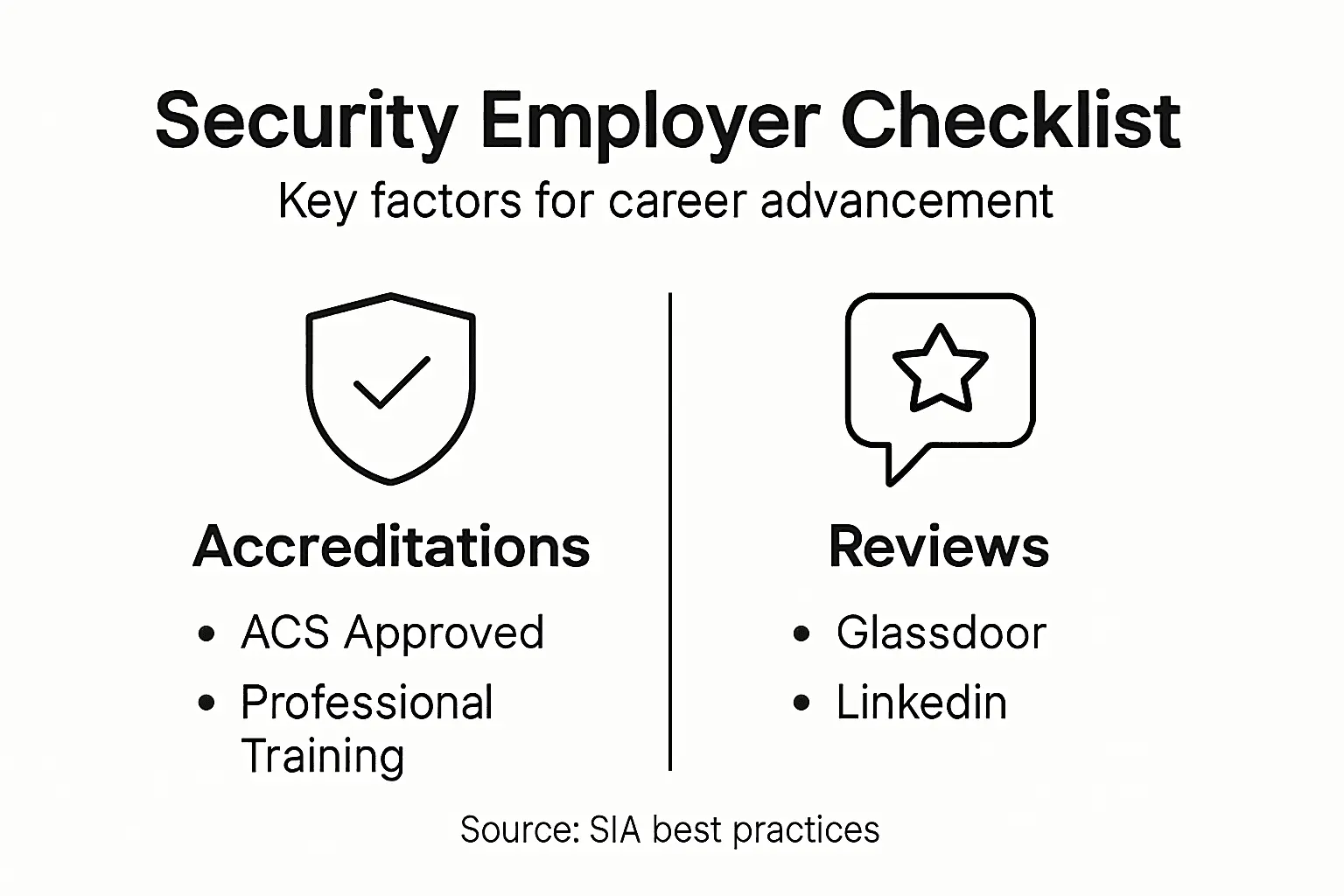
Step 4: Verify industry accreditations and employee reviews
Accreditations and employee reviews are your objective verification tools. They cut through marketing speak and show you what an employer actually delivers. Accreditations prove that external bodies have assessed the company and found it meets rigorous standards. Employee reviews reveal what it’s genuinely like to work there. Together, they provide a balanced picture of whether an employer is what they claim to be.
Start with industry accreditations specific to security. The most important one in the UK is ACS Approved Contractor Scheme certification, which is the government-backed standard for licensable security services. If a company holds ACS approval, it means they’ve voluntarily undergone assessment and demonstrated compliance with best practices in security service delivery, business management, and staff conduct. Check the Security Industry Authority website to verify whether companies actually hold this credential. Don’t just take their word for it. If they claim ACS status but aren’t listed on the official register, that’s a significant red flag. For cybersecurity roles or companies offering cyber security services, look for CREST accreditation, which certifies that organisations meet globally recognised standards for governance, skilled staffing, and security practices. You can check CREST’s membership database directly. Other relevant accreditations might include ISO 27001 for information security management, or memberships with bodies like the Security Institute. The presence of these credentials doesn’t guarantee perfection, but it shows the company takes professional standards seriously enough to invest in external assessment.
Now dig into employee reviews. Visit Glassdoor, Indeed, and Google Reviews specifically to see what people who actually work there are saying. Read recent reviews most carefully, as older feedback may not reflect current conditions. Look for consistent themes rather than treating individual negative reviews as definitive. If 30 reviews all mention poor management and limited progression, that’s a pattern. If one person complains about management but others praise their development opportunities, take that single review with appropriate scepticism. Pay particular attention to reviews mentioning your specific priorities from Step 1. If progression matters to you, search review sites for keywords like “promotion”, “advancement”, and “career growth”. What do people actually say? Are managers described as supportive or obstructive? Look for reviews discussing training investment, mentorship, and how the company handles professional development. Check review sites for comments about security roles specifically. Some companies treat security staff differently from other employees, so feedback specifically about security teams is more relevant than general company reviews.
Beyond major review sites, search LinkedIn for company employees and former employees. Look at their career histories. Did they stay for 5 years and move upward, or 18 months and leave? This tells you whether the company genuinely develops people or just cycles through staff. Search for company news, press releases, and industry mentions. Do they contribute to industry conversations? Are security leaders from the company speaking at conferences or publishing insights? Companies genuinely invested in professionalism usually have visible thought leaders. Check Trustpilot and other specialist review platforms too. Sometimes industry-specific feedback exists on platforms you might not have considered.
When you find information that concerns you, investigate further before making a decision. Send a thoughtful question to the company’s HR department or a contact you’ve made there. How they respond tells you something. A defensive response suggests they’re not open to scrutiny. A thoughtful response explaining context shows they engage genuinely with feedback. You can also ask specific people during interview stages. “I’ve read some reviews mentioning limited progression opportunities. Can you walk me through what development pathways actually look like here?” Their answer reveals whether they’re confident in their offering or scrambling to defend it.
Practical tip Create a simple scoring system for accreditations and reviews. Assign points for ACS certification, professional body membership, average review rating, and consistency of positive feedback about development. This removes emotion and gives you an objective way to compare shortlisted employers side by side.
Step 5: Assess long-term career prospects and support
A job that looks good for the next 12 months but leads nowhere after that isn’t career growth. It’s treading water. This step requires you to think beyond the immediate role and ask whether an employer genuinely invests in your long-term development or simply uses you up and replaces you. You’re evaluating whether this company will actively support your progression or whether you’ll need to leave to advance.
Start by understanding the company’s approach to career development. Does the organisation have clear progression pathways? Ask directly during interviews. What does progression look like for someone in this role? Can they move to team lead, then supervisor, then management? Or are roles fairly static with limited upward movement? Look at the organisation chart if you can access it. Are there multiple layers of seniority, or is the structure fairly flat with limited advancement opportunities? Ask about typical timeframes for progression. Do people genuinely move up, or do they stay in the same role for 10 years? Ask about mentorship and coaching programmes. Does the company assign experienced people to develop newer staff, or is progression something you figure out alone? Understanding how to plan career development effectively involves assessing whether an organisation actively supports growth through structured programmes and realistic timelines. Companies that take career development seriously have formal processes. They might have talent development programmes, leadership academies, or structured mentorship. Companies that don’t typically say “we support development” but can’t describe any actual mechanism for how that happens.
Investigate what happens when you reach your first major goal. Say your priority is becoming a team lead within 24 months. Ask specifically what the company would require from you and how they’d prepare you. Would they provide management training? Would you have access to coaching? Would you shadow an existing leader? Or would you simply be expected to figure it out? Companies genuinely committed to progression prepare people for bigger roles. Those just pushing warm bodies upward leave you drowning in responsibility with no support. Ask about sabbaticals, secondments, or rotation programmes. Does the company allow people to develop broader experience, or do they keep you locked in one role? Ask about support for external qualifications. If you want to pursue CISSP, ISACA certifications, or other industry qualifications, does the company fund these, allocate study time, or leave you to manage it entirely outside work hours? Setting achievable goals with specific timeframes helps you evaluate whether an employer’s actual support matches what they claim. Vague promises of “we support development” mean nothing without specifics.
Look at industry trends too. Is the security sector where this company operates growing or shrinking? Are new technologies creating new roles and opportunities, or is the sector consolidating and eliminating positions? A company in a growing segment with expanding needs offers more advancement opportunities than one in a mature or declining segment. Research the company’s strategic direction. Are they expanding, stable, or contracting? Expanding companies typically have more progression opportunities simply because they’re creating new roles. Contracting companies might have talented people desperate for advancement but nowhere for you to go. Check whether the company invests in innovation and new service lines. Companies that stagnate rarely develop their people. Those actively evolving create new roles and need people ready to step into them. Ask about staying power. Are people who join this company still there in 5 years? If not, where do they go? If talented people consistently leave after 2 to 3 years, that’s information. Either the company isn’t developing them, or it’s not offering what they actually want beyond the initial role.
During final interviews, ask for a realistic picture of your development. “If I do really well in this role, what does my career look like here in 3 years?” Listen carefully to the answer. Is it specific and enthusiastic, or vague and hesitant? Ask about people who’ve progressed recently. Can they connect you with someone who was promoted from the same role? That person can tell you whether progression is genuine or theoretical. Ask about investment in your sector of security. Is the company growing headcount in your specialisation, or shrinking it? If they’re growing, you’re positioned for progression. If they’re shrinking, advancement might involve moving into different security areas.
Practical tip Before accepting an offer, write down your 3-year career goal using specific, measurable criteria. Then ask the employer directly whether they can genuinely support you achieving that goal and what support they’d provide. If they can’t give you a clear answer or the structure doesn’t seem to exist, that’s your signal that long-term growth there might be limited.
Below is a summary table distinguishing typical short-term and long-term employer offerings:
| Aspect | Short-Term Focus | Long-Term Focus |
|---|---|---|
| Salary & Perks | Competitive pay, immediate bonuses | Increases, performance-based incentives |
| Skills Development | Ad hoc training, informal learning | Formal courses, sponsored qualifications |
| Career Pathways | Limited or undefined progression | Structured and transparent advancement |
| Employee Retention | High turnover, unclear futures | Stable workforce, clear retention efforts |
| Work Environment | Task-oriented, basic support | Inclusive, growth-oriented culture |
Secure Your Future with Employers That Match Your Career Growth Goals
Choosing the right security employer means going beyond the surface and finding an organisation that aligns with your specific career priorities such as progression pathways, accredited training, and supportive workplace culture. The article highlights the challenges of identifying employers who offer genuine long-term development rather than just short-term roles. At The Security Jobs Board, we understand these pain points and provide a tailored platform that connects you with UK security employers serious about your professional growth.

Start exploring a wide range of security vacancies that match your ambitions today. Use features like profile creation, CV uploads, and job alerts to take control of your career journey. Our platform’s affiliation with the BSIA ensures you engage with reputable companies that value accreditations such as ACS and offer structured development. Don’t wait until opportunity passes by. Visit The Security Jobs Board and take your first step towards a career where progression, learning, and culture all work for you.
Frequently Asked Questions
How can I identify my key career priorities in security?
To identify your key career priorities, conduct a self-assessment of your strengths, gaps, and work environment preferences. Write down specific priorities, such as desired progressions or salary ranges, to guide your job search effectively.
What should I consider when researching potential security employers?
When researching potential security employers, look for industry accreditations like ACS certification and memberships in professional bodies. Create a spreadsheet to compare companies on factors such as employee reviews and training investment to find ones that align with your priorities.
How do I assess workplace culture and benefits at a security organisation?
To assess workplace culture and benefits, start conversations with current employees and ask about their experiences. Pay attention to the types of support and benefits offered, like professional development budgets or mental health resources, to determine if they match your needs.
What role do industry accreditations play in choosing a security employer?
Industry accreditations, like ACS approval, serve as evidence that a security employer meets high standards of practice. Check for these certifications during your research, as they can indicate a commitment to professional development and employee support.
How can I evaluate long-term career prospects at a potential employer?
Evaluate long-term career prospects by asking about structured progression pathways during the interview. Find out how the company supports employee development through formal training and mentorship, and ensure it aligns with your career goals for the next few years.


