How to improve diversity hiring in UK security companies

TL;DR:
- The UK cybersecurity workforce is significantly less diverse than the overall workforce. Building inclusive hiring practices and internal culture is essential for better innovation and resilience.
Only 17% of the UK cybersecurity workforce is female, compared with 48% across the wider UK workforce. That single statistic tells a story many security employers already suspect but struggle to act on: the sector has a significant diversity problem. Attracting talent from underrepresented groups is not simply a matter of social responsibility. It directly affects innovation, threat detection capability, and long-term business resilience. This guide walks UK security companies through the practical steps needed to genuinely widen their hiring approach, from internal preparation to outreach, onboarding, and beyond.
Table of Contents
- Understanding the diversity gap in security
- Preparing your company for inclusive hiring
- Effective strategies to attract diverse talent
- Building supportive onboarding and progression
- A new approach: Inclusion beyond quotas and compliance
- Put your diversity hiring goals into action
- Frequently asked questions
Key Takeaways
| Point | Details |
|---|---|
| Diversity remains low | UK security sector has significantly lower female, ethnic minority, and disabled representation than the national workforce. |
| Preparation is key | Inclusive hiring starts with reviewing current practices and leadership support, not just external recruitment. |
| Partner for reach | Working with training partners and education providers helps access candidates from underrepresented groups. |
| Support drives retention | Structured onboarding, coaching, and workplace adjustments boost the long-term success of diverse hires. |
Understanding the diversity gap in security
Having framed the need for action, it is essential to grasp exactly where the sector stands and why the gap persists.
The numbers are striking. The UK cybersecurity workforce sits at 17% female, far below the 30% seen in wider digital sectors and barely a third of the 48% female representation across the UK workforce as a whole. Ethnic minority representation tells a similarly complex story: while ethnic minorities make up 19% overall in the cyber workforce, that figure drops to just 8% among professionals with six or more years of experience, meaning the pipeline leaks badly at senior levels. One brighter note: the neurodivergent proportion in the cyber workforce rose to 16% from 9% in 2020, suggesting growing awareness and some progress in attracting candidates who think differently.
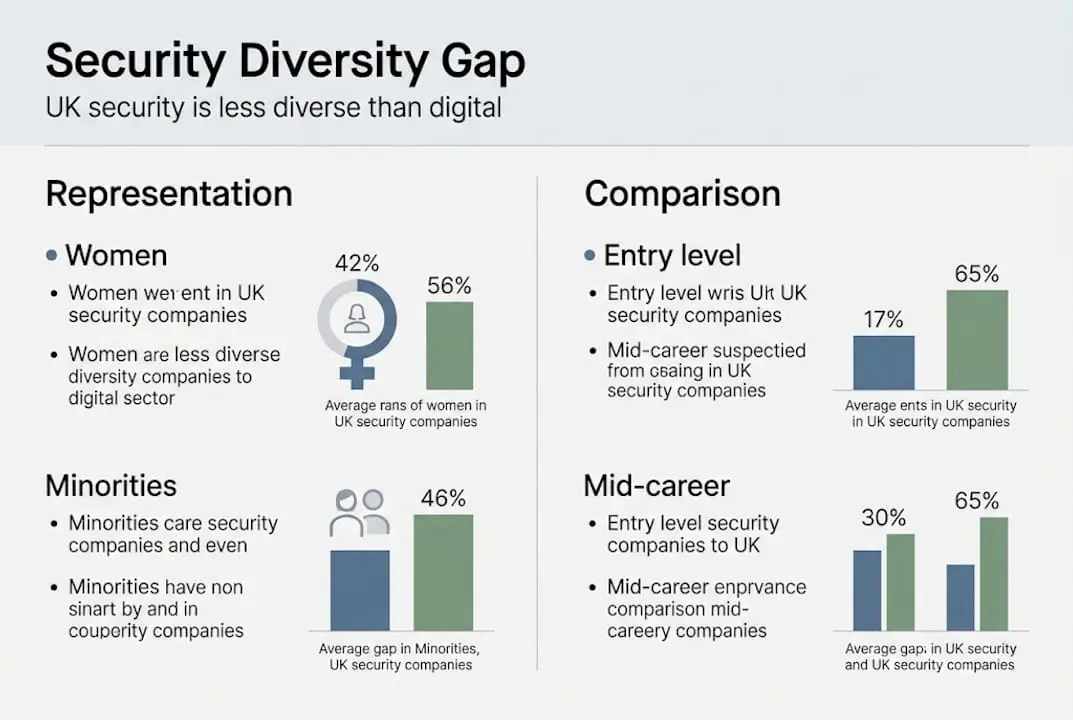
Where the gaps are sharpest
| Group | Security / cyber workforce | UK workforce overall |
|---|---|---|
| Women | 17% | 48% |
| Ethnic minorities (all levels) | 19% | ~18% (UK working age) |
| Ethnic minorities (senior, 6+ yrs) | 8% | N/A |
| Neurodivergent individuals | 16% | ~15% (estimated) |
The table above shows that representation at entry level is closing in some areas, but the real gap opens up mid-career and at senior levels. This matters for two reasons. First, it means the sector is losing experienced diverse professionals before they can influence culture or strategy. Second, it signals that the problem is not simply one of pipeline, it is also one of retention and progression.
Several causes drive the gap. Cultural fit expectations in security can subtly disadvantage candidates from different backgrounds. Job descriptions frequently use unnecessarily technical language or list requirements that go well beyond what the role actually demands. Interview panels that lack diversity unconsciously favour familiar profiles. For a deeper look at how these dynamics play out in practice, security sector recruitment explained on the Security Jobs Board blog outlines common pitfalls and how firms can begin to address them.
The business case for change is strong. Diverse teams bring a wider range of perspectives to threat analysis, making them more effective at anticipating the tactics of varied threat actors. They are also more resilient when facing complex, unfamiliar scenarios.
“A team that all thinks alike will identify the same vulnerabilities and miss the same blind spots. Diversity in security is not a nicety, it is a strategic asset.”
This insight is increasingly backed by evidence across the technology sector and applies with particular force to security, where adversarial thinking and creative problem-solving are core professional skills.
Preparing your company for inclusive hiring
Once the scale of the diversity challenge is clear, the next step begins with internal preparation.
Many security firms make the mistake of jumping straight to external recruitment campaigns without first addressing the structural barriers inside their own organisations. This approach rarely produces lasting results. Before you advertise a single role with diversity in mind, you need to audit what you already have.
Start with your job descriptions. Are they listing ten requirements when six would do? Are terms like “proven track record” or “cultural fit” appearing without clear definitions? These phrases act as subtle filters that discourage applications from people who have taken non-linear career paths, including career changers, veterans, returners, and candidates from different socioeconomic backgrounds.
Approaches to diversity hiring: a comparison
| Approach | Description | Effectiveness | Risk |
|---|---|---|---|
| Quotas | Fixed numerical targets for certain groups | High short-term visibility | Legal and cultural risk if poorly managed |
| Diversity targets | Aspirational goals without fixed numbers | Moderate, drives focus | Can become box-ticking |
| Inclusive practices | Removing barriers for all candidates | High long-term impact | Slower to show results |
| Outreach programmes | Proactive engagement with underrepresented groups | High if sustained | Resource intensive |
The data supports a culture-led approach. Very few UK firms use formal quotas (8%) or diversity schemes (7%), yet many are making meaningful progress through inclusive practices and targeted outreach. This suggests the most effective route is not mandating outcomes but removing barriers throughout the hiring process.
Key internal actions to take before you launch any external campaign:
- Audit your interview panel: Is there diversity of background, gender, and perspective among those making hiring decisions?
- Review your application process: Is it accessible to candidates with disabilities or neurodivergent traits?
- Train for bias: Unconscious bias training is not a one-off tick box. It needs to be embedded in your broader security recruitment workflow and revisited regularly.
- Get leadership buy-in: Diversity initiatives that lack visible senior support rarely survive beyond the first hiring round.
- Set measurable goals: Without baseline data on your current workforce demographics, you cannot track whether anything is changing.
For firms in physical security, the challenges carry their own nuances. The physical security recruitment guide highlights how operational roles often carry assumptions about physical capability or background that can inadvertently narrow the candidate pool.
Pro Tip: Ask every member of your hiring panel to write down what they are looking for in a candidate before they review CVs. Comparing those lists often reveals hidden assumptions that can skew decisions.
Effective strategies to attract diverse talent
With preparation completed, your company is ready to put inclusion ambitions into practice.
The most successful security employers do not simply wait for diverse candidates to find them. They go where underrepresented talent already is. That means forming partnerships, running outreach, and rethinking the routes through which people can enter the profession.
Five practical steps to widen your talent pool
- Partner with specialist organisations. Programmes such as Code First Girls connect employers with women pursuing careers in technology and security. GCHQ has partnered with Code First Girls to deliver more than 19,000 learning opportunities for women, with 67% to 72% of participants coming from underrepresented groups. This is a proven model that smaller security firms can replicate through local or regional partnerships.
- Attend and sponsor school and college events. 63% of cyber employers are now hiring through non-degree routes, and 41% run school or college events as part of their talent strategy. Visibility at this stage of the pipeline shapes who considers a career in security at all.
- Introduce apprenticeships and internships. These routes open the profession to people who cannot or do not wish to take a traditional degree pathway. They also allow you to assess candidates on demonstrated skills rather than academic credentials.
- Rewrite your job adverts. Use tools such as Textio or Gender Decoder to identify language that inadvertently narrows your applicant pool. Remove unnecessary requirements, lead with what you offer, and use inclusive language throughout. The job posting best practices guide from Security Jobs Board offers specific advice tailored to security roles.
- Target platforms where diverse candidates are active. Specialist platforms and communities exist for women in tech, veterans, and disabled professionals. Posting roles there in addition to mainstream boards significantly widens reach.
Statistic to note: 63% of cyber employers now use non-degree hiring routes, up from previous years, showing that degree requirements are increasingly seen as an unnecessary barrier in a skills-short market.
For firms wanting to specifically increase female representation, supporting women into security careers offers a detailed look at what works in practice. And for a broader view of talent attraction, ways to attract security talent covers approaches applicable across the workforce.
Pro Tip: When writing a job advert for a security role, list the five things the person will actually do in the job before listing any requirements. This shift in framing tends to attract a broader, more skills-focused applicant pool.
Building supportive onboarding and progression
After attracting diverse candidates, the way they are integrated greatly affects retention and advancement.

Hiring diverse talent is only half the job. If the culture, systems, and support structures within your organisation are not ready to sustain and develop those hires, attrition will follow. Many security firms report frustration when diversity initiatives seem to produce applications but not long-term retention. The cause is almost always in what happens after the hire.
Structured onboarding is the foundation. A clear, consistent onboarding programme signals to new joiners that they belong and that the organisation is invested in their success. For candidates from underrepresented groups, this matters even more, because they may be joining a team that does not yet reflect their background or experience.
Key elements of supportive onboarding and progression include:
- Mentoring and coaching schemes: Pairing new diverse hires with experienced colleagues accelerates development and builds a sense of psychological safety. Coaching platforms such as Talent Spaces, which focuses on women in professional roles, have produced measurable results.
- Peer networks and employee resource groups: Creating spaces where underrepresented employees can connect, share experiences, and access support reduces isolation and increases engagement.
- Disability and neurodivergence adjustments: Make reasonable workplace adjustments part of your standard onboarding conversation, not something employees have to request after the fact.
- Clear career pathways: Diverse hires who cannot see how to progress will leave. Transparent promotion criteria and active sponsorship from senior leaders make a real difference.
- Measurement and feedback loops: Track retention and promotion rates by demographic group and act on what the data shows.
The experience of Thales UK offers a compelling case study. The organisation used Talent Spaces coaching and inclusive hiring practices to hire 24 women in 2025 alone, ran a virtual work experience programme through SpringPod that attracted 1,557 participants, and embedded unconscious bias training and disability adjustments across its recruitment and onboarding processes. The results demonstrate that structured, sustained commitment to inclusion produces real outcomes at scale.
“Inclusion is not a recruitment campaign. It is a daily practice embedded in how teams are led, how performance is measured, and how success is celebrated.”
For more on building end-to-end hiring processes that support diverse talent, the hiring for security roles guide and recruitment best practices resources both offer practical frameworks for UK security managers.
Pro Tip: Build a six-month check-in into your onboarding timeline specifically to ask diverse hires how supported they feel. Do it informally, with someone outside their direct line management, to get honest responses.
A new approach: Inclusion beyond quotas and compliance
To put these lessons into action, it helps to critically reflect on what has proved genuinely effective and what can be counterproductive.
There is a meaningful difference between diversity as compliance and diversity as strategy. The UK approach to inclusion in the security sector has largely favoured the latter, focusing on culture, pathways, and systemic change rather than mandated numerical outcomes. This is worth defending. Across the Atlantic, the approach has sometimes veered toward quota-style targets, and the results have been mixed at best. The IBM $17M government DEI settlement illustrates the legal and reputational risks that can arise when diversity programmes are perceived as quota-driven rather than merit-based and genuinely inclusive.
The lesson for UK security firms is not to abandon ambition. It is to build inclusion into every hiring touchpoint authentically, from the language in a job ad to the make-up of an interview panel, to the structure of a promotion process. Firms that lead on this will not just look better on a diversity report. They will build stronger teams that are better equipped to face the complex, evolving threats the security sector exists to address.
Put your diversity hiring goals into action
Implementing genuine change in how you hire takes the right tools, the right platform, and the right candidates. Security Jobs Board is built specifically for the UK security sector, connecting employers with a wide pool of jobseekers across every region and specialism.

Whether you are posting roles designed to attract diverse candidates or searching for talent in underserved areas such as security jobs in Northern Ireland, the platform gives you the reach and the specialist focus to make every hire count. Employers can browse CV databases, set targeted listings, and benefit from BSIA-affiliated credibility that candidates trust. Start posting roles that reflect your inclusive ambitions and find the diverse talent your team needs today.
Frequently asked questions
What practical steps can small security firms take to improve diversity?
Small firms can audit their recruitment materials, remove unnecessary degree requirements, partner with local colleges, and use inclusive language in job adverts. 63% of cyber employers are already hiring through non-degree routes, demonstrating that this approach is both practical and increasingly mainstream.
How can we measure progress in diversity hiring?
Track the demographic breakdown of applicants, hires, and promotions over time, and gather structured feedback from diverse employees at regular intervals. Comparing these figures quarter by quarter shows clearly where progress is happening and where barriers remain.
Are quotas or targets required to make a difference?
Evidence shows that very few UK firms use quotas (8%) or formal diversity schemes (7%), yet many are achieving meaningful results through inclusive culture and targeted outreach rather than mandated numerical goals.
What evidence supports the link between diversity and innovation in security?
UK government and industry sources consistently emphasise that diverse teams improve innovation and organisational resilience, while the IBM DEI settlement case illustrates why UK firms should pursue authentic inclusion rather than quota-driven approaches that carry legal and cultural risk.


