What is physical security recruitment: a UK hiring guide 2026

Recruiting physical security staff in the UK is far more complex than many hiring managers realise. Unlike general recruitment, physical security roles demand rigorous vetting, specialised licences, and deep understanding of compliance frameworks that can make or break your hiring outcomes. This guide walks you through what physical security recruitment truly involves, the unique challenges you will face in 2026, and proven strategies to secure the right candidates for protecting your organisation’s assets and people.
Table of Contents
- What Is Physical Security Recruitment? Defining The Scope
- Key Challenges In Recruiting Physical Security Staff In The UK
- Effective Recruitment Strategies For Physical Security Roles
- Integrating Recruitment Workflow: From Sourcing To Onboarding
- Explore Tailored Recruitment Solutions For UK Security Roles
Key takeaways
| Point | Details |
|---|---|
| Specialised process | Physical security recruitment requires distinct approaches compared to general hiring due to vetting and compliance needs |
| Clear requirements | Precise job descriptions and structured vetting processes are critical for successful security hires |
| Dedicated platforms | Using security-specific recruitment channels significantly improves candidate quality and application rates |
| Workflow efficiency | A comprehensive recruitment workflow from sourcing to onboarding enhances hire success and retention |
| UK compliance | Understanding legal requirements and regulatory standards is essential for avoiding costly recruitment errors |
What is physical security recruitment? Defining the scope
Physical security recruitment is the targeted process of hiring personnel responsible for protecting tangible assets, premises, and people from threats such as theft, vandalism, and unauthorised access. This specialised hiring approach differs fundamentally from general recruitment because it demands candidates with specific skill sets, licences, and the ability to pass stringent background checks. You are not simply filling a vacancy but selecting individuals who will serve as the first line of defence for your organisation.
The UK’s legal and regulatory landscape adds another layer of complexity. Security personnel must typically hold valid SIA licences, undergo enhanced DBS checks, and demonstrate competence in areas ranging from conflict management to emergency response. Failing to understand these requirements can lead to non-compliant hires, legal penalties, and compromised security.
Physical security recruitment covers a wide range of roles, each with distinct responsibilities:
- Security guards who monitor premises and control access points
- Security officers with broader authority for incident response and reporting
- Supervisors who manage teams and coordinate security operations
- Specialists in areas such as close protection, event security, or surveillance
Each role requires tailored recruitment approaches. A retail security guard needs different competencies than a close protection officer, yet both must meet baseline compliance standards. Understanding these distinctions helps you craft targeted recruitment strategies that attract qualified candidates rather than wasting time sifting through unsuitable applications.
The stakes are high. Poor recruitment decisions in physical security can result in breaches, liability issues, and reputational damage. By recognising that security recruitment platforms and specialised processes deliver better outcomes, you position your organisation to build a reliable, competent security workforce.
Key challenges in recruiting physical security staff in the UK
Recruiting physical security personnel in the UK presents obstacles that general hiring processes simply cannot address. The first major hurdle is the complexity of security vetting and background checks. Enhanced DBS checks, SIA licence verification, and employment history validation take time and require meticulous attention to detail. Any shortcuts here expose your organisation to serious risks.
Candidate shortages compound the problem. The security sector faces ongoing skills gaps, with qualified candidates often snapped up quickly by competitors or agencies. Many applicants lack the required licences or training, forcing you to invest in upskilling or continue searching. This scarcity drives up recruitment costs and extends time to hire, leaving security gaps unfilled.
Competition from other sectors adds pressure. Candidates with transferable skills may choose roles in facilities management, retail, or hospitality that offer better pay or conditions. Agencies also compete aggressively for the same talent pool, often offering flexible contracts that appeal to workers seeking variety. You must differentiate your opportunities to stand out.
High turnover rates plague the security industry. Shift work, demanding conditions, and limited career progression drive many security professionals to leave roles within months. This churn creates a constant recruitment cycle, draining resources and disrupting operational continuity. Retention strategies must be built into your recruitment approach from day one.

Legal and compliance pitfalls are particularly treacherous. UK security recruitment demands strict adherence to employment law, data protection regulations, and industry standards. Missteps such as inadequate record keeping, discriminatory practices, or failure to verify credentials can result in fines, legal action, and loss of operating licences.
The challenges break down into five critical areas:
- Vetting complexity requiring multiple verification stages and extended timelines
- Talent scarcity limiting your candidate pool and increasing competition
- Sector competition pulling qualified individuals toward alternative careers
- Retention difficulties creating constant recruitment demands
- Compliance risks threatening legal standing and operational integrity
Pro Tip: Build relationships with candidates who do not quite meet current requirements but show potential. Maintaining a talent pipeline reduces time to hire when urgent vacancies arise.
These challenges are not insurmountable, but they require strategic thinking and specialised approaches rather than generic recruitment tactics.
Effective recruitment strategies for physical security roles
Successful physical security recruitment starts with precision in your job descriptions. Generic postings attract unqualified applicants and waste everyone’s time. Instead, specify exact requirements: SIA licence type, shift patterns, physical demands, and compliance expectations. Highlight what makes your opportunity attractive, whether that is career development, training investment, or workplace culture. Clear, structured job postings dramatically improve application quality.
Choosing the right recruitment channels makes an enormous difference. General job boards cast wide nets but yield poor matches. Security-specific platforms connect you directly with candidates who already understand the sector, hold relevant licences, and actively seek security roles. The comparison is stark:
| Factor | General Job Boards | Security-Specific Platforms |
|---|---|---|
| Candidate relevance | Low to moderate | High |
| Licence verification | Manual and time-consuming | Often integrated or simplified |
| Application volume | High but unfocused | Moderate but targeted |
| Time to shortlist | Extended due to filtering | Reduced through pre-qualification |
| Cost effectiveness | Lower upfront, higher screening costs | Higher upfront, lower total cost |
Dedicated security recruitment platforms enable targeted sourcing and higher quality applications, reducing the burden on your hiring team.
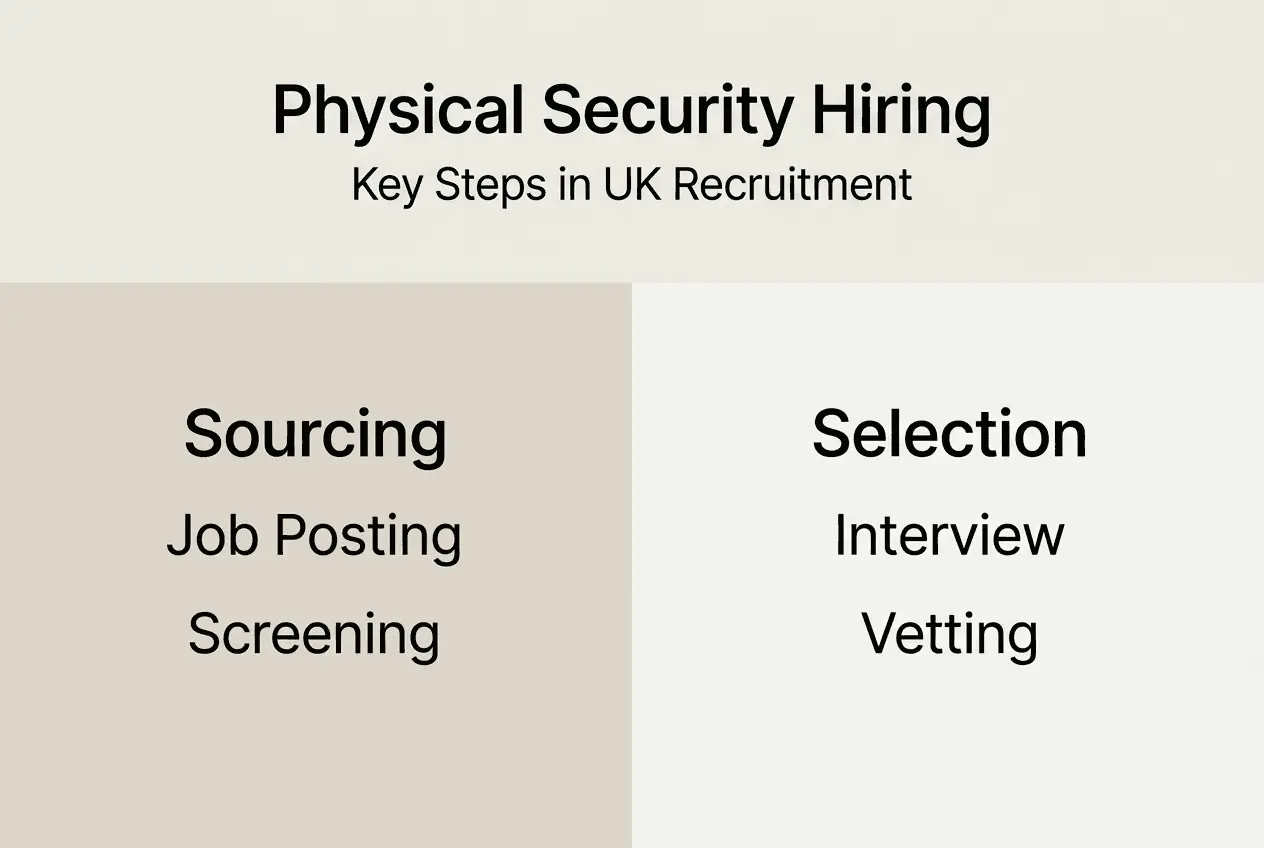
Implementing a structured interview and vetting process ensures consistency and compliance. Develop standardised questions that assess both technical competence and behavioural fit. Include scenario-based queries to evaluate decision making under pressure. Follow a clear vetting sequence: initial screening, competency interview, reference checks, DBS verification, and SIA licence confirmation. Document every stage meticulously.
Ongoing candidate relationship management pays dividends. Even candidates you do not hire immediately may be perfect for future roles. Maintain a database of promising applicants, send periodic updates about opportunities, and provide feedback after interviews. This approach builds goodwill and creates a ready pool of interested, pre-vetted candidates.
Clear communication throughout the process is non-negotiable. Candidates appreciate transparency about timelines, vetting requirements, and next steps. Slow or unclear communication drives top talent toward competitors who respond faster. Set expectations upfront and follow through consistently.
Pro Tip: Use video interviews for initial screening to assess communication skills and professionalism while saving time on unsuitable candidates before investing in face-to-face meetings.
Key recruitment tactics include:
- Crafting detailed job descriptions with specific licence and compliance requirements
- Leveraging security-focused recruitment platforms for targeted candidate access
- Standardising interview processes to ensure fair, consistent evaluation | Maintaining candidate relationships for future hiring needs
- Communicating clearly and promptly at every recruitment stage
These strategies transform recruitment from a reactive scramble into a proactive, efficient process that consistently delivers quality hires.
Integrating recruitment workflow: from sourcing to onboarding
A comprehensive recruitment workflow brings structure and repeatability to physical security hiring. Without a defined process, recruitment becomes chaotic, compliance suffers, and quality varies wildly. A well-defined workflow ensures consistency and improved candidate quality across all your security hiring activities.
The workflow begins with job posting. Publish detailed role descriptions on appropriate platforms, ensuring all compliance requirements are clearly stated. Track where applications originate to refine your channel strategy over time.
Candidate screening comes next. Review applications against essential criteria: valid SIA licence, relevant experience, availability matching shift requirements. Disqualify obvious mismatches quickly to focus energy on viable candidates. Use initial phone screens to verify basic information and gauge communication skills.
Interviewing moves promising candidates forward. Conduct structured interviews using standardised questions that assess technical knowledge, situational judgement, and cultural fit. Include practical assessments where appropriate, such as conflict de-escalation scenarios or observation exercises.
Vetting is where physical security recruitment diverges most sharply from general hiring. Initiate enhanced DBS checks, verify SIA licences through official registries, and conduct thorough reference checks with previous employers. Document every verification step. Any gaps or concerns must be investigated and resolved before proceeding.
The hiring decision should involve multiple stakeholders. Security managers, HR professionals, and operational leaders each bring valuable perspectives. Make decisions based on documented evidence from the entire process, not gut feelings.
Onboarding completes the workflow. Provide comprehensive induction covering site-specific procedures, emergency protocols, reporting systems, and compliance expectations. Assign mentors or buddies to support new hires during their first weeks. Schedule regular check-ins to address concerns early.
Compliance checks and record keeping are essential at each stage. Maintain audit trails showing who made decisions, when verifications occurred, and what documentation was reviewed. Store records securely in compliance with GDPR and employment law. These records protect your organisation if hiring decisions are ever challenged.
Technology and platforms streamline the workflow significantly. Applicant tracking systems manage candidate pipelines, automated reminders ensure timely follow-ups, and digital verification tools speed background checks. Security-specific platforms often integrate these functions, reducing administrative burden.
Physical security roles in logistics and transportation sectors require additional considerations. Candidates may need specific clearances for port or airport work, clean driving licences for mobile patrol roles, or familiarity with cargo security protocols. Tailor your workflow to accommodate these sector-specific requirements.
The recruitment workflow stages and corresponding actions are:
| Stage | Key Actions | Responsible Party | Timeline |
|---|---|---|---|
| Job Posting | Publish detailed role descriptions on targeted platforms | HR/Recruitment | Day 1 |
| Screening | Review applications against essential criteria, conduct phone screens | Recruitment Team | Days 2-7 |
| Interviewing | Structured interviews with standardised questions and assessments | Hiring Managers | Days 8-14 |
| Vetting | Enhanced DBS checks, SIA verification, reference checks | HR/Compliance | Days 15-28 |
| Hiring Decision | Multi-stakeholder review and formal offer | Senior Management | Day 29 |
| Onboarding | Induction, training, mentorship assignment | Operations/HR | Days 30-44 |
This structured approach transforms recruitment from an ad hoc activity into a reliable system that consistently delivers compliant, capable security personnel.
Explore tailored recruitment solutions for UK security roles
Finding the right physical security candidates requires more than posting jobs and hoping for responses. The Security Jobs Board connects UK hiring managers directly with qualified security professionals actively seeking opportunities. Whether you need personnel for retail, corporate, events, or specialised sectors, the platform’s targeted approach delivers candidates who already understand the demands and compliance requirements of security work.

Regional hiring becomes straightforward when you can access location-specific talent pools. If you are recruiting for security roles in Northern Ireland, the platform enables precise geographic targeting, reducing relocation complications and improving candidate fit. The career advice section provides valuable resources for refining your recruitment approach, from crafting compelling job descriptions to conducting effective interviews. By leveraging dedicated security recruitment tools, you streamline the entire hiring process, reduce time to hire, and improve the quality of candidates reaching your shortlist.
FAQ
What qualifications are essential for physical security roles in the UK?
An SIA licence is mandatory for most physical security positions, with specific licence types required depending on the role. Door supervision, security guarding, CCTV operation, and close protection each require distinct SIA qualifications. Beyond licensing, candidates need role-specific skills such as first aid certification, conflict management training, or specialist knowledge for sectors like retail or events. Enhanced DBS checks are standard, with some positions requiring additional security clearances.
How can hiring managers verify candidate backgrounds effectively?
Use criminal record checks through the Disclosure and Barring Service to assess candidate suitability. Verify SIA licences directly through the official SIA register, which provides real-time licence status and expiry dates. Contact previous employers for detailed references covering reliability, conduct, and performance. Third-party verification services can streamline multiple checks simultaneously, reducing administrative burden while maintaining thoroughness.
What are common pitfalls in physical security recruitment?
Poorly defined job roles create confusion and attract unsuitable candidates. Inadequate vetting processes expose organisations to security and legal risks that could have been prevented. Unclear communication during recruitment frustrates candidates and drives them toward competitors who provide better experiences. Ignoring sector-specific compliance requirements leads to costly consequences including fines, legal action, and operational disruptions. Rushing hiring decisions to fill urgent vacancies often results in poor matches and rapid turnover.
Is remote hiring feasible for physical security personnel?
Remote hiring works effectively for initial stages such as application screening, video interviews, and preliminary assessments. Virtual tools enable efficient candidate evaluation while reducing time and travel costs for both parties. However, physical presence remains necessary for final interview stages, practical assessments, and identity verification required for DBS checks. Remote hiring processes should follow best practices including secure document handling, verified identity checks, and clear communication about in-person requirements. Balance virtual efficiency with the hands-on elements essential for security role validation.


