What a security guard does: the UK career guide
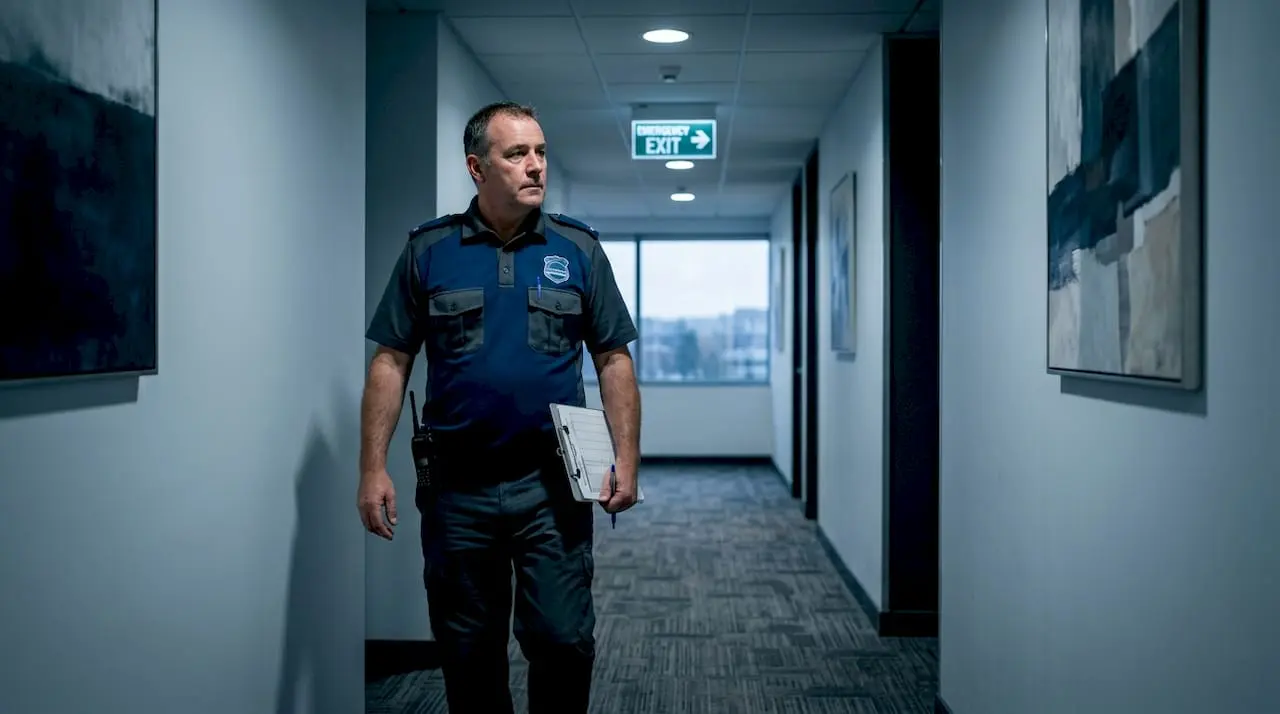
TL;DR:
- Security guards in the UK perform demanding roles including access control, patrols, incident response, conflict de-escalation, and detailed reporting. They must follow strict legal and safety protocols, requiring skills in judgment, communication, and record-keeping to ensure site security. Roles vary by environment, but consistent vigilance and professional discipline are essential for effective security.
Most people picture a security guard as someone who stands near a door and checks bags. The reality is considerably more demanding. Security guard roles in the UK fall into five distinct working areas: controlling site access, running structured patrols, responding to incidents, calming confrontations without physical force, and writing documentation. Each one carries real legal weight and practical complexity. If you are exploring a career in security, understanding what a security guard does before you apply will save you from surprises and help you find the right role from day one.
Table of Contents
- Core duties of a security guard explained
- Understanding access control and patrolling
- Incident response and conflict de-escalation
- The importance of reporting and record keeping
- How roles vary by environment and career path options
- What the role really demands: a security guard’s perspective
- Start your UK security career today with Security Jobs Board
- Frequently asked questions
Key Takeaways
| Point | Details |
|---|---|
| Core roles defined | Security guards in the UK have core duties: access control, patrolling, incident response, conflict de-escalation, and reporting. |
| Beyond ID checking | Access control includes managing people, vehicles, premises, and legal searching beyond just checking identification. |
| Incident response matters | The first minute of an incident is crucial for containment and safety, needing trained judgment and action. |
| Accurate reporting | Detailed, timestamped reports support investigations and legal processes and are essential professional duties. |
| Role variation | Security duties differ by setting but share responsibilities like risk assessment, communication, and documentation. |
Core duties of a security guard explained
The five primary responsibilities of a UK security guard are access control, patrolling and surveillance, incident response, conflict de-escalation, and reporting. These are not just bullet points on a job description. They represent the full scope of what you will be expected to handle on every shift, sometimes all at once.
Understanding these security guard responsibilities is essential before you begin training or apply for your first role. Here is what each area actually involves in practice:
- Access control: Deciding who enters and exits a site, in line with the client’s written policy and UK law. This includes managing queues, verifying credentials, and turning away unauthorised individuals without creating conflict.
- Patrolling and surveillance: Moving through a site on a structured schedule, checking for hazards, signs of forced entry, suspicious behaviour, and equipment failures. Many modern patrols include reviewing CCTV footage and using electronic logging systems.
- Incident response: Acting quickly and correctly when something goes wrong, whether that is a medical emergency, a theft in progress, or a fire alarm activation.
- Conflict de-escalation: Using communication skills to calm aggressive or distressed individuals before a situation becomes physically dangerous.
- Reporting: Writing clear, timestamped, factually accurate records of everything significant that happens during your shift.
Typical security guard tasks in each of these areas vary by site, but the underlying expectations stay consistent across the industry.
Understanding access control and patrolling
Access control is the entry point of the job, literally and professionally. UK private security standards define access control as covering people, vehicles, premises and property, with lawful management of searching and entry decisions made according to site policy and UK law. That is a precise legal framework, not a vague instruction to “check who comes in.”
In practice, access control on a busy commercial site might involve:
- Verifying staff ID badges against a current access list
- Logging vehicle registration numbers and departure times
- Managing a one-in-one-out system during peak hours
- Refusing entry to individuals who cannot provide identification and handling that refusal without confrontation
- Operating electronic gate systems and reporting malfunctions immediately
The patrolling side of the role carries its own discipline. Effective patrols are not random walks. They follow varied routes, deliberately changed to avoid predictability, because a guard who always takes the same path at the same time is easy for a determined intruder to work around. During a patrol, you are conducting a dynamic risk assessment: noting what has changed, what looks out of place, and what requires follow-up. Understanding the legal aspects of static guarding is equally important, particularly when your role involves a fixed post rather than a moving patrol route.
Pro Tip: Treat access control as a layered process rather than a single checkpoint. Your first line of defence is physical barriers. Your second is the verification process. Your third is your own judgement and communication. All three need to work together to prevent a breach.
Incident response and conflict de-escalation
When an incident occurs, the clock starts immediately. The first 60 seconds of any incident determine a great deal. A trained officer reads a developing situation and either contains it or involves emergency services while maintaining control of the scene. That is not an exaggeration. Whether it is a shoplifter who becomes aggressive or a medical collapse in a car park, your early actions shape every outcome that follows.
Effective incident response includes:
- Recognising warning signs before a situation becomes critical
- Making a rapid decision about whether to act directly, call for backup, or contact emergency services
- Keeping bystanders safe and managing the space around an incident
- Preserving evidence where relevant, particularly in theft or assault cases
- Remaining calm under pressure, because your composure directly affects everyone else’s behaviour
Conflict de-escalation is a skill that sits alongside incident response but deserves its own attention. Most confrontations a security guard faces do not require physical intervention. They require conflict management skills that are practised, not improvised. The key tools are tone of voice, controlled body language, physical positioning, and clear, plain-spoken language. You are not trying to win an argument. You are trying to reduce the temperature of a situation until it becomes manageable.
Pro Tip: When facing an agitated individual, lower your own voice instead of raising it. People instinctively match the energy of the person they are speaking to. Speaking quietly and slowly often pulls the other person down to your level, which makes the conversation far easier to manage.
The importance of reporting and record keeping
Reporting is the part of the job that newcomers most commonly underestimate. It feels administrative, almost clerical, until you understand what those records are actually used for. Record keeping supports incident reporting and evidential statements for court or police use, not just informal note-taking. A poorly written or incomplete incident log can undermine a prosecution, create liability for your employer, or leave a future security team without the context they need to manage a known risk.
Types of documentation a security guard produces during security guard daily activities include:
- Incident logs: A factual, timestamped account of what happened, who was involved, and what action was taken
- Evidential statements: Formal written accounts used in court proceedings or police investigations
- Witness statements: Recorded accounts from members of the public or staff who saw an incident
- Handover notes: Shift-end briefings that give the incoming team a current picture of site conditions
The table below shows how these documents are used across different stakeholders:
| Document type | Primary users | Key content required |
|---|---|---|
| Incident log | Employers, managers | Time, location, description, action taken |
| Evidential statement | Police, courts | First-person account, witness details, sequence of events |
| Witness statement | Investigators, solicitors | Third-party account, contact details, signed declaration |
| Handover notes | Incoming security team | Outstanding issues, known risks, equipment status |
For a fuller picture of what these documents look like in practice, the security guard duty descriptions guide on Security Jobs Board breaks down role-specific expectations clearly.
How roles vary by environment and career path options
One of the most useful things to understand about security guard daily activities is that they look quite different depending on where you work. Responsibilities vary substantially by environment. Static reception, mobile patrol, retail, and warehouse settings each carry different duties, but all share a consistent responsibility for risk assessment, communication, and records.
Here are five common types of security guard roles and what they typically involve:
- Static guard (reception or gatehouse): Fixed post, focused on access control, visitor logging, and CCTV monitoring. Often the first point of contact for staff and visitors.
- Mobile patrol officer: Covers multiple sites in a vehicle during a shift, conducting timed patrols at each location and responding to alarm activations.
- Retail security officer: Works in shops and shopping centres, deterring and responding to shoplifting, managing disturbances, and supporting staff safety.
- Warehouse and logistics guard: Focuses on perimeter security, vehicle access, and protecting high-value stock from theft or tampering.
- Event security officer: Works at concerts, sports events, or festivals, managing crowd flow, checking tickets, and responding to incidents in high-pressure environments.
Each of these roles requires an SIA Security Officer licence, which involves completing approved training and passing a criminal record check. The licence is not optional for frontline roles. It is a legal requirement.
What the role really demands: a security guard’s perspective

Here is something you will not find in most job descriptions: the biggest challenge in security is not the dramatic moments. It is the routine.

Patrol after patrol, shift after shift, you are expected to apply the same level of attention and care. That is harder than it sounds. Complacency is the most common source of security failures. Not incompetence, not lack of training, but the gradual drift that happens when nothing has gone wrong for a while and vigilance quietly drops.
Newcomers to the industry often underestimate access control. They expect it to be straightforward. Check the badge, let the person through. But access control demands constant judgement. Who does this person say they are? Does their behaviour match their stated purpose? Is their vehicle authorised, and does it match the booking? These are not questions with obvious answers every time.
The quality of handover notes and incident records determines how well the next team or authorities can reconstruct events. We have seen cases where an incident that started on one shift only became fully understood three shifts later, because the records were detailed enough to trace the pattern. That kind of documentation is not box-ticking. It is professional discipline with real consequences.
Good communication and consistent record-keeping also protect you personally. If a complaint is made about your conduct, your contemporaneous notes are your defence. If a colleague acts inappropriately and you witnessed it, your written account matters.
Pro Tip: At the end of every shift, read back through your notes and ask: “Could someone who was not there reconstruct what happened from this?” If the answer is no, add detail before you hand over. The security training essentials guide covers the skills that underpin all of this.
Start your UK security career today with Security Jobs Board
Now that you understand what a security guard does across different roles and environments, the practical next step is finding the right opportunity and the right training to match.

Security Jobs Board is built specifically for people in your position. You can search live vacancies across the UK, including security jobs in Northern Ireland and every other region, filtered by role type, location, and experience level. If you are just starting out, the SIA licence guide walks you through exactly what training you need and how to apply. Creating a profile is free, and you can set job alerts so relevant roles reach you before you have to go looking for them. The security industry in the UK is actively recruiting. The platform connects you directly with employers who need people who are serious about the role.
Frequently asked questions
What are the main duties of a security guard in the UK?
The five primary duties are access control, patrolling and surveillance, incident response, conflict de-escalation, and reporting, each requiring distinct skills and consistent professional discipline.
Is an SIA licence required to work as a security guard in the UK?
Yes. The SIA regulates private security in the UK and issues licences that serve as the legal requirement to work as a frontline security officer, obtained through approved training and a criminal record check.
How important is reporting in a security guard’s role?
Extremely important. Record keeping supports evidential statements for court or police use, meaning your notes can directly influence the outcome of investigations and legal proceedings.
What skills help with conflict de-escalation as a security guard?
Calm tone of voice, controlled body language, quick risk assessment, and clear spoken communication are the core tools for reducing tension safely, well before physical intervention becomes a consideration.
Can security guard duties differ depending on the working environment?
Yes. Responsibilities vary considerably between static guarding, mobile patrol, retail, and warehouse settings, but core requirements like risk assessment, communication, and accurate record-keeping remain constant across all environments.


