Best sites for security jobs in the UK 2026

Searching for security work in the UK can feel overwhelming when generic job boards bury sector-specific vacancies under irrelevant listings. You need platforms that understand security clearance levels, industry qualifications, and the unique demands of roles ranging from close protection to electronic security. This guide cuts through the confusion by revealing the most effective online job sites tailored specifically for UK security professionals in 2026, helping you connect with opportunities that genuinely match your skills and clearance status.
Table of Contents
- Understanding The UK Security Job Market In 2026
- How Specialised Job Boards Meet Security Sector Needs
- Comparing The Best UK Security Job Sites In 2026
- Practical Tips For Maximising Your Job Search Success
- Explore Top UK Security Job Opportunities Today
Key takeaways
| Point | Details |
|---|---|
| Specialised platforms deliver better matches | Security-focused job boards filter for clearance requirements and sector-specific qualifications, saving you hours of irrelevant browsing. |
| Industry growth creates opportunities | The UK security industry is valued at £12.3 billion and continues expanding, increasing demand for qualified professionals. |
| Clearance levels matter | Understanding SC and DV clearance requirements helps you target roles where you qualify, improving application success rates. |
| Strategic job searching wins | Using multiple specialised boards, setting alerts, and tailoring your CV to highlight security credentials accelerates your job hunt. |
Understanding the UK security job market in 2026
The security sector in the UK represents a massive employment landscape worth exploring strategically. The UK security industry is valued at £12.3 billion in 2023 and continues growing, creating thousands of new positions annually across manned guarding, electronic security, close protection, and cyber security. This expansion means genuine opportunities exist, but finding them efficiently requires understanding where employers actually post their vacancies.
The industry faces significant workforce challenges that directly affect how you should approach your job search. Retention issues, high SIA licensing costs, and diversity gaps create a competitive recruitment environment where employers increasingly turn to specialised platforms. Many firms struggle to fill positions requiring specific security clearances, particularly at SC (Security Check) and DV (Developed Vetting) levels, which narrows candidate pools considerably.
These clearance requirements create a crucial divide in the job market. Generic job boards mix clearance-required roles with basic security positions, forcing you to wade through hundreds of unsuitable listings. Understanding this landscape helps you recognise why UK security jobs recruitment in 2026 demands a targeted approach rather than scattergun applications across mainstream platforms.
Several factors influence where quality vacancies appear:
- Employers with clearance-required roles prefer specialised boards that pre-filter candidates
- Smaller security firms often lack resources for expensive mainstream job advertising
- Regional variations mean some platforms dominate specific UK areas
- Contract versus permanent positions tend to cluster on different sites
Recognising these patterns transforms your search from frustrating to focused. When you know that certain platforms attract government contractors whilst others specialise in commercial security, you can allocate your time where it genuinely counts. The size and complexity of the UK security market means no single job board captures everything, making strategic platform selection essential for maximising your opportunities in 2026.
How specialised job boards meet security sector needs
Security clearance represents a fundamental gatekeeper in many UK security roles, particularly those involving government sites, defence contractors, or sensitive commercial facilities. SC (Security Check) clearance involves background checks covering your last five years, whilst DV (Developed Vetting) goes deeper, examining ten years of history plus financial records and personal interviews. These aren’t quick processes, so employers specifically seek candidates who already hold current clearance or can demonstrate eligibility.

Specialised job boards like SecurityClearedJobs.com focus on positions requiring SC or DV clearance, tailored for UK security roles where these credentials matter most. This focus creates immediate value for you because every listing you view actually matches your clearance status. Generic boards force you to read deep into job descriptions before discovering clearance requirements, wasting precious search time on roles where you simply cannot qualify.
These niche platforms streamline your entire application process through several mechanisms:
- Profile fields specifically capture clearance levels and expiry dates
- Search filters immediately exclude roles above or below your clearance status
- Employers browsing CVs can instantly identify suitable candidates
- Job alerts trigger only for clearance-appropriate vacancies
Pro Tip: Update your clearance expiry date regularly on specialist platforms because employers often search for candidates whose clearance remains valid for at least six months, avoiding renewal delays during onboarding.
The concentration effect matters enormously. When employers know a platform attracts clearance-holding candidates, they prioritise posting there, creating a virtuous cycle. You benefit from higher-quality matches because both you and the employer have pre-qualified through the platform’s focus. This targeted approach typically reduces your application-to-interview ratio significantly compared to mass-market job boards where security roles get lost among thousands of unrelated positions.
Beyond clearance, sector specialisation helps platforms understand nuances like SIA licensing, CCTV qualifications, or close protection certifications. Top UK security job boards incorporate these criteria into their search and matching algorithms, ensuring the roles you discover genuinely align with your professional credentials rather than requiring extensive filtering on your part.
Comparing the best UK security job sites in 2026
Choosing where to focus your job search energy requires understanding how leading platforms differ in audience, features, and vacancy types. Not all security job boards serve identical purposes, so matching platform strengths to your specific situation accelerates results.
| Platform | Primary Focus | Best For | Key Feature | | — | — | | SecurityClearedJobs.com | SC/DV clearance roles | Government and defence sector positions | Clearance-level filtering | | Security Jobs Board | Broad UK security sector | Manned guarding, electronic security, all levels | BSIA affiliation and regional coverage | | Totaljobs Security | Mixed general and security | Entry to mid-level commercial roles | High traffic volume | | Indeed Security | Aggregated listings | Comprehensive market overview | Job alert customisation |
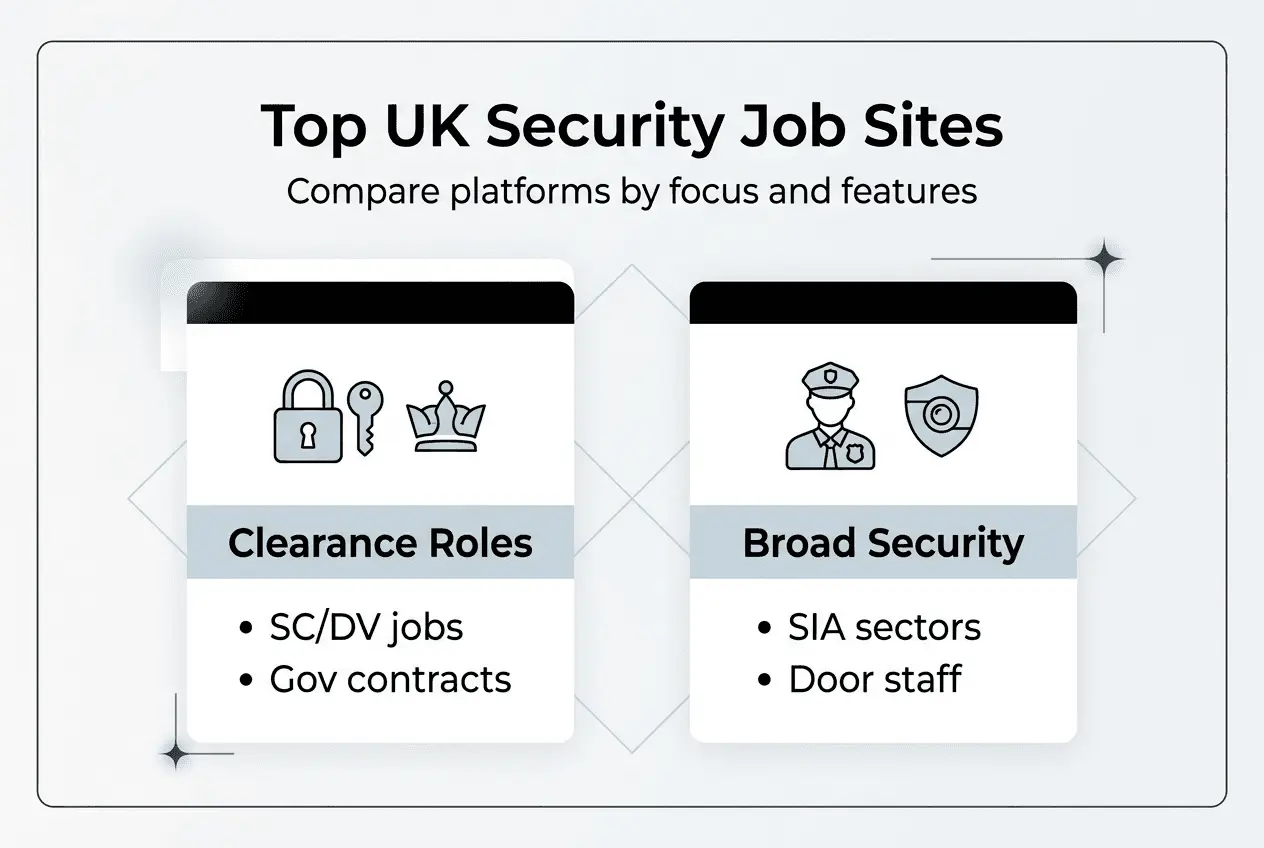
SecurityClearedJobs.com excels when you hold or can obtain security clearance and target government contracts or defence work. The platform’s laser focus means fewer listings overall but dramatically higher relevance if clearance defines your career path. However, if you work in commercial security without clearance requirements, you’ll find limited opportunities here.
Security Jobs Board offers broader coverage across the entire UK security industry, from door supervisors to security managers and electronic security engineers. Its BSIA connection adds credibility, and regional job categories help you target specific areas efficiently. The platform works particularly well for professionals seeking variety or exploring different security sectors simultaneously.
Security industry workforce shortages highlight the need for specialised recruitment tools that connect qualified candidates with employers quickly. Generic aggregators like Indeed capture volume but require extensive filtering, whilst niche boards deliver precision at the cost of comprehensiveness.
Follow these steps to choose your optimal platform mix:
- List your clearance status, licences, and specialisations honestly
- Identify which platforms emphasise your strongest credentials
- Create profiles on your top three matches rather than spreading thin across ten sites
- Monitor response rates over two weeks and adjust your platform focus accordingly
Pro Tip: Maintain active profiles on one clearance-focused board and one broad security board simultaneously, giving you both depth in your specialism and breadth across the wider market.
The best job posting sites for security recruiters from an employer perspective often mirror the best sites for candidates because active employer engagement drives listing quality. Platforms where recruiters invest advertising budgets typically offer better-maintained job descriptions, faster response times, and more genuine vacancies versus expired or duplicate listings.
Understanding security recruitment tools UK comparison factors helps you evaluate new platforms as they emerge. Look for GDPR compliance, mobile responsiveness, and whether the platform charges candidates, all signals of professional operation versus data-harvesting schemes disguised as job boards.
Practical tips for maximising your job search success
Knowing which platforms to use only matters if you use them effectively. Your CV and profile need tailoring specifically for security sector expectations, highlighting clearances, licences, and sector experience prominently. Many security employers scan CVs for keywords like SIA licence numbers, clearance levels, or specific qualifications before reading further, so front-load these credentials.
Regularly checking clearance-focused job boards pays dividends because many security roles fill quickly, particularly contract positions or those requiring immediate starts. Setting daily or twice-weekly check-ins ensures you catch new listings whilst they’re fresh. Employers often shortlist candidates within 48 hours of posting, making speed essential.
Job alerts transform passive browsing into active opportunity capture. Configure alerts narrowly enough to avoid inbox overload but broadly enough to catch relevant variations. For example, searching both “security officer” and “security operative” captures different employer terminology for similar roles.
Networking within security industry forums and professional groups surfaces opportunities before they hit public job boards. Many security managers prefer referrals, so building connections through LinkedIn groups or industry events can unlock the hidden job market. Recruitment challenges stem from unsociable hours and lack of career pathways, encouraging strategic job searches that go beyond basic applications.
Implement these specific tactics for better results:
- Apply within 24 hours of a listing appearing to maximise visibility
- Customise your covering letter to reference the specific platform where you found the role
- Keep your SIA licence and clearance documentation scanned and ready for quick upload
- Track which platforms generate interviews versus which produce silence, refining your focus over time
Pro Tip: Many security employers post the same vacancy across multiple platforms, so keep a simple spreadsheet tracking where you’ve applied to avoid embarrassing duplicate applications to the same company.
Licence and certification requirements vary significantly across security sectors. Door supervision demands current SIA licensing, whilst CCTV operation requires specific qualifications, and close protection involves advanced training. Understanding these requirements before applying saves everyone time and positions you as a knowledgeable professional rather than someone mass-applying without reading job specifications.
Your online presence extends beyond job boards. Security employers increasingly review LinkedIn profiles and may search your name online. Ensure your digital footprint reflects professionalism, particularly given the trust-based nature of security work. Remove or privatise any social media content that contradicts the responsible image security roles demand.
Visit security job career advice resources regularly because the industry evolves, with new regulations, technologies, and role types emerging. Staying informed about sector trends helps you position yourself for growing opportunities rather than declining specialisms.
Explore top UK security job opportunities today
You’ve now got the knowledge to navigate UK security job platforms strategically rather than randomly. The next step involves putting this understanding into action by exploring targeted vacancies that genuinely match your qualifications and career goals. Whether you’re seeking roles in specific regions or want expert guidance on advancing your security career, specialised resources make the difference between frustrating searches and focused success.

Browse security jobs in Northern Ireland or other regional categories to find geographically relevant opportunities. Access comprehensive security job career advice covering everything from CV optimisation to interview preparation tailored specifically for the security sector. Visit the Security Jobs Board homepage to create your free profile, upload your CV, and set personalised job alerts that deliver relevant vacancies directly to your inbox, ensuring you never miss opportunities suited to your unique skills and clearance status.
FAQ
What qualifications do I need for security clearance jobs?
Security clearance jobs typically require a clean background check covering criminal records, financial history, and residency verification. For SC clearance, you’ll need five years of verifiable UK residency and references, whilst DV clearance demands ten years plus deeper financial scrutiny. Most roles also require a current SIA licence for manned guarding positions, though some specialist roles like cyber security may prioritise technical certifications over SIA credentials.
How often are new security jobs posted online?
Posting frequency varies by platform and market demand, but expect daily new listings on major security job boards during peak recruitment periods. Specialised platforms like SecurityClearedJobs.com may post fewer positions weekly but with higher relevance, whilst broader boards update multiple times daily. Setting job alerts ensures you catch opportunities immediately rather than relying on manual checking, particularly important for contract roles that fill within days.
Are there job boards for specific security sectors, like cyber or electronic security?
Yes, several platforms focus on cyber security roles specifically, including dedicated sections on major tech job boards. Electronic security positions appear prominently on specialist UK security job boards that categorise by sector, letting you filter for installation, maintenance, or monitoring roles. Using these sector filters on comprehensive platforms often proves more effective than searching generic boards where relevant positions get buried under unrelated listings.
Can I use multiple job boards simultaneously without duplicating applications?
Absolutely, using multiple platforms strategically increases your market coverage without creating problems if you track your applications properly. Maintain a simple spreadsheet noting company names, positions, and platforms used to avoid accidentally applying twice to the same employer through different boards. Many security firms do post identical vacancies across several platforms, so this tracking becomes essential for maintaining professionalism and avoiding embarrassment during the interview process.
Do security job boards charge candidates to apply for positions?
Reputable UK security job boards offer free registration, profile creation, and job applications for candidates, generating revenue from employer subscriptions instead. Be cautious of any platform demanding payment from jobseekers, as this contradicts industry norms and may indicate questionable operations. Legitimate boards like Security Jobs Board explicitly advertise free candidate services, ensuring you can search and apply without financial barriers whilst employers pay for posting and CV database access.
Recommended
- Best job board site for UK security roles in 2026 | Security Jobs Board
- Top 5 Jobs UK Security Platforms for 2026 | Security Jobs Board
- Top UK job boards: security jobs & recruitment 2026|SJB
- Top 8 UK Security Job Boards to Compare in 2026 | Security Jobs Board
- Industrial Fencing Installation Guide for Secure Sites – Jumalu Fencing


