Write security job cover letters that get interviews

TL;DR:
- Tailor your cover letter specifically to each security role, highlighting relevant skills and achievements.
- Use a clear structure with personalisation, measurable examples, and professional tone to stand out.
- Avoid generic applications; demonstrate understanding of the company’s environment and operational needs.
You’ve got the experience, the licence, and the track record. Yet somehow, your applications keep disappearing into silence. It’s one of the most frustrating positions to be in as a UK security professional: knowing you’re right for the job but not getting the call. The problem often isn’t your qualifications. It’s how you’re presenting yourself on paper. A well-crafted, targeted cover letter can be the difference between landing an interview and being overlooked entirely. This guide breaks down exactly how to write one that makes UK security employers take notice, from preparation through to the final sign-off.
Table of Contents
- What makes a security cover letter effective?
- What to gather before you write your cover letter
- Step-by-step process to write your security cover letter
- Common mistakes in security cover letters and how to avoid them
- Our perspective: Why most cover letter advice does not work for UK security jobs
- Find your next security job with tailored support
- Frequently asked questions
Key Takeaways
| Point | Details |
|---|---|
| Structure is crucial | Following a clear cover letter format helps you make a professional impression. |
| Tailor every letter | Always match your skills and experiences directly to the security job description. |
| Show quantifiable results | Use specific numbers and outcomes from previous jobs to prove your impact. |
| Avoid generic templates | Personalised, research-backed letters get more attention from employers. |
What makes a security cover letter effective?
A cover letter is not just a formality. In the UK security sector, it’s often the first real test of whether you can communicate professionally and clearly. Employers receive dozens of applications for every vacancy, and a generic letter signals immediately that you haven’t made the effort to understand the role.
What separates a strong security cover letter from a weak one comes down to structure, personalisation, and evidence. A standard cover letter structure includes a header with your contact details and the employer’s information, a greeting that addresses the hiring manager by name, a focused introduction stating the role you’re applying for, a body section that highlights your relevant skills with specific examples, a closing paragraph expressing enthusiasm and inviting next steps, and a professional sign-off.
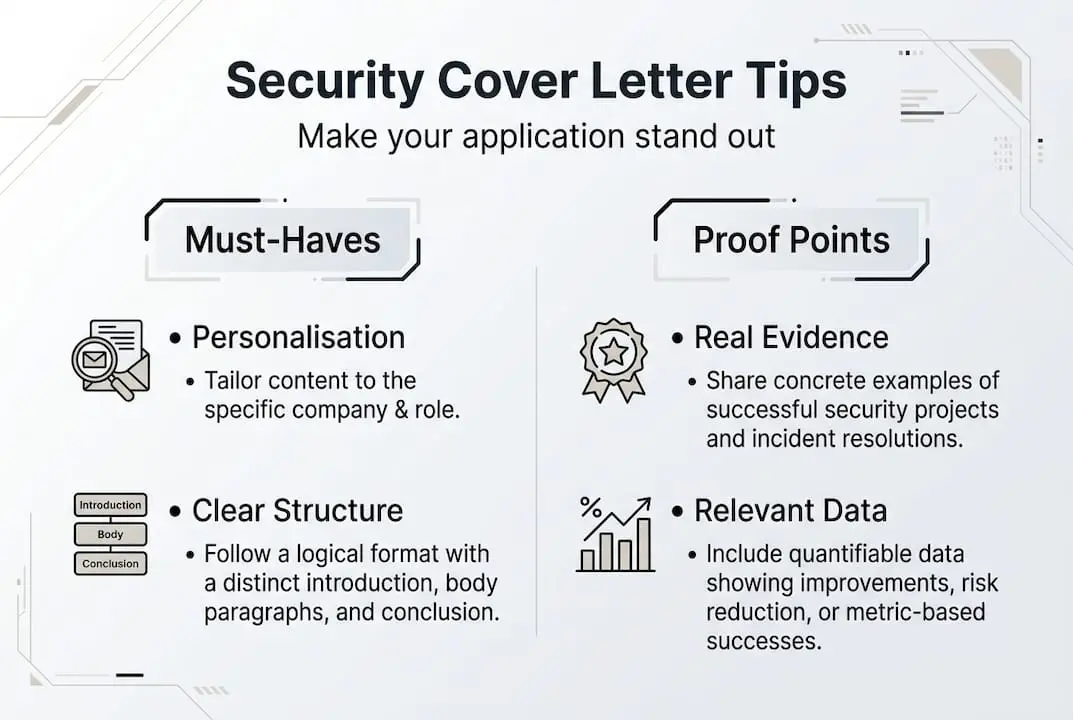
Personalisation matters enormously. Hiring managers can spot a copy-and-paste letter within seconds. If your letter could apply to any company in any sector, it won’t work. You need to show that you understand qualities UK security employers seek and that you genuinely match them.
Supporting your claims with data makes your letter far more persuasive. Instead of saying you’re reliable, say you maintained a perfect attendance record across a two-year contract. Instead of claiming you handle pressure well, mention that you managed access control for an event with over 5,000 attendees.
Here’s a quick comparison of what effective letters include versus what weak ones miss:
| Element | Effective letter | Weak letter |
|---|---|---|
| Greeting | Named hiring manager | “To whom it may concern” |
| Introduction | States specific role and fit | Vague opening statement |
| Skills section | Backed by measurable examples | Generic phrases only |
| Tone | Professional and confident | Overly formal or casual |
| Closing | Clear call to action | Trailing off without direction |
Key features to include in every security cover letter:
- Specific role title referenced in the opening line
- Relevant certifications such as SIA licence details
- Quantified achievements wherever possible
- Keywords from the job description woven naturally into the text
- A confident but respectful closing that invites a response
Getting these elements right consistently is what moves your application from the discard pile to the interview shortlist.
What to gather before you write your cover letter
Rushing straight into writing is one of the most common mistakes applicants make. A cover letter written without preparation tends to be vague, unfocused, and easy to dismiss. Taking 20 to 30 minutes to gather the right information before you type a single word will dramatically improve the quality of what you produce.
Start by pulling together the following:
- The full job description, including any listed responsibilities and requirements
- Your current CV, so you can cross-reference your experience with what’s being asked
- Details of two or three specific achievements that are directly relevant to this role
- The company’s name, values, and any recent news you can reference to show genuine interest
- The hiring manager’s name, which you can often find on LinkedIn or by calling the company directly
Company research is often underestimated. If a security firm has recently won a new contract or expanded into a new region, mentioning it briefly shows you’ve done your homework. Tailoring your letter to the specific company’s values and using keywords from the job description, alongside quantifiable achievements such as reduced incidents by a measurable percentage, signals a level of professionalism that generic letters simply cannot match.

Identifying your two or three strongest experiences is also critical. Don’t try to cram everything in. Choose the examples that most directly answer what the employer is looking for, and be ready to expand on them in an interview. For further support on structuring your application, step-by-step job application guidance can help you see how the cover letter fits into the wider process.
Pro Tip: Before writing, highlight every key requirement in the job description with a different colour. Then match each one to a specific experience from your CV. This simple exercise ensures your letter directly addresses what the employer actually wants.
If you’re new to the sector or returning after a break, the security jobseeker onboarding process guide can help you identify which experiences and credentials to prioritise in your application.
Step-by-step process to write your security cover letter
With your preparation done, writing the letter becomes a much more straightforward task. Follow this order to build a cover letter that flows logically and reads professionally.
- Write your header. Include your full name, phone number, email address, and the date. Below that, add the employer’s name, job title, company name, and address.
- Open with a direct greeting. Address the hiring manager by name. If you cannot find their name, use “Dear Hiring Manager” rather than “To whom it may concern.”
- Write your introduction. In two to three sentences, state the exact role you’re applying for and give one compelling reason why you’re a strong fit. Be direct. Avoid filler phrases.
- Develop your body paragraph. This is where you connect your experience to the job requirements. Use the examples you identified during preparation. Reference your SIA licence, relevant training, and any measurable achievements. Keep it to two focused paragraphs.
- Close with confidence. Express genuine enthusiasm for the role and invite the employer to contact you. A clear call to action, such as stating you’d welcome the opportunity to discuss your application further, leaves a positive final impression.
- Sign off professionally. Use “Yours sincerely” if you’ve addressed someone by name, or “Yours faithfully” if you used a generic greeting.
The recognised cover letter structure used across the UK security industry follows this exact sequence, and sticking to it ensures your letter meets employer expectations from the first line to the last.
Pro Tip: Write your body paragraph last. Once your introduction and closing are in place, it’s much easier to see exactly what gap your skills section needs to fill.
For a broader view of how this fits into the overall recruitment process, understanding the application workflow in security gives helpful context on what happens after you submit.
Common mistakes in security cover letters and how to avoid them
Even with a clear structure in place, certain habits can quietly undermine your application. Knowing what to watch out for is just as important as knowing what to include.
The most frequent mistakes include:
- Sending a generic letter that makes no reference to the specific company or role
- Failing to proofread, leaving spelling errors, grammatical mistakes, or the wrong company name in the text
- Ignoring the job description, so key requirements and keywords are absent from your letter
- Overloading with irrelevant experience, padding the letter with roles that don’t support your case
- Being too modest, underselling genuine achievements by using weak, vague language
A cover letter that could have been sent to any employer will be treated as if it was meant for none of them. Every letter you send should feel like it was written specifically for that company on that day.
The fix for most of these issues is straightforward: slow down and be deliberate. Tailoring your letter with company-specific language and quantifiable achievements is the single most effective thing you can do to improve your response rate. If you reduced theft incidents at a retail site by a measurable amount, say so. If you completed a patrol route covering a specific area without a single reported incident over 12 months, include it.
Proofreading deserves its own mention. Read your letter aloud before sending it. Better still, ask someone else to read it. Errors that your eyes skip over become obvious when you hear them spoken. Sending a letter with the wrong company name is an instant rejection in most cases.
For broader strategies on making your applications more competitive, optimising your security job searching covers practical steps you can take alongside your cover letter to improve visibility with employers.
Our perspective: Why most cover letter advice does not work for UK security jobs
Most cover letter guides are written for office-based, white-collar roles. They focus on tone, formatting, and professional language, which are all valid. But they miss something critical for the security sector: employers in this industry are hiring for trust, reliability, and situational judgement. These qualities cannot be conveyed through a polished template.
We’ve seen time and again that the applications which succeed aren’t the most beautifully formatted ones. They’re the ones where the candidate clearly understands the company’s actual environment and challenges. A letter that references the specific site type, the likely incidents you’d face, or the operational pressures the employer deals with daily signals something no template can replicate: genuine readiness.
Personalisation increases interview chances because it demonstrates research and fit, but in security, it goes further than that. It shows you think like a security professional, not just an applicant. Understanding the security job matching process can help you see what employers are genuinely looking for when they review your application.
Find your next security job with tailored support
Your cover letter is ready. Now it needs to land in front of the right employers. That’s where having access to a specialist platform makes a real difference.

At Security Jobs Board UK, we connect security professionals with employers across the country who are actively hiring. Whether you’re searching for security jobs in Northern Ireland or looking for roles closer to home, our platform lets you apply quickly and directly. You’ll also find a full library of security job career advice to support every stage of your application, from writing your CV to preparing for interviews. Create your free profile today and put your new cover letter to work.
Frequently asked questions
How long should a cover letter be for a UK security job?
Aim for half a page to a maximum of one page, keeping every sentence focused and relevant to the specific role you’re applying for.
What skills are most important to highlight in a security job cover letter?
Emphasise reliability, observation, teamwork, and a track record of handling incidents professionally, as these are the skills employers prioritise when reviewing security applications.
Should I use the same cover letter for every security job?
No. Always tailor your letter to each role by matching your skills to the job description, as tailoring your application to each employer significantly increases your chances of being shortlisted.
Do UK employers expect cover letters in 2026?
Yes. A cover letter remains a standard employer expectation, particularly in the security sector where clear communication and professionalism are central to the role.
Recommended
- Security Job Search Workflow for Faster Career Success
- Your Complete Guide to Acing Security Job Interviews
- Optimising Job Listings for Top Security Talent | Security Jobs Board
- 9 Steps to Create the Ultimate Security Job Posting Checklist
- Employment form letters: streamline hiring with templates | Gammatica


