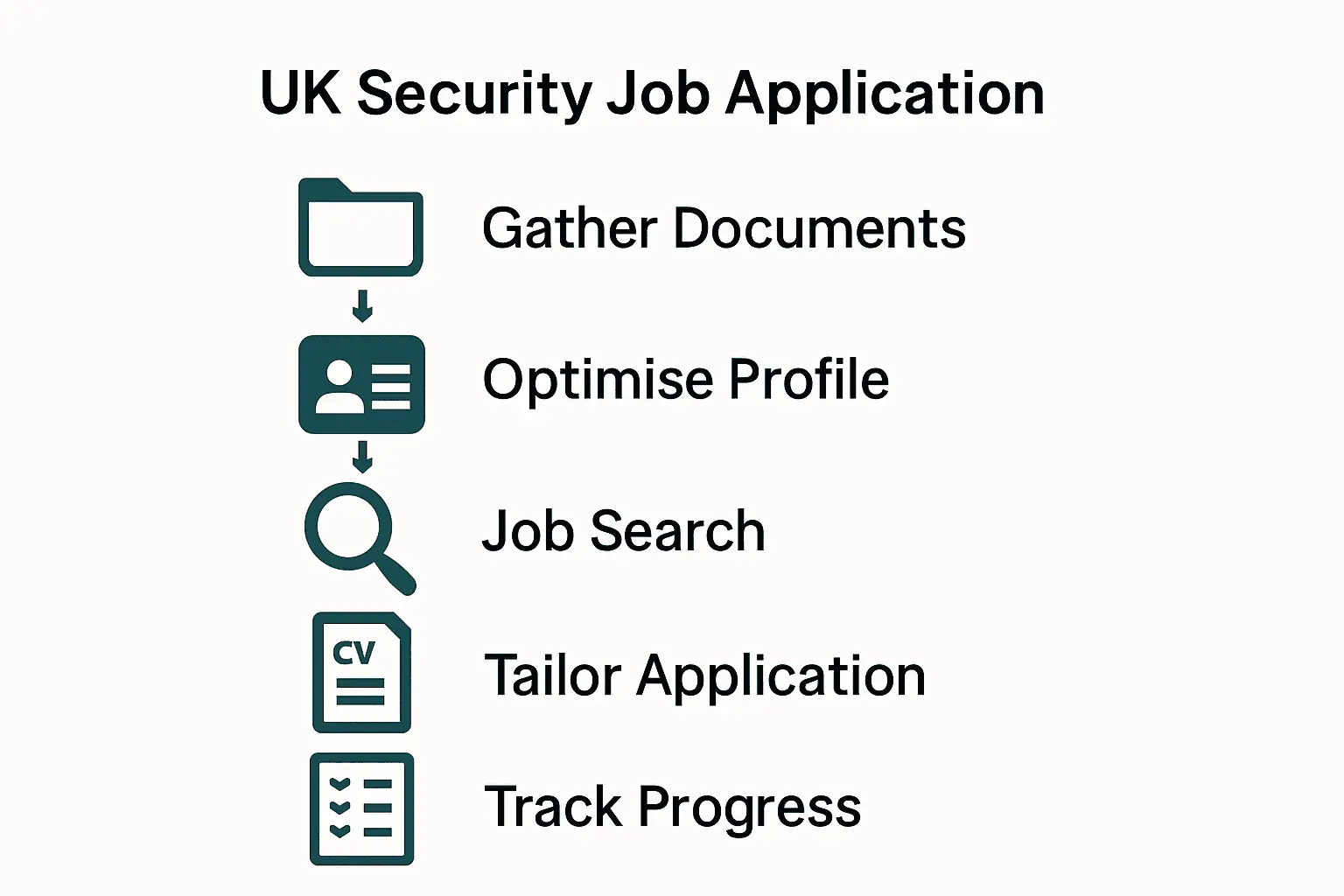
Workflow for Job Applications in UK Security Industry

Over 80 percent of british security employers say a well prepared application sets candidates apart from the start. In the competitive british security job market, delivering the right documents and presenting your qualifications clearly can be the difference between landing an interview or being overlooked. Whether you are just starting out or looking to advance in the sector, this practical guide will help you approach each step with confidence and clarity.
Table of Contents
- Step 1: Prepare Essential Security Job Documents
- Step 2: Optimise Your Security Jobs Board Profile
- Step 3: Search And Shortlist Relevant Security Vacancies
- Step 4: Tailor Applications For Each Job Listing
- Step 5: Submit And Track All Job Applications
Quick Summary
| Key Insight | Explanation |
|---|---|
| 1. Prepare essential documents | Gather key documents like ID, address proof, qualifications, and references to support your security job application. |
| 2. Optimise your profile | Enhance your Security Jobs Board profile with a professional photo, compelling summary, and detailed work history to attract employers. |
| 3. Use strategic job searches | Implement search filters based on location, specialisation, and salary to find relevant security vacancies efficiently. |
| 4. Tailor your applications | Customise your CV and cover letter for each job, focusing on required skills and achievements to increase interview chances. |
| 5. Track your applications | Maintain a detailed record of all applications, including statuses and correspondence to stay organised throughout the job search. |
Step 1: Prepare essential security job documents
Preparing the right documents is crucial for a successful security job application in the UK. When applying for security roles, you need a comprehensive set of professional documents that demonstrate your credibility, qualifications, and suitability for sensitive positions.
According to the UK Government, security job applicants must gather several key documents for vetting purposes. These typically include:
- Valid passport or birth certificate for identity verification
- Proof of address (recent utility bill or bank statement)
- Qualification certificates from educational institutions
- Professional certification documents
- Detailed employment history with contact references
- Financial records showing fiscal responsibility
The National Protective Security Authority emphasises thorough employment screening, recommending that candidates organise these documents systematically. Keep both physical and digital copies, ensuring all certificates are current and easily accessible.
Pro tip: Create a dedicated folder for your security job application documents. Scan and save digital copies securely, and keep original documents in a safe place. This preparation demonstrates professionalism and helps streamline the application and vetting process.
Once your documents are prepared, you will be well positioned to progress to the next stage of your security job application workflow.
Step 2: Optimise your Security Jobs Board profile
Creating a standout profile on the Security Jobs Board can dramatically improve your chances of landing your ideal security role. A well crafted profile acts as your professional digital calling card, showcasing your skills and experience to potential employers.
To optimise your profile effectively, you will want to include comprehensive and precise information about your professional background. This means uploading a professional headshot, writing a compelling personal summary that highlights your unique security expertise, and detailing your work history with specific achievements. When listing your experience, focus on quantifiable outcomes and specific responsibilities that demonstrate your capabilities in the security sector.
In our guide on creating a jobseeker profile for security roles, we recommend paying special attention to your skills section. List both hard skills like specific security certifications and soft skills such as communication and problem solving. Ensure all information is current, accurately reflects your professional capabilities, and is free from errors.
Pro tip: Regularly update your profile to reflect new training, certifications, or job experiences. An up to date profile signals to employers that you are an active and engaged professional committed to your career development.
With a polished and comprehensive profile, you will be well positioned to attract the right security job opportunities and take the next step in your career progression.

Step 3: Search and shortlist relevant security vacancies
Searching for the right security job requires a strategic approach that goes beyond simply browsing job listings. Your goal is to find vacancies that precisely match your skills, experience, and career aspirations in the security sector.
As recommended in our guide on finding security jobs near you, start by using multiple search filters to narrow down your options. Consider factors like location, specific security specialisation, salary range, and required qualifications. Pay close attention to job descriptions that align with your professional background and career goals.
According to the Home Office Careers resource, effective job searching involves carefully reviewing each vacancy’s detailed requirements and application procedures. Create a spreadsheet to track potential opportunities, noting key details such as application deadlines, required documents, and specific role responsibilities. This systematic approach helps you manage multiple applications efficiently and ensures you do not miss critical opportunities.
Pro tip: Set up job alerts on Security Jobs Board to receive instant notifications about new vacancies that match your specific criteria. This proactive strategy ensures you are always aware of the latest security job openings.
Once you have compiled a shortlist of promising vacancies, you will be ready to move forward with tailoring your application materials to each specific role.
Step 4: Tailor applications for each job listing
Crafting a personalised application for each security job requires strategic attention to detail and a precise approach to showcasing your professional capabilities. Your objective is to demonstrate how your unique skills and experiences directly align with the specific requirements of each role.
According to the National Protective Security Authority, successful applications must provide accurate and verifiable information that precisely matches the job requirements. Begin by thoroughly analysing the job description, identifying key skills and responsibilities, and mapping your professional background to these specific criteria.
Create a customised cover letter and CV for each application, strategically highlighting relevant experiences and achievements that directly speak to the job specification. Use the exact language from the job listing, demonstrating that you understand the role’s unique demands. Quantify your achievements where possible with specific metrics that showcase your professional impact in previous security roles.
Pro tip: Develop a master CV document with all your professional experiences, then create targeted versions for different job applications by selecting and emphasising the most relevant sections for each specific role.
By meticulously tailoring your application, you significantly increase your chances of progressing to the interview stage and standing out among other candidates in the competitive security job market.
Step 5: Submit and track all job applications
Submitting job applications in the security sector requires a systematic approach that helps you maintain organisation and professionalism throughout your job search. Your goal is to manage multiple applications efficiently while keeping track of each submission’s status and potential progression.
According to the Home Office Careers portal, successful job applicants utilise structured tracking methods to monitor their application progress. Create a detailed spreadsheet that captures critical information for each application including company name, job title, application date, submission method, required documents, and current status.
Utilise the Security Jobs Board platform to streamline your application tracking process. Ensure you save digital copies of every submitted application and maintain a comprehensive record of correspondence. Follow up with potential employers within a reasonable timeframe if you have not received an initial response, demonstrating your proactive professional approach.
Pro tip: Set up a dedicated email folder specifically for job application communications and enable email filters to help you quickly identify and manage potential employer responses.
By implementing a robust tracking system, you will remain organised and demonstrate your professional approach to potential security employers.
Take Control of Your Security Job Application Journey Today
Navigating the detailed workflow for job applications in the UK security industry can feel overwhelming. From gathering essential documents and optimising your professional profile to tailoring applications and tracking submissions, each step demands careful attention and organisation. Are you ready to overcome these challenges and present yourself as the perfect candidate to top security employers?

Start by visiting Security Jobs Board, the UK’s specialised platform designed to simplify every stage of your job search. With a user-friendly interface, you can effortlessly create and update your profile to showcase your qualifications and experience exactly as highlighted in the article. Set personalised job alerts, easily browse targeted vacancies, and submit applications directly through the platform. Don’t let paperwork or job hunting complexities hold you back – take advantage of a secure, GDPR-compliant space tailored specifically for your career growth. Join now and step confidently into your future within the security sector.
Frequently Asked Questions
What documents do I need to prepare for a security job application?
To apply for a security role, you need essential documents such as a valid passport or birth certificate, proof of address, qualification certificates, and a detailed employment history. Organise these documents systematically and create both physical and digital copies to ensure easy access during the application process.
How can I optimise my profile on the Security Jobs Board?
To optimise your profile, upload a professional headshot, write a compelling personal summary highlighting your security expertise, and detail your work history with concrete achievements. Ensure all information is current and regularly update your profile to reflect new skills or experiences.
What steps should I take to find relevant security job vacancies?
Use multiple search filters on job boards to narrow your search by location, specialisation, salary range, and qualifications. Create a spreadsheet to track potential opportunities, noting key details such as application deadlines and specific role requirements.
How do I tailor my application for specific security job listings?
Start by thoroughly analysing the job description to identify key skills and responsibilities, then create a customised cover letter and CV that highlight relevant experiences. Use exact language from the job listing to demonstrate a clear match between your qualifications and the role’s demands.
How can I effectively manage and track my job applications?
Develop a detailed spreadsheet to track each application, capturing information such as company name, application date, and current status. Follow up with potential employers if you haven’t heard back within a week or two to show your proactive approach.
What should I do after submitting my job applications in the security sector?
After submitting your applications, maintain a comprehensive record of correspondence and save digital copies of each submission. Set up a dedicated email folder for job application communications to quickly manage responses and follow up with employers if necessary.


