Job matching process explained for UK security pros

Your CV disappears into a system, weeks pass, and you hear nothing. For security professionals in the UK, this is a frustratingly common experience, and it rarely has anything to do with your qualifications. The job matching process in the security sector involves multiple automated and human filters, each capable of silently rejecting your application before a recruiter ever reads your name. Understanding exactly how these filters work, what they look for, and how to satisfy them is the difference between a stalled application and a confirmed interview. This guide walks you through every stage, with practical strategies to improve your match rate and move faster through the process.
Table of Contents
- What is the job matching process in UK security?
- Essential requirements and tools for job matching success
- Step-by-step guide: Navigating the job matching process
- Common mistakes and how to avoid them
- Verifying your match and next steps
- Advance your security career with expert job matching
- Frequently asked questions
Key Takeaways
| Point | Details |
|---|---|
| ATS-first process | Your CV is first screened by an ATS, so formatting and correct keywords are essential for job matching. |
| Clearance matters most | Holding the right security clearance is often the main filter that determines if you reach interview stage. |
| CV optimisation | Simple, single-column CVs with relevant keywords avoid ATS misreads and improve your match odds. |
| Fix common errors | Avoid tables, graphics, and missing keywords to prevent your application stalling in the system. |
| Specialist boards help | Using security-focused job boards and networking groups accelerates matching with the right roles. |
What is the job matching process in UK security?
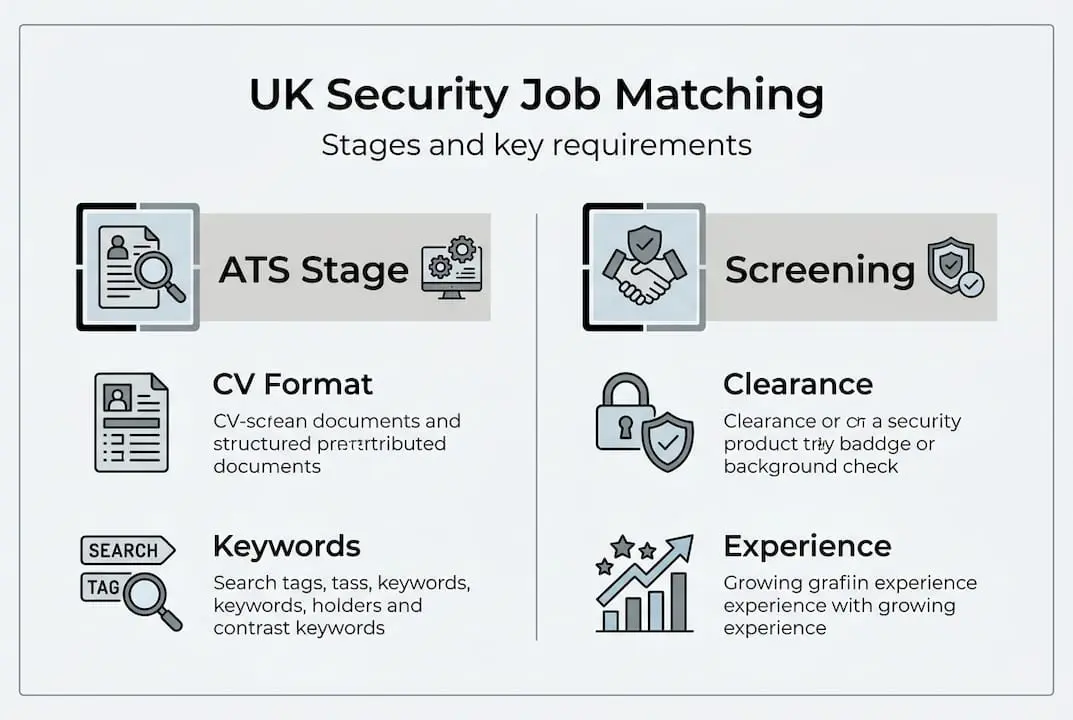
The security sector does not operate like most industries when it comes to recruitment. Before any human reviews your application, it passes through a series of automated checks that are specifically calibrated for security roles. The initial ATS keyword and semantic matching on CVs is followed by mandatory security clearance checks as a key filter before human review even begins.
ATS stands for Applicant Tracking System. It parses your CV for relevant keywords, scores it against the job description, and either advances or discards your application automatically. Only candidates who clear this stage move on to clearance verification, and only those who pass clearance verification reach a human reviewer.
Here is the typical sequence of stages in a UK security job match:
- Job advertisement published
- CV submitted by candidate
- ATS parsing and keyword scoring
- Security clearance check and verification
- Human shortlisting and review
- Interview and further vetting
Clearance is not a formality. 52% of cyber and defence roles are filled from a pre-cleared candidate pool, meaning employers actively prioritise candidates who already hold BPSS, SC, DV, or eDV clearance. If your clearance is absent or expired, you are competing at a significant disadvantage.
| Stage | What is assessed | Who assesses it |
|---|---|---|
| ATS parsing | Keywords, format, headings | Automated system |
| Clearance check | BPSS, SC, DV, eDV status | Automated and HR |
| Human review | Experience, fit, screener answers | Recruiter or hiring manager |
| Interview | Competency, culture, vetting | Panel or individual |
Understanding security screening checks and how they interact with ATS scoring is essential before you submit a single application.
Essential requirements and tools for job matching success
Understanding the mechanics means little without the right preparation. Your CV is your primary tool, and in the security sector, it must satisfy both automated systems and human reviewers simultaneously.

ATS systems fail to parse CVs that contain tables, graphics, or non-standard headings. A single-column, plain-text format with standard section headings such as “Work Experience” and “Skills” is the only reliable approach. Keywords matter enormously. Phrases like “SC cleared,” “DV cleared,” “CCTV operations,” and “access control” must appear naturally throughout your CV, mirroring the language used in the job advertisement.
Here is what a prepared candidate profile looks like compared to an unprepared one:
| Factor | Prepared candidate | Unprepared candidate |
|---|---|---|
| CV format | Single-column, plain text | Tables, graphics, columns |
| Keywords | Mirrors job ad language | Generic or missing |
| Clearance status | Current, noted prominently | Expired or unlisted |
| Screener questions | Answered fully | Skipped or incomplete |
| Application speed | Applies within 48 hours | Delays beyond one week |
Essential items to have ready before applying:
- Current clearance certificate or reference number (BPSS, SC, DV, or eDV)
- ATS-optimised CV with relevant keywords embedded
- A tailored personal statement for each role
- Contact details for referees who can confirm your vetting history
Pro Tip: Specialist platforms such as SecurityClearedJobs and Security Jobs Board filter roles by clearance level, saving you from applying to positions you cannot yet access. Use them as your primary search tools rather than general job boards.
For a deeper look at how clearances affect your career trajectory, the guide on mastering security clearances is worth reading before your next application.
Step-by-step guide: Navigating the job matching process
Preparation sets the foundation. Execution determines the outcome. Follow these steps in order to give your application the best possible chance of progressing through every filter.
- Match your CV to the job advertisement. Read the job ad carefully and identify the core security keywords. Integrate them naturally into your CV, particularly in your skills section and role descriptions.
- Submit an ATS-friendly CV. Use a plain, single-column format. Remove all tables, text boxes, and images. Standard headings only. The ATS parses CVs using keywords and scores them against the job description before any human sees them.
- State your clearance prominently. List your clearance level, issuing authority, and expiry date near the top of your CV. Transferable clearances should be noted explicitly. The UK vetting authority provides guidance on transferability between roles and departments.
- Complete all screener questions. Do not skip these. Roles with screener questions are 40% more likely to result in a hire, and AI shortlisting tools use your answers to boost scoring accuracy by up to 65%.
- Monitor your application status actively. Check your email and the employer’s ATS portal regularly. Respond to any requests for additional information within 24 hours to avoid being timed out of the process.
Pro Tip: Keep a simple spreadsheet logging each application, the CV version used, the keywords targeted, and the outcome. This audit trail helps you refine your approach over time and identify which keyword strategies produce results.
For a broader view of how to structure your search, the step-by-step job search guide covers the wider strategy beyond individual applications.
| Action | Impact on match rate |
|---|---|
| ATS-optimised CV format | Prevents automatic rejection |
| Clearance listed prominently | Passes primary security filter |
| Screener questions completed | 40% higher hire likelihood |
| Application within 48 hours | Higher visibility in ATS queue |
Common mistakes and how to avoid them
Even well-qualified candidates make avoidable errors that cost them opportunities. The most damaging mistakes happen before a recruiter ever reads a single word.
CV formatting errors are the most common cause of ATS rejection. CV parsing fails on tables and columns, and non-cleared candidates already face delays of four to eighteen months in the vetting process. Adding a formatting error on top of that compounds the problem significantly.
Mistakes to avoid:
- Using tables, text boxes, or multi-column layouts in your CV
- Omitting your clearance level or leaving it vague
- Failing to mirror keywords from the specific job advertisement
- Skipping screener questions or providing minimal answers
- Applying to roles that require a higher clearance than you currently hold
“Clearance is the primary match filter in the security sector. AI and ATS systems are secondary. Without the right clearance, no amount of keyword optimisation will advance your application.” This insight from defence recruitment specialists underlines why clearance must always come first.
AI bias is also a genuine concern. The ICO’s intervention into AI recruitment tools led to improved data protection practices, but candidates should still be aware that some systems may inadvertently disadvantage certain profiles. If you suspect your application is being filtered unfairly, you have the right to request information about how automated decisions were made.
Pro Tip: Audit and update your CV every quarter. Clearances expire, roles evolve, and the keywords employers use shift over time. A CV that worked six months ago may now be missing critical terms.
For a closer look at how job advertisements are structured and what they signal, understanding job ads will help you decode employer requirements more accurately.
Verifying your match and next steps
Once you have submitted a well-prepared application, the process does not stop. Verification is an active step, not a passive wait.
Check the following after every submission:
- Confirmation email from the ATS or employer portal (if absent, recheck your submission)
- Any requests for additional documentation, particularly clearance evidence
- Status updates within the employer’s recruitment system
- Whether your clearance level matches the stated requirement for the role
52% of cyber and defence hires come from an existing cleared pool, and AI shortlisting boosts screening accuracy by approximately 15%. This means pre-cleared candidates who apply promptly and correctly are statistically far more likely to progress.
If you narrowly miss a criterion, do not assume the process is closed. Some employers allow candidates to address gaps through supplementary information or a brief screening call. Always ask politely whether there is an opportunity to clarify your application before accepting a rejection.
Joining security-cleared professional networks on LinkedIn and sector-specific forums also accelerates your visibility. Recruiters actively search these communities for pre-cleared candidates, particularly for urgent or sensitive roles. For further guidance on improving your overall search strategy, optimising your security job search covers the broader picture.
Advance your security career with expert job matching
You now understand how the job matching process works in the UK security sector, from ATS parsing to clearance verification and human review. The next step is putting that knowledge to work with the right platform behind you.

Security Jobs Board is built specifically for security professionals in the UK, with listings filtered by clearance level, role type, and location. Whether you are seeking roles in physical security, cyber, or intelligence, the platform connects you directly with employers who understand your background. You can also explore security jobs in Northern Ireland and other regions across the UK. Create your free profile, upload your ATS-ready CV, and set targeted job alerts to ensure you never miss a relevant opportunity.
Frequently asked questions
What security clearances are needed for UK security roles?
Most roles require BPSS, SC, DV, or eDV clearance, with the required clearance level specified clearly in the job listing. Always check this before applying.
Why does my application not progress past ATS?
The most common causes are missing keywords, improper CV formatting such as tables or graphics, or failure to list your clearance level explicitly on your CV.
How can I speed up the job matching process?
Hold or transfer your clearance, use an ATS-ready CV, and apply only to roles that match your current clearance level. Transferable clearances are prioritised by employers and significantly reduce processing time.
Are there risks of AI bias in recruitment?
Some AI tools previously inferred protected characteristics from candidate data, but ICO audits have since enforced greater transparency and fairness in how recruitment tools handle personal information.


