Security guard cover letter sample PDF: free templates to download

Download ready-to-use, editable security guard cover letter PDF samples, entry-level, experienced and career-change versions, from Security Jobs Board and customise them in minutes. The pack covers three common situations: no security experience at all, an established security career, and a move into security from another trade.
- Fillable PDF versions let you type straight into the boxes and export instantly.
- Word-to-PDF versions give you full control over wording, spacing and layout before you convert.
- Download the master copy first, save it somewhere you’ll find it again, then create a fresh export for every application.
If you’re applying for a front-line role in the UK, state your SIA licence status in the opening lines. Recruiters scan for it before anything else, and leaving it out is one of the fastest ways to get passed over.
Key Takeaways
A downloadable, editable PDF sample only works when it’s tailored with matched keywords, achievement-based lines, and an SIA licence stated early.
| Point | Details |
|---|---|
| Pick the right sample | Choose entry-level, experienced or career-change based on your actual work history, not the longest one. |
| Lead with your licence | State your exact SIA licence type in the first or second paragraph to clear screening faster. |
| Use achievement lines | Convert duties into situation, action, result statements with a measurable outcome. |
| Keep it to one page | Aim for 250 to 400 words in Arial or Calibri, with clean margins and British English spelling. |
| Apply through Security Jobs Board | Use a free profile, CV upload and job alerts to send tailored applications quickly. |
Table of Contents
- Security guard cover letter sample PDF: what each template includes
- How do you tailor a security cover letter to a job advert?
- Getting the format right for UK employers
- Keeping your template editable without losing formatting
- Why your SIA licence belongs at the top of the letter
- Common mistakes that get security cover letters rejected
- Explaining employment gaps or frequent job changes
- Strong opening and closing lines for security cover letters
- Tailoring your letter for corporate, event and retail security
- Using keywords so your letter clears ATS software
- Why generic advice on security cover letters misses the point
- Download your PDF sample pack and start applying today
- FAQ
Security guard cover letter sample PDF: what each template includes
Each template in the pack is built around a different work history, because a guard with ten years on corporate sites needs a different opening line to someone applying for their first shift. Here’s what you’ll find in each one, and what to swap out before you send it.
1. Entry-level / no-experience sample
The opening line reads: “I am writing to apply for the Security Officer position at [Company], and I am keen to bring my recent SIA Door Supervisor qualification and strong customer-facing background to your team.”
Replace the bracketed company name, swap the qualification for whichever licence you actually hold, and change “customer-facing background” to your real previous role, retail, hospitality, warehouse work, whatever gives you transferable ground to stand on. This one is built as a fillable PDF, so you can type directly into it without touching the layout.
2. Experienced officer sample
This version opens with a results line rather than an introduction: “I bring proven experience in incident management and access control to [Company]'s security team.”
Update the years of experience, the site types you’ve actually worked, and the job title you’re targeting. Swap “incident management and access control” for whichever two skills the advert mentions first. This template is supplied as a Word document for conversion to PDF, since experienced applicants tend to rewrite more of the body text.
3. Career-change sample
Written for someone moving into security from another trade: “Having recently completed my SIA Security Guarding licence, I am now looking to apply eight years of experience in [previous industry] customer service and risk awareness to a security role with [Company].”
Replace the previous industry, and don’t undersell it. Retail, healthcare and hospitality backgrounds all carry conflict-management and vigilance skills that read directly across to security work. This one also arrives as a Word master file for a heavier rewrite.
Name every export something you’ll recognise at 11pm when you’re applying for six jobs in a row: [YourName]_[CompanyName]_CoverLetter.pdf beats “Document4.pdf” every time a recruiter opens their inbox.
How do you tailor a security cover letter to a job advert?
A downloaded sample only does half the job. The rest is matching it to the specific vacancy, and that takes three steps.
-
Pull two or three priority responsibilities straight from the advert. If it mentions “lone working,” “access control” and “conflict resolution,” those exact phrases need to appear somewhere in your letter, not just synonyms for them. Applicant tracking systems and human readers both respond better to matched language than to paraphrased skill.
-
Turn routine duties into short achievement lines. Use situation, action, result. Instead of “responsible for patrols,” try: “Identified a recurring break-in pattern during night patrols and flagged it to the client, leading to a revised patrol schedule that stopped further incidents.” Or: “Managed access control for a 500-person corporate site, reducing unauthorised entries by tightening visitor sign-in procedures.”
-
Place your credentials where they’ll actually get read. State your SIA licence type, first aid certificate, or CCTV/VMS training in the first or second paragraph, not buried at the bottom. State your availability (full-time, nights, immediate start) in the closing paragraph, right before your call-to-action.
Before exporting, check: correct company name and hiring manager’s name if known, current phone number and email, and a closing line that asks for an interview rather than just thanking them for their time.
Pro Tip: Keep a running list of two or three achievement lines written in the situation, action, result format. You’ll reuse them across applications, just swap the site type and figures to match the advert.
Getting the format right for UK employers
A well-written letter loses credibility fast if it looks cramped, oddly spaced, or American in its conventions. Security recruiters see dozens of these a week, and formatting is often the first filter, before anyone reads a word of content.
- Keep it to one page. Anything longer suggests you can’t prioritise, which isn’t a great first impression for a role built around judgement calls.
- Use Arial or Calibri at 11 or 12 point, with 2.5cm margins and single or 1.15 line spacing.
- Include a simple header: your name, phone number, email, and UK postcode if you want to signal local availability for a specific site.
- Write in British English throughout, licence, organisation, not license or organisation, and sign off with “Yours sincerely” if you’ve addressed a named person, or “Yours faithfully” if you haven’t.
A one-page letter of roughly 250 to 400 words, built around two or three relevant achievements and a clear ask for an interview, tends to get read in full rather than skimmed and binned.
Save the final file as a proper PDF export, never a scanned photo of a printed page. Scanned images can’t be searched or copied, which trips up applicant tracking systems and irritates anyone trying to quote your phone number back to you. Aim for a file under 1MB so it doesn’t stall as an email attachment.

Keeping your template editable without losing formatting
The safest workflow is simple: keep a Word document as your permanent master copy, and export a fresh PDF every time you apply. That way you never risk overwriting details from a previous application, and the formatting stays intact.
- If a job board asks for a fillable form, use a genuine fillable PDF rather than typing over a flattened one, otherwise your text can shift the layout.
- For quick edits on the move, most phones can open a Word file, make small changes, and export directly to PDF without needing a laptop.
- If you use a free online PDF editor, check its privacy policy before uploading anything with your address or phone number on it.
- Watch for font substitution (a font you don’t have installed getting swapped for a generic one), stretched images, and file sizes that balloon after conversion. All three are common, and all three are fixable by re-exporting from the original Word file rather than editing the PDF directly.
Why your SIA licence belongs at the top of the letter
UK security operatives need a front-line SIA licence to carry out licensable activities, which means passing identity and criminal record checks, proving the right to work in the UK, and holding a recognised licence-linked qualification. Recruiters need to confirm this before they can shortlist you, so making them dig for it costs you time you don’t have in a competitive applicant pool.
Stating your licence type and number up front removes a screening step the recruiter would otherwise have to chase you for, and applicants who are demonstrably “job-ready” tend to move through the process faster than those who leave it vague or unmentioned.
- Name the exact licence type (Security Guarding, Door Supervision, CCTV) rather than just writing “SIA licensed.”
- Mention any refresher training if it’s recent, since renewal refresher training became mandatory for Security Guarding licences in 2025.
- If you’re still working towards a licence, say so and give an expected completion date rather than omitting it.
For a full breakdown of licence types and the qualification pathway, Security Jobs Board’s SIA licence guide and its checklist of what you need to become a security guard in the UK both walk through the process in more depth.
Common mistakes that get security cover letters rejected
The most common fault is genericism: a letter that never mentions the company name, the site type, or a single specific duty reads like it was fired off to fifty employers at once, because it usually was. Recruiters notice within the first two lines.
A close second is burying the SIA licence status somewhere in paragraph three, or leaving it out entirely because “it’s on my CV anyway.” It isn’t the recruiter’s job to hunt for it across two documents.
Other recurring problems:
- Listing duties instead of results. “Patrolled the site and checked ID badges” tells a hiring manager nothing they couldn’t guess. Show what happened because of your vigilance.
- Overlong letters. Three paragraphs of backstory before getting to the point loses the reader before they reach anything useful.
- Spelling and formatting slips. American spellings, missing capital letters on job titles, or a font that doesn’t render properly all read as carelessness, which is the opposite of what a security employer wants to see.
- No clear call-to-action. Ending with “Thank you for your consideration” and nothing else leaves the recruiter to do the work of deciding what happens next. Ask directly for an interview or a call.
- Forgetting to proofread the customised version. Editing a sample for a new company but leaving the previous employer’s name in a later paragraph is one of the most common, and most avoidable, giveaways that a letter was recycled carelessly.
Explaining employment gaps or frequent job changes
Gaps and short stints worry applicants more than they worry most recruiters, provided they’re addressed rather than ignored. A cover letter that says nothing about a two-year gap invites the reader to assume the worst; one that gives a brief, confident explanation usually closes the question.
Keep it to one sentence. “Following a period caring for a family member, I am now looking to return to full-time security work and bring renewed focus to the role” does the job without turning into a personal essay. The same applies to career breaks for study, travel, or health, state it plainly, then move straight back to why you’re a strong fit now.
Frequent job changes need a different framing. If your CV shows several short security contracts, use the cover letter to explain the pattern rather than let it look like instability: “My background includes several fixed-term and contract security placements across retail and event sites, giving me broad exposure to different site protocols and client expectations.” Framed that way, variety reads as adaptability rather than a red flag.
Where a gap or change genuinely has no tidy explanation, it’s still better to acknowledge it briefly than to leave a visible hole in the timeline for the recruiter to speculate about. A short, matter-of-fact line beats silence every time, and it keeps the focus on what you can do next rather than what happened before.
Strong opening and closing lines for security cover letters
The first sentence either earns a full read or gets skimmed. Generic openers like “I am writing to apply for the position I saw advertised” waste the strongest real estate you have.
Stronger openings name the role, the licence, and a hook in one breath:
- “As a licensed SIA Door Supervisor with three years’ experience managing entry to high-footfall venues, I am applying for the Security Officer role at [Company] with confidence in my ability to keep your site safe and welcoming.”
- “Having spent the past four years reducing incident rates across two retail sites, I am keen to bring that same focus to [Company]'s loss prevention team.”
Closings should ask for something specific rather than trail off politely:
- “I would welcome the chance to discuss how my SIA licence and site experience could support your team, and I am available for interview at short notice.”
- “I am immediately available and would appreciate the opportunity to discuss this role further at your convenience.”
Both closings do the same job: they state availability and invite a next step, rather than leaving the recruiter to guess whether you’re still interested.
Tailoring your letter for corporate, event and retail security
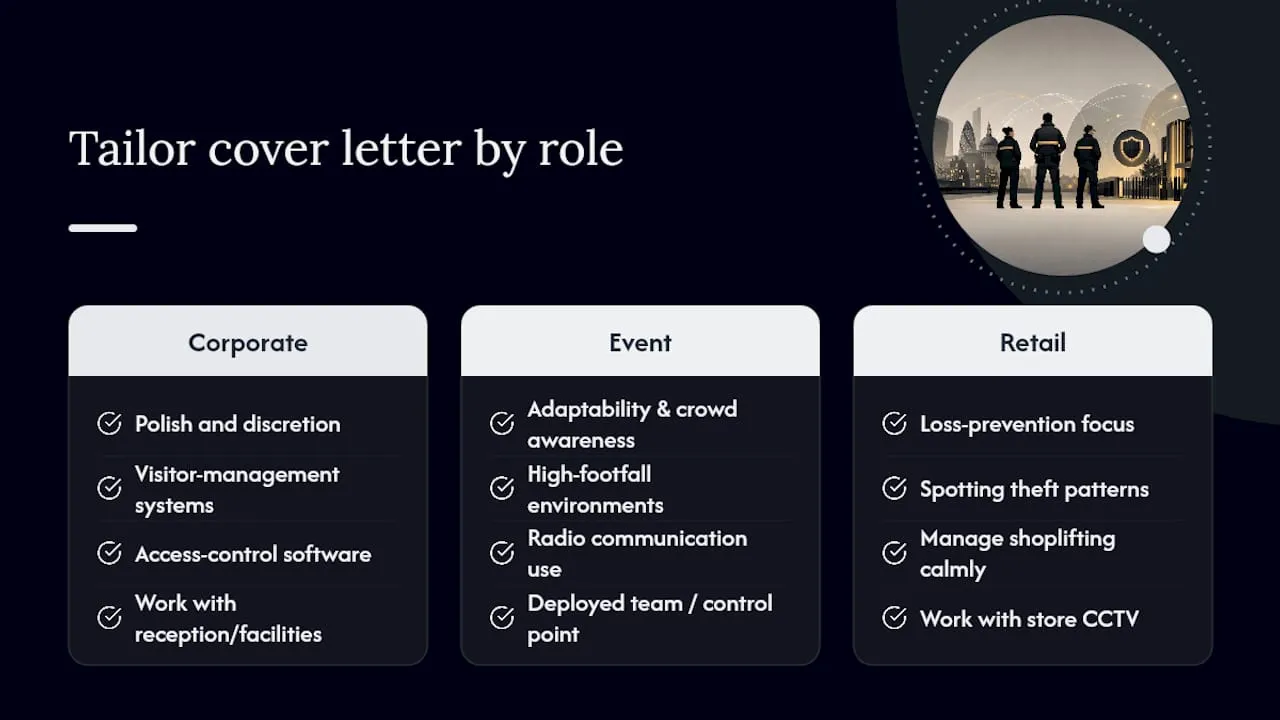
A cover letter written for a corporate reception desk and one written for a festival security team should not read the same, because the priorities the employer is screening for are genuinely different.
Corporate security roles reward polish and discretion. Mention experience with visitor management systems, access control software, or working alongside reception and facilities teams. Employers here often care as much about presentation and professionalism as about physical capability, so keep the tone formal and mention any customer-service background explicitly.
Event security work rewards adaptability and crowd awareness. Reference any experience with high-footfall environments, radio communication, or working as part of a larger deployed team under a control point. Flexibility around shift patterns and short-notice availability is worth stating directly, since event work is rarely a fixed nine-to-five.
Retail security roles want evidence of loss-prevention thinking. Mention specific experience spotting theft patterns, managing shoplifting incidents calmly, or working with store CCTV systems. Naming the type of retail environment, high street, shopping centre, warehouse, gives the letter more texture than a generic reference to “retail experience.”
In every case, naming the site type and the systems you’ve actually used, rather than describing patrols in the abstract, signals that you understand the specific operational context you’re applying into rather than treating security work as interchangeable.
Using keywords so your letter clears ATS software
Many UK employers, especially larger security firms, run applications through an applicant tracking system before a person ever reads them. A well-written letter that misses the advert’s exact phrasing can get filtered out before it reaches a human.
The fix is straightforward: read the job advert twice and note the specific terms used for licences, systems and duties, then mirror that exact language rather than a rewording of it. If the advert says “CCTV monitoring,” don’t write “video surveillance,” use their term.
Priority keywords to weave in naturally:
- Your exact SIA licence type (Security Guarding, Door Supervision, CCTV)
- Named systems or software mentioned in the advert (specific VMS or access control platforms)
- Shift-pattern language used in the posting (nights, weekends, static or mobile)
- Site-type terms (corporate, retail, industrial, event)
Never stuff keywords into a list at the bottom of the letter, that reads as spam to both software and humans. Fold them into the achievement sentences you’re already writing, so the letter still sounds natural when read aloud.
Why generic advice on security cover letters misses the point
Most guidance on this topic treats a cover letter like a formality, a polite cover note that restates the CV. That’s backwards. A CV shows what you’ve done; a cover letter is the only place you get to explain why it matters for this specific site, this specific employer, right now.
The advice that actually moves the needle isn’t about tone or enthusiasm, it’s specificity. Naming the licence type, the site type, and one measurable outcome does more work than three paragraphs of general keenness. Recruiters in this sector are often screening dozens of applicants against a licensing checklist before they even consider personality, so burying your SIA status in paragraph three isn’t a stylistic choice, it’s a practical mistake that costs interviews.
What gets underrated is the achievement line. Most applicants list duties because that’s what feels safe and familiar. The situation, action, result format takes ten extra minutes and separates a forgettable letter from a shortlisted one. If you take one thing from this article and act on it, make it that.
— Rob
Download your PDF sample pack and start applying today
Security Jobs Board gives you a free profile, CV upload, job alerts and quick apply, so once your cover letter is ready, applying takes minutes rather than hours of repeat form-filling. That’s the practical advantage over piecing together applications from scratch on every job site: one profile, one CV, alerts that flag matching roles before you have to go looking for them.

If you’re looking for frontline roles right now, Northern Ireland Security Jobs is a good place to start browsing live vacancies while your cover letter pack is fresh. Pair it with the platform’s guidance on writing a security CV so both documents are ready before you apply. Set up your free profile, upload your CV, and turn on job alerts, then send your first tailored application today.
FAQ
How do I write a good cover letter for a security guard job?
Open by stating the role and your SIA licence type, add two or three achievement-based lines using the situation, action, result format, then close with a clear request for an interview.
What is a good short cover letter?
A strong short cover letter runs to roughly 250 to 400 words, fits on one page, and focuses on two or three relevant achievements rather than a full career history.
What are five qualities of a good security guard?
Employers commonly look for vigilance, calm conflict management, reliability, clear communication, and sound judgement under pressure, and a cover letter that gives one concrete example of each carries more weight than simply listing them.
How do I write a letter for a security guard job with no experience?
Lead with your SIA qualification or licence progress, then translate transferable skills from previous work (customer service, teamwork, attention to detail) into terms relevant to security duties.
Do I need to mention my SIA licence in the cover letter?
Yes. UK front-line security roles require a valid SIA licence, and stating your licence type early removes a screening step recruiters would otherwise need to chase you for.


