How to Write a Security CV for UK Security Jobs
Securing your next role as a security officer often depends on how well your CV highlights your professional credentials and experience. The UK security sector places real value on clearly displayed contact details and accurate SIA licence information, making attention to detail an immediate priority for job seekers. Whether you are preparing your first CV or refining an existing one, this guide will show you proven strategies to present your skills, training, and achievements in a format that matches employer expectations.
Table of Contents
- Step 1: Gather Essential Personal And Licence Information
- Step 2: Highlight Relevant Security Experience And Training
- Step 3: Showcase Key Skills For Security Roles
- Step 4: Format Your Security Cv For Clarity And Impact
- Step 5: Review And Customise Your Cv For Each Application
Quick Summary
| Main Point | Explanation |
|---|---|
| 1. Accurate Personal Information | Compile clear contact details and ensure accuracy for effective employer communication. |
| 2. Relevant Security Experience | Highlight specific security duties and transferable skills to demonstrate your suitability for the role. |
| 3. Key Skills Showcase | Emphasise both hard and soft skills that are essential in the security field to stand out to employers. |
| 4. Clear CV Formatting | Maintain a professional layout and structure for easy readability and a strong first impression. |
| 5. Customise for Each Application | Tailor your CV to align with the job description and highlight relevant achievements to increase interview chances. |
Step 1: Gather essential personal and licence information
Preparing your security CV starts with compiling accurate personal details and professional credentials. This crucial first step sets the foundation for a professional presentation that will catch employers’ attention.
Begin by collecting your most critical personal information. You’ll want to clearly display your contact details, including:
- Full name
- Phone number
- Professional email address
- City and postcode (for regional job applications)
- SIA licence details if applicable
Securing a job in the UK security sector requires precise documentation. Your SIA licence number is particularly important - employers will want to verify your credentials quickly and efficiently. Double-check that all information is current and matches official documentation.
Your personal details are your first point of professional contact - accuracy is paramount.
When listing your licence information, include the full licence number, licence type, and expiration date. If you’re in the process of obtaining your licence, note the expected completion date and any current training status.

Top tip: Use a professional email address that includes your name, avoiding nicknames or humorous handles that might undermine your professional image.
Step 2: Highlight relevant security experience and training
Building a compelling security CV requires strategically showcasing your professional experience and qualifications. This section is your opportunity to demonstrate why you’re the ideal candidate for security roles.
Start by comprehensively listing security qualifications that prove your expertise:
- Level 2 Door Supervisor certification
- Emergency First Aid at Work
- Fire Marshal training
- Any ongoing professional development courses
- Specialised security-related certifications
When detailing your work experience, focus on security-specific duties and transferable skills. Even if your previous roles were not strictly in security, highlight moments that demonstrate your ability to handle high-pressure situations, manage incidents, and provide excellent customer service.
Your professional history tells a story - make sure it speaks to your potential as a security professional.
Organise your experience chronologically, with the most recent roles first. Use clear, concise bullet points to describe your responsibilities and achievements. Quantify your accomplishments where possible - for instance, mention the size of venues you’ve secured or number of incidents successfully managed.
Top tip: Tailor your experience description to match the specific security job requirements, emphasising skills that directly relate to the position you’re applying for.
Step 3: Showcase key skills for security roles
Your security CV must effectively communicate the unique skills that make you an exceptional candidate. This section is your opportunity to demonstrate the precise capabilities that set you apart in the competitive security job market.
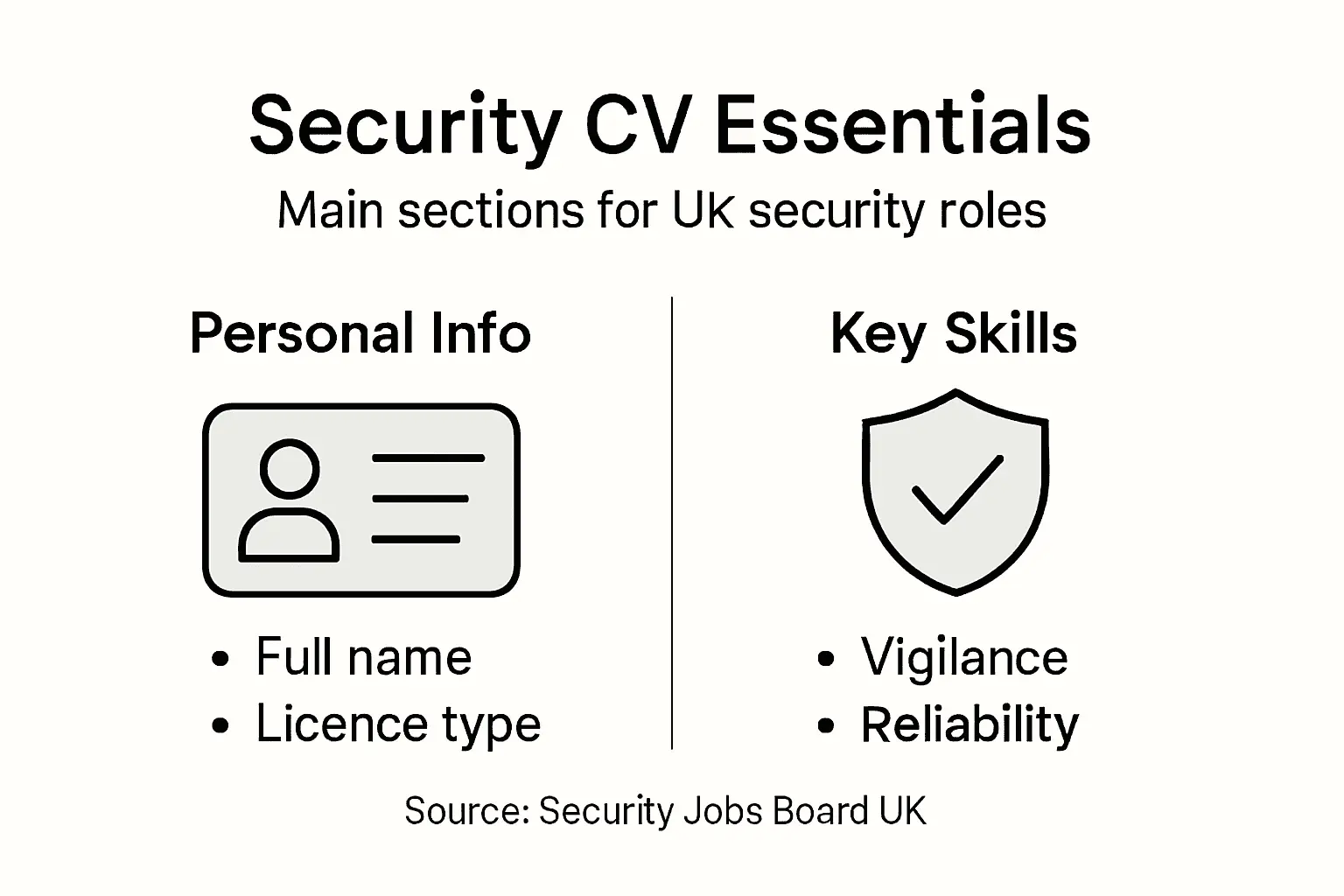
When highlighting your skills, focus on comprehensive skill categories that matter most to employers:
Hard Skills:
- Operational knowledge of security equipment
- Technical surveillance techniques
- Risk assessment and management
- Incident reporting and documentation
- Emergency response protocols
Soft Skills:
- Quick decision-making under pressure
- Exceptional situational awareness
- Strong communication and interpersonal abilities
- Calm and professional demeanour
- Ability to de-escalate potential conflicts
Your skills are your professional currency - showcase them strategically and confidently.
Emphasise your ability to maintain composure in challenging situations. Security employers want professionals who can think critically, respond swiftly, and manage complex scenarios with professionalism. Provide concrete examples that illustrate how you’ve applied these skills in previous roles or training scenarios.
Here is a quick comparison of hard and soft skills valued in the UK security sector:
| Skill Type | Example Skill | Employer Value |
|---|---|---|
| Hard Skill | Incident documentation | Ensures precise record-keeping |
| Hard Skill | Risk management | Minimises organisational risk |
| Soft Skill | Situational awareness | Enables rapid threat response |
| Soft Skill | Calm demeanour | Preserves safety in conflicts |
Top tip: Tailor your skills section to mirror the specific requirements in the job description, highlighting the most relevant capabilities that directly match the employer’s needs.
Step 4: Format your security CV for clarity and impact
Creating a well-structured CV is crucial for making a strong first impression in the security sector. Your document needs to be clear, professional, and strategically organised to showcase your capabilities effectively.
Develop a consistent and professional CV structure that highlights your strengths:
Standard CV Sections:
- Professional profile
- Core skills
- Work experience
- Education and training
- Professional certifications
- Licences and credentials
Ensure your CV follows these key formatting principles:
- Use a clean, professional font (Arial or Calibri)
- Maintain consistent 10-12 point font size
- Apply clear section headings with minimal styling
- Use bullet points for readability
- Align text consistently
- Limit CV to 2-3 pages maximum
A well-formatted CV speaks volumes before you say a word.
Pay particular attention to white space and visual hierarchy. Your document should guide the reader’s eye naturally, emphasising your most significant achievements and skills. Use subtle formatting techniques like bold text and consistent indentation to create a professional, easy-to-navigate document.
Top tip: Always save and send your CV as a PDF to preserve formatting across different devices and software platforms.
Step 5: Review and customise your CV for each application
Crafting a targeted CV is essential for standing out in the competitive security job market. Your goal is to create a document that speaks directly to each specific role’s requirements.
Tailor your CV strategically by following these key steps:
Customisation Checklist:
- Analyse the job description thoroughly
- Identify key skills and requirements
- Match your experience to specific criteria
- Use job description keywords
- Highlight relevant achievements
- Remove irrelevant information
Each application demands a unique approach. Carefully examine the job advertisement and align your professional profile with the employer’s specific needs. This means adjusting your personal statement, emphasising skills that directly correspond to the role, and demonstrating how your background makes you an ideal candidate.
Precision in CV customisation can dramatically increase your chances of securing an interview.
Pay special attention to subtle details in your application. Employers use automated screening systems, so incorporating exact phrases from the job description can help your CV pass initial digital reviews. Focus on demonstrating how your skills and experiences precisely match the role’s requirements.
Below is a summary of how customising your CV increases interview chances:
| Customisation Method | Benefit for the Candidate | Impact on Employer Review |
|---|---|---|
| Matching keywords | Passes automated screening | Highlights relevant expertise |
| Tailored professional statement | Shows targeted motivation | Demonstrates job-specific focus |
| Selective achievement emphasis | Underscores role-relevant strengths | Makes CV stand out |
Top tip: Keep a master CV with all your experiences, then create tailored versions for each application by selectively highlighting the most relevant information.
Secure Your Future in UK Security with a Strong, Targeted CV
Writing a security CV that truly reflects your skills, licences like your SIA, and relevant experience is the first challenge in breaking into the UK security job market. Many jobseekers struggle to present their qualifications clearly while tailoring their credentials to specific roles. If you want to overcome these hurdles and connect with trusted employers quickly, a specialised platform can make all the difference.

At Security Jobs Board, you can upload your professionally crafted CV, create tailored job alerts, and apply instantly to vacancies that match your unique skillset and licence status. Our user-friendly site helps you navigate the competitive landscape with ease and confidence. Take control of your career by joining today and tapping into a UK-wide network designed exclusively for security professionals. Start showcasing your hard and soft skills where employers are actively looking by visiting Security Jobs Board now.
Frequently Asked Questions
How can I ensure my contact information is correct on my Security CV?
To ensure your contact information is correct, carefully compile your full name, phone number, professional email address, and location details. Double-check that everything is up to date and matches what is reflected in official documentation to avoid any communication issues during the hiring process.
What relevant experience should I include in my Security CV?
Include all security-specific experience and transferable skills relevant to the role you are applying for. Focus on detailing notable achievements and responsibilities using clear bullet points, ensuring to quantify results where possible, such as the number of incidents managed.
What key skills should I highlight in a Security CV?
Highlight both hard skills like operational knowledge of security equipment and soft skills such as strong communication abilities. Provide specific examples of how you have utilised these skills in previous roles to demonstrate your capability to handle security challenges effectively.
How can I format my Security CV for maximum impact?
Use a clean and professional layout with consistent formatting, clear section headings, and bullet points for ease of reading. Aim to keep your CV to a maximum of 2-3 pages, ensuring it guides the reader’s eye through your achievements and skills.
Why is it important to customise my Security CV for each application?
Customising your Security CV for each application increases your chances of standing out by directly addressing the specific requirements of the job. Analyse the job description to align your experience and skills with what the employer is seeking, using their keywords to pass automated reviews.
What is the best way to review and improve my Security CV before sending it out?
Thoroughly review your CV for accuracy, clarity, and relevance, ensuring all information is tailored to the job. Consider getting a friend or colleague to give feedback or even proofread your final version, as a fresh set of eyes can often catch errors and provide valuable insights.


