Get better results with security consulting services UK

TL;DR:
- Half of UK businesses experienced cyber breaches in 2024, highlighting increased threats and regulatory tightening.
- Security consulting in the UK covers both cyber and physical risks, offering gap analysis, compliance audits, risk assessments, and tailored recommendations.
- Effective security strategies require blending methodologies like ProtectUK and CRAMM, emphasizing bespoke, sector-specific approaches and ongoing advisory relationships.
Roughly 50% of UK businesses experienced a cyber breach in 2024, yet many security managers still treat consulting as a luxury reserved for large corporations. That assumption is costly. Threats have grown more sophisticated, regulatory demands have tightened, and the gap between adequate and excellent security has never been wider. This guide unpacks the full scope of professional security consulting in the UK, from proven physical and cyber frameworks through to practical selection criteria. Whether you are reviewing your security posture or building a business case for board approval, you will leave with a clear and actionable framework.
Table of Contents
- What security consulting services cover in the UK
- Key methodologies: ProtectUK, CRAMM, and beyond
- Physical security consulting: Multi-layer protection
- Cybersecurity consulting: Tools, compliance, and ROI
- Selecting the right security consulting partner
- Our perspective: Why security consulting must evolve in 2026
- Find your next step with expert security consulting
- Frequently asked questions
Key Takeaways
| Point | Details |
|---|---|
| Integrated approach | Combining physical and cyber security consulting dramatically improves overall risk management. |
| Custom frameworks | Tailored solutions and recognised UK methodologies outperform generic, one-size-fits-all packages. |
| ROI-focused delivery | Consulting services yield measurable financial and compliance benefits, especially when vendor overlap is reduced. |
| Compliance readiness | Prioritising Cyber Essentials and supply chain assurance is fundamental for UK organisations. |
What security consulting services cover in the UK
Security consulting is far broader than most executives expect. It spans both cyber risks, covering data protection, IT infrastructure, and digital access, and physical risks, including premises security, personnel safety, and hostile vehicle mitigation. A credible security consulting UK guide will always address both domains together rather than treating them as separate disciplines.
UK consultants typically deliver the following core services:
- Gap analysis to identify where current controls fall short
- Compliance audits aligned to GDPR, ISO 27001, and the NIS2 Directive
- Risk assessments using recognised methodologies
- Security awareness training for staff at every level
- Tailored recommendations specific to your sector and risk profile
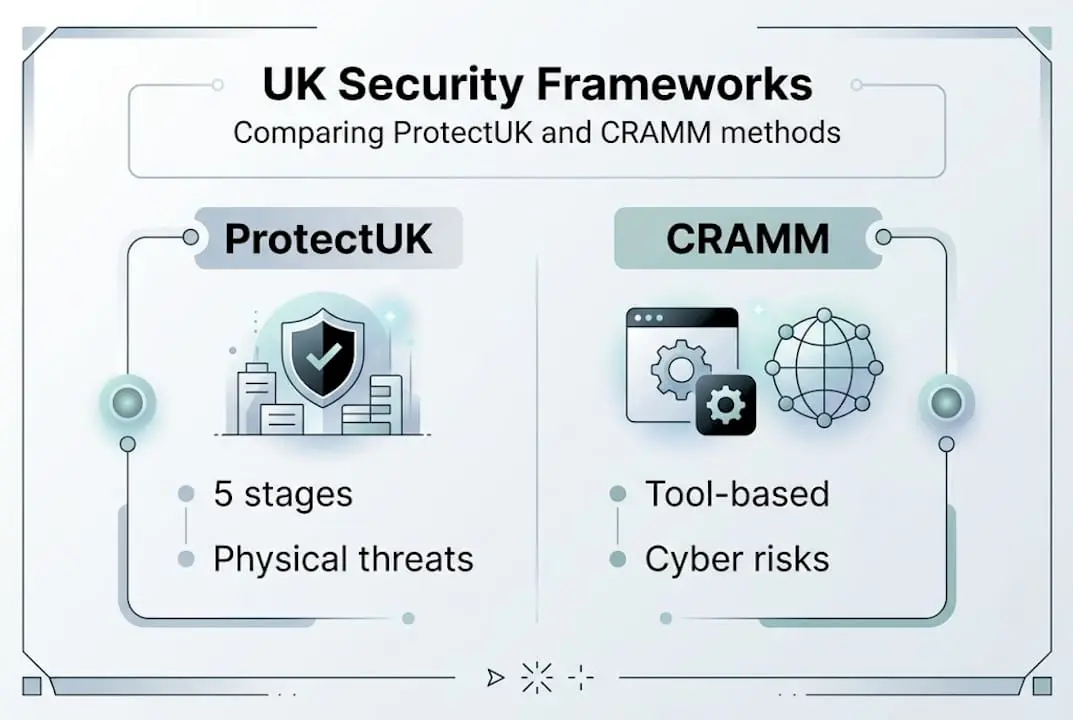
Organisations across finance, logistics, retail, and critical infrastructure all rely on these services. The ProtectUK methodology guides physical and counter-terrorism risk assessment, while CRAMM (CCTA Risk Analysis and Management Method) structures IT and cyber risk evaluation. Together, ProtectUK and CRAMM give consultants a robust toolkit for UK environments.
Consulting also includes structured compliance support covering Cyber Essentials, ISO 27001 readiness, and supply chain due diligence.
| Feature | ProtectUK | CRAMM |
|---|---|---|
| Primary focus | Physical and terrorist threats | Cyber and IT infrastructure |
| Approach | Qualitative, five-step process | Structured, tool-assisted |
| Output | Threat and vulnerability report | Risk register and countermeasures |
| Best suited for | Premises, events, public spaces | IT systems, data assets, networks |
| Compliance alignment | Counter-terrorism guidance | ISO 27001, Cyber Essentials |
“Good security consulting does not simply identify problems. It builds a roadmap that connects risk findings to practical, prioritised actions your organisation can actually implement.”
Key methodologies: ProtectUK, CRAMM, and beyond
Understanding what these frameworks actually do in practice helps you evaluate whether a consultant is applying them rigorously or simply ticking boxes.
ProtectUK physical assessment follows a five-step qualitative method for threat evaluation:
- Define the asset and its value to potential attackers
- Identify credible threats from the national threat picture
- Assess current vulnerabilities in your environment
- Evaluate the likelihood and impact of each threat scenario
- Recommend proportionate countermeasures
CRAMM cyber assessment takes a more structured, tool-based path. It supports over 70 threat types and draws on a library of more than 3,000 countermeasures, making it one of the most thorough cyber risk tools available to UK practitioners.
| Methodology | Steps | Scope | Key benefit |
|---|---|---|---|
| ProtectUK | 5 qualitative stages | Physical, counter-terrorism | Nationally aligned threat picture |
| CRAMM | Asset, threat, countermeasure stages | IT systems and data | Vast countermeasure library |
| FAIR | Quantitative financial modelling | All risk types | Board-friendly ROI output |
Experienced consultants rarely apply a single method in isolation. They blend UK security methodologies based on sector, organisation size, and specific risk profile. A logistics firm faces very different exposure to a legal practice, and a credible consultant will reflect that.
One powerful addition is the FAIR (Factor Analysis of Information Risk) model, which translates qualitative findings into financial terms. This matters enormously when presenting risk to a board that thinks in pounds rather than threat levels.
Pro Tip: Require your consultant to demonstrate how they will tailor the methodology to your organisation. Generic frameworks applied rigidly produce generic results. Ask for sector-specific examples before you commit. Relevant security training requirements also signal how well a consultant understands UK operating standards.
A critical and often overlooked point: physical breaches frequently enable cyber compromise. An unlocked server room or an unescorted visitor is as much a cyber risk as a phishing email.
Physical security consulting: Multi-layer protection
Physical security consulting is built on a principle known as defence in depth. Rather than relying on a single barrier, consultants design overlapping layers that deter, deny, delay, detect, and ultimately prompt a rapid response.
A thorough physical security review will examine:
- Perimeter controls such as fencing, barriers, and hostile vehicle mitigation (HVM)
- Access control including electronic entry systems and visitor management
- CCTV coverage and its integration with monitoring protocols
- Lighting, signage, and environmental design that naturally deters opportunistic threats
- Policies and procedures governing staff behaviour and incident response
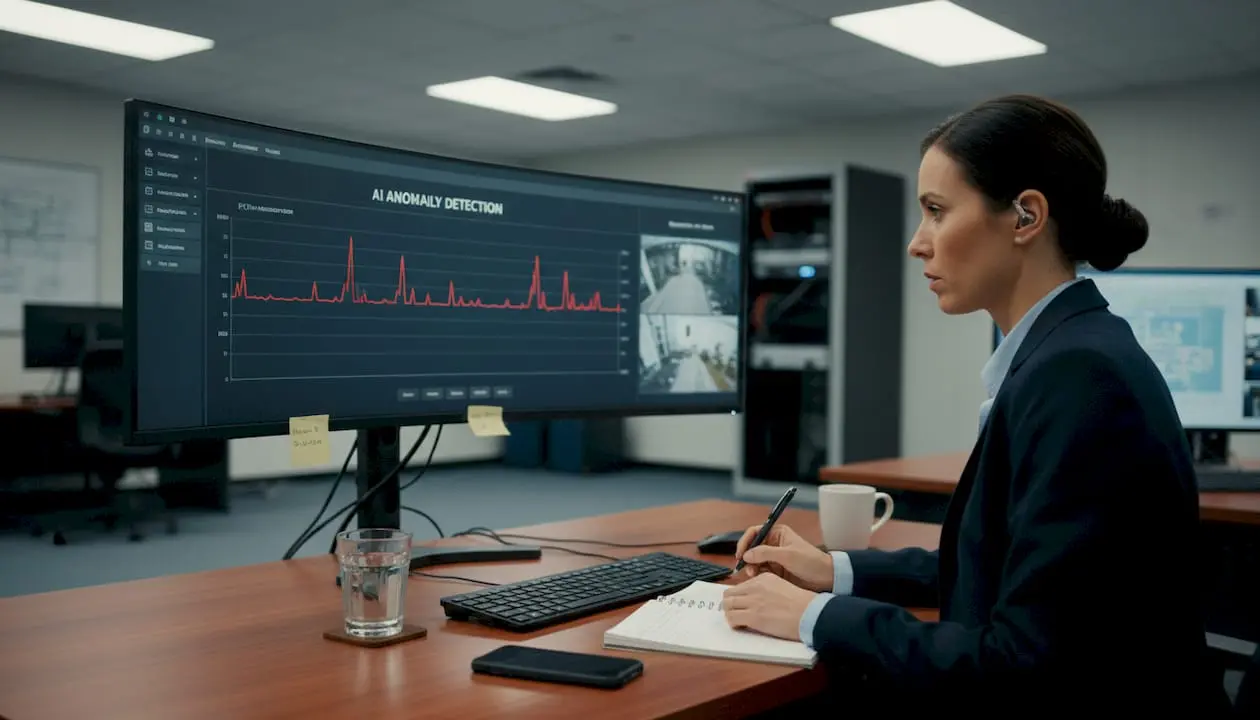
Emerging technology is reshaping what is possible. AI-enabled monitoring systems can now detect unusual behaviour patterns before an incident escalates. Integrated alert systems connect CCTV, access control, and perimeter sensors into a single operational picture, reducing response times significantly.
The scale of investment in this area reflects the seriousness of demand. The UK physical security market is projected to reach £10.2 billion by 2030, driven by rising threat levels and growing regulatory expectations. That growth means more consultants entering the market, so quality assurance matters even more when selecting a partner.
Pro Tip: No single technology solves physical security. CCTV alone is insufficient without access controls. Access controls without monitoring miss real-time threats. Commission a layered review, not a product pitch.
For organisations looking to benchmark what strong physical security looks like across UK sectors, reviewing profiles of top UK security companies offers useful context.
Cybersecurity consulting: Tools, compliance, and ROI
With 50% of UK businesses hit by a cyber breach in 2024, the financial and reputational stakes of inadequate cyber protection are well documented. The question is no longer whether to invest, but how to invest wisely.
Effective cyber consulting typically follows these steps:
- Initial audit to map your current asset landscape and identify vulnerabilities
- Gap analysis against recognised standards such as Cyber Essentials and ISO 27001
- Compliance readiness assessment covering GDPR and supply chain obligations
- Remediation planning with prioritised, costed actions
- Board reporting that translates technical risk into business impact
The NCSC’s five Cyber Essentials controls provide the baseline: firewalls, secure configuration, software updates, access control management, and malware protection. These are not optional extras. They represent the minimum viable defence for any UK organisation handling customer data or operating in regulated supply chains.
The ROI case for cyber consulting is compelling. Organisations that pursue vendor consolidation as part of a consulting engagement have achieved returns exceeding 240%, alongside a 70% reduction in risk exposure and significantly faster incident response. These are board-level outcomes that justify the investment.
For executives who want a deeper understanding of compliance obligations, the UK security compliance guide covers the legal landscape clearly.
Selecting the right security consulting partner
With dozens of consultancies operating across the UK, choosing correctly is as important as choosing at all. The wrong partner delivers a report that sits on a shelf. The right one changes how your organisation thinks about risk.
Key criteria to apply when evaluating candidates:
- Sector experience: Have they worked with organisations of similar size and complexity in your industry?
- Certifications: Look for CISM, CISSP, Chartered Security Professional, or equivalent credentials
- Methodology transparency: Can they explain clearly which frameworks they will apply and why?
- Compliance expertise: Do they understand GDPR, ISO 27001, NIS2, and Cyber Essentials in depth?
- References: Can they provide verifiable case studies from comparable clients?
Bespoke consulting consistently produces stronger compliance outcomes than generic, off-the-shelf solutions. This is not opinion; it reflects how risk profiles differ so significantly between organisations that cookie-cutter approaches leave material gaps.
Ask potential consultants these pointed questions before engaging: How do you handle cyber-physical overlap? How do you measure success at the 12-month mark? What happens when your recommendations meet internal resistance?
Pro Tip: Prioritise industry accreditation and client references over polished proposals. A consultant with BSIA affiliation or NCSC recognition has been vetted to a standard that no brochure can replicate.
Common mistakes to avoid include going generic over bespoke, neglecting the overlap between cyber and physical risk, and underestimating the value of ongoing advisory relationships. Useful UK security recruitment tools can also help you identify where in-house capability gaps may need supplementing alongside consulting support. For guidance on edge device security in your environment, NCSC guidelines offer clear, current direction.
Our perspective: Why security consulting must evolve in 2026
Here is the uncomfortable truth that most consulting engagements still avoid: separating cyber and physical security is no longer a manageable shortcut. It is a structural risk. A compromised access badge reader can expose your entire network. A poorly secured server room entrance can be more damaging than a sophisticated phishing campaign. Organisations that treat these as distinct disciplines are, in effect, leaving a door open.
Our experience watching client transformations also shows that rigid adherence to any single framework consistently underperforms. The consultancies producing the best outcomes are the ones combining methodologies, adapting to the organisation, and keeping the board meaningfully engaged throughout. Vendor consolidation is a strong example: it appears counterintuitive to reduce tooling, yet the evidence shows it sharpens focus and maximises outcomes.
Simplicity, applied by genuine experts, outperforms complexity every time. The UK security consulting guide lays out where to start, but the real differentiator is finding a partner who challenges your assumptions rather than confirming them.
Find your next step with expert security consulting
Translating security insight into organisational change requires the right people as much as the right frameworks. Whether you are looking to close a skills gap, find specialist consultants, or strengthen your team with experienced professionals, the right resources make all the difference.

The Security Jobs Board connects UK security organisations with vetted professionals across every specialism. From cyber analysts to physical security consultants, you can browse current UK security opportunities or explore regional demand through listings such as security jobs in Northern Ireland. If your security posture review has revealed talent gaps alongside framework gaps, this is where your next step begins. Review your organisation’s security position this quarter and take action before the next threat does it for you.
Frequently asked questions
What is the difference between ProtectUK and CRAMM frameworks?
ProtectUK addresses physical and terrorist risk using a five-step qualitative process, while CRAMM is designed for cyber and IT risk management, drawing on asset valuation and a library of over 3,000 countermeasures. Each serves a distinct domain and the strongest consulting engagements use both.
Why is Cyber Essentials important for UK organisations?
Cyber Essentials provides a recognised baseline of five technical controls recommended by the NCSC to guard against the most common cyber attacks. It is also increasingly required as a condition of public sector supply chain contracts.
How do security consultants measure ROI for their services?
ROI is measured through quantifiable outcomes such as reduced breach probability, cost savings from vendor consolidation, and faster incident response times. Independent research from Forrester’s Google SecOps study further validates the financial case for structured security investment.
What are the biggest pitfalls when choosing a security consultant?
The most common errors are selecting a generalist over a specialist, ignoring the overlap between cyber and physical security, and prioritising technology features over genuine expertise. Bespoke approaches consistently outperform generic solutions in compliance outcomes.


