Boost Candidate Engagement 50% in UK Security Recruitment

Have you ever sent a promising candidate an invitation only to get radio silence back? You’re not alone. Low engagement is a major barrier in UK security recruitment today. This guide delivers practical, data-driven steps to improve engagement and hiring outcomes. You’ll learn how to cut drop-off rates, accelerate time to hire, and build a stronger employer brand through strategic communication and automation. Whether you’re filling door supervisor roles or executive security positions, these proven tactics will transform how candidates respond to your outreach and stay committed throughout the hiring journey.
Table of Contents
- The Critical Role Of Candidate Engagement In UK Security Recruitment
- Prerequisites: What You Need Before Enhancing Candidate Engagement
- Core Steps To Improve Candidate Engagement In Security Recruitment
- Common Mistakes And Failure Points In Candidate Engagement
- Expected Results And Outcomes: Measuring Success In Candidate Engagement
- Enhance Your Security Recruitment With Security Jobs Board
- Frequently Asked Questions
Key Takeaways
| Point | Details | |-------|---------|| | Strategic Communication | Candidate engagement is a steady two-way effort increasing response rates and reducing drop-off. | | Automation Impact | AI-driven personalization can boost candidate reply rates by over 50%. | | Timeline Transparency | Clear communication and simplified steps reduce drop-off by up to 30%. | | Skills Assessment Value | Early skills-based screening improves candidate-job fit and recruitment quality. | | Metrics Matter | Weekly tracking of engagement data drives continuous hiring improvements. |
The Critical Role of Candidate Engagement in UK Security Recruitment
Candidate engagement is continuous, strategic, and personalized communication that keeps applicants actively interested throughout the hiring process. In UK security recruitment, this matters more than ever. The sector faces unique pressures that make engagement essential for success.
UK security recruitment confronts three major challenges. First, regulatory compliance demands like SIA licensing create additional screening steps. Second, persistent talent shortages mean you’re competing for the same qualified candidates. Third, market competitiveness forces employers to differentiate quickly or lose top talent to faster-moving rivals.
Effective engagement transforms these challenges into advantages:
- Builds employer brand reputation that attracts passive candidates
- Establishes candidate trust through transparent, consistent communication
- Improves quality of hires by maintaining interest among best-fit applicants
- Reduces time to hire by keeping candidates moving through stages
- Lowers drop-off rates at critical decision points
When you engage candidates properly, they perceive your organization as professional and respectful. This perception directly impacts their willingness to accept offers and recommend your company to peers. In a sector where reputation matters, strong engagement becomes your competitive edge.
Pro Tip: Track where candidates drop off in your process. If you see patterns at specific stages, that’s where engagement needs immediate attention.
Prerequisites: What You Need Before Enhancing Candidate Engagement
Before implementing engagement strategies, establish these foundations. Without them, even the best tactics will underperform.
Start by defining role competencies and daily task expectations clearly. Security roles vary widely from retail guards to close protection officers. Align clearly on role skills and prepare honest job descriptions reflecting realistic expectations. Include pay ranges, shift patterns, physical demands, and licensing requirements. Candidates who understand exactly what they’re applying for stay engaged longer.
Next, prepare your technology infrastructure. You need systems to automate candidate communications while tracking engagement metrics. Have technology in place to automate communication and track candidate metrics; ensure GDPR compliance. This includes applicant tracking systems, email automation tools, and analytics dashboards. GDPR compliance isn’t optional. Ensure you have proper consent mechanisms, data storage protocols, and candidate data access procedures.
Establish measurement capabilities before launching new engagement tactics. Identify which metrics matter most:
- Application completion rates
- Time from application to first contact
- Response rates to interview invitations
- Candidate progression through hiring stages
- Drop-off points and reasons
Create baseline measurements so you can track improvement accurately. Without data, you’re guessing whether your engagement efforts work.
Finally, prepare your team. Everyone who touches candidates needs training on communication standards, response time expectations, and the importance of personalization. Understanding the UK security recruitment steps helps align your team on process and timing. Inconsistent experiences destroy engagement faster than any single mistake.
Pro Tip: Create response templates that sound human, not robotic. Test them with colleagues before sending to candidates.
Core Steps to Improve Candidate Engagement in Security Recruitment
Implement these evidence-backed strategies to transform how candidates interact with your hiring process.
Step 1: Craft Clear, Honest Job Advertisements
Your job ad is the first engagement touchpoint. Make it count. Include accurate pay ranges, specific shift patterns, required licenses, and realistic role demands. Vague descriptions attract unqualified applicants who drop off quickly. Clear job ads and structured communication lift response rates significantly and can increase candidate reply rates by over 50%.
Step 2: Automate with a Human Touch
Automation doesn’t mean impersonal. Set up automated acknowledgments within one hour of application. Schedule interview reminders 24 hours before meetings. Send application status updates every five to seven days. Automation combined with human touch reduces candidate drop-off and shortens hiring timelines by up to 20%. Use the candidate’s name, reference the specific role, and maintain a conversational tone.
Step 3: Deploy AI-Driven Personalized Communications
Using AI-driven candidate engagement tools increases candidate reply rates by more than 50%. AI analyzes candidate profiles to customize messaging across email, SMS, and WhatsApp. It identifies optimal contact times and preferred channels. The key is combining AI efficiency with genuine personalization that reflects your brand voice.

Step 4: Establish Consistent Communication Cadence
Set clear timelines and stick to them. Tell candidates when they’ll hear back and meet that deadline. If delays occur, communicate proactively. Uncertainty kills engagement. Share your security recruitment process timeline upfront so candidates know what to expect.
Step 5: Incorporate Skills-Focused Assessments Early
Early skills assessments filter candidates effectively while demonstrating you value competence over credentials alone. Use scenario-based questions relevant to actual security situations. This approach improves candidate experience by showing respect for their time and abilities.
| Approach | Manual Outreach | AI-Driven Automated |
|---|---|---|
| Response Rate | 15-25% | 50-70% |
| Time Per Candidate | 10-15 minutes | 2-3 minutes |
| Personalization | High effort, inconsistent | Scalable, consistent |
| Multi-Channel | Difficult | Seamless |
| Follow-Up | Often missed | Automated, timely |
These tactics work together. Clear ads attract right-fit candidates. Automation maintains momentum. AI personalizes at scale. Consistent timelines build trust. Skills assessments validate fit. The compound effect dramatically improves engagement metrics and transforms ways to improve candidate experience throughout your recruitment funnel.
Pro Tip: Test different messaging styles with small candidate groups before rolling out to your entire pipeline. What works for door supervisors may not resonate with security managers.
Common Mistakes and Failure Points in Candidate Engagement
Even experienced recruiters make these engagement-killing errors. Recognize and fix them to protect your candidate pipeline.
Unclear or Shifting Timelines
Lack of timeline transparency causes candidate drop-off rates up to 30%. When you tell candidates they’ll hear back in three days but take two weeks, they assume you’re not interested. They accept other offers or disengage completely. Fix this by building realistic timelines with buffer days and communicating proactively if delays occur.
Complex Initial Steps
Long and complex steps reduce candidate motivation by 15-30%. Asking for extensive forms, multiple documents, and detailed assessments before the first conversation creates friction. Candidates with options go elsewhere. Simplify your application to essential information only. Gather details progressively as interest increases on both sides.
Generic Messaging
Mass emails that don’t reference the specific role or candidate background signal you don’t care. Candidates sense this immediately and respond accordingly. Generic communication also damages your employer brand. Personalize every touchpoint, even automated ones, by including role-specific details and acknowledging candidate qualifications.
Misaligned Evaluation Criteria
Testing candidates on skills they’ll never use frustrates everyone. If the role requires conflict de-escalation, assess that skill specifically. Irrelevant assessments waste time and reduce engagement. Align every evaluation with actual job demands to maintain candidate respect and interest.
| Failure Point | Impact | Fix | Expected Improvement |
|---|---|---|---|
| Vague timelines | 30% drop-off | Set and meet clear deadlines | 25-30% drop-off reduction |
| Complex applications | 15-30% abandonment | Simplify to 3-5 fields initially | 20-25% completion increase |
| Generic messages | Low response rates | Personalize with role/candidate details | 40-50% response boost |
| Misaligned tests | Candidate frustration | Align assessments with job tasks | 15-20% quality improvement |
Avoid these common mistakes in security recruitment by building systems that prioritize transparency, simplicity, personalization, and relevance. Your candidates will notice immediately and stay engaged longer.
Expected Results and Outcomes: Measuring Success in Candidate Engagement
What should you expect when you implement these strategies correctly? Here are realistic, data-backed benchmarks for UK security recruitment.
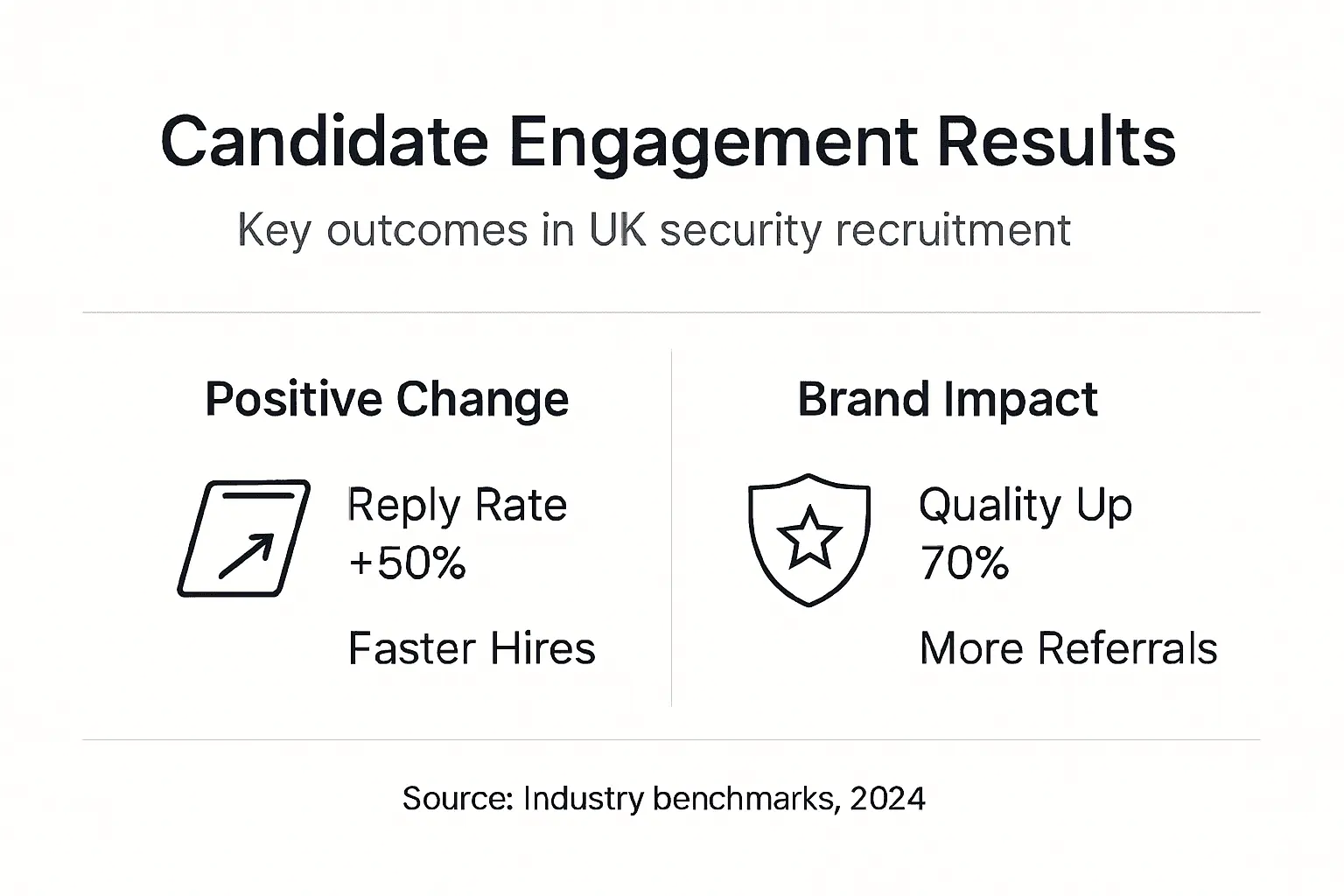
Candidate reply rates can improve by over 50% with personalized AI outreach. If you’re currently getting 20% response rates to interview invitations, expect that to climb to 30-40% within weeks of implementing personalized, multi-channel communication.
Time to fill decreases significantly. Improved engagement shortens time to fill security roles by approximately 20%. This happens because candidates move through stages faster when they stay interested and informed. Reduced delays at each touchpoint compound into major time savings across your entire hiring cycle.
Retention improves dramatically. Engaged units show 43% lower turnover rates, benefiting long-term hiring. Candidates who experience strong engagement during recruitment arrive with realistic expectations and positive impressions. They’re more likely to stay beyond the critical first-year mark.
Track these key metrics weekly to measure your engagement effectiveness:
- Application completion rate (target: 75%+)
- Time from application to first contact (target: under 24 hours)
- Response rate to interview invitations (target: 60%+)
- Pass-through rate at each hiring stage
- Candidate pulse survey scores
- Offer acceptance rate (target: 75%+)
Tracking key metrics weekly enables continuous process improvement. Review data every Monday. Identify where candidates drop off. Test small changes. Measure impact. Iterate based on results.
Your employer brand strengthens as engagement improves. Candidates talk to each other. Positive experiences generate referrals and repeat applicants. The candidate experience impact extends beyond individual hires to your overall talent attraction capability. You’ll see more qualified candidates applying as your reputation for respectful, efficient hiring spreads.
Perceived candidate quality improves up to 70% when engagement strategies align candidate expectations with role realities. Better-informed candidates self-select more accurately, reducing mismatched hires.
Enhance Your Security Recruitment with Security Jobs Board
Ready to apply these engagement strategies? Security Jobs Board provides the specialized platform UK security recruiters need. Our GDPR-compliant tools support automated communications while maintaining the personal touch candidates expect.

Utilize platform features designed specifically for effective UK recruitment steps in the security sector. Post roles that reach qualified, licensed candidates actively seeking security positions. Access our regularly updated guides and security recruitment best practices to continuously refine your approach. Target specialized talent pools through regional boards like Northern Ireland security jobs for location-specific hiring needs. Join hundreds of UK security employers who’ve transformed their candidate engagement and hiring outcomes through our purpose-built platform.
Frequently Asked Questions
What is candidate engagement and how does it differ from candidate experience?
Candidate engagement is the active, two-way communication and interaction between recruiters and candidates throughout the hiring process. It focuses on keeping candidates interested and responsive. Candidate experience is the broader perception candidates form about your organization based on every touchpoint. Strong engagement creates positive experiences, but experience includes elements beyond direct communication like application ease and workplace reputation.
How can AI improve candidate engagement without losing personalization?
AI analyzes candidate data to customize messaging at scale, identifying optimal contact times, preferred channels, and relevant content. It automates repetitive tasks while incorporating personal details like candidate name, applied role, and specific qualifications. The key is using AI to enhance human judgment, not replace it. Review AI-generated messages before deployment to ensure they sound authentic and align with your brand voice.
What are the best metrics to track candidate engagement effectiveness?
Focus on response rates to communications, time between hiring stages, application completion rates, and pass-through rates at each stage. Add candidate pulse surveys asking about communication clarity and timeline transparency. Track offer acceptance rates and first-year retention as lagging indicators of engagement quality. Review these metrics weekly to identify patterns and opportunities for improvement.
How do GDPR regulations affect candidate engagement communications?
GDPR requires explicit consent before storing or processing candidate data. You must clearly explain what data you collect, how you’ll use it, and how long you’ll retain it. Candidates have the right to access, correct, or delete their data. For engagement communications, this means obtaining consent for emails and texts, providing easy opt-out mechanisms, and documenting all candidate interactions. Non-compliance risks significant fines and reputational damage.
What are quick wins to reduce candidate drop-off in security recruitment?
Simplify your initial application to five fields or fewer. Send automated acknowledgment within one hour of application. Provide clear timelines for each hiring stage and meet those deadlines. Use SMS or WhatsApp for time-sensitive communications since open rates exceed email by 300%. These changes require minimal investment but deliver immediate drop-off reductions of 20-30% in most cases.


