Roles and responsibilities of security guards: 2026 guide
TL;DR:
- Security guards are trained professionals responsible for monitoring premises, controlling access, responding to incidents, and maintaining detailed records. Their core duties include patrolling, surveillance, access verification, incident response, and documentation, all of which vary by site type. Accurate record-keeping and adherence to site-specific protocols are essential for legal protection and operational effectiveness.
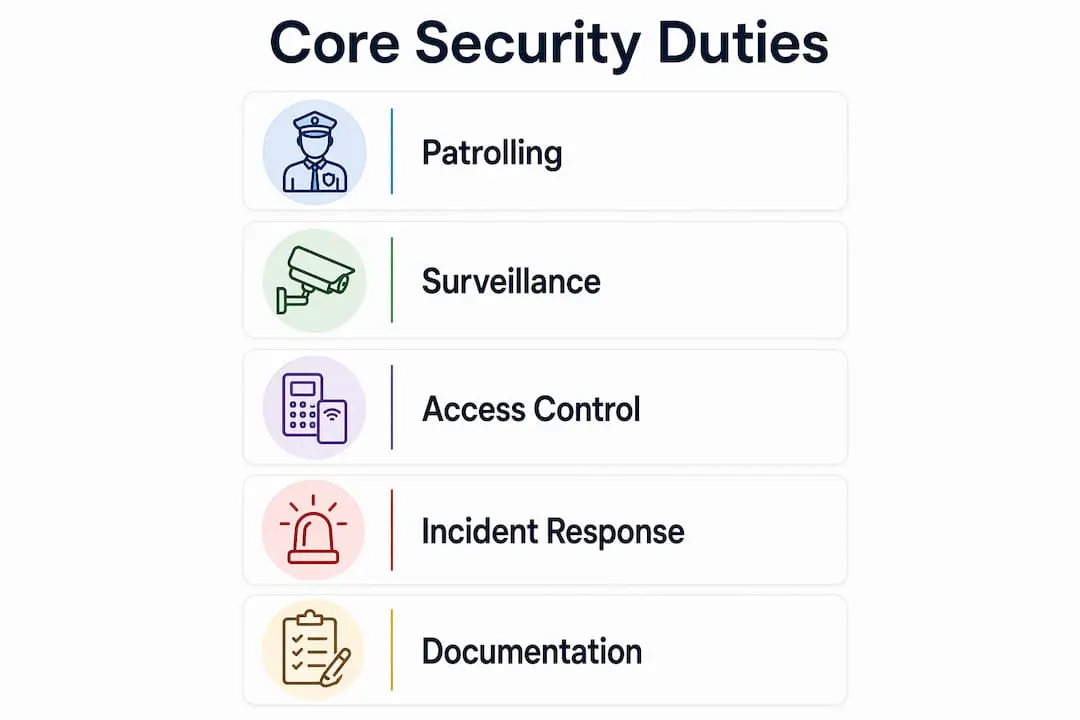
Security guards are defined as trained professionals responsible for observing premises, deterring criminal activity, controlling access, responding to incidents, and producing detailed written records. The industry term for this function is “security officer,” though “security guard” remains the widely used working title across UK recruitment. The roles and responsibilities of security guards span eight core areas: surveillance, access control, incident response, rule enforcement, public assistance, patrolling, documentation, and crowd management. Understanding each area matters whether you are considering a career in security, currently working in the sector, or recruiting staff for a site.
What are the core duties security guards perform during a typical shift?
A typical security shift is built around four primary functions: patrolling, monitoring, access control, and maintaining a visible deterrent presence. Each function connects directly to reducing risk on site.

Patrolling and surveillance
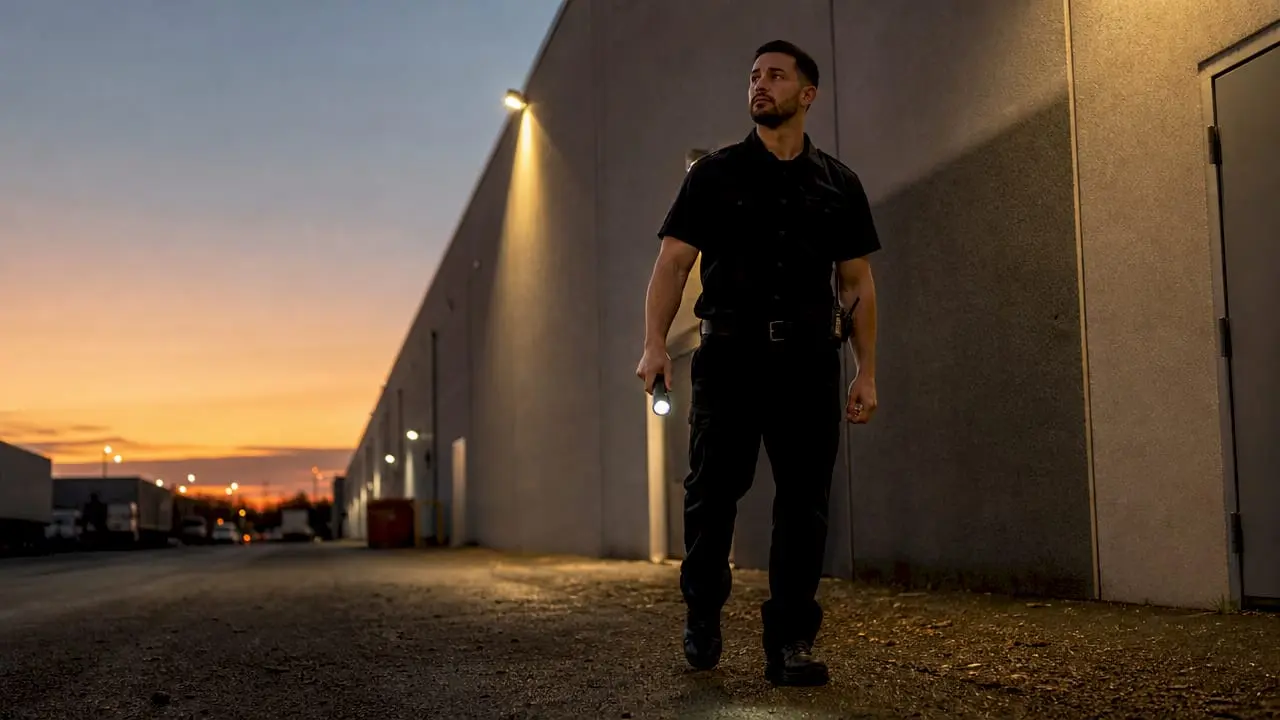
Foot and vehicle patrols, combined with electronic monitoring, create layered deterrence. Routine randomness improves effectiveness because predictable patrol patterns are easier for intruders to exploit. A guard who varies their route and timing removes that advantage entirely. During patrols, guards check for hazards such as unlocked doors, broken lighting, fire risks, and signs of forced entry.
Monitoring CCTV systems runs alongside physical patrols. Guards watch camera feeds for unusual behaviour, track movement across entry points, and flag anomalies in real time. The combination of physical presence and electronic monitoring is far more effective than either method alone.
Access control
Access control requires verifying identification for all non-authorised personnel and enforcing site protocols using technology. This includes operating electronic access systems, monitoring intercoms, and preventing unauthorised entry. In practice, a guard at a corporate office building checks visitor credentials, issues temporary passes, and logs contractor arrivals and departures.
Access control is one of the most visible security guard duties. A single lapse, such as allowing an unverified contractor through a secure door, can compromise an entire site.
Pro Tip: Keep a written log of every access decision, not just refusals. If a dispute arises later, your record of who entered and when becomes critical evidence.
- Verify photo identification before granting entry to any non-staff visitor
- Log all contractor arrivals and departures with timestamps
- Monitor intercom and CCTV feeds simultaneously at entry points
- Report any tailgating attempts immediately to a supervisor
- Follow site-specific post orders for visitor greeting procedures
How do security guards respond to incidents and emergencies?
Security guards act as first responders during emergencies, managing evacuations, directing people, and liaising with emergency services. This responsibility goes well beyond passive observation. When an alarm sounds or an incident occurs, the guard is the first trained person on the scene.
Effective incident response follows a clear sequence:
- Assess the situation. Identify the nature of the incident, whether it is a medical emergency, trespassing, fire alarm, or altercation, before taking action.
- Communicate immediately. Alert management and, where required, contact emergency services such as the police, ambulance, or fire brigade.
- Implement site procedures. Follow the evacuation plan or lockdown protocol as set out in the post orders for that specific site.
- Assist people on site. Direct staff, visitors, and contractors to safety. Account for all individuals, including those with mobility needs.
- Use specialist equipment. Operate fire panels, duress alarms, and first aid kits as trained. Guards who know their equipment respond faster and more accurately.
- Record everything. Write a full incident report immediately after the event, with precise timestamps and a factual account of actions taken.
Written, timestamped shift records are not optional. They form the primary evidence base for insurance claims, legal proceedings, and internal investigations. Relying on memory for post-incident recaps is a major professional error.
Pro Tip: Complete your incident report within 30 minutes of the event ending. Memory degrades quickly under stress, and courts and insurers require precise, contemporaneous accounts.
How do roles and responsibilities vary across different security environments?
Security guard responsibilities differ by site. Residential, commercial, and construction sites each carry unique priorities and require different skill sets. A guard working a luxury residential complex has very different daily tasks from one stationed at an industrial warehouse or a busy retail centre.
Site-specific post orders govern all detailed duties, making the role highly adaptable. Post orders cover everything from how to greet visitors to which alarm codes to use in a fire evacuation. No two sites are identical, which is why flexibility and the ability to follow written protocols precisely are non-negotiable qualities in any security professional.
| Environment | Primary focus | Typical duties | Key skills required |
|---|---|---|---|
| Residential complex | Resident safety and access | Entry verification, CCTV monitoring, parking enforcement | Customer service, discretion |
| Corporate office | Staff and asset protection | Visitor management, ID checks, out-of-hours patrols | Communication, access control |
| Retail centre | Loss prevention and public safety | Floor patrols, shoplifting deterrence, crowd management | De-escalation, observation |
| Construction site | Asset security and health and safety | Perimeter patrols, contractor access, equipment checks | Physical fitness, hazard awareness |
| Industrial or warehouse | Asset and personnel protection | Vehicle access control, CCTV, alarm response | Technical knowledge, report writing |
Guards working construction sites, for example, focus heavily on perimeter security and contractor verification. Those in retail prioritise loss prevention and managing difficult interactions with the public. Understanding which environment suits your skills is a practical first step when exploring security roles in the UK.
What skills and behaviours make an effective security officer?
Modern security guards require operational awareness and tactical training for de-escalation, going well beyond passive guarding. The functions of security personnel today include technical competence, communication skills, and professional conduct in equal measure.
Technical and operational skills
Guards must operate electronic access systems, CCTV platforms, fire panels, and duress alarms confidently. Errors with technical equipment during an emergency can delay response and put people at risk. Regular training on the specific systems installed at each site is the standard expectation across UK employers.
Incident logs and daily activity reports with precise timestamps form the primary evidence base for legal defence and insurance claims. A guard who writes clear, factual, timestamped reports provides their employer with a defensible record. One who relies on verbal recollections does not.
Communication and customer service
The customer service aspect is often underestimated. Guards act as the face of the property, managing tensions and difficult interactions professionally. De-escalation and polite assistance are frequently prioritised over tactical measures by site management. A guard who can defuse a confrontation calmly protects the site without escalating risk.
Liaison with tenants, visitors, contractors, and staff is a daily reality. Clear, professional communication builds trust and makes the guard’s job easier over time.
Conflict resolution and professional conduct
- Use calm, clear language when addressing confrontational individuals
- Maintain a professional appearance at all times, as uniform and bearing signal authority
- Follow the de-escalation techniques covered in your training before considering physical intervention
- Never act outside your legal powers; know the limits of your authority under UK law
- Report all conflicts, even minor ones, in writing on the same shift they occur
Professional conduct extends to punctuality, reliability, and how a guard represents the employer on site. A security officer who is well-presented, approachable, and consistent in applying the rules builds the kind of presence that deters problems before they start.
Key takeaways
Security guards perform eight core functions, and documentation is as critical as physical deterrence for professional and legal outcomes.
| Point | Details |
|---|---|
| Core functions are structured | Security officer responsibilities cover surveillance, access control, patrolling, incident response, and documentation. |
| Post orders govern every site | Site-specific post orders define exact duties, making adaptability a fundamental requirement for all security personnel. |
| Documentation is non-negotiable | Timestamped incident logs and shift reports provide the legal and insurance evidence base after any event. |
| Environment shapes the role | Duties differ significantly across residential, commercial, retail, and industrial sites, requiring tailored skills. |
| De-escalation outranks force | Employers prioritise communication and conflict resolution over physical intervention in most UK security contexts. |
Why documentation is the most underrated part of the job
The security industry talks a great deal about physical presence and deterrence. What gets far less attention is the written record. In my experience, the guards who advance their careers fastest are not necessarily the most physically imposing. They are the ones who write clear, accurate, timestamped reports every single shift.
Post orders are the foundation of the role. A guard who reads, understands, and follows their site’s post orders precisely will outperform someone with more experience who improvises. The post orders exist because the site has specific risks, specific legal obligations, and specific expectations. Ignoring them is not flexibility. It is a liability.
The customer service dimension also catches new guards off guard. You are not just there to stop things happening. You are the first person a visitor speaks to, the person a distressed employee turns to, and the face of the organisation at 2am when no one else is around. That requires composure, empathy, and communication skills that no amount of physical training alone will give you. If you are considering a career in security, invest in your conflict resolution training as seriously as you invest in your SIA licence.
— Rob
Security guard jobs across the UK with Securityjobsboard
Securityjobsboard connects security professionals and employers across the UK through a platform built specifically for the sector. Whether you are looking for your first role or moving into a new security environment, the site lists verified vacancies from employers who understand what the job actually involves.

Candidates can create a free profile, upload a CV, and set job alerts for roles that match their experience and location. Employers can post listings and search a dedicated CV database. For those targeting specific regions, security jobs in Northern Ireland are listed alongside opportunities across England, Scotland, and Wales. Securityjobsboard is affiliated with the BSIA, which adds a layer of credibility that generic job boards cannot match.
FAQ
What are the main roles and responsibilities of security guards?
Security guards observe premises, deter criminal activity, control access, respond to incidents, and produce written records. The role is structured around eight core areas: surveillance, access control, patrolling, incident response, rule enforcement, public assistance, documentation, and crowd management.
Do security guard duties change depending on the site?
Yes. Site-specific post orders define exact duties for each location, meaning responsibilities differ significantly between residential, commercial, retail, and industrial environments.
What qualifications do security guards need in the UK?
Security guards working in the UK require a valid SIA (Security Industry Authority) licence. Specific licence categories cover door supervision, CCTV operation, and close protection, depending on the role.
How important is report writing for security officers?
Report writing is critical. Incident logs with precise timestamps form the primary evidence base for legal proceedings and insurance claims, making accurate documentation a core professional skill.
What is the difference between a security guard and a security officer?
The terms are used interchangeably in UK recruitment. “Security officer” is the recognised industry title, while “security guard” is the common working term. Both refer to the same licensed, trained role.


