Streamline your job posting life cycle for UK security roles

TL;DR:
- UK security recruitment is slowed by inefficient processes and lengthy vetting stages.
- Proactive planning, structured workflows, and automation can significantly reduce delays and candidate drop-offs.
- Most hiring delays are avoidable and stem from internal process failures rather than clearance timelines.
Many UK security firms lose strong candidates not because of poor salaries or weak employer brands, but because their recruitment processes are slow, siloed, and poorly planned. Security clearance processes can extend hiring timelines by months, and without a structured approach to each stage of the job posting life cycle, even the best candidates will disengage. This guide breaks down every stage of that life cycle, from planning and advertising through to vetting and onboarding, and gives you practical, compliance-aware strategies to reduce delays, improve candidate engagement, and ultimately fill roles faster.
Table of Contents
- Understanding the job posting life cycle in UK security recruitment
- Optimising job posting stages for efficiency and compliance
- Addressing security clearance challenges and candidate engagement
- Measuring success and continuous improvement in the job posting life cycle
- The uncomfortable truth: Most UK security hiring delays are preventable
- Find your next cleared security talent with Security Jobs Board
- Frequently asked questions
Key Takeaways
| Point | Details |
|---|---|
| Long clearances matter | Security vetting can add months to hiring, so plan for extended timelines. |
| Efficiency boosts outcomes | Automation and unified teams reduce delays, improving recruiter productivity and candidate experience. |
| Engagement prevents drop-offs | Transparent, timely communications and tracking metrics help retain applicants throughout the process. |
| Continuous improvement | Regularly assess key metrics and feedback to refine your job posting life cycle for best results. |
Understanding the job posting life cycle in UK security recruitment
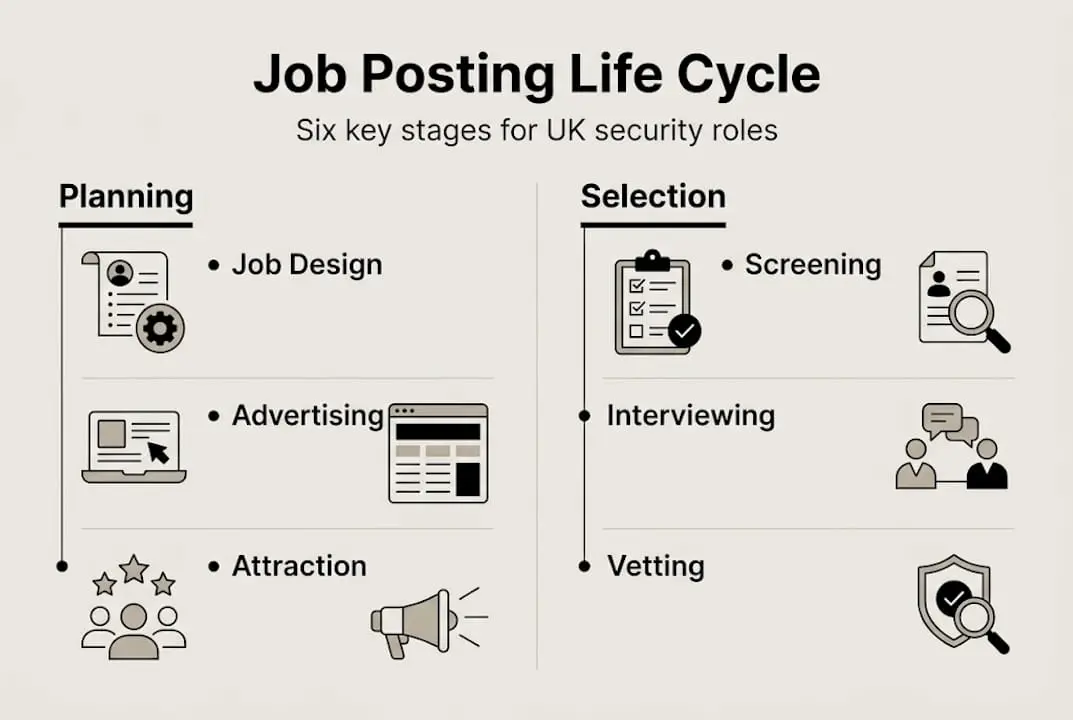
The job posting life cycle is not simply a matter of writing an advert and waiting for CVs to arrive. In UK security recruitment, it is a structured sequence of interdependent stages, each carrying its own risks and timelines. Understanding where delays occur is the first step to fixing them.
The core stages are: planning and job design, advertising and attraction, screening and shortlisting, interviewing, vetting and clearance, offer management, and onboarding. In most sectors, these stages flow relatively quickly. In security, the vetting stage alone can stretch the entire process by weeks or months depending on the clearance level required.
For context, the CIPD recruitment factsheet outlines how structured recruitment frameworks reduce both time-to-hire and cost-per-hire. Yet many security firms still operate without a formal framework, treating each hire as a one-off exercise rather than a repeatable process.
Benchmarks matter here. The average time-to-fill for UK agencies sits at 36 days, but security roles regularly exceed this due to mandatory vetting requirements. Security Check (SC) clearance typically takes 6 to 12 weeks, while Developed Vetting (DV) can run from 6 to 9 months. These are not outliers. They are standard timelines that must be built into your recruitment planning from day one.
The risk of candidate drop-off is highest during the vetting stage. Candidates who have already accepted verbal offers elsewhere will not wait indefinitely. Without proactive communication and clear timelines, firms lose strong candidates at precisely the moment they thought the hire was secured.
| Clearance level | Typical timeline | Drop-off risk |
|---|---|---|
| Baseline Personnel Security Standard (BPSS) | 1 to 2 weeks | Low |
| Security Check (SC) | 6 to 12 weeks | Medium to high |
| Developed Vetting (DV) | 6 to 9 months | Very high |
Key risks at each stage include:
- Planning: Vague role requirements lead to poorly targeted adverts
- Advertising: Generic job boards attract unqualified applicants
- Screening: Manual processes create bottlenecks and slow response times
- Vetting: Lack of candidate communication causes disengagement and withdrawal
- Onboarding: Poor handover from HR to operations increases early attrition
Reviewing your job posting workflow against these stages is a practical starting point. Firms that map their current process against this framework almost always find at least two or three stages where time is being lost unnecessarily.
Optimising job posting stages for efficiency and compliance
Once you understand the life cycle, the next step is improving it. Efficiency and compliance are not competing priorities in UK security recruitment. They reinforce each other when the process is well designed.
Start with your job descriptions. Vague or inflated requirements deter qualified candidates and attract unsuitable ones. A compliant job description for a security role should clearly state the clearance level required, the physical or operational demands of the role, and any licensing requirements under the Private Security Industry Act 2001. Following CIPD guidance on inclusive language also reduces the risk of indirect discrimination claims.
Screening is where many firms lose the most time. Manual CV review is slow, inconsistent, and prone to unconscious bias. Automation can reduce candidate processing time from 60 to 90 minutes down to 15 minutes per applicant. Applicant Tracking Systems (ATS) that are configured for security-specific criteria, such as SIA licence status or clearance eligibility, can filter candidates before a human reviewer is even involved.

Research on candidate engagement metrics confirms that faster response times at the screening stage directly improve offer acceptance rates. Candidates who wait more than five days for a response after applying are significantly more likely to have accepted another role.
Here is a practical comparison of traditional versus optimised approaches:
| Stage | Traditional model | Optimised model |
|---|---|---|
| Job description | Generic, copied from previous adverts | Role-specific, compliance-checked, inclusive |
| Screening | Manual CV review by one person | ATS-filtered, shared shortlisting |
| Vetting coordination | Starts after offer | Integrated from planning stage |
| Candidate communication | Ad hoc, reactive | Scheduled, templated, proactive |
A step-by-step approach to optimising your process:
- Audit your current job descriptions against CIPD inclusivity standards
- Configure your ATS to filter on security-specific criteria
- Set response time targets at each stage (aim for 48 hours maximum)
- Introduce shared shortlisting between HR and operations managers
- Build vetting timelines into your offer letters and candidate communications
Pro Tip: The biggest efficiency gain most firms overlook is integrating vetting planning into the job design stage, not the offer stage. When you know upfront that a role requires SC clearance, you can build that timeline into your advertising copy, your candidate briefings, and your hiring manager expectations. This single change reduces late-stage drop-offs significantly.
For more detail on writing effective adverts, the guides on optimising job listings and job posting best practices are worth bookmarking.
Addressing security clearance challenges and candidate engagement
Security clearance is the single biggest differentiator between security recruitment and almost every other sector. It is also the stage where the most preventable attrition occurs. The good news is that most clearance-related drop-offs are avoidable with the right planning and communication.
Pre-cleared candidates are your fastest route to filling clearance-heavy roles. Building a talent pool of individuals who already hold SC or DV clearance means you can bypass the longest part of the timeline entirely. This requires proactive sourcing, including maintaining relationships with candidates who were not placed in previous rounds but who hold valid clearances.
For roles requiring SC or DV, integrate clearance vetting with your planning from the outset, as these processes typically take 4 to 5 months and cannot be rushed. Firms that treat vetting as a post-offer formality consistently find themselves losing candidates who simply cannot afford to wait.
Engagement during the vetting period is critical. Candidates who go weeks without contact assume the worst. A simple weekly or fortnightly update, even if there is no new information to share, maintains the relationship and signals that you value their patience.
“Offer acceptance rates have risen to 84% with personalised outreach and transparent communication throughout the recruitment process.”
Practical engagement strategies that work in security recruitment:
- Send a personalised acknowledgement within 24 hours of application
- Provide a written timeline at the point of offer, including expected vetting duration
- Assign a named point of contact for clearance queries
- Schedule check-in calls at the midpoint of any vetting period longer than four weeks
- Share relevant news or updates about the role or team during long vetting periods
Poor candidate experience does not just lose you one hire. It damages your employer brand in a sector where word travels fast. Security professionals talk to each other, and a reputation for poor communication will reduce your future applicant pool.
Pro Tip: Track stage-specific metrics including no-show rates at interview, withdrawal rates during vetting, and average days between stages. These numbers will show you exactly where your process is leaking candidates. Most firms are surprised to find their biggest drop-off is not during vetting but during the gap between screening and first interview.
The guides on improving candidate experience and candidate experience tips offer further practical frameworks for this.
Measuring success and continuous improvement in the job posting life cycle
Optimising a process without measuring it is guesswork. The firms that consistently fill security roles faster and with better retention are the ones that track the right metrics and act on what they find.
The key metrics every security HR team should monitor are:
- Time-to-fill: From job approval to accepted offer
- Time-to-hire: From application to accepted offer
- Application completion rate: The percentage of started applications that are submitted
- Stage drop-off rate: Where candidates are withdrawing or going silent
- Offer acceptance rate: The percentage of offers that are accepted
- Source quality: Which channels produce candidates who reach the offer stage
Despite high application volumes, cost per hire is rising for niche UK security roles, which means volume alone is not the answer. Quality of source and efficiency of process matter far more than the number of applicants.
Stage metrics and source quality are the two variables most strongly linked to improved recruitment outcomes, yet they are the two most commonly overlooked by security HR teams who focus primarily on time-to-fill.
Feedback loops are equally important. After every hire, conduct a brief debrief with the hiring manager and, where possible, with the candidate. Ask what worked, what caused delays, and what information they wished they had received earlier. This takes 20 minutes and generates insights that no dashboard can replicate.
| Improvement strategy | Expected impact |
|---|---|
| ATS configuration for security criteria | Reduces screening time by up to 75% |
| Vetting timeline integrated at planning | Reduces late-stage drop-off |
| Personalised candidate communication | Improves offer acceptance rates |
| Stage-by-stage metrics tracking | Identifies bottlenecks within two hiring cycles |
| Source quality analysis | Reduces cost per hire over 6 months |
For a structured approach to building these feedback loops into your workflow, the recruitment workflow guide is a useful reference.
The uncomfortable truth: Most UK security hiring delays are preventable
Here is something the industry rarely says plainly: the majority of delays in UK security recruitment are not caused by clearance timelines or candidate shortages. They are caused by internal process failures, specifically the handoff model that most firms still use.
In a traditional handoff model, HR writes the job description, passes it to a recruiter, who passes shortlists to a hiring manager, who passes the selected candidate to a vetting team. Each handoff introduces delay, miscommunication, and lost context. The candidate experiences this as silence and disorganisation.
Full life cycle recruiting, where a single team or individual owns the process from planning to onboarding, reduces these handoff delays and measurably improves candidate communications. It is not always possible in large organisations, but even a joint ownership model, where HR and operations share accountability from day one, produces significantly better outcomes.
The firms we see filling clearance-heavy roles fastest are not the ones with the biggest budgets. They are the ones that planned for vetting before they posted the advert, communicated proactively throughout, and treated the process as a shared responsibility. Using a structured security posting checklist is a simple first step toward that kind of discipline.
Find your next cleared security talent with Security Jobs Board
If you are ready to put these strategies into practice, Security Jobs Board gives you the tools to do it efficiently. Built specifically for UK security recruitment, the platform lets you post clearance-specific roles, browse a targeted CV database, and connect with candidates who understand the demands of the sector.

From security jobs in Northern Ireland to nationwide clearance-heavy vacancies, the platform supports every stage of your job posting life cycle. Our resource hub includes guides, checklists, and human support to help HR professionals and security managers recruit compliantly and confidently. Visit the UK security jobs board to explore flexible posting plans and start reaching the right candidates today.
Frequently asked questions
What is the typical time-to-fill for UK security roles?
Most UK security roles take between 36 and 45 days to fill, but roles requiring SC or DV clearance extend timelines considerably, sometimes by several months.
How does security clearance affect candidate engagement?
Lengthy vetting periods increase the risk of candidate withdrawal, so firms should maintain regular contact and prioritise pre-cleared applicants wherever possible.
What are the best practices for compliant job postings in the UK security sector?
Use clear, unbiased language and follow CIPD recruitment guidelines to ensure your adverts are both legally compliant and genuinely inclusive.
How can automation improve the job posting life cycle?
Automation can cut CV review and submission time by up to 75%, with ATS tools reducing processing time from over an hour to around 15 minutes per candidate.


