How to shortlist CVs: a step-by-step guide for recruiters

TL;DR:
- Effective shortlisting relies on a structured, evidence-based process starting with predetermined criteria. Using independent scoring, detailed notes, and a consistent workflow results in a defensible and efficient shortlist. Incorporating bias reduction methods and clear communication helps meet legal standards and enhances hiring fairness.
Shortlisting CVs well comes down to one thing: a repeatable, evidence-based workflow. Start with a defined person specification, run a fast first pass to remove clearly unsuitable applications, score the remainder against a weighted matrix, validate by phone, and close with a dated audit trail. That sequence protects your decision and saves time. For a typical mid-level vacancy, aim for a shortlist of a small handful of candidates and allow a few days from application close to shortlist confirmed. ACAS recommends involving at least two independent reviewers throughout.
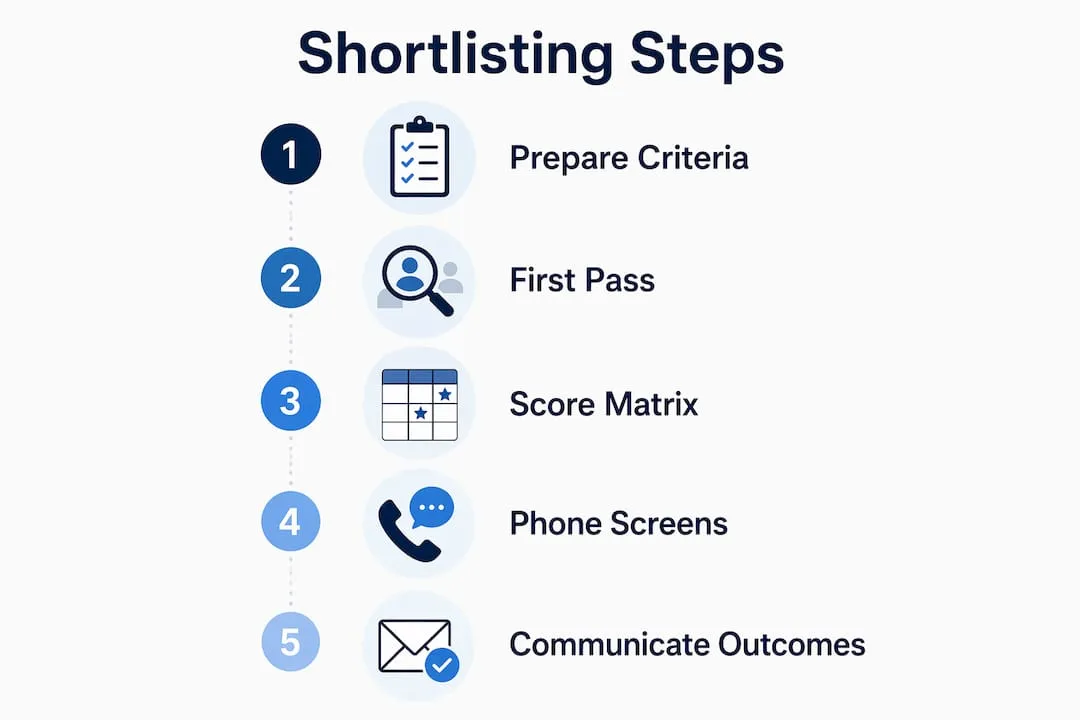
Six-step shortlisting checklist:
- Prepare: agree essential and desirable criteria from the person specification before opening any applications
- First pass: skim all CVs and sort into Reject, Hold, and Proceed buckets
- Score: apply a shortlisting matrix with weighted criteria and a minimum threshold
- Phone screen: run 10–15 minute calls to verify eligibility and key claims
- Compliance check: confirm two-reviewer sign-off, dated notes, and Equality Act 2010 alignment
- Communicate: send rejections, hold notifications, and interview invites promptly
Keep dated shortlisting notes for every applicant, not just those you progress. Record the specific criterion that led to each rejection. Two reviewers scoring independently before comparing results is the single most effective bias-reduction step you can take.
Table of Contents
- Step 1: prepare your criteria before you open a single application
- Step 2: how do you do a fast first pass on a large pile of CVs?
- Step 3: how to build and use a shortlisting matrix
- Decide how many to invite and when to arrange phone screens
- Step 4: phone screens, screening questionnaires and candidate engagement
- Avoiding bias and meeting UK legal requirements when shortlisting
- Tools and tactics for high-volume shortlisting
- Communicating outcomes and keeping records
- UK legal and best-practice checklist: Equality Act, ACAS and defensible shortlisting
- Key takeaways
- The shortlisting step most recruiters skip
- Securityjobsboard employer tools cut shortlisting time for UK security roles
- Useful sources and templates (UK)
- FAQ
Step 1: prepare your criteria before you open a single application
The most common shortlisting mistake is opening the inbox before agreeing what you are actually looking for. Decide your essential and desirable criteria from the person specification first, and document them. This protects defensibility and keeps every reviewer working from the same standard.
Aim for several essential criteria (the non-negotiables a candidate must meet to be considered) and several desirable criteria (skills or experience that add value but are not disqualifying if absent). For a security officer role, essential criteria might include a valid SIA licence, right to work in the UK, and a minimum of one year’s relevant experience. Desirable criteria could include CCTV operation experience, first-aid certification, or a specific sector background such as retail or events.
Shortlist size should be decided before you start reviewing. For entry-level roles, a moderate number of candidates is workable. Mid-level positions suit a smaller shortlist, and senior appointments require an even narrower group. The right number depends on applicant volume, role complexity, and the interview resources you have available. A well-structured job posting workflow makes this easier because the criteria are already embedded in the advert.
Document who will shortlist, declare any conflicts of interest before the process begins, and set a firm shortlisting deadline. A first-pass skim of a single CV takes roughly 30–60 seconds; a detailed matrix review takes 3–5 minutes. Build your timeline around those benchmarks. Prepare your scoring rubric before you open the first application.
Step 2: how do you do a fast first pass on a large pile of CVs?
The first pass is a timed skim, not a decision. Its purpose is to remove applications that clearly fail an essential criterion so you spend detailed review time only where it matters.
Work through CVs in batches, taking manageable groups at a time. For each one, check three things: right to work (or evidence of eligibility), essential qualifications or licences, and a clear indicator of relevant experience. If any essential criterion is absent, the CV goes into the Reject bucket. If the CV meets essentials but you need more time to assess desirables, it goes into Hold. If it clearly meets essentials and shows strong desirable indicators, it proceeds to detailed review.
Common first-pass rejection triggers include:
- Missing or expired SIA licence where one is required
- No evidence of right to work in the UK
- Unexplained employment gaps spanning the entire required experience period
- Applying for a role that requires a specific qualification the candidate does not mention
- A CV so poorly structured that no relevant information can be located after a 60-second scan
Pro Tip: Never permanently reject a CV on the first pass without recording the specific criterion it failed. A note reading “No SIA licence stated — essential criterion 1 not met” takes ten seconds and is invaluable if a decision is later challenged.
The so-called “7-second rule” — the idea that recruiters form a view in seconds — is a real phenomenon, but relying on it introduces unconscious bias. Use the first pass to filter on objective essentials only, not on gut feel about layout or presentation. Inconsistent standards and over-reliance on job titles are among the most common shortlisting mistakes employers make.
Step 3: how to build and use a shortlisting matrix
A shortlisting matrix converts subjective impressions into auditable scores. Build it from your person specification: rows are criteria, columns are candidates. Score each criterion and record a reason when a candidate scores zero on any essential item.

Scoring options
A simple scoring scale works well for most roles, for example from not met to fully met. For senior or specialist roles where some skills matter far more than others, apply a weighting multiplier. A best-practice matrix design combines per-criterion scoring with a weighted total and a mandatory pass on all essential criteria. This prevents a candidate with critical gaps progressing purely because they scored highly on desirable items.
Sample matrix: mid-level security officer role
| Criterion | Weight | Candidate A | Candidate B | Candidate C |
|---|---|---|---|---|
| Valid SIA licence (Essential) | Must pass | 2 | — | 2 |
| Right to work in UK (Essential) | Must pass | 2 | 2 | 2 |
| Min. 2 years’ security experience (Essential) | Must pass | 2 | 1 | 2 |
| CCTV operation experience (Desirable) | ×2 | 4 | 2 | 2 |
| First-aid certificate (Desirable) | ×1 | 1 | 1 | 2 |
| Evidence of measurable impact (Desirable) | ×1 | 2 | — | 1 |
| Weighted total | — | 6 | — | |
| Proceed? | Yes | No (fails essential) | Yes |
Set a minimum threshold before scoring begins — for example, “must score 2 on all essential criteria and achieve a weighted total of 9 or above.” Candidate B fails on the SIA licence essential, so they do not proceed regardless of their desirable scores.
Pro Tip: Require each reviewer to complete their matrix independently before comparing scores. Where reviewers disagree by more than one point on any criterion, document the discussion and the agreed final score. That note is your audit trail.
Decide how many to invite and when to arrange phone screens
Shortlists often include several candidates, but a shortlist of a handful makes meaningful comparison practical without exhausting interview panels. The right number also depends on whether you intend to phone-screen before interview.
Phone screening makes sense when: the role has a high volume of applicants, there are role-critical behaviours that are hard to assess from a CV alone (communication style, shift flexibility), or the interview process is resource-intensive. For a straightforward entry-level security post with a clear licence requirement, you may proceed straight to interview with 4–6 candidates. For a senior operations manager role, phone-screening several before inviting a few to interview is a sensible use of everyone’s time.
Typical timeline from advert close to shortlist confirmed:
- Day 1: close applications, distribute CVs to reviewers
- Days 1–2: first-pass skim, Reject/Hold/Proceed sort
- Days 2–3: detailed matrix scoring by both reviewers
- Day 3: reconcile scores, agree shortlist, arrange phone screens
- Days 4–5: phone screens completed
- Day 5–6: final shortlist confirmed, interviews scheduled
Before confirming interview slots, check interviewer availability, confirm any assessment resources needed (practical tests, scenario exercises), and allow for candidate notice periods when setting dates.
Step 4: phone screens, screening questionnaires and candidate engagement
A 10–15 minute phone screen often saves two hours of interviewing time. Use it to confirm eligibility, verify key claims, and surface any practical issues before committing to a full interview slot.
Phone screen script skeleton
- Opener: introduce yourself, confirm the role and that the call will take roughly 10–15 minutes
- Eligibility check: confirm right to work, SIA licence number and expiry date, notice period
- Core competency probe: one or two questions tied to essential criteria (“Can you describe a situation where you had to manage a difficult member of the public on site?”)
- Practical logistics: shift availability, travel to site, any reasonable adjustments needed
- Closing: explain next steps and timeline, invite questions
For roles where documentary verification matters before shortlisting, send a short screening questionnaire by email first. Ask for:
- SIA licence number and expiry date
- Right-to-work document type (you verify at offer stage, not here)
- Confirmation of any specific qualifications listed as essential
- Availability for interview
Record every phone-screen outcome in your shortlisting matrix or ATS immediately after the call. Note the date, who conducted the screen, and the key points confirmed or flagged. Consistency here is what makes the process defensible. High-performing shortlisters look beyond job titles and use the phone screen to probe for concrete evidence of impact rather than relying on CV presentation alone.
Avoiding bias and meeting UK legal requirements when shortlisting
Shortlisting is a legal act. Under the Equality Act 2010, rejected candidates can bring uncapped discrimination claims even if they were never employed by your organisation. Every shortlisting decision must be defensible, objective, and tied to job-related criteria.
ACAS guidance is clear: involve at least two people in shortlisting, with each reviewer scoring independently before any discussion takes place. This reduces the risk of one person’s bias influencing the outcome and provides a stronger evidential base if a decision is challenged.
ACAS recommends that shortlisters receive training in unconscious bias before taking part in the process. Blind shortlisting — removing names, addresses, and graduation years from CVs before scoring — is worth considering for roles where demographic bias is a known risk. It is not a legal requirement, but it is a practical step that supports equal opportunities hiring and strengthens your audit trail.
Pro Tip: Avoid “culture fit” as a shortlisting criterion. It is almost impossible to define objectively and is frequently cited in discrimination claims. Record only job-related reasons for every decision.
Your audit-trail checklist for each vacancy should include:
- Completed shortlisting matrix with scores and reviewer names
- Dated first-pass notes recording the criterion each rejected CV failed
- Phone-screen records with date, interviewer, and outcome
- Reconciliation notes where reviewers disagreed
- Record of who approved the final shortlist and when
For diversity hiring beyond legal compliance, consider monitoring the demographic profile of your shortlisted pool against your applicant pool. If your shortlist consistently under-represents groups that applied in proportion, that is a signal to review your criteria and scoring, not just your sourcing.
Tools and tactics for high-volume shortlisting
When you are processing 100+ applications, manual review of every CV in full is neither practical nor consistent. The right tools and batching approach keep quality high without burning out your shortlisters.
- ATS parsing normalises CV data into structured fields (dates, job titles, qualifications), making matrix scoring faster and more consistent. CV parsing is most useful when it extracts fields for human review, not when it makes selection decisions autonomously.
- Boolean and semantic search lets you locate candidates with specific licences or skills across a CV database without reading every document. A string like
"SIA licence" AND "CCTV" AND "retail"surfaces relevant profiles quickly. Semantic matching goes further, finding candidates whose experience matches the intent of a criterion even when the exact words differ. - Batching: process CVs in groups of 25, take a short break between batches, and rotate shortlisters across batches where possible. Reviewer fatigue is real and measurable; decisions made in the final batch of a long session are less consistent than those made at the start.
- Interview scheduling tools (Calendly, Microsoft Bookings, or your ATS’s built-in scheduler) cut the back-and-forth of arranging phone screens and interviews significantly.
Properly configured automated parsing can reduce manual review time by up to 87% by standardising data extraction before human review. The risk is over-reliance: keyword matching alone rejects capable candidates who did not optimise their CV for ATS. Skills-based and semantic analysis reduces that false-negative rate.
Pro Tip: Use automated parsing to populate your matrix fields — dates, job titles, licence numbers — then apply human judgement to assess whether the evidence behind those fields is credible and relevant.
Communicating outcomes and keeping records
Timely, professional communication after shortlisting protects your employer brand and keeps the process compliant.
Who to contact and when:
- Immediate rejections: send within 48 hours of the shortlisting decision
- Hold candidates: notify them that the process is ongoing and give a date by which you will update them
- Shortlisted candidates: confirm interview details within 24 hours of the shortlist being finalised
A compliant rejection message confirms the role, thanks the candidate, and states that they have not been progressed. It does not compare them to other candidates, give detailed scoring breakdowns, or include language that could be read as discriminatory. Keep it factual and brief.
Pro Tip: Never include comparative language in rejection emails (“we found stronger candidates”). State only that the application was not progressed on this occasion. If a candidate requests feedback, provide it based on the job-related criteria in your matrix, not on impressions.
For record retention, GDPR compliance requires that you keep candidate data only as long as necessary for the purpose it was collected. Industry guidance suggests retaining shortlisting matrices, phone-screen notes, and decision rationales for six months after the vacancy closes. This covers the standard three-month window for Employment Tribunal claims and provides a buffer. Store records securely, limit access to those involved in the process, and document your retention policy so candidates can request information under their Subject Access Rights.
UK legal and best-practice checklist: Equality Act, ACAS and defensible shortlisting
Shortlisting decisions sit squarely within the scope of the Equality Act 2010. The nine protected characteristics — age, disability, gender reassignment, marriage and civil partnership, pregnancy and maternity, race, religion or belief, sex, and sexual orientation — apply from the moment a candidate applies. Discrimination claims are uncapped, meaning there is no ceiling on the compensation a tribunal can award.
The Equality Act 2010 Code of Practice on Employment states that short-listing should be carried out consistently, using the same criteria for all applicants, and that those criteria should be directly related to the requirements of the job. Criteria that are not job-related risk being found indirectly discriminatory.
The GOV.UK guidance on preventing discrimination in recruitment confirms that you cannot ask questions about protected characteristics during shortlisting, and that any criterion that disproportionately disadvantages a protected group must be objectively justified by the requirements of the role.
Annotated shortlisting note: what to record and why
| Element | What to record | Why it matters |
|---|---|---|
| Reviewer name and date | Full name, date of review | Establishes who made the decision and when |
| Criterion assessed | Exact criterion from person specification | Ties decision to job requirements |
| Evidence found | Quote or paraphrase from CV | Shows decision was evidence-based |
| Score awarded | Numeric score (e.g. 2/2) | Enables consistent comparison |
| Reason if score is — | Specific gap or absence | Defensible if challenged |
| Final decision | Proceed / Hold / Reject | Clear outcome with rationale |
For further reading, the Equality Act 2010 Code of Practice covers shortlisting at section 235 onwards. ACAS guidance on choosing who to interview is the practical companion. For security-sector specific employment law, the 2026 compliance guide on Securityjobsboard covers sector-relevant obligations in detail.
Key takeaways
A structured shortlisting process — criteria agreed before applications open, independent scoring by two reviewers, and dated notes for every decision — is the fastest route to a defensible shortlist.
| Point | Details |
|---|---|
| Agree criteria first | Set 3–5 essential and 3–5 desirable criteria from the person specification before opening any applications. |
| Use a shortlisting matrix | Score each candidate —/1/2 per criterion; apply a mandatory pass on all essentials before totalling desirables. |
| Two independent reviewers | ACAS recommends at least two people scoring separately to reduce bias and strengthen defensibility. |
| Keep dated audit notes | Record the specific criterion each rejected CV failed; retain shortlisting records for at least six months. |
| Securityjobsboard employer tools | The platform’s CV database and applicant tracker support faster, structured shortlisting for UK security roles. |
The shortlisting step most recruiters skip
There is a gap between what shortlisting guides recommend and what actually happens under pressure. Most articles tell you to use a matrix. Fewer tell you what goes wrong when you do.
The most common failure is not bias in the traditional sense. It is criteria drift: the person specification says “minimum two years’ security experience” but by the third batch of CVs, reviewers are mentally adjusting that threshold because the pool is thin. Nobody documents the adjustment. The shortlist gets made, the hire gets made, and six months later a rejected candidate with two years’ experience asks why they were not progressed. You have no answer that holds up.
The fix is not a better matrix. It is a pre-shortlisting conversation where reviewers explicitly agree what “two years’ experience” means in practice — does a career-break year count? Does a related role in a different sector count? — and write that down before scoring begins. That conversation takes fifteen minutes and it is the difference between a defensible process and an exposed one.
The second thing most guides underplay is the phone screen. Recruiters treat it as a courtesy call or a scheduling step. It is neither. A well-run 12-minute phone screen surfaces more about a candidate’s suitability than 45 minutes of CV review. Ask one concrete competency question. Listen for specifics. A candidate who answers “I managed a difficult situation by staying calm” has told you almost nothing. A candidate who says “there was an aggressive patron at the venue entrance, I called for backup within 30 seconds and documented the incident before my shift ended” has given you evidence. That distinction shapes the shortlist more than any score on a desirable criterion.
Securityjobsboard employer tools cut shortlisting time for UK security roles
Posting a vacancy and then manually tracking 80 applications across a spreadsheet is where shortlisting processes break down. Securityjobsboard gives UK security employers a faster alternative: a searchable CV database of sector-specific candidates, built-in applicant tracking, and search filters that let you locate candidates by licence type, location, and experience level before you have read a single full CV.

The applicant tracker lets you move candidates through shortlisting stages, record notes against each application, and keep your audit trail in one place rather than across disconnected spreadsheets and email threads. The platform is GDPR-compliant and built specifically for the UK security sector, so the fields and filters reflect the licences and roles that actually matter to your hiring decisions.
If you are recruiting for security roles across the UK, including positions in Northern Ireland, the CV database gives you a starting pool of relevant candidates rather than waiting for applications to arrive. Visit the employers’ page to set up your account and access the full suite of tools.
Useful sources and templates (UK)
| Source | What it covers | Why it matters |
|---|---|---|
| ACAS: choosing who to interview | Two-person shortlisting, independent scoring, bias reduction | Practical best-practice guidance with legal grounding |
| GOV.UK: preventing discrimination in recruitment | Protected characteristics, questions you cannot ask, positive action | Primary government source for legal obligations |
| Equality Act 2010 Code of Practice | Shortlisting criteria, consistency requirements, uncapped claims | The authoritative statutory code; section 235 covers shortlisting directly |
| Securityjobsboard employer tools | CV database, applicant tracker, search filters | Sector-specific tools for UK security recruitment |
FAQ
How are CVs shortlisted?
CVs are shortlisted by scoring each application against pre-agreed essential and desirable criteria from the person specification, using a shortlisting matrix. Candidates who meet all essential criteria and reach a minimum weighted score are invited to interview or phone screen.
How do I get my CV shortlisted?
Address every essential criterion stated in the job description explicitly, include your SIA licence number if applicable, and provide concrete evidence of relevant experience rather than generic descriptions. CVs that clearly meet the stated requirements on a first skim are far more likely to proceed.
What is the 7-second rule for CVs?
The 7-second rule refers to the brief initial scan a recruiter gives a CV before deciding whether to read further. Relying on this snap judgement introduces unconscious bias; structured shortlisting against objective criteria is the recommended alternative.
How do recruiters read CVs?
Most recruiters begin with a fast skim to check essentials (licence, experience level, right to work), then conduct a detailed review of candidates who pass that filter using a scoring matrix. Phone screens follow for candidates who reach the shortlist, to verify key claims before interview.
How many candidates should be on a shortlist?
For most roles, a shortlist of 3–8 candidates is practical, enabling meaningful comparison without exhausting interview panels. The exact number depends on applicant volume, role complexity, and interview resources.


