CV Parsing Explained: Streamlining UK Security Recruitment

Over half of all British job applications are now screened first by automated CV parsing systems, dramatically shaping the hiring process for security professionals. If you are building your career in the United Kingdom’s security sector, understanding how these tools dissect and assess your CV can make the difference between being shortlisted or missed altogether. This guide reveals how modern parsing technology works and shows practical steps you can take to increase your visibility in a highly competitive market.
Table of Contents
- What Is CV Parsing And How It Works
- Types Of CV Parsing Technology In Recruitment
- Key Features For Security Industry Hiring
- Benefits And Limitations For Jobseekers
- Legal And Data Protection Issues In The UK
Key Takeaways
| Point | Details |
|---|---|
| CV Parsing Enhancements | CV parsing technology transforms unstructured CVs into structured data, improving the efficiency of candidate screening for security professionals. |
| Evolving Technologies | Parsing technologies have advanced from rule-based systems to AI-driven approaches, significantly enhancing adaptability and capability in processing complex documents. |
| Critical Features for Security Roles | Effective CV parsing in the security sector focuses on credential verification, technical skills mapping, and compliance, ensuring precise candidate matching. |
| Legal and Data Protection Compliance | Recruitment organisations must adhere to UK data protection laws, requiring explicit candidate consent and safeguards to protect personal information. |
What Is CV Parsing And How It Works
CV parsing represents a sophisticated technological approach that transforms unstructured candidate documents into structured, searchable data. Advanced natural language processing techniques enable recruitment platforms to automatically extract critical information from CVs, streamlining the initial screening process for security industry professionals.
The parsing process involves several intricate steps. First, the system digitally scans and converts the CV document, breaking down text into recognisable components. Machine learning algorithms then identify specific data points such as contact details, professional experience, educational qualifications, and skills. Sophisticated AI-driven parsing tools can now interpret complex document layouts, handling variations in formatting and presentation that would traditionally require manual review.
Key parsing capabilities include:
- Extracting precise contact information
- Categorising professional experience chronologically
- Identifying specific skills and certifications
- Standardising data for easy recruiter comparison
- Enabling rapid database searching and matching
For security professionals, CV parsing dramatically reduces the time between application submission and potential interview. The technology allows recruiters to quickly filter candidates based on specific criteria like security clearance levels, specialised training, or particular industry experience.
Pro Tip Security Professional Strategy: Always use clear, standard formatting in your CV to ensure maximum compatibility with parsing technologies, increasing your chances of being accurately matched with relevant job opportunities.
Types Of CV Parsing Technology In Recruitment
CV parsing technologies have evolved dramatically, progressing from basic rule-based systems to sophisticated artificial intelligence approaches. Systematic parsing methods now categorise technologies into distinct generations, each offering unique capabilities for extracting candidate information in the recruitment sector.
Three primary parsing technology categories dominate modern recruitment approaches:
- Rule-Based Parsing
- Uses predefined patterns and regular expressions
- Best for structured, consistent document formats
- Limited flexibility with varied CV layouts
- Machine Learning Parsing
- Learns from multiple document examples
- Adapts to different formatting styles
- More intelligent pattern recognition
- Advanced Layout-Aware Parsing
- Utilises deep learning neural networks
- Comprehends complex document structures
- Handles graphics, tables, and non-linear information
Advanced parsing technologies now integrate semantic search capabilities, enabling recruiters to extract nuanced information beyond simple text matching. These systems can interpret context, recognise professional terminology, and rank candidate suitability with remarkable precision.
For security recruitment, parsing technologies offer unprecedented efficiency. They can rapidly identify candidates with specific clearance levels, specialised training certificates, and relevant industry experience, transforming how organisations screen potential talent.
Here’s a comparison of CV parsing technologies for recruitment:
| Parsing Approach | Document Handling | Adaptability | Typical Use Case |
|---|---|---|---|
| Rule-Based | Fixed structure required | Minimal | Bulk screening of uniform CVs |
| Machine Learning | Learns from examples | Moderate | Diverse industry roles |
| Layout-Aware AI | Manages graphics/tables | High | Complex professional CVs |
Pro Tip Technology Selection Strategy: Always evaluate parsing tools based on your specific recruitment needs, considering document complexity, industry specifics, and required extraction precision.
Key Features For Security Industry Hiring
CV parsing technology for security recruitment demands sophisticated features that go beyond standard candidate screening. Advanced parsing capabilities are specifically designed to identify and validate critical security sector credentials, ensuring precise candidate matching for sensitive roles.
Key features critical for security industry hiring include:
-
Credential Verification
- Automatic detection of SIA licensing
- Validation of security clearance levels
- Background check compatibility checks
-
Technical Skills Mapping
- Recognition of specialised security qualifications
- Identification of technical certifications
- Mapping of industry-specific training
-
Compliance and Risk Assessment
- Screening for regulatory requirements
- Flagging potential employment risks
- Ensuring data protection standards
The parsing technology goes beyond simple keyword matching. Intelligent systems now interpret contextual information, understanding the nuanced requirements of security roles. They can distinguish between different levels of expertise, recognise career progression, and evaluate candidates based on comprehensive professional profiles.

For security employers, these advanced parsing technologies transform recruitment from a time-consuming manual process to a streamlined, data-driven selection strategy. By automatically filtering candidates against precise role requirements, organisations can significantly reduce recruitment timelines and improve candidate quality.
Pro Tip Security Recruitment Strategy: Invest in parsing technologies that offer granular skill recognition and comprehensive credential verification to ensure you’re selecting the most suitable candidates for critical security positions.
Benefits And Limitations For Jobseekers
CV parsing technologies present a double-edged sword for security sector jobseekers, offering significant advantages alongside potential pitfalls. Parsing technologies reveal complex challenges that candidates must strategically navigate to maximise their employment opportunities.
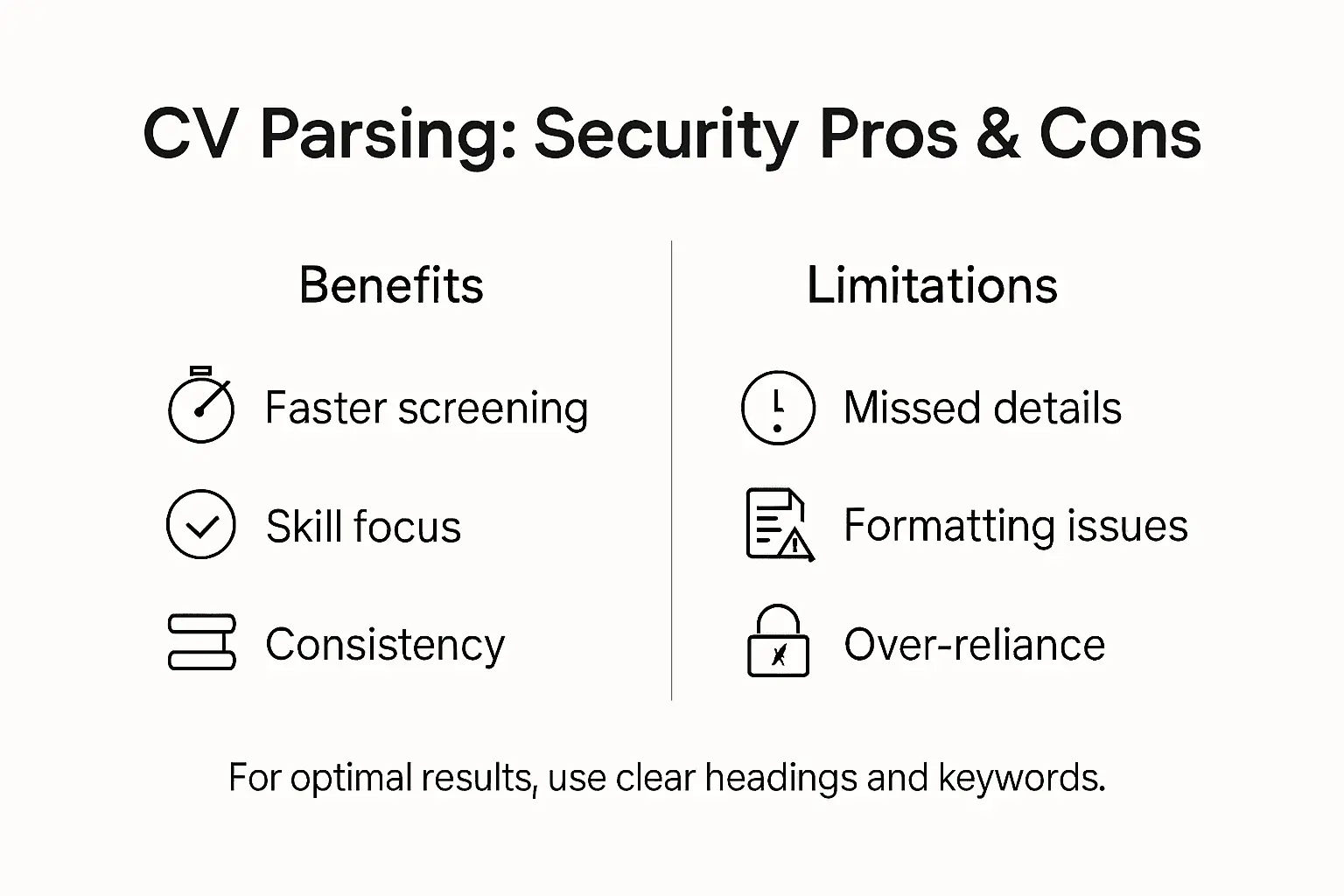
Benefits for Jobseekers:
- Faster application processing
- More objective initial screening
- Increased visibility of relevant skills
- Automated matching with suitable roles
- Reduced human bias in initial selection
Potential Limitations:
- Risk of algorithmic skill misinterpretation
- Potential exclusion due to non-standard CV formats
- Over-reliance on specific keywords
- Challenges representing complex career progressions
- Limited contextual understanding of professional experiences
For security professionals, understanding these parsing dynamics becomes crucial. Intelligent candidates can strategically optimise their CVs by using standard formatting, incorporating industry-specific terminology, and ensuring clear, structured information presentation.
Modern parsing technologies increasingly incorporate sophisticated machine learning algorithms that can interpret nuanced professional backgrounds. However, jobseekers must remain proactive, periodically reviewing and updating their CVs to align with evolving technological screening mechanisms.
Pro Tip CV Optimization Strategy: Design your CV with parsing technologies in mind by using clear section headings, standard font styles, and incorporating precise industry keywords to improve your chances of successful automated screening.
Legal And Data Protection Issues In The UK
CV parsing technologies in the UK recruitment landscape must navigate a complex web of legal requirements, with data protection being paramount. Data protection considerations for AI recruitment tools highlight the critical need for transparent, ethical data handling practices.
Key Legal Considerations:
- Compliance with UK GDPR regulations
- Mandatory Data Protection Impact Assessments
- Explicit candidate consent for data processing
- Transparent algorithmic decision-making
- Protection against potential discrimination
Recruitment organisations must establish clear legal frameworks that protect candidate rights while leveraging technological innovations. This requires implementing robust mechanisms for:
- Obtaining explicit consent
- Ensuring data minimisation
- Providing clear privacy notices
- Maintaining robust data security protocols
- Enabling candidate rights to access and challenge processed information
Recent legislative changes underscore the importance of human oversight in automated recruitment processes. The evolving legal landscape demands that AI-driven parsing technologies maintain a delicate balance between technological efficiency and individual privacy protection.
For security sector recruiters, these legal considerations are particularly critical. The sensitive nature of security roles requires an even more stringent approach to data handling, with additional layers of scrutiny and compliance.
Here is a summary of legal measures essential for CV parsing in UK security recruitment:
| Legal Safeguard | Description | Relevance to Security Sector |
|---|---|---|
| Explicit Consent | Candidate agreement for data use | Critical due to sensitive roles |
| Data Protection Assessment | Evaluates risks in processing | Prevents privacy breaches |
| Algorithm Transparency | Clarity in automated decisions | Avoids unfair exclusions |
| Data Security Protocols | Protects stored personal details | Reduces risk of unauthorised access |
Pro Tip Legal Compliance Strategy: Regularly review and update your data processing policies, ensuring they align with the latest UK data protection regulations and provide clear, transparent mechanisms for candidate consent and data management.
Unlock Speed and Precision in UK Security Recruitment with CV Parsing
The challenges of manually sifting through countless CVs with varying formats and complex layouts are clear. As highlighted in the article, the need for advanced CV parsing technology that accurately extracts critical security credentials, skill sets, and compliance data is crucial for recruiters and jobseekers alike. Whether you aim to reduce recruitment timelines or overcome obstacles caused by traditional keyword matching, embracing intelligent, GDPR-compliant parsing tools can transform your hiring process.
Security Jobs Board understands these pain points and offers a tailored platform that supports fast CV uploads, profile creation, and job matching designed specifically for the UK security sector. With a focus on speed, accuracy, and compliance, our site empowers employers to browse well-structured candidate profiles easily while providing jobseekers with clear formatting tips to optimise CV parsing success.
Enhance your recruitment or job search experience today with the platform trusted by security professionals. Visit Security Jobs Board now.

Take control of your security career or recruitment process by joining the community that prioritises quality matches and efficient, technology-driven hiring solutions. Get started now at Security Jobs Board.
Frequently Asked Questions
What is CV parsing and how does it benefit security recruitment?
CV parsing is a technology that converts unstructured CV documents into structured, searchable data, streamlining the initial screening process in security recruitment. It enables recruiters to quickly filter candidates based on specific criteria like security clearance levels and specialised training.
What are the different types of CV parsing technologies available?
The three primary types of CV parsing technologies include Rule-Based Parsing, which uses predefined patterns, Machine Learning Parsing, which adapts to various document formats, and Advanced Layout-Aware Parsing, which uses deep learning to manage complex document structures.
How can jobseekers optimise their CVs for CV parsing technologies?
Jobseekers can optimise their CVs by using clear, standard formatting, incorporating industry-specific keywords, and ensuring the CV is structured with clear section headings to maximise compatibility with parsing systems.
What legal considerations should recruiters be aware of when using CV parsing technologies?
Recruiters must comply with data protection laws, including obtaining explicit consent for data processing, conducting Data Protection Impact Assessments, and ensuring transparency in algorithmic decision-making to protect candidate rights.


