Why use a CV database: faster, smarter security hiring

TL;DR:
- CV databases allow instant access to pre-screened security candidates, reducing hiring time.
- They offer sector-specific filters like licences and vetting status for higher candidate relevance.
- Using CV databases helps security employers build ongoing talent pipelines and stay competitive.
Posting a job advert and waiting weeks for a handful of half-relevant CVs is no longer a viable strategy for UK security employers. The sector moves fast, candidate expectations have shifted, and the competition for qualified, SIA-licensed professionals is fierce. CV databases have fundamentally changed how smart employers source talent, offering instant access to screened candidates rather than passive hope. This guide walks you through exactly what a CV database is, how to choose the right one, how to integrate it into your workflow, and how to get the best results from it in the UK security sector.
Table of Contents
- What is a CV database and how does it work?
- Benefits of using a CV database for security recruitment
- Choosing the best CV database for your needs
- Integrating CV databases into your hiring workflow
- Maximising results: CV database best practices for UK security employers
- Why embracing CV databases is the future of security hiring
- Find your next security professional today
- Frequently asked questions
Key Takeaways
| Point | Details |
|---|---|
| Faster hiring | CV databases provide immediate access to qualified candidates, shortening the recruitment cycle. |
| Improved candidate quality | Sector-specific filters ensure you reach only relevant, pre-screened professionals for your roles. |
| Process integration | Seamless database integration with your workflow boosts efficiency and reduces manual errors. |
| Best practices matter | Regularly refining searches, prompt communication, and legal compliance significantly enhance results. |
What is a CV database and how does it work?
A CV database is an online repository where job seekers upload their professional profiles and CVs, and employers search through them to find suitable candidates. Rather than waiting for applicants to respond to adverts, you go directly to the talent. Think of it as a searchable catalogue of pre-existing candidates, available on demand.
In the security sector, this matters enormously. You are not sifting through generalist CVs hoping someone has an SIA licence buried on page two. A well-structured security CV database lets you filter by licence type, years of experience, location, and availability from the outset.
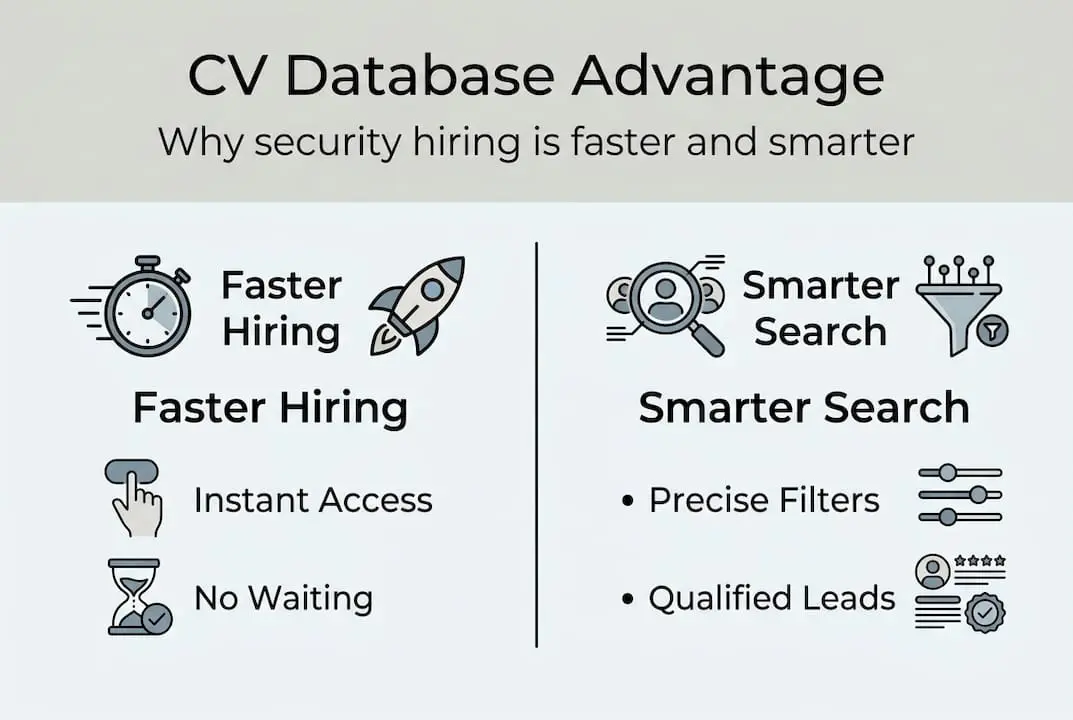
CV databases centralise candidate profiles for quick search and filtering, meaning the manual work of screening is dramatically reduced. Employers interact with the database by setting search parameters, reviewing profiles, and contacting candidates directly. Candidates, meanwhile, upload their details once and become discoverable to multiple employers simultaneously.
Key features you will typically find in a modern CV database include:
- Keyword and filter search by role, qualification, and location
- Direct messaging to contact candidates without intermediaries
- CV parsing tools that extract structured data automatically
- Saved searches so you can revisit relevant candidate pools quickly
- Candidate availability status to prioritise those actively seeking work
Pro Tip: Use structured data fields when setting up searches. The more specific your filters, the faster you surface genuinely relevant candidates rather than wading through near-misses.
Benefits of using a CV database for security recruitment
Now that the basics are clear, let us explore why CV databases are proving indispensable for security hiring.
Speed is the most immediate benefit. Traditional job adverts require a waiting period before applications arrive, then further time to screen them. With a CV database, you can begin shortlisting within minutes of logging in. Employers fill roles faster and reduce hiring costs by directly accessing qualified candidates, bypassing the delays of passive advertising entirely.
Cost is another compelling factor. Advertising on generalist job boards repeatedly, especially for niche security roles, adds up quickly. A CV database subscription often costs less over a year than a handful of individual job postings, particularly when you factor in the time saved by your internal team.
For security-specific hiring, the quality advantage is significant. You can filter directly for:
- SIA licence holders across door supervision, CCTV, and close protection
- Ex-military and ex-police candidates with relevant experience
- First aid and conflict management certified professionals
- Candidates with specific clearance levels or vetting history
| Factor | CV database | Traditional advertising |
|---|---|---|
| Time to first candidate | Minutes | Days to weeks |
| Cost per hire | Lower | Higher |
| Candidate relevance | High (filtered) | Variable |
| Sector specificity | Strong (niche platforms) | Weak (generalist boards) |
| Ongoing talent pipeline | Yes | No |
“Access to a targeted candidate pool means security employers spend less time searching and more time hiring the right people.” — Security Jobs Board
Choosing the best CV database for your needs
Understanding the benefits sets the stage for choosing a database that truly fits your unique needs.

Not all CV databases are equal, and for security hiring, the difference between a generalist platform and a sector-specific one is substantial. Specialist CV databases offer sector-relevant filters and background checks that generic platforms simply cannot replicate.
When evaluating your options, assess the following:
- Coverage: How many active security candidates are registered? A large but outdated database is less useful than a smaller, regularly refreshed one.
- Data quality and recency: When were profiles last updated? Stale CVs waste your time.
- Security-specific filters: Can you search by SIA licence type, vetting status, or specific security discipline?
- Compliance tools: Does the platform support GDPR-compliant data handling and right-to-work checks?
- Integration capability: Will it connect with your existing applicant tracking system or HR tools?
- Support: Is there a human team available to assist, or are you left to figure it out alone?
A checklist worth keeping when speaking to any provider:
- How frequently is the candidate database updated?
- What verification steps do candidates go through?
- Can I export candidate data securely?
- Is pricing flexible based on hiring volume?
Pro Tip: Ask the provider for a sample search before committing. If you cannot find at least a dozen relevant security candidates within your target region in five minutes, the database coverage may not justify the investment.
Integrating CV databases into your hiring workflow
After selecting the right CV database, success depends on seamless integration into your recruitment workflow.
Adopting a new tool without a clear process leads to inconsistency and wasted potential. Follow these steps to embed a CV database effectively:
- Define your role requirements clearly before searching. Know the exact licence, experience level, and location parameters you need.
- Connect the database to your applicant tracking system. Integration with applicant tracking and job posting tools streamlines hiring and removes duplicate data entry.
- Set up saved searches for recurring roles so you can revisit relevant candidates regularly without starting from scratch.
- Align your job posting workflow so active adverts and database searches run in parallel, maximising your candidate reach.
- Assign ownership within your team. One person managing database searches ensures consistency and avoids duplicate outreach.
| Integration tool | Key benefit |
|---|---|
| Applicant tracking system | Centralises candidate pipeline management |
| Job board posting tools | Simultaneous active and passive sourcing |
| Calendar and scheduling tools | Faster interview booking with candidates |
| Communication platforms | Streamlined candidate messaging and follow-up |
Common mistakes to avoid include searching too broadly (which floods you with irrelevant profiles), failing to update your saved searches as role requirements evolve, and neglecting to follow up promptly with candidates you have contacted.
Pro Tip: Automate initial candidate communications where possible. A prompt, professional response to a candidate you have contacted from the database significantly improves their experience and your conversion rate from contact to interview.
Maximising results: CV database best practices for UK security employers
With technical integration handled, employers must focus on refining practices for the best recruitment outcomes.
Accessing a CV database is only half the equation. How you engage with candidates once you find them determines whether you actually hire them. Streamlined communication and quick responses improve the candidate experience considerably, and in a competitive market, slow employers lose good candidates to faster ones.
Best practices for outreach and engagement:
- Personalise your initial message. Reference something specific from the candidate’s CV to show you have actually read it.
- Be transparent about the role. Include pay, location, shift patterns, and licence requirements upfront to avoid wasted time on both sides.
- Respond within 24 hours to any candidate reply. Security professionals are often in active employment and will not wait long.
- Follow GDPR guidelines at every stage. Only contact candidates for roles genuinely relevant to their profile, and store their data securely.
- Conduct right-to-work checks early in the process, not as an afterthought at the offer stage.
For ongoing success, review the ways to improve candidate experience throughout your hiring process, not just at the point of contact.
Pro Tip: Track which search parameters and outreach messages generate the best response rates. Refining your approach based on real data will consistently improve your results over time.
Why embracing CV databases is the future of security hiring
Having covered best practice, it is worth considering why some in the industry still hesitate and why that is rapidly changing.
Some security employers still rely almost entirely on word of mouth, agency referrals, or repeat advertising on the same boards. This is understandable. It is familiar, and familiarity feels safe. But these methods are increasingly misaligned with how qualified security professionals actually look for work in 2026.
The uncomfortable truth is that the best candidates are not always the ones actively applying to adverts. Many are passively registered on databases, open to the right opportunity but not actively job hunting. If you only advertise, you never reach them.
CV databases also shift the power dynamic in a useful way. Rather than hoping the right person sees your advert, you go and find them. This is not just faster. It is a fundamentally more intelligent use of your recruitment budget and your team’s time.
The most successful security employers we see are not just using CV databases to fill individual vacancies. They are using them to build ongoing talent pipelines, maintaining relationships with strong candidates so that when a role opens, they already have people to call. That is the real competitive advantage.
Find your next security professional today
If your current recruitment approach relies on waiting for the right CV to land in your inbox, you are already behind. A dedicated security CV database gives you the ability to search, shortlist, and contact qualified candidates on your terms and on your timeline.

The Security Jobs Board offers employers direct access to a growing database of UK security professionals, from door supervisors and CCTV operators to close protection specialists and security managers. Whether you are hiring across the country or looking for security jobs in Northern Ireland specifically, the platform gives you the tools to find the right person faster. Explore flexible employer plans and start building your talent pipeline today.
Frequently asked questions
What is a CV database in recruitment?
A CV database is a searchable, online hub where candidates upload CVs and employers locate suitable applicants quickly. CV databases centralise profiles for search and filtering, removing the need to wait for inbound applications.
How does a CV database save time in security hiring?
It enables employers to search and shortlist candidates instantly, reducing manual processing and speeding up placements. Employers fill roles faster using direct access to pre-screened, relevant candidates.
What features should I look for in a security CV database?
Seek sector filters, up-to-date CVs, compliance checks, and integration tools for best results. Specialist CV databases offer security-relevant features that generalist platforms cannot match.
Is it easy to integrate CV databases with current recruitment tools?
Yes, many modern CV databases offer integration with applicant tracking and job posting software for seamless workflows. Integration streamlines hiring and eliminates duplicate data entry across your systems.
Recommended
- Top employer CV search tips for UK security recruitment|SJB
- CV Parsing Explained: Streamlining UK Security Recruitment
- Why Update Your CV – Boost Security Job Success | Security Jobs Board
- What Is a Digital CV? Key Benefits for UK Security Jobs
- Advantages of replacing CVs: 74% faster hiring with AI assessments | We Are Over The Moon


