The role of equal opportunities hiring in UK workplaces

Why equal opportunities hiring matters for UK employers
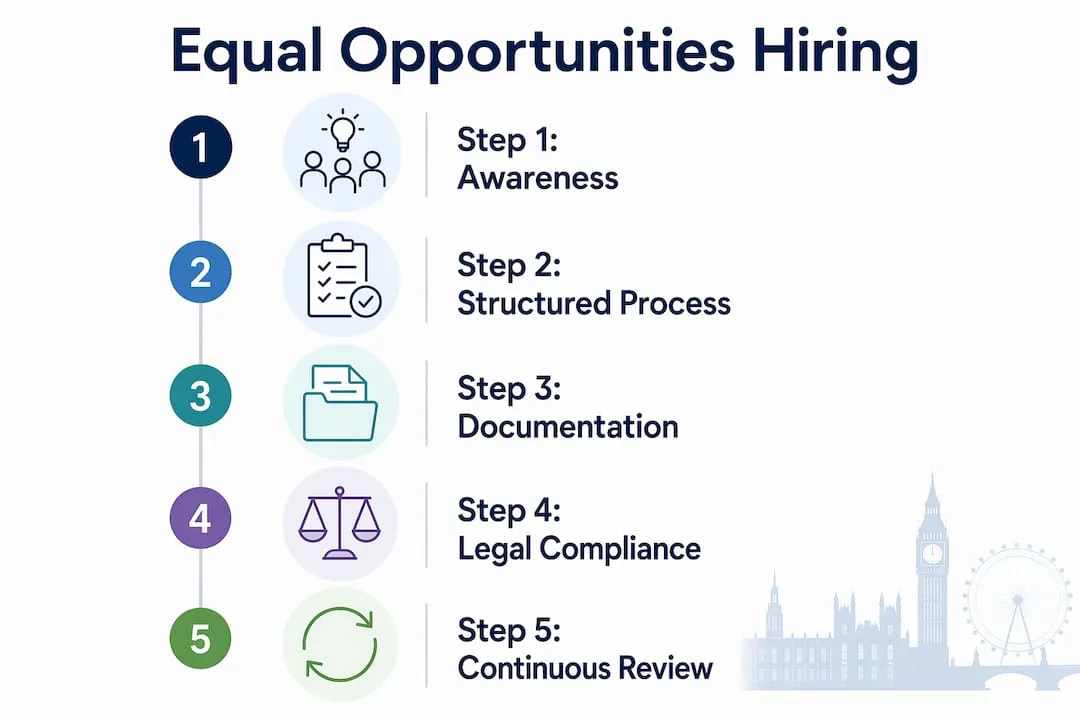
Equal opportunities hiring means giving every candidate a fair chance at employment, assessed on merit alone, regardless of protected characteristics such as age, race, sex, disability, religion, or sexual orientation. Under the Equality Act 2010, this is not a voluntary aspiration. It is a legal obligation that applies to every employer in the UK, from a sole trader to a multinational, across every stage of recruitment and employment.

The Equality and Human Rights Commission (EHRC) enforces these rights and provides statutory guidance that employers are expected to follow. Getting this wrong carries real consequences: discrimination claims, tribunal costs, reputational damage, and the loss of talent that never applied because your process felt unwelcoming.
The core elements of equal opportunity employment include:
- Merit-based selection using objective, role-related criteria set before advertising
- Protection from discrimination across all nine protected characteristics defined by the Equality Act 2010
- Consistent processes applied equally to every candidate at every stage
- Reasonable adjustments for disabled applicants throughout recruitment
- Transparent documentation of shortlisting and selection decisions
Beyond legal compliance, the benefits of fair hiring are concrete. Organisations that embed equal opportunities into their recruitment attract a wider talent pool, build stronger employer brands, and reduce costly staff turnover.
Table of Contents
- What does the legal framework actually require?
- How to implement equal opportunities during recruitment
- Keeping equal opportunities alive beyond the hiring stage
- What does equal opportunities hiring actually deliver?
- Key takeaways
- FAQ
What does the legal framework actually require?
The Equality Act 2010 consolidates and strengthens previous anti-discrimination legislation, defining nine protected characteristics: age, disability, gender reassignment, marriage and civil partnership, pregnancy and maternity, race, religion or belief, sex, and sexual orientation. Discrimination is prohibited across direct and indirect forms, harassment, and victimisation.
Employer obligations under the Act include:
- Non-discrimination in job advertising, shortlisting, interviewing, and offers
- Prevention measures such as training, policy enforcement, and workplace culture
- Duty of care to ensure well-being and a harassment-free environment
- Reasonable adjustments for disabled applicants and employees
- Gender pay gap reporting for organisations with 250 or more employees
One area that catches employers out is vicarious liability. Under Acas guidance, an organisation can be held legally responsible for discriminatory acts committed by its hiring managers during recruitment, even when the employer did not authorise or know about the conduct. That exposure applies to both the individual manager and the organisation itself.
| Area | Legal obligation | Practical requirement |
|---|---|---|
| Recruitment | Non-discrimination in all stages | Structured, documented process |
| Workplace policies | Active equal opportunities policy | Regular review and communication |
| Diversity initiatives | Positive action (lawful, voluntary) | Evidence-based, proportionate measures |
| Reporting | Gender pay gap (250+ employees) | Annual publication of pay data |
| Training | Prevent discrimination and harassment | Ongoing manager and staff training |
A static equal opportunities policy filed away after drafting offers no legal protection. Davidson Morris makes this point clearly: a policy only functions as a legal defence when it is actively communicated, regularly updated, and visibly enforced through training and accountability.
Pro Tip: Document every hiring decision. If a candidate raises a discrimination claim, your written records of criteria, scoring, and reasoning are your primary defence.
How to implement equal opportunities during recruitment
The gap between having an equal opportunities policy and actually running a fair recruitment process is wider than most HR teams realise. CIPD research is direct on this: knowing about unconscious bias does not automatically translate into inclusive hiring. Structural change to the recruitment process itself is what moves the needle.
Concrete steps that work are especially important to attract nieuwe jobs in de logistieke sector candidates and ensure a fair process.
- Set role-related criteria before advertising. Define the skills, experience, and competencies the role genuinely requires. Criteria added after applications arrive are a red flag in any tribunal.
- Use structured interviews. Every candidate answers the same questions, scored against the same criteria. Unstructured conversations favour whoever the interviewer happens to like.
- Document shortlisting decisions. Record why each candidate progressed or was rejected, using the pre-set criteria. Vague notes like “not quite right” do not hold up to scrutiny.
- Advertise widely. CIPD guidance on inclusive recruitment warns that relying on personal recommendations and word-of-mouth hiring risks entrenching homogeneity and excluding marginalised groups.
- Apply reasonable adjustments. Ask all candidates at the application stage whether they need adjustments. Waiting until they ask puts the burden on the candidate and risks missing the requirement entirely.
- Train hiring managers. Acas is clear that employers face vicarious liability for their managers’ conduct, so training is not optional.
Understanding positive action vs positive discrimination
These two concepts are frequently confused, and the distinction matters legally. Positive discrimination, such as appointing a less qualified candidate solely because of a protected characteristic, is unlawful. Positive action, by contrast, is lawful and voluntary. It allows an employer to favour a candidate from an underrepresented group when two candidates are of genuinely equal merit, provided the action is proportionate and backed by documented evidence of underrepresentation.
The GOV.UK guidance is explicit: employers must not adopt a routine policy of favouring candidates with certain protected characteristics. Positive action works only as a tie-breaker at the end of a rigorous, objective process.
For security sector employers looking to reduce subjectivity in their processes, the diversity hiring guide on Securityjobsboard covers practical approaches specific to the UK security industry.
Pro Tip: Redesign the process, not just the mindset. Structured scoring sheets, blind CV reviews, and diverse interview panels reduce bias far more reliably than a one-off unconscious bias workshop.
Keeping equal opportunities alive beyond the hiring stage
Recruitment is where equal opportunities hiring begins, not where it ends. Organisations that treat fair hiring as a one-time compliance exercise tend to see the same problems resurface: underrepresentation at senior levels, pay gaps that widen over time, and attrition among staff who feel excluded.
Embedding equal opportunities into the wider workplace requires:
- A live, enforced policy. Review your equal opportunities policy at least annually. Communicate it to all staff, not just HR. Make clear what the reporting process is for concerns.
- Diversity and inclusion initiatives that go beyond awareness days. Mentoring schemes, targeted development programmes, and employee networks give underrepresented groups genuine pathways to progression.
- Ongoing monitoring. Track representation data by protected characteristic across recruitment, promotion, and pay. Without data, you cannot identify where the gaps are or whether your interventions are working.
- Gender pay gap transparency. Organisations with 250 or more employees must publish their gender pay gap data annually. Smaller employers benefit from doing this voluntarily: it signals commitment and identifies corrective action early.
- Regular training for all staff, not just managers. Harassment and discrimination can occur at any level, and a culture of respect requires consistent reinforcement.
The Acas framework frames this clearly: employers must take reasonable steps to prevent discrimination, and failure to do so leads to discrimination complaints and legal action. “Reasonable steps” means active, documented effort, not good intentions.
For employers building out their recruitment workflows, Securityjobsboard’s job posting workflow guide outlines how to structure the process to reduce subjectivity from the start.
What does equal opportunities hiring actually deliver?
The business case for equal opportunity employment is well established, even if it is sometimes stated in vague terms. The concrete benefits fall into three areas.
Talent attraction and employer brand. Candidates actively research employer reputation before applying. An organisation known for fair, transparent hiring attracts a wider and stronger applicant pool. This matters particularly in sectors like security, where skills shortages make every quality application count.
Innovation and decision-making. Diverse teams consistently outperform homogeneous ones on complex problem-solving. When a group brings different lived experiences and perspectives to a decision, it is less likely to fall into groupthink and more likely to spot risks and opportunities others miss. Companies with strong equal opportunities and diversity initiatives report improved innovation, better employee morale, and reduced staff turnover.
Reduced legal and financial risk. Discrimination claims are costly in time, money, and reputation. An organisation with documented, consistently applied equal opportunities practices is far better placed to defend itself at tribunal than one relying on informal processes and good intentions.
The CIPD frames the structural argument well: organisations that redesign their recruitment systems, rather than simply training individuals to think differently, see better and more durable outcomes. Attitude change without process change rarely holds.
For employers in the security sector, Securityjobsboard’s proven hiring tips resource covers how to screen and recruit fairly within the specific demands of UK security recruitment.

Securityjobsboard connects UK security employers with a broad, qualified candidate pool through a GDPR-compliant, BSIA-affiliated platform built for fair, efficient hiring. Whether you are filling roles in Northern Ireland or tracking applicants across multiple sites, the applicant tracker helps you manage recruitment consistently and compliantly. Visit https://www.securityjobsboard.co.uk to post your next role.
Key takeaways
Equal opportunities hiring under the Equality Act 2010 requires structured, documented, and consistently applied recruitment processes, backed by active workplace policies and ongoing manager training.
| Point | Details |
|---|---|
| Legal foundation | The Equality Act 2010 covers nine protected characteristics and applies to every employer in the UK. |
| Vicarious liability | Employers are legally responsible for discriminatory acts by hiring managers, making training non-optional. |
| Positive action | Lawful only as a tie-breaker between equally qualified candidates, with documented evidence of underrepresentation. |
| Policy as live document | An equal opportunities policy only provides legal protection when actively communicated and enforced. |
| Business case | Diverse teams report improved innovation, stronger employer branding, and lower staff turnover. |
FAQ
What is equal opportunity in recruitment?
Equal opportunity in recruitment means assessing every candidate solely on their ability to do the job, without discrimination based on protected characteristics such as race, sex, disability, or age. The Equality Act 2010 makes this a legal requirement for all UK employers.
What are the nine protected characteristics under UK equality law?
The Equality Act 2010 defines nine protected characteristics: age, disability, gender reassignment, marriage and civil partnership, pregnancy and maternity, race, religion or belief, sex, and sexual orientation. Discrimination on any of these grounds is unlawful in recruitment and employment.
What must an employer do under equal opportunities legislation?
Employers must avoid discrimination in all stages of recruitment, provide reasonable adjustments for disabled applicants, train hiring managers, enforce an active equal opportunities policy, and take reasonable steps to prevent harassment. Organisations with 250 or more employees must also publish annual gender pay gap data.
What is the purpose of equal employment opportunity?
Equal employment opportunity exists to give every person a fair chance at work based on merit, regardless of personal characteristics unrelated to the job. It protects individuals from unfair treatment and helps organisations access the widest possible talent pool.
Can employers use positive action to improve diversity?
Yes, but only within strict limits. Positive action allows an employer to favour a candidate from an underrepresented group when two candidates are of equal merit. It cannot be used to appoint a less qualified candidate, and it must be proportionate and backed by documented evidence.


